Lagotto Romagnolo
A curly-coated Italian truffle dog whose searching talent, coat care, and individual confidence need thoughtful daily attention.
How these guides are researched and reviewed
- Origin
- Italy
- Adult height
- Males 43–48 cm; females 41–46 cm
- Adult weight
- Males 13–16 kg; females 11–14 kg
- Coat
- Dense woolly curls with a water-resistant undercoat
General information for owners. These articles have not been reviewed by a veterinarian. Medical decisions need your dog's history and an examination.
A searching dog whose curls are only part of the picture
The Lagotto Romagnolo is an Italian dog developed around scent and practical work. Its curly coat attracts attention, but a household should look first at what it can offer a dog that enjoys investigating. A garden alone does not organize that interest. Daily opportunities to explore, learn, rest, and remain near its people need places in the schedule. Before choosing a puppy, meet adults belonging to the family you are considering and ask what their ordinary days involve. A delightful photograph says little about the work behind relaxed behavior in a busy household.
A useful owner question is whether you enjoy helping a dog solve small problems without making every activity competitive. Searching for a familiar toy, following an easy scent exercise, and learning to settle after an outing can all become shared routines. The individual may need help with unfamiliar people, equipment, or noisy places. Treat those needs as information about this dog, rather than a failure to match a cheerful breed description. The aim is a manageable companion whose interests have suitable outlets, with room for its confidence and physical condition to develop at an appropriate pace.
From Romagna marshes to truffle searching
The FCI standard traces the breed to retrieving water dogs of the Comacchio lowlands and Ravenna marshes. As wetlands were drained, the work shifted toward finding truffles in Romagna's plains and hills. That account explains why water-dog ancestry and modern scent work both appear in descriptions. It does not mean that a pet must hunt truffles to have a worthwhile life. It does mean that planning only decorative grooming and short toilet outings misses a substantial part of what people value in the breed.
Ask a breeder how searching interest appears in its dogs at home. Does an adult enjoy a calm supervised hunt for an object, or become frustrated when a game ends? Can it leave a promising patch of soil when called away? Those practical observations help you choose activities and training priorities. Do not buy expensive specialist equipment before learning how your dog responds to simple tasks. If you want to pursue truffle work, obtain suitable instruction and landowner permission. A training goal should include safe handling of anything found, rather than allowing the dog to swallow unidentified material while the owner watches its nose work.
Adult size and a rustic curly outline
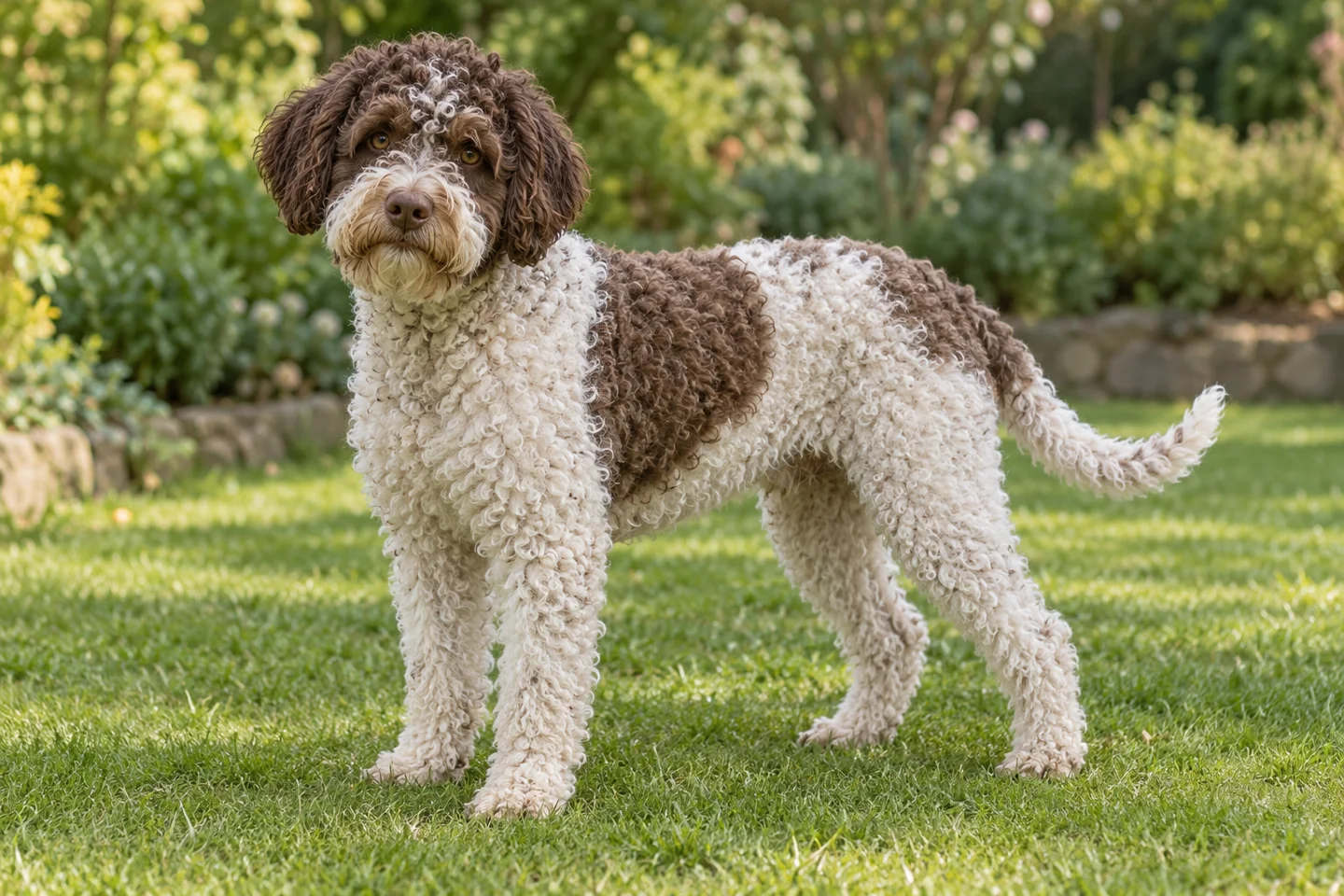
The current FCI standard gives males a height of 43–48 cm and females 41–46 cm, allowing a centimetre above or below those figures. Listed weights are 13–16 kg for males and 11–14 kg for females. The outline is square and sturdy, with a broad head, rounded-tip hanging ears, and a full natural tail. Brown pigmentation and woolly curls help distinguish the breed from a generic white curly companion. The illustrations accompanying this guide show a brown-and-white example; other permitted colors exist.
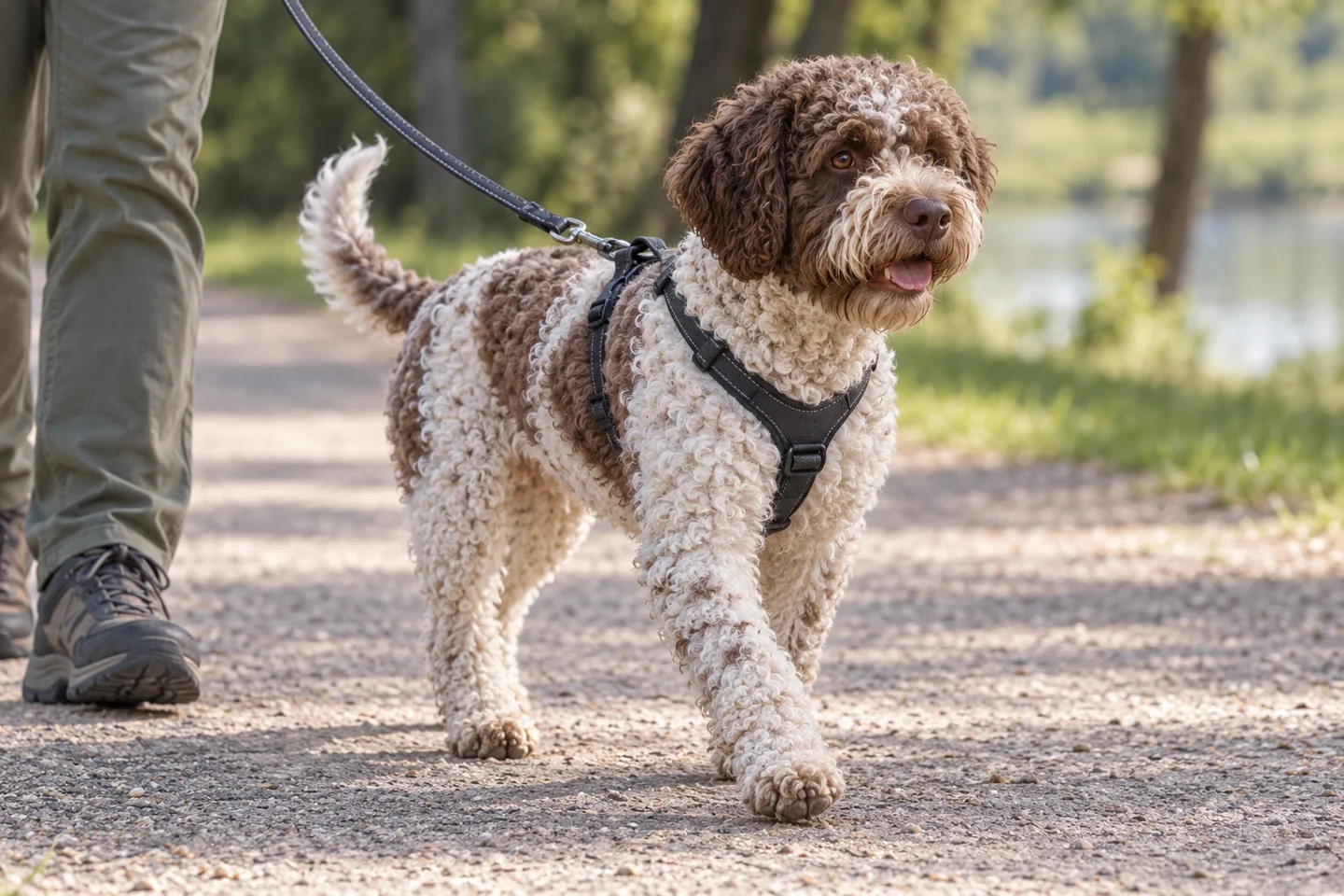
Size guidance describes the standard, rather than a demand that every pet reach a particular number. A veterinarian should assess body condition in relation to the individual frame. Curls can conceal weight change or a harness rubbing behind an elbow, so use regular gentle handling as well as looking. Equipment should fit the dog beneath its coat. Check movement after fitting it, then check again as a puppy grows or an adult receives a shorter trim. A well-presented coat should still allow the dog to see, move, toilet, and rest comfortably without hair creating an avoidable obstacle.
Temperament and the difference between attachment and coping alone
The standard describes an affectionate, tractable dog with a talent for searching. Such descriptions are useful starting points, but ask how a particular adult behaves when a visitor arrives, a meal is delayed, or its owner goes upstairs. A dog may be keen to train in the kitchen and uncertain in a crowded street. Confidence is specific to experience and context. Ask the source for examples of recovery after a surprise and for honest information about situations requiring help. Observations from ordinary routines are more useful than a promise that every Lagotto suits every home.
Introduce comfortable time apart gradually. Begin when the dog's needs have been met and it has somewhere familiar to rest. Notice whether it actually relaxes, rather than judging success only by a lack of noise. A recording can help you describe what happens during a short absence to a professional if needed. Arrange practical support when your schedule exceeds what the dog currently manages. Avoid turning a difficult first week into a test of endurance. Predictable departures, appropriate help, and changes made in response to the individual provide a better basis for daily independence than expecting attachment to resolve itself with age.
Training for searching and for leaving a discovery
Teach a reward marker, coming when called, and moving away from an interesting object before attempting complicated scent exercises. Begin in a room with few distractions. Reward an easy response, release the dog to something appropriate, and finish while it can still participate comfortably. Outside, use suitable secure equipment while recall develops. A dog finding scent rewarding needs practice in disengaging from scent, not repeated shouting after it has become absorbed in a discovery. Make the first versions easy enough that you can reward the behavior you want.
Searching games should have a clear start and finish. Use a safe familiar object or food appropriate for that dog, count what you put out, and supervise the whole exercise. Ask a qualified instructor about safe materials before using scent products. Do not encourage indiscriminate mushroom collecting or digging in public planting. Teach an exchange for a found object with something worthwhile, while preventing access to dangerous items. If the dog guards discoveries, stop arranging situations that provoke a confrontation and seek advice. Training should leave both parties with a practical way to end the activity without chasing, grabbing, or escalating frustration.
Exercise that leaves room for recovery
Build an exercise pattern around the individual's age, health, and current condition. A varied walk with time to investigate can offer more useful engagement than continually increasing speed or distance. Include quieter days and comfortable sleep. If the dog is learning a sport, ask the instructor how to prepare safely and what veterinary advice is needed before demanding work. A puppy's enthusiasm does not establish readiness for repeated strenuous effort. Keep progress responsive to its movement and recovery rather than following a fixed target copied from another owner.
Consider the whole outing, including the car journey, surfaces, weather, and crowding. A shaded route and ready access to water matter when conditions are warm. Plan a shorter option before leaving so you can change course without feeling the walk has failed. Repeated reluctance, altered gait, or an unusual reduction in stamina needs attention rather than motivational pressure. Tell the veterinarian what changed, when you noticed it, and what activity preceded it. The useful measure is whether this dog remains comfortable through its routine and afterward, with enough capacity left to eat, rest, and participate normally at home.
Aggression, guarding, and changes that need investigation
No breed description can establish that an individual dog will never bite. A growl over a found object, a snap during coat care, and a reaction to an approaching dog need their own histories. Record the distance, handling, object, and sequence involved, then prevent a repeat while seeking help. Pain or illness can change tolerance, so sudden changes deserve veterinary assessment. Punishing a warning can make the next interaction harder to interpret and does not resolve the reason the dog felt threatened.
Keep food and valuable finds away from competing pets and children. Practice exchanges with safe objects before a real emergency, and avoid routinely taking things to prove control. A professional can help assess guarding or persistent fear and design management the household can maintain. Give future carers a factual account of bites or close calls before they accept responsibility. If protective equipment is part of the plan, learn its correct fit and gradual introduction. Retain distance, barriers, and supervision as needed. A manageable plan reduces opportunities for conflict rather than expecting the dog's sociable moments to cancel an established risk.
Children, other dogs, and small animals in the household
A child should never be responsible for persuading the Lagotto to surrender an object, endure brushing, or accept a visitor. Put adults in charge of those situations and provide a comfortable dog-only resting space. Explain that walking away ends an interaction. Closely supervise appropriate contact and separate when attention must go elsewhere. Ask the source which ages of children the dog has actually encountered and under what conditions. A brief friendly meeting cannot answer how it will cope with several excited visitors during a long afternoon.
Introduce resident animals through a plan that protects everyone's food, sleep, and ability to move away. Start dog meetings with space rather than crowded doorways. A dog can enjoy one companion while needing distance from another, and a successful walk does not automatically establish safe sharing indoors. For cats and smaller animals, ask about observed behavior and maintain secure separation where safety is uncertain. Do not turn release into a test. If the household layout cannot support the necessary management, resolve that problem before bringing the new dog home rather than relying on optimism after arrival.
Grooming a coat that can felt close to the skin
The Lagotto's continuously growing curly coat requires planned care. The current standard explicitly warns that neglected hair can felt and calls for periodic removal of felted coat. Ask a groomer experienced with the breed to show you how to assess the coat near the skin, especially where equipment and movement create friction. A neat surface can hide a dense tangle underneath. Keep the eyes unobstructed and maintain hygiene around the rear. A rustic appearance still requires regular work and does not mean leaving the dog untouched between appointments.
Choose a practical care schedule the dog can tolerate. Discuss the desired trim before the appointment and tell the groomer about skin problems or handling difficulties. Avoid pulling painfully through a neglected area to save a particular look. Ask the veterinarian about redness, odor, persistent scratching, or discharge rather than treating every problem as ordinary curls. Check ears and feet through brief trained routines; painful or inflamed ears need clinical advice, not aggressive cleaning. Keep a record of products used if the dog reacts. Routine care works best when coat comfort, skin health, and cooperation matter more than copying a photograph.
Health tests that answer different questions
The Lagotto Romagnolo Club of America identifies DNA tests for benign familial juvenile epilepsy and Lagotto storage disease, alongside hip assessment, patellar evaluation, and regular specialist eye examination in its health guidance. Storage disease is a progressive neurological disorder; it should not be confused with the juvenile epilepsy condition. Obtain the parents' actual results and ask how the proposed combination avoids affected puppies for the relevant recessive variants. A carrier result requires interpretation for that particular condition and pairing. It does not mean the dog is generally ill or that every possible neurological disease has been excluded.
The club also distinguishes incorrect coat from a health problem. That distinction matters when someone advertises a large DNA panel: a coat result and a disease result do different work. Ask which tests concern this breed, whether eye examinations are current, and what clinical information exists beyond DNA. If a puppy or adult has abnormal movement, seizures, or another new sign, arrange veterinary assessment despite reassuring ancestry paperwork. Bring records and a video only if it can be taken without delaying care or putting anyone at risk. Later diagnoses should reach the breeder and relevant health programme so that family information remains useful as dogs age.
Nutrition and care costs you can maintain
Plan complete nutrition for life stage with the veterinary team and include training food in the daily amount. Measure portions, monitor condition through the coat, and review the plan when work or activity changes. Avoid adding supplements simply because a dog is growing or beginning a sport. Ask what purpose a proposed product serves and whether it fits the complete diet. Separate feeding from other pets if that helps the dog eat calmly and lets you see its intake. Persistent digestive changes need a clinical conversation rather than an endless sequence of unrecorded food changes.
Budget for professional coat care or the training and equipment needed to do suitable work yourself. Add preventive veterinary care, secure walking equipment, transport, and help during absences. Ask a boarding provider about its experience with the dog's actual needs, including any difficulty with handling or separation. Obtain local prices instead of relying on a universal breed ownership figure. Emergency funding or suitable insurance needs to be arranged before an urgent problem occurs. The purchase or adoption fee is only one part of the commitment; a realistic plan must continue through changes in work, family routines, and the dog's later medical needs.
Mixes, labels, and choosing the actual dog
A Lagotto cross may have curls, loose waves, or a coat that requires an unexpected combination of care. A familiar texture does not establish parentage. Ask what is known about both parents and which claims are documented. If the animal is described as a rescue mix with uncertain ancestry, preserve that uncertainty. Do not promise that any particular cross will be free of allergies, inherited illness, or behavioral difficulty. Assess the individual's condition, handling needs, and observed responses alongside whatever reliable family information is available.
When choosing between a puppy and an adult, consider the information each placement can provide. A puppy needs substantial teaching and its mature behavior remains in development. An adult may offer a clearer picture of everyday routines but still need time to adjust. Ask for a written handover, support arrangements, and an honest explanation of the proposed match. If essential care depends on somebody learning a skill, arrange that learning before arrival. Choosing carefully includes recognizing when the household's available time, grooming budget, or environment cannot meet a particular dog's needs even if the breed remains appealing.
dogsDating meetings with space for a searching companion
On dogsDating, describe this Lagotto's comfortable walking pace, interest in scent, and preferences about canine greetings. Use an approximate area and keep exact coordinates and your home address private. Choose a public starting point with enough width for the dogs to remain apart. Tell the other handler about restrictions before meeting, including any current need to avoid close contact. Each person should manage their own animal and know how to leave. A clear profile provides useful conditions for an outing rather than a promise that two breed names guarantee friendship.
Begin with parallel walking and allow quiet investigation without shared food games or crowded greetings. If one dog repeatedly retreats, stiffens, or cannot disengage, increase distance or end the meeting. Choose another route next time if a narrow gate or busy corner made the first outing difficult. Note the conditions that helped, including pace, separation, and how long the dogs remained comfortable. Repeated relaxed company can be valuable even without play or physical contact. The purpose is a safe shared experience for these animals and their handlers, with enough flexibility to respect what each dog actually communicates that day.
Sources and editorial notes
Sources checked October 22, 2026. Breed measurements describe reference ranges, not a diagnosis or an individual dog's ideal weight. Images are AI-generated breed illustrations and do not document a particular dog or health condition.
- AVSAB: Humane Dog Training Position Statement
- VCA Animal Hospitals: Food aggression in puppies
- Orthopedic Foundation for Animals: CHIC health screening programs
- VCA Animal Hospitals: Aggression toward unfamiliar dogs, diagnosis
- VCA Animal Hospitals: Grooming and coat care for your dog
- VCA Animal Hospitals: Ear infections in dogs (otitis externa)
- AAHA: Feeding plans for healthy, appropriate weight cats and dogs
- VCA Animal Hospitals: Heat stroke in dogs
- AVSAB: Puppy Socialization Position Statement
- VCA Animal Hospitals: Dog behavior problems, aggression toward children
- Official breed standard: Lagotto Romagnolo
- Lagotto Romagnolo Club of America: Health and genetic testing
- Lagotto Romagnolo Club of America: Health conditions and screening
Keep getting to know dogs.
Read another guide or return to your dogsDating community.
Explore breed guidesBack to dogsDating