Portuguese Water Dog
A Portuguese fishing companion with a curly or wavy coat, an active cooperative working background, and care needs that include water safety, regular grooming, and specific inherited-disease screening.
How these guides are researched and reviewed
- Origin
- Portugal
- FCI male size
- 50–57 cm; 19–25 kg
- FCI female size
- 43–52 cm; 16–22 kg
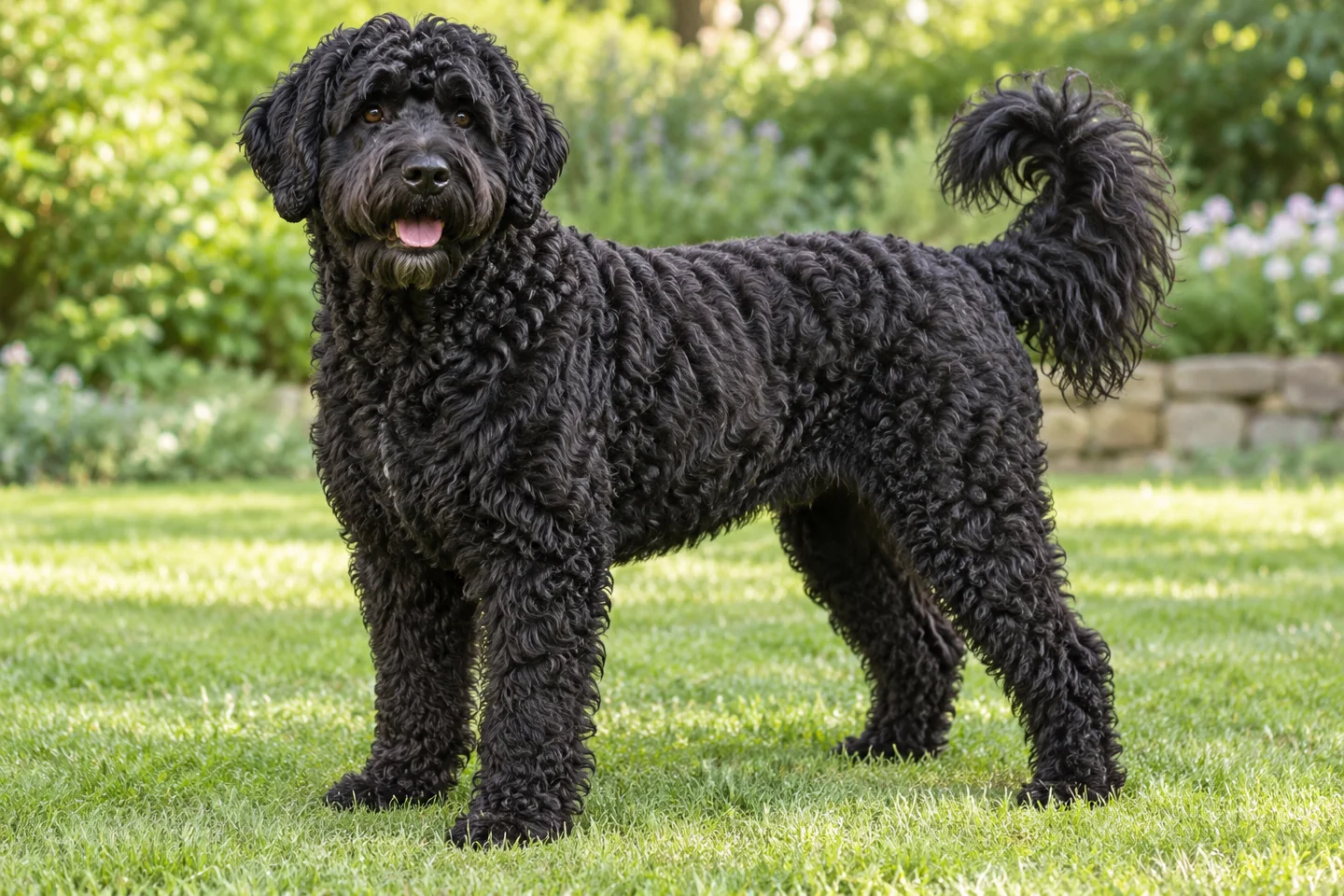
- Illustrated form
- Solid black curly coat in a practical pet trim
General information for owners. These articles have not been reviewed by a veterinarian. Medical decisions need your dog's history and an examination.
A fishing dog still needs an ordinary household plan
The Portuguese Water Dog developed alongside people working on the Portuguese coast. A robust body, distinctive coat, and interest in cooperative activity belong to a practical working dog. Those features can suit an engaged home, but they do not produce an effortless companion. Before choosing one, plan how searching, movement, learning, grooming, company, and quiet recovery will fit into normal weeks. A waterside address is not required, and access to a lake alone cannot replace interaction. The useful question is whether the particular animal's needs match the household's resources and willingness to provide consistent care.
Meet adults and ask how they behave after excitement, around visitors, and during short necessary absences. A demonstration in water gives only one part of the picture. Find out what routines and teaching make the quiet moments possible. A puppy is still developing, and an adult moving homes needs time to learn new expectations. Arrange a secure resting place, transport, suitable equipment, and clinical care before arrival. Choose a source willing to discuss setbacks and ongoing support, rather than relying on a glamorous photograph or an assurance that intelligence makes every part of ownership straightforward.
Portuguese coastal work and breed identity
The FCI describes a coastal fishing helper, and the breed's historical tasks included work in and around water. That background explains the emphasis on a strong functional body and cooperation. It should not be stretched into a claim that every modern dog swims confidently without preparation or can judge dangerous currents. Nor does curly hair establish that an unknown animal is a Portuguese Water Dog. Similar coats occur in other breeds and mixes. Keep pedigree claims tied to records, and distinguish documented history from what an owner can directly observe about this dog today.
Ask how contemporary selection combines temperament, health, structure, and working interest. An appealing coat or a prestigious ancestor does not answer all four questions. If the dog comes from a programme active in water work or sports, discuss how puppies are matched to households with different ambitions. A rescue may provide valuable foster observations even when ancestry remains uncertain. Preserve that distinction rather than inventing a lineage to make the animal sound more desirable. A realistic placement includes a plan for ordinary indoor life, reliable care during absences, and activities adapted to health and age throughout the dog's life.
Adult size, two coats, and a full natural tail
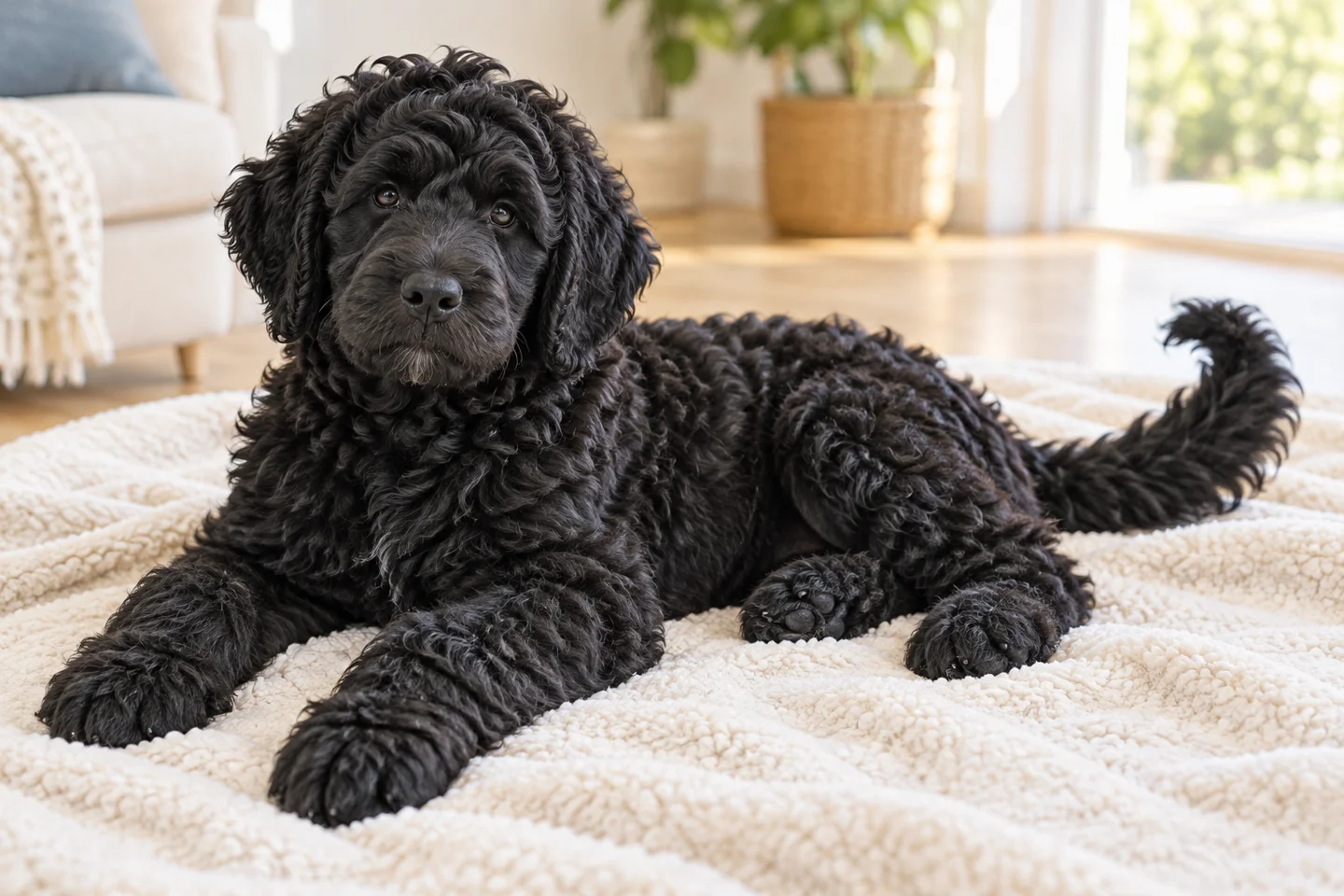
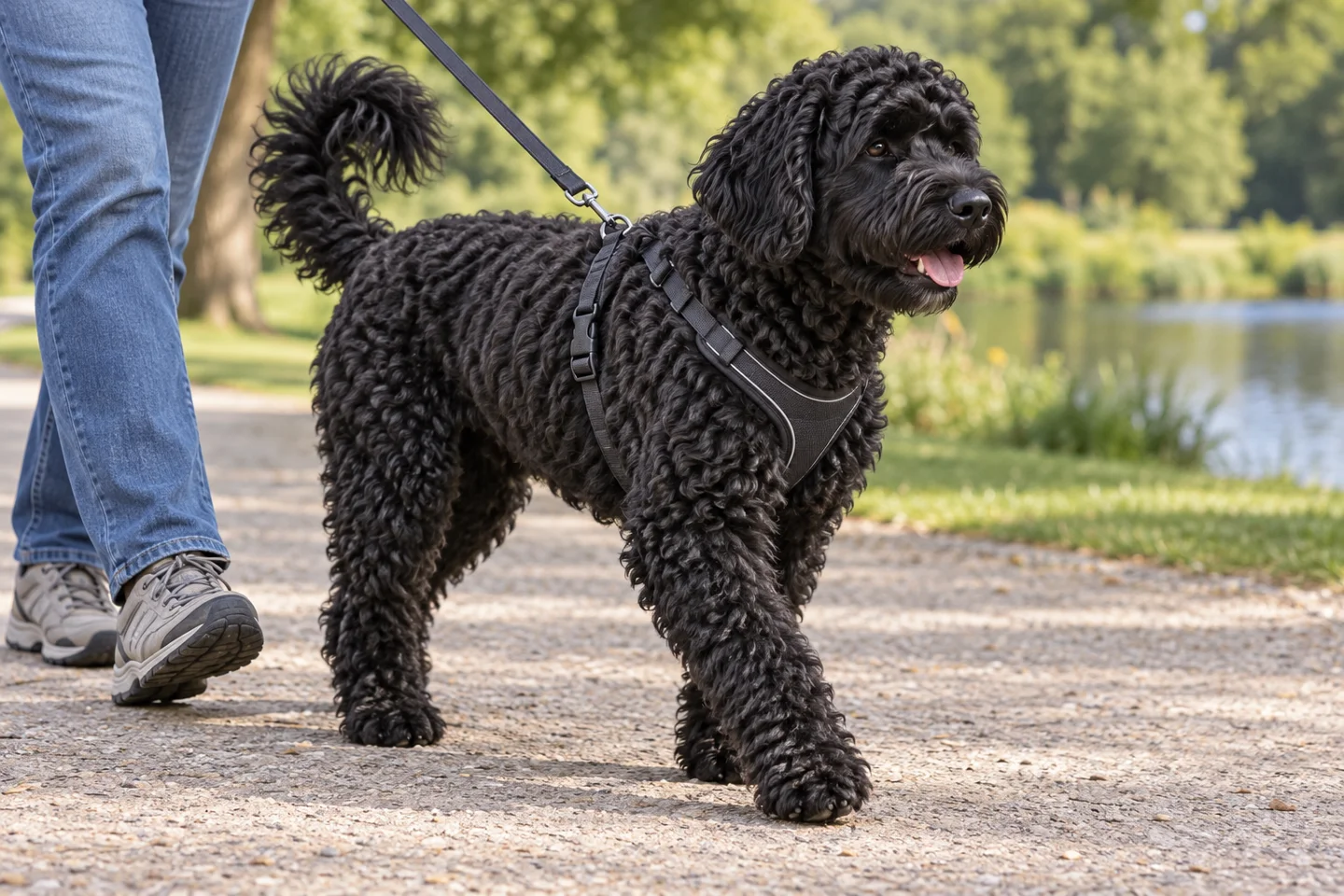
FCI males stand 50–57 cm and weigh 19–25 kg; females stand 43–52 cm and weigh 16–22 kg. The standard recognizes curly and wavy coats without undercoat, with black, brown, white, and permitted combinations. Natural ears hang beside the head, and the full tail participates in the characteristic outline and movement. The illustrations use solid black curls with a practical pet trim. They are labeled AI illustrations rather than photographs of a named individual. A pet grooming choice should be comfortable and maintainable, while show presentation follows the rules of the relevant registry.
Examine the individual beneath the coat. Curls can hide body condition, rubbing, and skin changes. Watch ordinary walking, rising, and turning and ask about pain, injuries, or altered recovery after activity. A standard's weight range is descriptive, while a veterinarian can assess a suitable condition for this frame. Do not encourage rapid growth through unnecessary supplements or use adult workouts to shape a puppy. Fit a harness and travel restraint to the actual dog, check movement and escape risk, and recheck as it grows. A comfortable functional body matters more than copying the exact silhouette of a carefully posed picture.
Temperament, mouth use, and rest between activities
An active dog working closely with people needs appropriate choices for its mouth and energy. Provide safe objects, teach exchanges, and prevent stealing games from becoming the household's main entertainment. If the dog takes an item, chasing and grabbing can intensify the contest. Arrange the environment so tempting unsafe objects are inaccessible, then teach a clear release with something worthwhile in return. Guarding requires a more careful plan and professional help. Intelligence means the animal can learn from repeated consequences, including consequences an owner accidentally supplies while trying to recover a shoe.
Reward settling as deliberately as activity. A comfortable mat, predictable endings to games, and time away from busy entrances help the dog learn that nothing is required for a while. More high-speed play is not always helpful when excitement remains elevated. Practice short comfortable separations with observation guiding increases, and arrange reliable care when workdays exceed the dog's current ability. Another pet is not a guaranteed treatment for distress. A newly arrived dog benefits from a modest routine with sleep and familiar cues, rather than constant attempts to entertain it into instant confidence in a strange home.
Training for cooperation at the lead, door, and grooming table
Begin with useful skills in a quiet setting: responding to name, recall, loose-lead movement, waiting at exits, and going to a resting place. Reinforce achievable steps before adding distractions. A strong dog excited about water or another animal needs management while those skills develop. Use suitable secure equipment and keep practice away from situations where a mistake would endanger the dog or others. Reward voluntary check-ins on walks and make returning to the handler worthwhile. Repeating a cue after attention has been lost is less useful than changing distance and rebuilding a successful response.
Cooperative care deserves equal priority. Introduce standing on a non-slip surface, brief foot handling, a comb touching the coat, and mouth inspection in small comfortable steps. Reward participation and permit pauses. The first extensive grooming session should not be the first time the animal experiences a dryer, table, or sustained touch. Work with a groomer to make the process gradual where possible. Train comfortable transport and a predictable lift if needed for care. A dog able to participate in practical tasks has more choices and can be assessed more accurately than one whose impressive tricks coexist with fear whenever a brush appears.
Exercise and water safety need separate decisions
Provide varied activity that fits age, fitness, health, and weather. Walking, searching, training, and suitable sports place different demands on the dog. Build new workloads gradually and evaluate recovery later in the day. An enthusiastic leap toward a toy does not prove unlimited stamina or absence of pain. Young animals need coordination and safe exploration rather than forced endurance. Changes in stride, willingness, or tolerance deserve clinical attention. Include quiet days and adapt during illness or heat instead of using one demanding routine as the only acceptable measure of an active dog's care.
Water access requires its own assessment: permission, water quality, temperature, current, boat traffic, banks, and an easy exit. Introduce swimming gradually and use appropriate flotation and supervision where indicated. Never force a hesitant animal into water or assume a water-dog name prevents fatigue. Repeated retrieves should stop before the dog struggles to recover. Carry drinking water, avoid questionable pools, and dry and warm or cool the animal appropriately afterward. Keep people safe too; a handler should not create a situation that requires an improvised rescue. Land-based training remains useful when local water cannot be accessed safely.
Aggression, guarding, and reducing unwanted pressure
No working or family description guarantees that aggression cannot occur. Fear, pain, intrusive handling, and valued objects can change a dog's response. Watch for stiffening, withdrawal, a hard stare, or growling and reduce pressure. Do not punish warnings while continuing the same interaction. An animal that now resists grooming may have a painful mat, ear problem, skin irritation, or another issue requiring assessment. A sudden change deserves veterinary attention. Record what preceded it, where people were positioned, and whether the response changes with distance or a different approach.
Make the environment safer while obtaining help. Protect meals and rest, remove opportunities for repeated object confrontations, and use barriers for difficult arrivals. Explain the plan to adults and visitors so management remains consistent. A bite or credible risk requires qualified assessment, and positively introduced basket-muzzle training may have a role when advised. It is not permission to force contact or grooming. Improvement should mean more comfortable behavior and manageable choices. A dog remaining still under restraint may be unable to escape rather than comfortable, so do not judge safety solely by whether it endured an interaction without a visible struggle.
Children, dogs, and safe play around water
Adults should manage children's contact, especially during running games or high arousal. Prevent hugging, climbing, pulling curls, grabbing the tail, and disturbing food or sleep. Provide a protected resting area and separate before play becomes rough. Teach a child to invite brief contact and pause so the dog can choose whether to continue. A strong active animal may knock someone over accidentally, and a child cannot be responsible for managing it near traffic or water. Family friendliness is a reason to teach good routines, rather than a reason to remove supervision.
Introduce dog companions in space where both can move away. Avoid throwing a valued toy between unfamiliar dogs or beginning with a competitive water retrieve. Observe whether play roles change and both animals can stop. Cats and smaller pets need individual assessment and appropriate barriers, with no chase used to test friendliness. At the shore, manage children and dogs separately enough that excitement does not pull someone into water or onto slippery ground. Some dog pairings will be better suited to calm walks than intense games. Accept that result instead of treating play as the only valid form of companionship.
Grooming curls and waves through to the skin
Both coat forms need regular thorough maintenance. Part the hair and work systematically through areas prone to tangles, including behind ears, under straps, and in the armpits. A surface brushing can leave tight mats beneath an attractive outline. Ask a knowledgeable groomer to demonstrate tools, drying, and a schedule that suits the dog's coat and the owner's capacity. A shorter practical trim can be a sensible pet choice. Severe matting needs professional help, with comfort taking priority over preserving length. Do not attempt a lengthy painful rescue of neglected hair while expecting the animal to learn that grooming is safe. Keep grooming appointments aligned with home maintenance capacity, and tell the groomer promptly if illness or a missed session has changed what the coat needs.
After swimming, rinse when appropriate for the exposure and dry fully, checking skin and feet. Inspect the visible outer ears and obtain advice for odor, discharge, head shaking, redness, or pain. Follow patient-specific cleaning guidance and avoid deep probing or leftover drops. Keep nails and mouth care in the routine too. Low shedding does not mean no maintenance or an allergy guarantee for people. Anyone with significant allergy concerns needs an appropriate individual assessment and realistic contact experience, rather than a promise based on coat type. Clean bedding, dry equipment, and regular handling practice make the routine easier to maintain.
Health screening includes more than one form of PRA
The current AKC list of national-club recommendations includes hip and ophthalmologist evaluations plus DNA testing for GM1 gangliosidosis, microphthalmia syndrome, juvenile dilated cardiomyopathy, early-onset PRA, and prcd-PRA. Verify the programme and actual reports for both parents before a breeding decision. A result for prcd-PRA does not automatically answer the question of early-onset PRA, and an eye examination has a different role from a variant test. Ask the source to explain each named result, identity, date, and implication for the pairing, rather than accept a photograph of an unexplained collection of abbreviations.
The Portuguese Water Dog Foundation describes resources for several distinct genetic tests. That work supports informed choices, but a tested pairing does not guarantee a puppy can never develop illness. Some risks are not captured by a known variant, and clinical examinations still matter. Keep DNA identity and parentage documentation separate from disease-test interpretation, including any claimed clear-by-parentage status. Ask the relevant registry or laboratory about accepted documentation. A CHIC number should lead you to published results, not replace reading them. Medical transparency also includes relatives' diagnoses, treatment, and age at death when known.
Juvenile heart risk requires precise language
PennGen describes its Portuguese Water Dog juvenile dilated cardiomyopathy assay as a linked-marker test. Its interpretation uses probable normal, probable carrier, and probable affected categories and explains limitations inherent to linkage. That wording matters when a seller presents a result as an absolute guarantee. Ask for the actual laboratory report and professional interpretation, especially before breeding. Do not transplant a general adult-heart screening claim into a statement that juvenile disease has been excluded. A DNA or marker result addresses its defined question and cannot establish that every cause of future cardiac illness has been removed.
A puppy that collapses, has difficulty breathing, or becomes seriously unwell needs urgent veterinary care regardless of parental testing. Tell the clinician about known family information and the exact result, without delaying treatment to obtain more paperwork. For an established diagnosis, follow the patient's clinical plan and make sure alternate carers understand it. Avoid prescribing exercise limits or medication from another dog's online account. The useful role of a breed guide is to identify the right questions and preserve accurate information. It cannot determine the cause of a current episode or replace assessment of the individual animal.
Nutrition, mixes, and costs behind the coat
Choose complete food appropriate to life stage, workload, and any medical needs. Measure portions and include training rewards in the daily total. Check body condition beneath curls and adjust with the veterinary team as activity changes. A Portuguese Water Dog mix needs individual assessment and consideration of both known parental backgrounds. Crossing cannot promise a particular shedding level, easier grooming, or freedom from inherited disorders. Curly hair and webbed toes alone do not establish ancestry. Keep uncertain labels honest, and avoid selecting a puppy on a promise that it will inherit only the convenient features of its parents.
Budget for regular grooming, routine and urgent care, training, transport, secure equipment, and competent cover during absences. Ask local professionals about actual fees rather than relying on a universal lifetime-price estimate. Arrange suitable insurance or emergency funds and clarify source support and return terms. A sitter must be able to maintain the coat and handle water or object interests safely. Plan for illness and later changes in mobility, not only energetic weekend outings. A sustainable home values the ordinary care that keeps the dog comfortable as much as the distinctive appearance or appealing story of a fishing partner.
dogsDating meetings should start on dry ground
Describe the individual's pace, possession concerns, and comfort around dogs on dogsDating. Share an approximate area while keeping exact coordinates and the home address private. Agree on an open public starting point with a clear exit and one capable handler per dog. Begin with parallel walking on dry ground rather than a shared retrieve or a crowded swimming entrance. Leave valued objects and food bowls out of the interaction. Water can be added to later plans only if both owners understand the animals' behavior and the site's conditions.
Observe whether each dog can sniff, look away, and maintain comfortable movement. Increase distance or finish when one repeatedly withdraws, stiffens, or pursues the other. An early calm ending can be more useful than extending play until fatigue or possession creates conflict. Review duration, pace, and spacing afterward, and use that evidence for a future invitation. Avoid public photographs showing precise addresses or another person's private details. Companionship does not require immediate wrestling or swimming together. It requires an arrangement in which the animals remain comfortable and their handlers can change plans responsibly.
Sources and editorial notes
Sources checked October 22, 2026. Breed measurements describe reference ranges, not a diagnosis or an individual dog's ideal weight. Images are AI-generated breed illustrations and do not document a particular dog or health condition.
- AVSAB: Humane Dog Training Position Statement
- VCA Animal Hospitals: Food aggression in puppies
- VCA Animal Hospitals: Common emergencies in dogs
- Orthopedic Foundation for Animals: CHIC health screening programs
- VCA Animal Hospitals: Aggression toward unfamiliar dogs, diagnosis
- VCA Animal Hospitals: Grooming and coat care for your dog
- VCA Animal Hospitals: Ear infections in dogs (otitis externa)
- AAHA: Feeding plans for healthy, appropriate weight cats and dogs
- VCA Animal Hospitals: Heat stroke in dogs
- AVSAB: Puppy Socialization Position Statement
- VCA Animal Hospitals: Dog behavior problems, aggression toward children
- Official breed standard: Portuguese Water Dog
- American Kennel Club: Portuguese Water Dog identity and care
- AKC: Current national-club Portuguese Water Dog screening recommendations
- Portuguese Water Dog Foundation: Genetic resources and distinctions among disease tests
- University of Pennsylvania PennGen: Juvenile dilated cardiomyopathy linked-marker test limitations
Keep getting to know dogs.
Read another guide or return to your dogsDating community.
Explore breed guidesBack to dogsDating