Maremma Sheepdog
An Italian flock guardian whose placement should begin with its working role, secure management, and supervised preparation around animals.
How these guides are researched and reviewed
- Origin
- Italy
- Adult height
- Males 67–73.5 cm; females 62–70 cm
- Adult weight
- Males 40–52 kg; females 35–45 kg
- Primary work
- Protection of livestock and property
General information for owners. These articles have not been reviewed by a veterinarian. Medical decisions need your dog's history and an examination.
Begin with the guardian role and the source’s placement policy
The Maremma Sheepdog is an Italian livestock guardian. Its job is to protect rather than to move a flock in the manner of a herding dog. That distinction should lead the ownership decision. The Maremma Sheepdog Club of America states that it does not recommend the breed as a pet, emphasizing its livestock-guarding purpose. A prospective owner should discuss that position with an experienced source instead of treating a large garden as an automatic substitute for the role. An attractive white puppy does not make every proposed household suitable.
If you are considering a working placement, describe the animals, fencing, access, visitors, and support already in place. If you are considering a particular rescue or nonworking adult, ask why that placement has been recommended and obtain an individualized professional assessment. A general breed description cannot settle that exception. The goal is a home or enterprise that can meet the dog's needs and manage its behavior safely. Do not conceal your intentions to obtain a puppy from a programme expecting livestock work. Honest agreement before placement protects the dog, the source, and the animals and people who will share its environment.
Italian regions and the difference between guarding and driving
The FCI history describes flock guardians from the Abruzzes and the Maremma region, with seasonal movement of livestock contributing to their development. The current standard names the Abruzzes and Maremma shepherd dog and describes protection of flocks and property. English names can vary, but they should not erase the function. A guardian expected to remain with livestock makes different decisions from a dog trained to move animals on cue. Ask the source to explain how that distinction appears in the adults it breeds and the placements it supports.
Work does not remove the need for human teaching. A dog still needs safe handling, transport, recall appropriate to its role, and a way to remain controlled during veterinary care. It also needs supervision while learning which animals belong and how to behave around them. Historical usefulness cannot establish that an unprepared puppy will make every correct choice on arrival. Seek instruction grounded in the actual enterprise and the individual animal's stage of development. A source should explain the training and management behind a successful guardian rather than letting a romantic account of independence replace a practical preparation plan.
The current standard’s adult size and white double coat
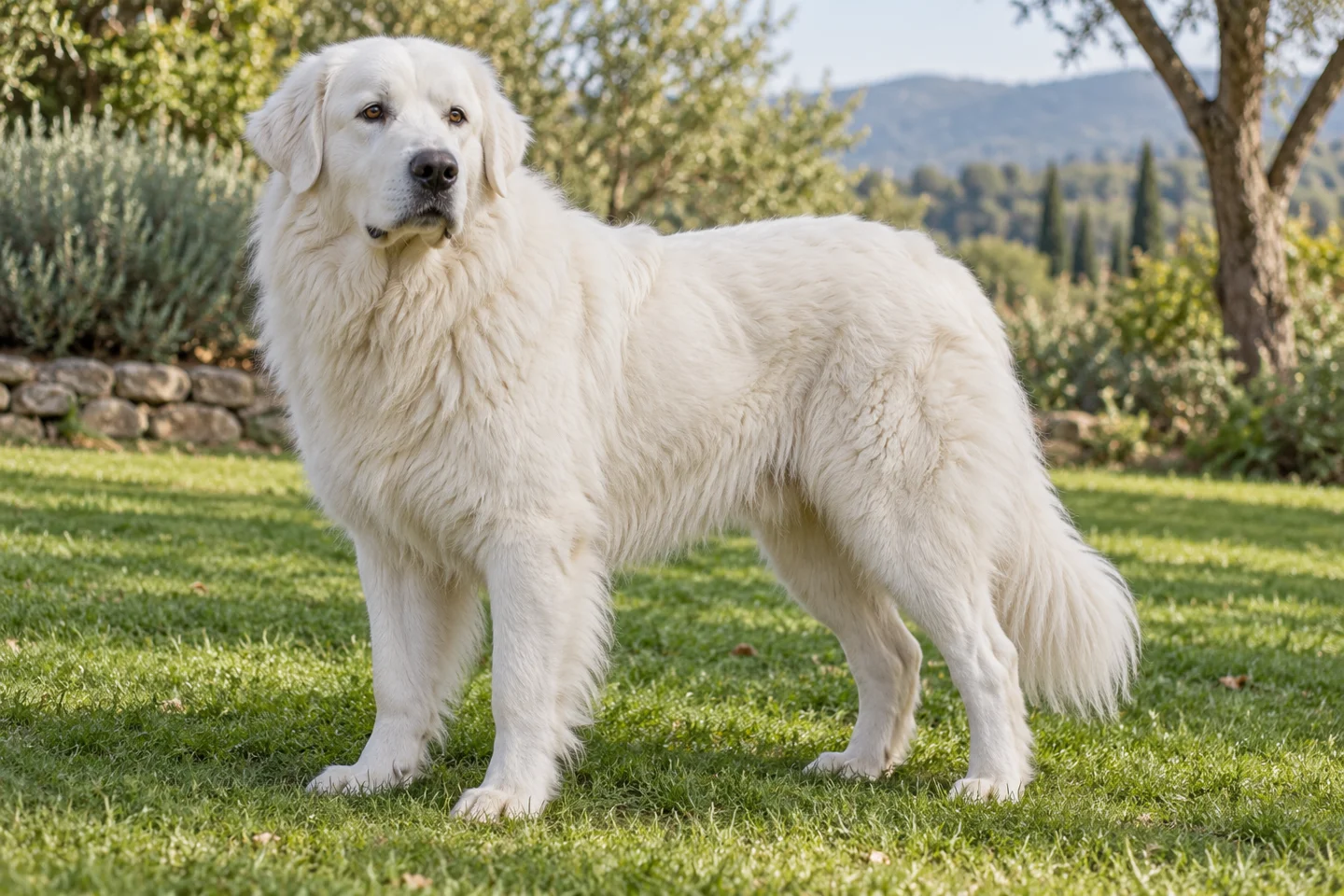
The December 2025 FCI standard lists male height at 67–73.5 cm and female height at 62–70 cm. Male weight is 40–52 kg and female weight 35–45 kg. The outline is large and strong, slightly longer than tall, with a broad conical head, formed muzzle, natural triangular hanging ears, and a full low-set tail. A dense white double coat forms part of the rustic appearance. The illustrations retain ordinary anatomy and a full tail rather than borrowing cropped ears, a bobtail, or the tightly curled tail of another white northern-looking breed.
Look for movement and condition beneath the hair. A standard weight range should not become a target for adding bulk regardless of the individual frame. A veterinarian should assess growth and body condition, and the owner needs gentle handling skills to notice changes hidden by coat. Equipment, transport, and resting areas must fit the adult body. Consider what happens if an injured dog cannot walk or jump into a vehicle. Identifying suitable help and a practical route to care before an emergency is part of responsible preparation for a dog of this size, especially where daily work occurs away from immediate assistance.
Fencing and access are part of the job description
Before arrival, review the actual boundaries and the movement of people through them. A fence only helps when its gates, gaps, and daily use fit the dog and the animals involved. Discuss the setup with the source and an appropriate livestock-guardian adviser. Do not rely on a tracking device as containment; locating a dog does not prevent an unsafe encounter on a road or another property. Everyone using the space needs clear instructions about entrances, visitors, and where the dog will be during deliveries or repairs.
Prepare a comfortable secure area for times when separation is necessary. That area should meet the animal's needs rather than serve as a place to leave an unprepared puppy indefinitely. Teach the routine gradually and give the dog appropriate company, care, and supervised activity. A working environment can still be overwhelming if every arrival produces confrontation. Ask how to manage the particular dog's response without encouraging suspicion for display. A practical plan should be usable by more than one capable person so that illness or absence of the usual handler does not leave the enterprise without a safe way to maintain ordinary operations.
Training near livestock must protect the livestock too
The American club's poultry-training article emphasizes supervision and a protected adjacent area when a young dog cannot safely have direct access. It rejects the assumption that simply placing a puppy with birds teaches the whole job. Ask an experienced adviser to design an introduction for your animals and setup. The dog needs opportunities to learn calm behavior while the livestock retain protection from chasing, rough play, or trapping. A puppy's friendly intention cannot prevent accidental injury, and some livestock can injure the puppy in return.
Keep the plan specific enough for every person supervising to follow. Decide what access is permitted, what behavior requires interruption, and where the dog goes when nobody can attend. Do not test readiness by leaving a vulnerable animal unprotected. A mature experienced guardian may contribute to learning, but its own behavior and compatibility need assessment. Record progress and seek advice when a pattern changes. Age alone cannot prove that the individual has completed training. Safe work develops through suitable experience, management, and observation rather than a deadline copied from somebody else's dog or a promise that instinct makes supervision unnecessary.
Training for care and ordinary human cooperation
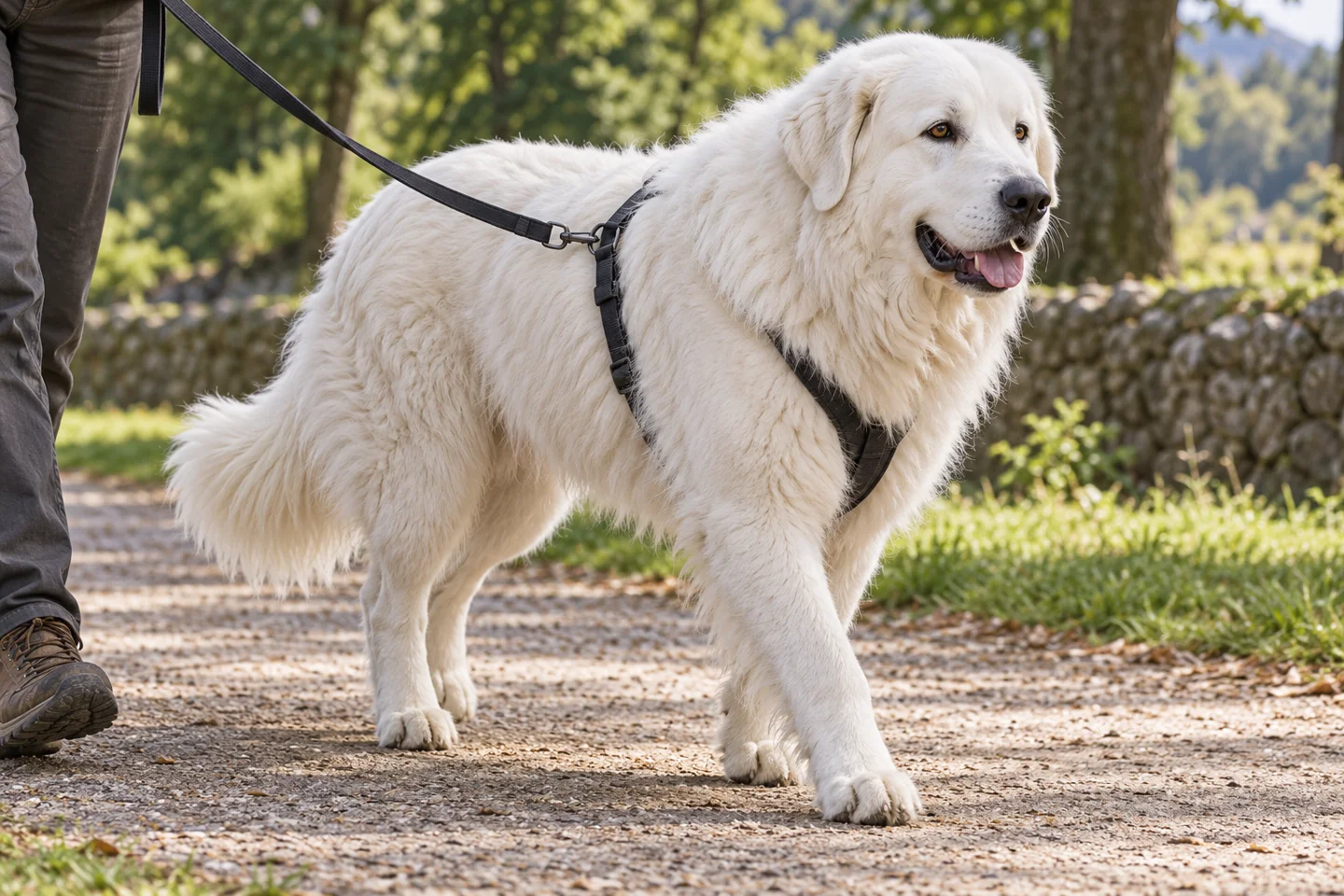
Teach coming toward the handler, comfortable lead movement, entering transport, and pausing on a stable surface for inspection. Use rewards and small manageable steps. Practice when the dog can participate rather than waiting until urgent care makes every task more difficult. An independent working role does not make clinical handling optional. Ask an instructor familiar with appropriate reward-based methods to help translate the enterprise's needs into useful skills. Keep the environment secure while the response is unfinished and avoid interpreting every hesitation as a challenge to authority.
Human cooperation should be predictable. Give a cue before attaching equipment, reward a relaxed examination step, and release when the task allows. Tell the veterinary team what remains difficult before an appointment. Repeated avoidance, freezing, or threats call for assessment and a revised approach, not stronger restraint as the default answer. A dog may be physically capable of resisting several people, which makes early preparation valuable for everyone's safety. The underlying purpose is still the animal's comfort and care. A clear medical handover and trained routine can remain useful when illness, injury, or a new handler changes the circumstances.
Aggression and visitor management need individual assessment
A guardian role does not excuse an unsafe encounter or establish that every threatening response is appropriate. Record who approached, what happened at the boundary, any handling or resource involved, the available space, and whether contact or injury occurred. Prevent repetition while arranging veterinary and behavior guidance. Sudden changes deserve assessment for discomfort or illness. Do not recreate an incident to demonstrate protective ability. The useful question is how to reduce risk and meet the individual's needs, not whether a reaction looks impressive in a working-breed story.
Visitors and carers need the actual management plan in advance. Protect food and rest from interference, and keep unfamiliar people out of situations the dog cannot handle safely. A qualified professional can help decide what restrictions are realistic. Share a factual history of bites and near misses before another person accepts responsibility. If muzzle conditioning is advised, learn comfortable introduction and correct fit while retaining barriers, distance, and supervision. Equipment can support a wider plan, but it cannot make repeated crowding or forced greetings appropriate. A capable owner recognizes when a situation should not occur rather than treating every encounter as a training opportunity.
Children and other dogs are separate from the flock
Children must not be responsible for approaching a guarding dog, recovering an object, opening access during a visitor arrival, or managing a lead. Adults need to organize those situations. Teach children to leave food and rest undisturbed and to stop when the dog chooses distance. Provide secure comfortable separation when active supervision cannot continue. Ask the source about actual child experience and the management used. A dog's calm behavior near familiar animals does not establish how it will interpret unfamiliar people moving quickly or interacting energetically with children.
Other dogs also require an individual plan. A familiar guardian partner is not evidence that every visiting dog can enter the working space. Ask about past relationships and arrange introductions with appropriate help where needed. Keep resources and rest separate when required. Cats, poultry, young stock, and other vulnerable animals need protection while safety is uncertain, regardless of the dog's breed label. Do not assume a working title settles every species or age group. The people responsible must be able to maintain the necessary boundaries through ordinary distractions, and a placement should be reconsidered if the environment cannot reliably support that management.
Exercise and rest in a working or changing routine
Activity should fit the dog's role, age, health, and recent workload. A guardian may spend time observing and resting as well as moving, so do not measure usefulness only through constant action. A growing puppy is not ready for every adult demand. Discuss physical preparation and recovery with the veterinary team, especially after injury or illness. A dog moving into a different placement needs its previous routine documented so the new plan does not jump abruptly between inactivity and demanding work. Watch comfort and movement over the whole day.
Warm weather, surfaces, and access to water and shelter affect the real workload. A protective coat does not eliminate heat risk or make a hot vehicle safe. Keep practical options for reducing demands and reaching care. Report repeated stiffness, altered gait, or unexplained changes in stamina rather than explaining them solely as independence or reluctance. A clear account of when the change appears helps the clinician. Appropriate rest and normal recovery support both welfare and useful work. Pushing through a persistent problem can leave the owner with less information and the dog with more discomfort, regardless of how willing it appeared at the beginning.
Grooming and inspection through a dense white coat
The dense coat needs care suited to its condition and environment. Ask an experienced professional to demonstrate how to inspect near the skin and work through loose hair without pulling. Check friction areas under equipment, feet after activity, and any place the dog seems sensitive. A white surface can make some debris visible while hiding tangles or a changing body condition beneath the volume. Break routine work into manageable sessions. If neglect has produced tight mats, obtain help and choose comfort over preserving a particular outline.
Maintain nails and a dental routine advised by the clinic, alongside coat care. Ear redness, discharge, odor, or repeated head shaking needs medical advice. Avoid instruments in the canal and do not reuse prescriptions from another episode. Record products and responses when the skin reacts. Tell an alternate carer about handling limitations and what requires contact with the veterinarian. A dog described as rustic still needs regular observation. Working history does not make pain normal or reduce the responsibility to investigate a sudden change in willingness to be touched, brushed, or fitted with equipment.
Health evidence includes hips and information from ordinary dogs
The Maremma Sheepdog Club of America's code-of-ethics programme requires specified hip certification for breeding dogs and asks breeders to provide the parents' certificates to buyers or make results public. Ask which assessment the source used and obtain the actual reports. Do not reduce different scoring systems to a vague statement that hips were checked. Ask the breeder or a veterinarian to explain the finding and its role in the pairing. A normal-looking gait on a short video does not replace the relevant documented assessment.
The club also encourages owners to obtain hip information from dogs beyond the immediate breeding animals. That makes later owner participation useful to the family account. Ask where significant diagnoses should be reported and retain identified clinical records. For an adult in work or changing placement, include injuries, medication, previous restrictions, and recovery history in the handover. A parental result cannot determine the cause of a new symptom in the patient. Avoid importing a complete disease panel from another large white guardian without evidence. Current examination, family screening, and unknown information each have their own place in a sensible medical conversation.
Nutrition and the costs of a reliable guardian arrangement
Use complete nutrition appropriate to life stage and condition, with veterinary guidance on portions. A large puppy should not receive supplements simply because the owner wants strong bones or rapid growth. Measure intake, count rewards, and review the plan as work changes. Keep feeding arrangements calm and protected so the dog can eat and the owner can observe consumption. Persistent changes in appetite, drinking, digestion, or body condition need a clinical conversation. Maintain dates and product details rather than making repeated undocumented changes that later become difficult to interpret.
The budget must include suitable fencing and repairs, transport, veterinary care, equipment, training support, and capable cover. A working dog still needs help if the usual handler is absent or the enterprise changes. Confirm who can follow the visitor, livestock, and medical routines before a crisis. Written support and return arrangements from the source should be clear, and emergency funding or appropriate insurance needs attention in advance. The initial fee is a small part of a long-term arrangement. Practical support should remain available if the dog needs reduced duties, extra supervision, or a different environment later in life.
Mixes and the meaning of a guardian label
A Maremma mix may have known parents from different guardian breeds or may be a rescue described from appearance. Ask what is documented and preserve uncertainty. A white coat, broad head, or work around sheep cannot establish ancestry by itself. When parents are known, assess relevant information about both rather than assuming a cross inherits only desirable working qualities. Mixing does not guarantee easier handling, fewer inherited conditions, or automatic suitability for every flock. The individual's development and experience still determine what training and management it needs.
Be especially cautious with promises that a young cross can replace supervision immediately. Ask what livestock exposure occurred, what behavior was observed, and whether a knowledgeable person can support the transition. A mature animal may offer more information about established work, but a move still changes context. A puppy's future ability remains a process to assess rather than a certainty to advertise. Match the source's placement advice to your actual enterprise and obtain an honest handover. A label should help locate relevant experience, not serve as a substitute for the practical decisions that protect the dog and the animals it may eventually guard.
dogsDating may be useful only when an outing suits the individual
A livestock guardian does not need every kind of social activity promoted by a companion app. Before arranging a dogsDating meeting, consider whether the outing fits the individual's role, behavior, and professional advice. Describe restrictions honestly and share an approximate area while keeping exact coordinates and the home address private. Do not invite unfamiliar dogs onto a working property as an experiment. If a separate public walk is suitable, agree on a spacious route and enough distance beforehand, with each capable adult managing their own dog.
Begin in parallel and avoid shared toys, food between the dogs, or pressure for close greetings. Either handler should be able to finish without feeling obliged to demonstrate success. Repeated withdrawal, stiffness, or excitement that prevents comfortable disengagement calls for more space or departure. Record which conditions helped and choose any later meeting from that evidence. Quiet walking at an appropriate distance may be a worthwhile outcome; some pairings will be unsuitable. The useful purpose is a manageable experience for the actual animals, rather than making a working guardian conform to an owner's expectation of universal canine sociability.
Sources and editorial notes
Sources checked October 22, 2026. Breed measurements describe reference ranges, not a diagnosis or an individual dog's ideal weight. Images are AI-generated breed illustrations and do not document a particular dog or health condition.
- AVSAB: Humane Dog Training Position Statement
- VCA Animal Hospitals: Food aggression in puppies
- Orthopedic Foundation for Animals: CHIC health screening programs
- VCA Animal Hospitals: Aggression toward unfamiliar dogs, diagnosis
- VCA Animal Hospitals: Grooming and coat care for your dog
- VCA Animal Hospitals: Ear infections in dogs (otitis externa)
- AAHA: Feeding plans for healthy, appropriate weight cats and dogs
- VCA Animal Hospitals: Heat stroke in dogs
- AVSAB: Puppy Socialization Position Statement
- VCA Animal Hospitals: Dog behavior problems, aggression toward children
- Official breed standard: Maremma Sheepdog
- Maremma Sheepdog Club of America: Breed role and placement position
- Maremma Sheepdog Club of America: Code of ethics and hip certification
- Maremma Sheepdog Club of America: Poultry training and supervision
- Maremma Sheepdog Club of America: Practical questions about work and ownership
Keep getting to know dogs.
Read another guide or return to your dogsDating community.
Explore breed guidesBack to dogsDating