Spanish Mastiff
The Mastín Español is a very large Spanish guardian whose strength, space needs, clinical care, and visitor management should be planned before choosing a puppy.
How these guides are researched and reviewed
- Origin
- Spain
- FCI minimum male height
- 77 cm
- FCI minimum female height
- 72 cm
- FCI size framework
- No upper height limit; harmony and comfortable function still matter
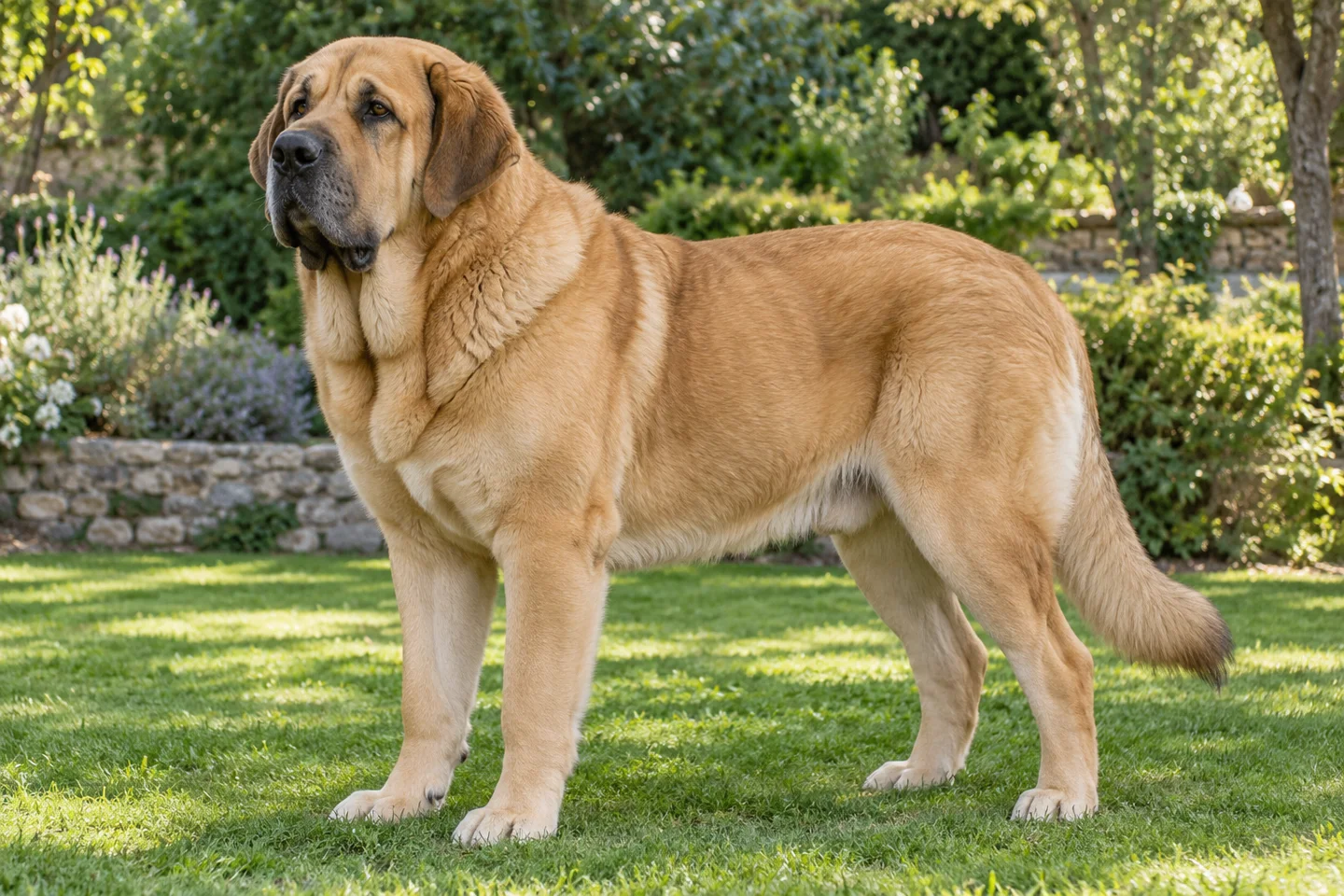
- Illustrated color
- Solid golden fawn with natural ears and full tail
General information for owners. These articles have not been reviewed by a veterinarian. Medical decisions need your dog's history and an examination.
A very large guardian changes practical household decisions
The Spanish Mastiff, or Mastín Español, is a very large livestock guardian with substantial bone, a broad head, and a powerful rectangular body. Before choosing one, consider ordinary tasks at adult scale. Can capable adults handle the lead, transport the animal, and help it if it cannot walk? Can visitors enter safely while the dog rests elsewhere? Is there reliable care when the main owner is unavailable? Those questions matter more than an appealing photograph of a heavy puppy. A suitable home needs resources that remain practical after growth and through later health changes.
Meet adults and ask what routines support their behavior. How do they respond to unfamiliar people at home, movement beyond a fence, handling, and temporary separation? An individual raised around stock may have different experiences from a family-raised animal, and neither background answers every question without observation. Arrange secure accommodation, clinical care, transport, and appropriate professional help before arrival. A source should discuss unsuitable placements and difficult moments honestly. A guardian's affection toward familiar people cannot replace management, and a large garden cannot compensate for a household unable to provide consistent daily interaction and care.
Spanish pastoral history and the animal in a modern home
The FCI identifies Spain as origin and connects the breed with guarding flocks and pastoral movement. That background helps explain independent attention to animals, people, and boundaries. It should not become a claim that a modern puppy knows automatically which visitor or threat its owner considers acceptable. Spanish Mastiff is a particular breed, distinct from other large mastiffs and Spanish guardian dogs. Similar size, loose skin, or fawn hair cannot establish ancestry. For a rescue with uncertain lineage, keep the label cautious and give observed behavior and current medical needs priority.
Ask how current selection balances health, temperament, and functional structure. Working ability and a show award can contribute information, but they do not replace individual clinical reports or a practical suitability assessment. Spain's canine organization identifies AEPME as a Spanish Mastiff breed association, giving buyers a primary route for information. Establish which registry and programme applies to the actual parents. Preserve original identification and readable reports when importing. A long pedigree becomes useful when the source can explain relevant family findings, rather than use historical prestige to avoid discussing what the dog will require in an ordinary contemporary household.
Minimum heights, no upper limit, and comfortable function
The FCI minimum shoulder heights are 77 cm for males and 72 cm for females. It states no upper height limit, within harmonious proportions, and expresses a preference for larger measurements. That is a standard description, not an instruction to pursue maximum weight or rapid puppy growth. The broad head, natural triangular hanging ears, double dewlap, and thick full tail belong to a strong functional body. The tail hangs low toward the hock at rest and can rise in sabre fashion, without curling over the croup. The illustrations choose solid golden fawn with natural ears and tail.
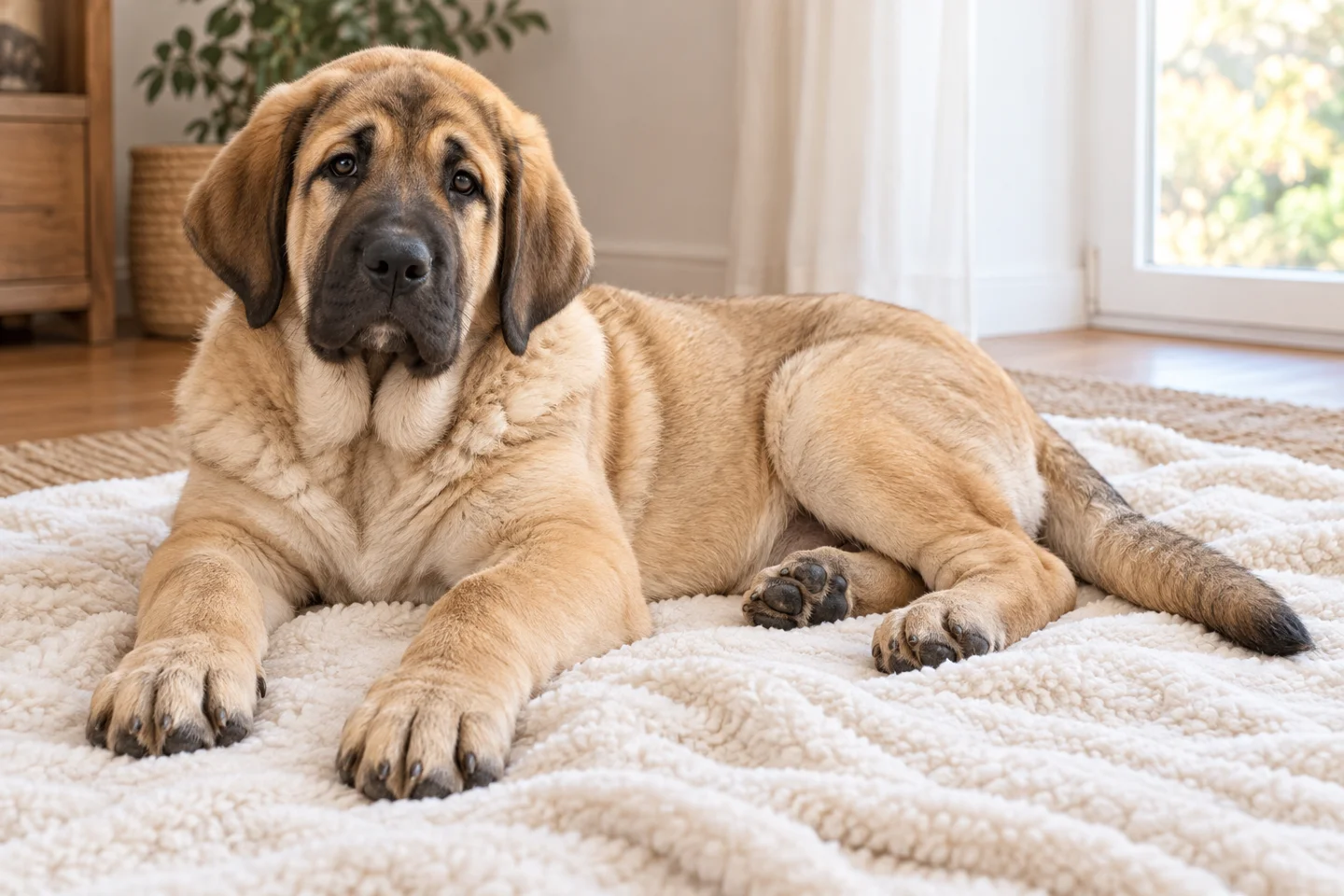
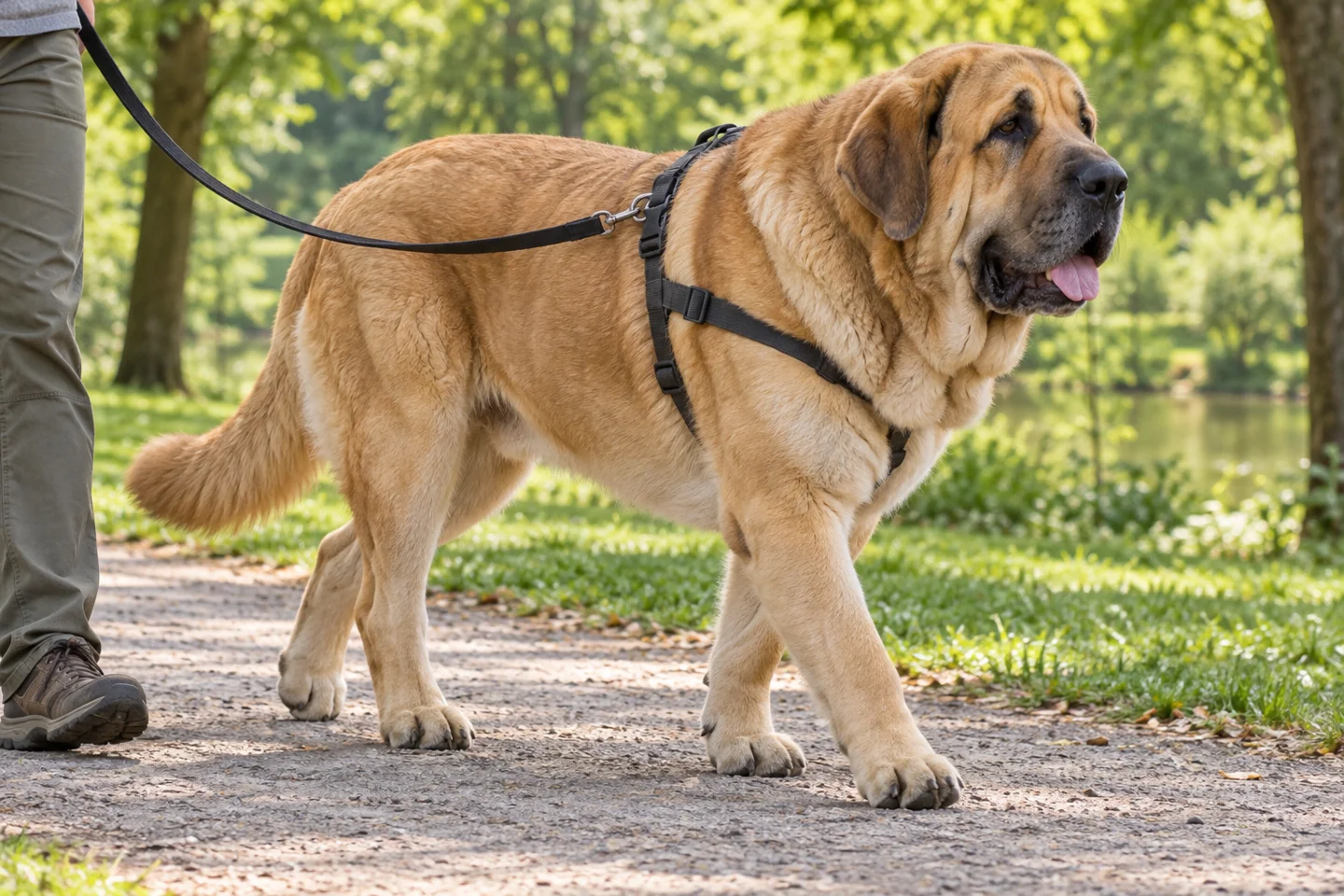
Each image is labeled as an AI illustration and does not document a specific available dog. Look at comfortable walking, turning, rising, and rest when meeting an adult. Ask about changed movement, injuries, and previous restrictions. Loose skin should not be treated as a reason to ignore irritation or uncomfortable eyes. Feel condition with appropriate guidance and fit equipment to the actual body. A puppy needs suitable nutrition and movement rather than supplements or demanding exercise intended to produce an imposing outline quickly. Individual examination is more useful than assuming that greater size proves better health or a more capable guardian.
Visitors, boundaries, and reliable separation
Plan visitor access before the dog is responsible for a new property. Secure the animal in a comfortable area before opening a gate or front door. Tradespeople, delivery workers, and visiting relatives should receive clear instructions, and every household member must understand the same routine. Do not expect a stranger to judge when a loose guardian will accept entry. A friendly owner greeting from across the garden may not provide the animal with the clear situation people assume it does. The arrangement needs to work when events are hurried or unfamiliar, including a repair or emergency visit.
Reduce repeated rehearsals of boundary alarm by changing access to a busy view where needed. Reward returning attention to a handler or resting place, and provide quiet space away from constant traffic. Let unfamiliar people remain at a manageable distance rather than insist they pet the dog to prove sociability. A newly adopted adult may need a modest initial schedule with sleep and familiar cues. Confidence develops through useful experiences and recovery, not a sequence of increasingly intrusive greetings. A guardian's reserve should encourage preparation, while fear or unsafe reactions still deserve assessment instead of being dismissed as the breed doing its job.
Training at adult scale starts in easy settings
Teach waiting at thresholds, moving with the handler, recall, a practical turn, and resting in a designated place while the environment is quiet. Reinforce clear achievable steps before adding distractions. Strong equipment and adult handling can prevent dangerous mistakes during learning, but should not become substitutes for a well-practiced response. A large adolescent pulling toward an unfamiliar animal is a poor first opportunity to decide how a household will train. Agree on cues and management early so the dog receives understandable feedback rather than conflicting instructions from several people.
Cooperative care should include comfortable standing, paw inspection, ear lifting, mouth checks, and a position useful for clinical examination. Reward brief participation and add duration gradually. Teach safe transport and any clinician-advised assistance before injury makes it urgent. Practise exchanging objects and protect food from interference. If possession creates stiffness or guarding, change the arrangement and obtain qualified help. A large dog should not be expected to accept force simply because people find restraint difficult. Learning to participate in ordinary care can make treatment safer and more accurate while protecting the animal from repeated frightening encounters with hands and equipment.
Exercise and recovery for a growing or mature mastiff
Provide regular movement and investigation suited to age, health, condition, and fitness. A guardian's historical endurance does not set one daily distance for every modern animal. A large puppy needs coordination, suitable surfaces, and rest rather than forced adult mileage or repeated high-impact jumps. Build new demands gradually and watch movement later that day and the next morning. Persistent stiffness, reluctance to rise, or reduced tolerance deserves veterinary assessment. An enthusiastic response at a gate does not establish that joints and feet are comfortable or that continuing a demanding outing is wise.
Inspect routes and boundaries for roads, livestock, loose dogs, and escape opportunities. Secure transfers from vehicle to building and supervise outdoor time. Carry drinking water, provide shade, and adapt timing and duration in warm conditions. A large body still needs appropriate cooling and recovery, and a familiar route may become unsuitable after a weather change. Plan quieter forms of engagement for illness or restricted days rather than rely entirely on exhausting exercise to obtain calm. Resting comfortably near the household is a useful part of an active animal's routine, not evidence that it must be pushed into more work.
Aggression and the consequences of preventable contact
The size and strength of a Spanish Mastiff make bite prevention a practical responsibility. Assess this animal and its circumstances rather than assume family affection predicts every greeting. Withdrawal, freezing, a hard stare, stiffness, and growling call for more distance and a change in approach. Do not punish the warning while continuing unwanted handling. A sudden reaction around touch, rest, or movement may have a medical contribution and deserves veterinary attention. Give the professional a concrete account of preceding events, rather than a motive inferred from a breed reputation or one upsetting encounter.
Use secure barriers and predictable routines while obtaining help. Protect meals and sleep, control visitor access, and tell alternate carers about bites or close calls before they accept responsibility. Persistent risk requires veterinary and suitably qualified behavior support. Positively introduced basket-muzzle training can form part of an individual plan where appropriate, but it does not permit forced greetings. Avoid staged threats and unqualified protection practice. The useful goal is comfortable manageable daily life, with the environment arranged before the dog is repeatedly asked to face a situation its current skills or emotional state cannot handle safely.
Children need active supervision and protected rest
A large calm-looking animal is not a climbing frame. Adults must prevent riding, hugging, ear pulling, chasing, and interruption of meals or sleep. Provide a comfortable area children cannot enter and separate before noisy running games become intense. Teach an invitation to brief contact followed by a pause, respecting the dog's choice to leave. A child who understands a rule may forget it when excited, so the physical arrangement matters. The animal's weight can cause an accidental injury even when no aggression is intended, and direct close face contact should not be required for a family photograph.
An adult should manage walks and difficult care tasks. Ask the source about actual experience with children, including ages and context, while keeping supervision in the new home. Visiting children and busy events differ from quiet familiar contact. Plan where the dog will rest before guests arrive, rather than improvise after excitement rises. A secure calm area is a normal care resource, not punishment. A suitable household can sustain those arrangements through changes in children, visitors, and the dog's health, without expecting a guardian to tolerate every interaction because it has previously been gentle.
Other dogs, smaller pets, and stock work
Introduce unfamiliar dogs with separate capable handlers and room for parallel movement. Avoid starting at the mastiff's own gate or sharing valued items. Watch whether both animals can disengage before allowing close contact. Familiar dog companions do not establish acceptance of every visitor or play style. Size differences matter even without aggressive intent, so prevent repeated body contact that overwhelms a smaller animal. At home, provide separate rest and feeding where needed and plan transitions gradually. A shared guardian background cannot guarantee an immediate comfortable pairing.
Stock work requires suitable selection, experienced supervision, and permission from the livestock owner. Do not release an unprepared dog into a flock to discover whether instinct supplies safe behavior. Protect stock from chasing and the dog from injury. Household poultry, cats, and small pets also need assessment and secure safeguards, with permanent separation where necessary. Acceptance of one familiar animal does not predict every outdoor encounter. A workable placement recognizes those limits before arrival rather than stage a test whose consequences fall on vulnerable animals. The guardian's historical role gives context for learning, not an unlimited safety guarantee.
Grooming, skin folds, and equipment contact
Brush the dense coat gently and inspect beneath collars, harnesses, and skin folds. Loose hair, moisture, and friction can make an apparently simple coat require more attention in specific areas. Ask the veterinary team how to keep folds clean and dry without irritating them. Persistent odor, redness, discharge, or soreness deserves assessment rather than a stronger cosmetic product. Bathe when needed with suitable products and dry comfortably. The dewlap and other characteristic features should not be used to normalize a problem that causes pain or repeated inflammation.
Check nails, pads, mouth, and the visible outer ears through brief cooperative routines. Ear odor, discharge, sensitivity, or persistent shaking calls for advice, without deep probing or old medication. Include dental care appropriate to the patient. Equipment must fit securely without restricting movement or rubbing loose skin, and growing animals need frequent rechecks. Tell carers and groomers about medical or handling concerns. If a previously easy step becomes difficult, investigate the change before demanding more tolerance. Care should make the animal's condition easier to understand, rather than merely produce a clean outer appearance for a photograph.
Health evidence: the Spanish breed association’s hip protocol
AEPME publishes a protocol for obtaining, submitting, and evaluating hip radiographs in Spanish Mastiffs. Ask which current association and registry rules apply to the planned parents and obtain the named individual reports. Submission, evaluation, and registry recognition can have specific conditions, so avoid interpreting an informal statement that a dog was x-rayed as a complete result. A qualifying status needs explanation alongside the actual findings and pairing decision. A working history or a brief video of comfortable movement cannot replace the relevant medical assessment.
Ask about close relatives' diagnoses, surgery, mobility, and later owner reports, retaining unknown information honestly. A historical study or a selected collection of radiographs cannot establish the current risk for every Spanish Mastiff. Do not invent a universal disease panel or borrow another mastiff breed's requirements. A veterinarian can help interpret report systems and decide what examination is useful for the individual. For an adopted adult, gather its own treatment and injury history first. Parental information can improve the context, while present symptoms still need assessment of the animal experiencing them.
Gastric dilatation-volvulus needs an emergency plan
The American College of Veterinary Surgeons describes gastric dilatation-volvulus, or GDV, as a rapidly progressive life-threatening condition. Large deep-chested dogs warrant an informed discussion, although a precise Spanish Mastiff frequency cannot be inferred from size alone. Know the signs the clinic advises watching for, including repeated unsuccessful retching, a distended abdomen, distress, weakness, or collapse. Suspected GDV needs immediate veterinary contact and transport. Do not wait for every listed sign or attempt a home remedy. The animal's usual appetite or reassuring parental records cannot make an acute emergency safe to observe indefinitely.
Discuss the individual's risk and whether preventive gastropexy is appropriate with the veterinarian. The procedure has a defined purpose and is not a universal guarantee against every episode of stomach distension or abdominal illness. Ask how prevention, feeding, activity, and emergency response fit this patient's care rather than copy another owner's schedule. Keep transport and clinic contacts accessible to other adults. A very large dog unable to move requires practical preparation, and a plan made when it is well is easier to use under pressure than an improvised attempt to lift or load it during severe distress.
Nutrition, mixes, and the budget for a very large adult
Feed complete nutrition appropriate to growth, adulthood, or medical needs. Measure portions and assess condition with the veterinary team rather than encourage maximum size. Do not add calcium or other supplements to a balanced diet without advice. Count rewards and review intake as activity changes. A Spanish Mastiff mix can vary in frame, coat, watchfulness, and handling needs. Ask what is known about both parents and preserve uncertain ancestry. Crossing does not guarantee a manageable middle size or freedom from inherited disease, and fawn hair with a broad head cannot confirm a particular pedigree.
Budget for routine and urgent care, suitable insurance or emergency funds, secure equipment, transport, training support, and capable cover during absences. Large-scale supplies and clinical logistics deserve actual local estimates. Ask a sitter to demonstrate the visitor and gate routine before relying on one during an emergency. Clarify source support and return arrangements in writing. A rural address or large garden cannot compensate for missing care resources. The placement needs to remain sustainable through ordinary employment, human illness, and later changes in mobility, rather than depend on the appealing impression that a traditional guardian will be self-sufficient.
dogsDating meetings should keep the first encounter spacious
A Spanish Mastiff's dogsDating invitation should explain its comfortable walking speed and the space required for turning or passing. A narrow busy path may be unsuitable even when both dogs are sociable, because the handlers have little ability to change the arrangement. Choose a broad public route where this heavy dog can stop without blocking everyone behind it. Keep exact coordinates and the residential address private, identifying only an approximate locality on the profile. Arrange separate arrivals rather than bringing the visiting dog through the mastiff's gate. Walk in the same direction with a gap each handler can preserve. The companion should suit this dog's movement and comfort rather than require it to keep pace through constant energetic play.
Observe whether both dogs can investigate, look away, and move comfortably. Increase distance or finish when freezing, fixation, withdrawal, or repeated blocking prevents disengagement. Calm repeated walks can provide companionship at a useful separation. Review route, duration, spacing, and pace afterward and use those observations to plan another outing. Keep public pictures free of exact addresses and another person's private information. A successful introduction leaves both handlers able to manage their dogs and both animals able to depart calmly, including the option to decide that a pairing needs more distance or is unsuitable for further meetings.
Sources and editorial notes
Sources checked October 22, 2026. Breed measurements describe reference ranges, not a diagnosis or an individual dog's ideal weight. Images are AI-generated breed illustrations and do not document a particular dog or health condition.
- AVSAB: Humane Dog Training Position Statement
- VCA Animal Hospitals: Food aggression in puppies
- VCA Animal Hospitals: Common emergencies in dogs
- Orthopedic Foundation for Animals: CHIC health screening programs
- VCA Animal Hospitals: Aggression toward unfamiliar dogs, diagnosis
- VCA Animal Hospitals: Grooming and coat care for your dog
- VCA Animal Hospitals: Ear infections in dogs (otitis externa)
- AAHA: Feeding plans for healthy, appropriate weight cats and dogs
- VCA Animal Hospitals: Heat stroke in dogs
- AVSAB: Puppy Socialization Position Statement
- VCA Animal Hospitals: Dog behavior problems, aggression toward children
- Official breed standard: Spanish Mastiff
- AEPME: Official Spanish Mastiff hip-radiograph submission and evaluation protocol
- Real Sociedad Canina de España: recognized Spanish Mastiff association AEPME
- American College of Veterinary Surgeons: gastric dilatation-volvulus and preventive gastropexy
Keep getting to know dogs.
Read another guide or return to your dogsDating community.
Explore breed guidesBack to dogsDating