Borzoi
A tall Russian sighthound needing secure exercise, suitable transport, careful animal introductions, and individual health interpretation.
How these guides are researched and reviewed
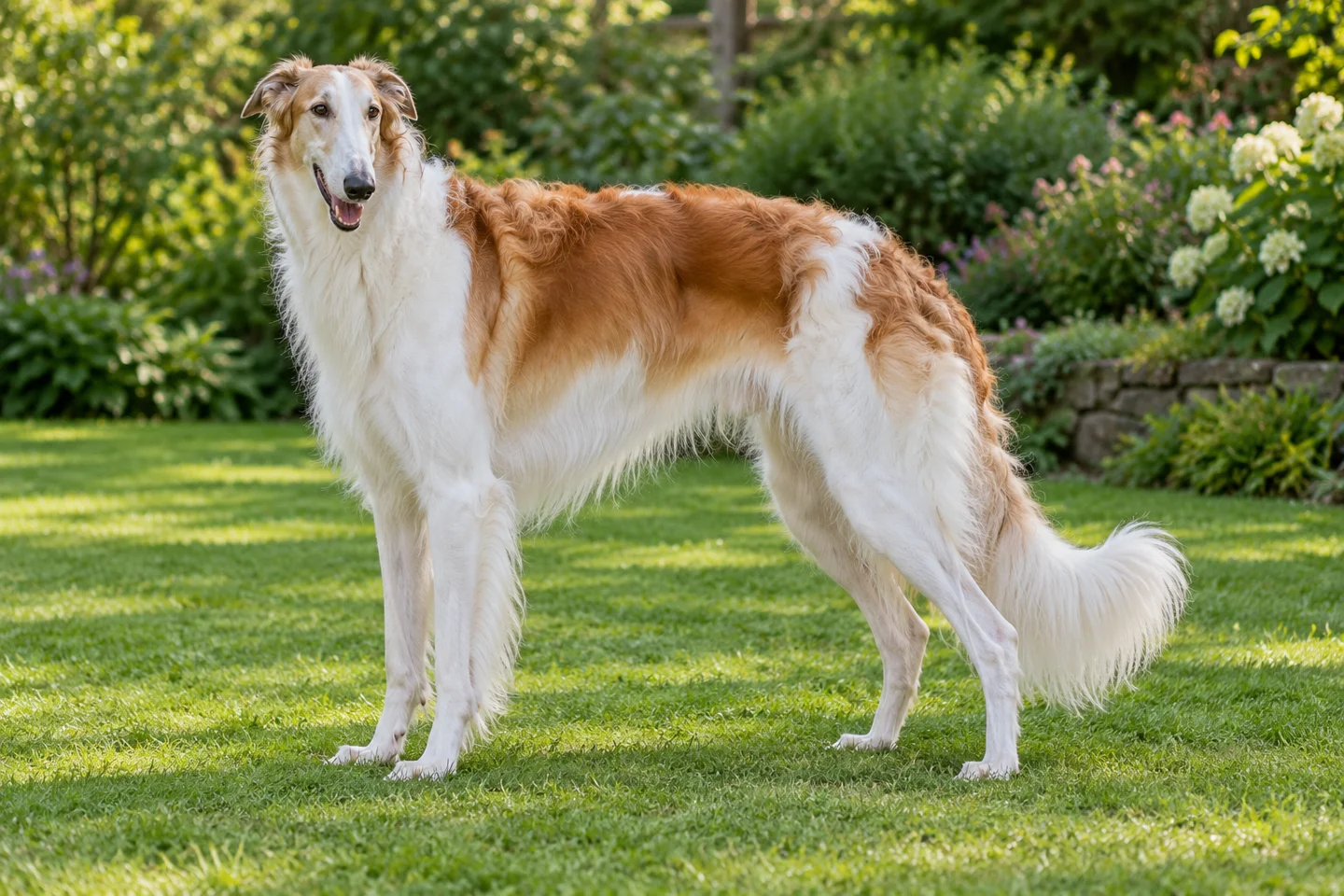
- Origin
- Russia
- Coat
- Silky coat with feathering
- Care priorities
- Secure pursuit outlets and comfortable access
General information for owners. These articles have not been reviewed by a veterinarian. Medical decisions need your dog's history and an examination.
Living comfortably with a very tall sighthound
A Borzoi needs room to move safely, a secure way to run when appropriate, and an owner who plans around its height and pursuit interests. Begin with practical measurements. Can the dog turn in the vehicle, stretch out in its sleeping area, and pass through the hallway without people squeezing around it? A lean body does not make a large dog weightless when it needs help after an injury. Plan access and transport before a graceful puppy grows into a tall adult.
Ask to meet dogs during ordinary home life. Notice how they rest, recover after excitement, and accept a lead or a brief body check. Discuss what happens when a squirrel runs across the route, a visitor arrives, or the owner leaves. A quiet presentation during one visit cannot answer every question about later behavior. Someone placing a Borzoi responsibly should be able to describe limitations and management, including animals or activities that have proved unsuitable for the particular dog.
Russian history and the meaning of sighthound
The Borzoi is a Russian sighthound, with hunting by sight central to its established identity. Its historical association with pursuing large game should be understood as context rather than an instruction for modern ownership. A companion still needs careful teaching about safe movement and access. The ability to notice and follow something moving can become a serious problem beside a road or vulnerable animal, regardless of how peacefully the same dog spends an afternoon sleeping near its owner.
Borzoi, Greyhound, Saluki, and other sighthounds are separate breeds. Long legs and a narrow silhouette do not establish a registered variety or prove ancestry in a rescue dog. Ask for actual records where pedigree is part of the placement. With uncertain parentage, keep the description provisional and assess the dog itself. A breed label can suggest useful questions, while current health, social history, and observed behavior determine the routine that this household needs to build.
A lean frame beneath a silky coat
The Borzoi's long head, deep chest, tucked-up outline, long limbs, and silky feathering contribute to its recognizable shape. A naturally lean outline should not become an excuse to ignore weight loss. Ask your veterinarian to demonstrate body-condition assessment for this individual and record meaningful changes over time. Coat can make photographs misleading, especially when different seasons, angles, and grooming are compared. A hands-on assessment and actual weight trend provide better information than an argument about how a sighthound ought to look.
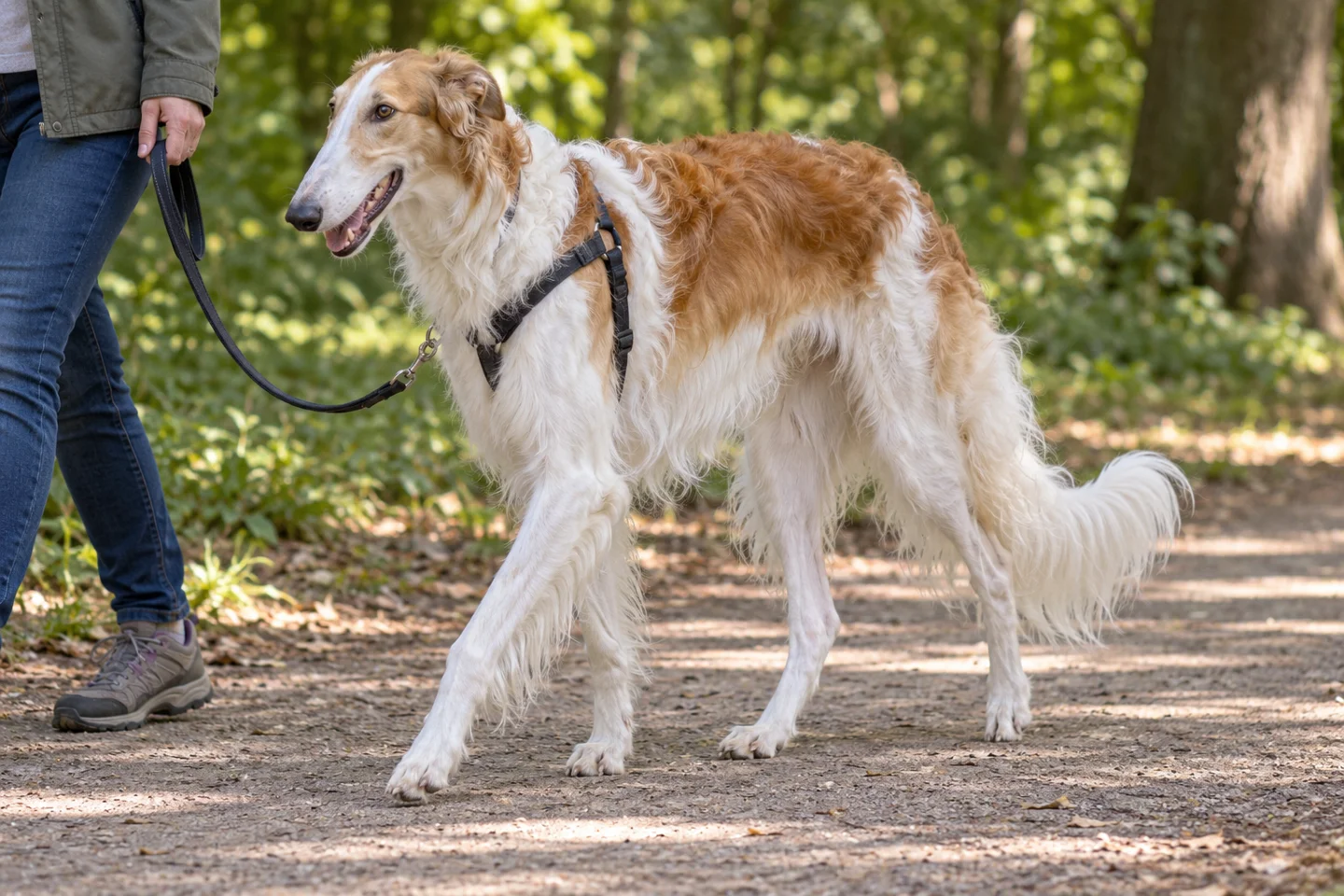
Choose equipment for the real shape of the dog. Ask someone experienced to check whether a collar or harness remains secure if the dog backs away suddenly. Fit should protect comfortable movement and avoid rubbing beneath feathering. Practice putting equipment on in a quiet room before trying beside an open vehicle or an exciting walking route. A tall dog can reach surfaces owners did not expect, so store food, medicines, and hazardous objects with its adult reach in mind.
Secure exercise within a checked boundary
Walk around an exercise enclosure before unclipping a lead. Examine gates, damaged panels, concealed gaps, and objects beside the fence that may create an escape route. Assess the surface and available turning space as well. A field can be enclosed yet unsuitable for fast movement if it contains holes, slippery patches, or obstacles the dog may encounter at speed. Keep the first visit controlled while you learn the setting. A booking described as secure is still worth inspecting personally.
Give the dog a chance to warm up through ordinary movement before expecting vigorous running, and allow recovery afterward. Do not turn every outing into repeated high-speed pursuit of a thrown object. Suitability depends on age, condition, and medical history. Ask a veterinarian about activity when a dog has pain, weakness, or a previous injury. A willingness to run can coexist with a problem, and an owner should stop when movement changes rather than waiting for the dog to abandon an exciting activity voluntarily.
Moving wildlife and the limits of recall
A Borzoi watching a distant animal may already be preparing to move before the owner identifies what attracted its attention. Use a lead where pursuit could reach traffic, livestock, or an animal that cannot escape safely. Teach recall and a practiced turn toward the handler in manageable surroundings, with worthwhile rewards. Those skills are valuable while the physical safeguard remains necessary. A successful response at a familiar field does not establish reliability in every encounter with fast-moving wildlife.
Be careful with long lines and speed. An abrupt stop at the end can injure the dog or handler, and loops create entanglement risks. Choose the setting, equipment, and handling method deliberately rather than assuming extra length automatically supplies safe freedom. In a narrow path, turn away early when a distraction appears. There is little training value in repeatedly letting a powerful surge reach the end of the line while a person braces against it. Easier conditions allow clearer learning and safer practice.
Cats and prey-sized animals
Ask about actual responses to cats, including whether the dog remained comfortable when the cat ran. A history of quiet coexistence in one setting cannot establish safety in every situation. Give household cats routes, resting places, and food stations beyond the dog's access. Use barriers and controlled introductions while you assess behavior. If the Borzoi fixes on the cat, stalks, or repeatedly pursues, stop access and obtain qualified advice. Waiting for the animals to settle the matter can expose the cat to severe harm.
Rabbits, rodents, poultry, and similar animals need dependable separation. A muzzle is not permission to stage an encounter that terrifies or physically injures a vulnerable pet. Consider whether the home can maintain the necessary boundaries every day, including when children visit or doors are left open. When adequate separation is unrealistic, the placement may be unsuitable. Warm behavior toward people does not answer questions about predatory responses, and an owner should be able to discuss that distinction without minimizing the danger.

Children around a long-limbed dog
A Borzoi's height puts its head and body close to children in ways a photograph may not convey. Prevent neck-hugging, climbing, and attempts to pull the dog off furniture or a bed. Make sure a child can reach an adult without stepping over the sleeping dog. Provide a retreat that remains genuinely private. Adults must watch interactions closely enough to notice withdrawal or discomfort before a child follows the dog into a corner and removes its option to leave.
Running games can create excitement, particularly when children move quickly through a garden. Separate before the game begins if there is uncertainty about pursuit or collision. A large dog may knock a child down without any intention to hurt, while a startled child may grab coat or ears. Offer calmer shared activities with adult direction and keep children away from meals and chews. Neither a calm breed description nor previous good behavior removes the need to manage the actual setting and the dog's current comfort.
Dog friendships without assuming matching play
A dog that enjoys fast running may find close wrestling unwelcome. Another may enjoy brief physical play but need frequent pauses. Let the individual pair show their preferences in a spacious setting, starting with movement at a distance. Watch what happens when one dog turns away: does the other allow the pause or continue pressing? Intervene when contact becomes one-sided. Choosing a compatible companion is more useful than trying to make a Borzoi participate in every play style available at a busy park.
Take size differences seriously. A fast pass beside a much smaller dog can cause injury even if no threat is intended. Keep introductions free of valued objects and give established household dogs protected resting areas. An older companion may need a different route or session from a young Borzoi. Ask a foster carer for concrete descriptions of encounters and the management used. A broad statement that the dog gets on with others leaves questions about speed, body contact, resources, and the ability to disengage.
Aggression and respecting a refusal
A tall dog trying to move away during brushing may be communicating discomfort before it growls. Stop and check the situation rather than holding it more firmly to finish. Tangled hair, painful joints, fatigue, or a frightening previous experience may contribute. The same attention to context applies when a dog guards a resting place or reacts to another dog approaching food. Protect space and prevent the recurring conflict while a veterinarian or qualified behavior professional helps identify a workable response.
AVSAB recommends training based on rewards. Physical confrontation can increase fear and makes handling a large dog more hazardous. If a growl occurs, treat it as information about a situation that needs to change. Do not deliberately recreate it for visitors to judge the dog's character. Keep children and unfamiliar people out of unresolved handling or resource conflicts. An accurate record of what happened, including any contact or injury, helps professionals plan safety more than a label such as aloof, dominant, or protective.
Training cooperation with realistic rewards
Teach the skills that make a tall dog easier to care for: approaching equipment, waiting before a door opens, standing on a stable surface, and returning toward a handler. Break tasks into short steps and reward voluntary participation. A Borzoi may find some activities more interesting than repeated positional exercises, so vary the useful task without losing clarity. If the dog stops responding, review the setting and reward rather than assuming that it understands perfectly and is choosing to defy you.
Practice recall as an enjoyable arrival, avoiding a pattern in which returning always ends the outing. Release the dog to a safe activity again when appropriate. Teach settling while people move around, so quiet time becomes part of the routine rather than a demand made only after an exciting day. Family members should agree on access to furniture, doors, and food. Clear routines reduce the number of moments in which the owner tries to solve a predictable problem through sudden physical restraint.
Grooming feathering and protecting skin
Brush through feathering and friction areas in manageable sessions, checking close to the skin. The hair behind ears, around legs, and beneath equipment can hold tangles or debris. Work gently and seek help when a mat is tight rather than cutting blindly near skin. Regular inspection after countryside walks can reveal burrs or small wounds before they become more troublesome. The long coat's appearance should not take priority over comfort, particularly in an older dog that finds standing for extended periods difficult.
Teach brief foot and mouth handling alongside coat care. Nails, teeth, ears, and skin all need attention even when the dog looks clean. A sudden objection to a familiar procedure deserves investigation. Do not put old medication into an irritated ear or eye without current veterinary advice. Tell grooming and veterinary staff about sensitive areas and the handling that helps the dog remain comfortable. A patient appointment plan is safer than expecting an unfamiliar professional to discover every concern during a rushed restraint.
Health screening and medical interpretation
The AKC lists cardiac, ophthalmologist, and thyroid evaluations, together with degenerative-myelopathy DNA testing, among the national-club recommendations for Borzoi. The Borzoi Club of America's health letter gives further context. Request the actual parent reports and ask about significant disease in close relatives. A useful discussion includes findings and follow-up, rather than a simple claim that the family is healthy. Keep copies so a veterinarian can interpret the results alongside the individual dog's examination and history.
A degenerative-myelopathy risk result does not diagnose every later gait problem. Thyroid results also need clinical interpretation rather than an owner's assumption based on a single number. Avoid universal claims that all sighthounds react identically to medications or anesthesia. The treating veterinarian needs the dog's own health status and proposed procedure. New weakness, altered breathing, fainting, or unexplained loss of condition needs assessment even when earlier screening was reassuring. Do not deliberately provoke a symptom to compare it with an online description.
Feeding, emergencies, and Borzoi mixes
Choose a complete diet for the dog's life stage and monitor body condition with veterinary help. Divide and time meals according to advice appropriate to the individual, particularly when there is a digestive history. Repeated unsuccessful retching, abdominal enlargement, severe distress, or collapse can signal an emergency and calls for immediate veterinary contact. Do not wait for every possible sign to appear or experiment with a home remedy while the dog deteriorates. Keep an emergency transport plan that accommodates a tall, unwell adult.
A Borzoi mix may inherit substantial height and pursuit interests without a predictable coat or temperament. A combined breed name cannot promise easy recall, freedom from illness, or allergy compatibility. Ask what is documented and what the dog has actually experienced. Consider the cost of food, veterinary treatment, safe transport, secure exercise, and competent holiday care over the dog's lifetime. If mobility changes with age, adjust flooring and access while preserving comfortable opportunities for exploration, choice, and social contact.
A dogsDating meeting that leaves space
Use a dogsDating profile to describe the Borzoi's actual preferred contact, running style, lead needs, and any limits around smaller animals. Keep exact home coordinates private. Select a quiet public route where the dogs can move alongside each other without being funnelled into a close greeting. Agree on a short first session and a way to end it easily. Avoid treating an off-lead chase as the necessary test of whether two dogs can become companions.
Watch for relaxed movement, pauses, and willingness to disengage as the walk develops. If one dog repeatedly crowds or pursues the other, create distance before excitement escalates. Toys and food can wait until resource behavior is understood separately. A comfortable walk may be enough for the first meeting and for an ongoing friendship. The people should remain prepared to change the plan when weather, fatigue, physical discomfort, or an unexpected animal alters what the dogs can manage safely that day.
Planning an overnight stay
Ask a prospective carer about usable fencing, resting space, vehicle access, and the handling of arrivals. A place accepting large dogs may still have a low gate or a crowded exercise group that does not suit this individual. Explain the pursuit precautions and demonstrate equipment before leaving. A brief trial can reveal whether the dog rests comfortably and whether the carer follows the agreed routine. Leave veterinary contacts and clear permission arrangements for urgent treatment. Familiar bedding and food can help maintain continuity while the people responsible learn how this particular dog responds away from home.
Sources and editorial notes
Sources checked October 21, 2026. Breed measurements describe reference ranges, not a diagnosis or an individual dog's ideal weight. Images are AI-generated breed illustrations and do not document a particular dog or health condition.
- VCA: Ear Infections in Dogs
- VCA Animal Hospitals: Common emergencies in dogs
- VCA: Food Aggression in Puppies
- AVSAB: Humane Dog Training Position Statement
- Orthopedic Foundation for Animals: Diseases
- VCA: Feeding Guidelines for Dogs
- American Kennel Club: Borzoi
- American Kennel Club: Borzoi Recommended Health Tests
- VCA: Grooming and Coat Care for Your Dog
- Borzoi Club of America: Health Letter
Keep getting to know dogs.
Read another guide or return to your dogsDating community.
Explore breed guidesBack to dogsDating