French Bulldog
A compact companion whose care needs close attention to breathing, heat, skin, movement, and comfortable everyday activity.
How these guides are researched and reviewed

- Height reference
- About 11–13 in
- Weight reference
- Under 28 lb
- Care priorities
- Breathing, heat, skin, and mobility
General information for owners. These articles have not been reviewed by a veterinarian. Medical decisions need your dog's history and an examination.
Choosing a French Bulldog with daily care in mind
A French Bulldog can be an affectionate, playful companion who enjoys taking part in household life. Its compact size can suit a smaller home, but size does not describe the work involved in caring for it. Breathing comfort, temperature control, skin care, and access to veterinary treatment deserve attention before you choose a puppy or adopt an adult.
Picture the routine you can provide. Consider your summer climate, indoor cooling, stairs, travel plans, and the time available for short outings and quiet company. Ask how a particular dog sleeps, eats, walks, and recovers from excitement. A reassuring description such as typical Frenchie can hide a problem if nobody explains what the dog actually does.
Spend time observing the individual. A dog should be able to rest without obvious respiratory struggle and participate in suitable activity comfortably. Appearance alone cannot establish that it has healthy airways. Request medical records and an independent veterinary assessment, and be prepared to reconsider a placement when the care requirements exceed what your household can manage.
Breed history and companion life
The French Bulldog's development involved small Bulldogs in England and later breeding in France. The American Kennel Club describes the connection with English lace workers and the breed's development as a companion. Upright bat ears became a recognizable feature. The breed belongs to the AKC Non-Sporting Group.
That companion background helps explain why many owners seek a dog who enjoys close household contact. It does not remove the need to teach independence, toilet habits, comfortable handling, and calm greetings. A dog bred primarily for companionship still needs a predictable routine and appropriate activities when people are occupied.
Avoid letting a breed story decide a household match. Meet the dog, ask about its living history, and discuss medical needs in practical terms. Someone who works long hours away from home needs a care arrangement regardless of how appealing the dog's social nature sounds. A quiet adult may suit some homes better than a puppy who needs frequent attention throughout the day.
Size, coat, and what photographs cannot show
The AKC lists a height of about 11 to 13 inches and weight under 28 pounds. These are breed reference figures, not a target for every dog. Body condition and frame matter. Ask your veterinarian to assess weight and muscle rather than deciding that a dog is healthy because it falls below a chart limit.
French Bulldogs have a short coat, compact body, upright ears, and a short muzzle. Do not choose exaggerated features as proof of quality. A very flat face, heavy folds, or an unusually large head should prompt questions about function and comfort. Coat color and an expensive sales label do not establish better health or more desirable behavior.
A still image cannot tell you how a dog breathes during sleep or after ordinary movement. Ask for direct observations and veterinary findings. Treat edited pictures, popularity claims, and rare-color pricing as separate from evidence about the animal. The important questions concern its actual health, behavior, and the support available after it comes home.
Understanding breathing and BOAS
Brachycephalic obstructive airway syndrome, usually called BOAS, is a respiratory disorder linked to short-headed conformation. The University of Cambridge's veterinary department identifies French Bulldogs among affected breeds. Obstruction can involve several structures, so a brief look at the nostrils cannot provide a complete assessment of the airway.
Noisy breathing, difficulty tolerating suitable activity, disturbed sleep, or effortful breathing warrants veterinary discussion. Do not assume a dog is simply lazy when it stops or struggles. Ask what has been observed, whether a formal respiratory assessment has been performed, and what management or treatment has been advised.
Describe everyday function rather than relying on a single label. Explain whether the dog wakes repeatedly, needs to change sleeping position, cannot recover comfortably after excitement, or has trouble eating. Those details can help the veterinary team decide what to investigate. Avoid copying an exercise test from the internet. Respiratory grading belongs with trained assessors who can evaluate the dog and respond if it becomes unwell.
Breathing emergencies, heat, and travel
Severe breathing difficulty, collapse, or a blue or grey appearance to the tongue or gums requires urgent veterinary contact. Stop activity, move away from heat or excitement where possible, and follow the clinic's instructions while arranging care. Do not wait for a social-media reply or assume recovery will be quick because an earlier episode improved.
Plan outings around conditions and the dog's medical needs. Cambridge advises avoiding overheating and excessive exertion in dogs affected by BOAS. Choose cooler times and shaded routes, and make the return trip easy to shorten. A fixed distance should never become a reason to push a struggling dog onward.
Keep the dog out of hot vehicles and prepare for cooling failures at home or during transport. Check travel requirements well in advance, including the carrier's rules for short-muzzled dogs. Discuss medical suitability with your veterinarian rather than assuming a ticket makes a journey safe. Anyone caring for the dog needs its emergency contacts and a clear account of breathing concerns or previous treatment.
Children, handling, and other animals
A French Bulldog's smaller stature does not make rough handling harmless. Children need an attentive adult who can stop hugging, lifting, chasing, and interference with meals or sleep. Give the dog a comfortable retreat. Use separation when supervision is unavailable instead of asking the child to recognize every warning sign.
Learn a comfortable lifting technique from your veterinary team, especially if the dog has a history of pain or spinal disease. Support the body and avoid letting children carry the dog. A new objection to touch, lifting, or stairs should prompt assessment. Pain can change behavior, including the response of a dog who usually seeks contact.
Introduce cats with barriers and escape routes. Introduce dogs in a setting where both can create distance and recover from excitement. Size, breed, and a friendly first minute cannot establish compatibility. Some French Bulldogs enjoy gentle play with a familiar companion and dislike rough wrestling. Arrange meetings around that preference and any medical limits, rather than expecting the dog to keep up with a more athletic partner.

Aggression, guarding, and a safer household
French Bulldogs can show aggression and can bite. Take freezing, growling, snapping, or attempts to escape seriously. Avoid describing conflict as a funny small-dog habit. People can be injured, and the behavior may indicate fear, pain, or a situation the dog cannot manage comfortably.
If food or toys create conflict, provide separate feeding areas and control access to valued objects. Keep children away from bowls and chews. Do not repeatedly take items to prove that the dog permits it. Prevent access to dangerous objects so that an urgent confrontation is less likely, and obtain advice if guarding has already appeared.
Ask your veterinarian about a new behavior change and seek qualified behavior support when needed. Describe incidents accurately, including injuries and the circumstances before the event. Use gates, distance, and a predictable routine while a plan is developed. If a professional considers a muzzle, its design and use need to account for this dog's breathing and anatomy. Never improvise equipment that restricts panting or breathing.
Training and comfortable independence
Teach useful skills through rewards and manageable steps. A French Bulldog can learn to come when called, walk calmly, settle on a mat, and cooperate with care. The American Veterinary Society of Animal Behavior recommends reward-based training. Choose short sessions in comfortable conditions and pause if the dog becomes distressed or physically uncomfortable.
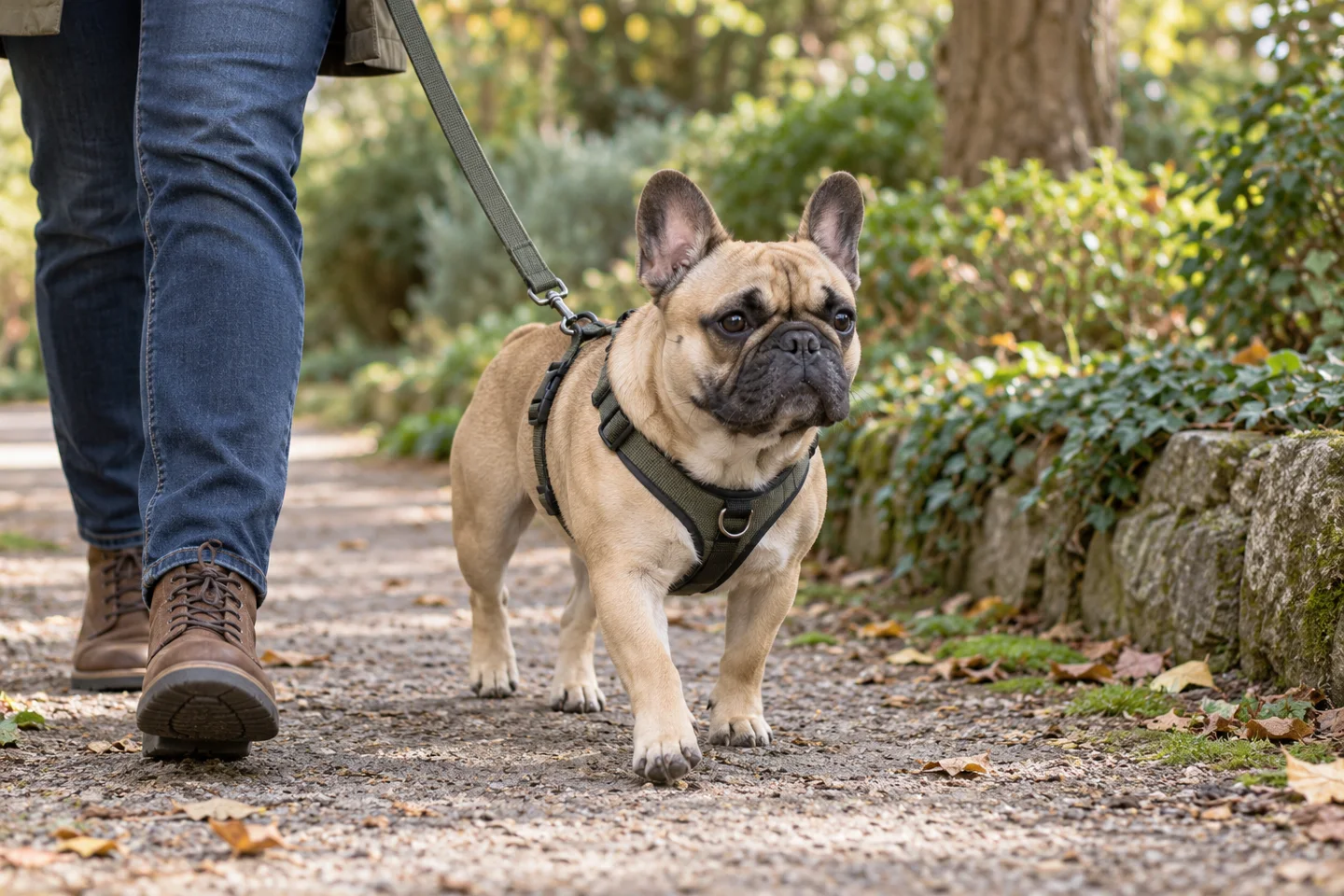
Use an appropriately fitted harness and practice a few calm steps before adding distractions. Reward returning attention to you and moving away from an overwhelming situation. Plan toilet opportunities after waking and other predictable transitions, and reward success where it happens. Punishing an accident after the event does not explain where you wanted the dog to go.
Build alone time gradually. Observe whether the dog can settle, and arrange help when your absence exceeds its current ability to cope. Persistent distress needs an individual assessment. Another dog, a longer confinement period, or a collection of toys cannot be promised to solve it. Training works best when the task and environment match what the dog can currently manage.
Exercise, play, and useful rest
A French Bulldog needs opportunities to move and explore, with intensity matched to health and conditions. Ask the veterinarian what is appropriate for your dog, especially after respiratory or spinal treatment. Gentle sniffing, easy searches, and short training sessions can provide interest without turning every outing into sustained exertion.
Watch breathing and recovery throughout play. Excitement can keep a dog participating after a sensible stopping point. End the game before the dog struggles, and choose companions whose style allows pauses. Avoid repeated high jumps or rough collisions, particularly when medical advice limits those activities.
For indoor enrichment, place a familiar toy in a simple hiding spot or offer suitable feeding equipment under supervision. Keep the area comfortable and remove objects the dog breaks or attempts to swallow. Rest should be easy to access and undisturbed. If the dog cannot sleep comfortably or seems to need unusual positions to breathe, report that observation instead of treating it as an amusing sleeping habit.
Health screening and questions for a breeder
The French Bull Dog Club of America's testing page lists hip, eye, patella, and cardiac evaluations for its CHIC requirements. It also discusses additional testing, including respiratory function grading. Read the current page and ask which findings are available for each parent. A DNA panel alone does not answer all of those questions.
Verify the parents' identities against results. Ask when examinations took place, whether repeat assessments are advised, and what any abnormal result means for a proposed litter. CHIC participation does not guarantee every finding is normal or that every puppy will remain healthy. Read the actual reports rather than relying on the presence of a number in an advertisement.
Ask about breathing, mobility, allergies, eye problems, and medical treatment in close relatives. Discuss why a particular pairing was chosen and what support is offered after placement. A seller should be willing to explain limitations. For an adopted adult with missing records, begin with the known history and a current examination. Uncertainty needs a practical plan, not an unsupported assurance that no records means no problems.
Spine, movement, and sudden pain
French Bulldogs are among the breeds Cornell identifies as predisposed to chondrodystrophy-related intervertebral disc disease. Discs can degenerate and cause pain or neurological problems. A dog who becomes reluctant to move, cries when lifted, drags a paw, or loses coordination needs prompt veterinary attention. Inability to walk is urgent.
Do not massage, stretch, or repeatedly make a painful dog walk to identify the problem yourself. Ask the clinic how to handle and transport it. Similar signs can have different causes, and treatment depends on the examination and appropriate testing. A breed article cannot determine whether surgery or another treatment is needed.
Discuss comfortable access to furniture and vehicles, suitable footing, and activity with the veterinary team. A well-fitted ramp may help a dog avoid repeated jumping when recommended, but equipment cannot guarantee prevention of disease. If treatment is prescribed, ask about restrictions, medication, warning signs, and follow-up. Make sure every caregiver understands the same plan.
Grooming, skin folds, ears, and eyes
A short coat still needs regular brushing and a look at the underlying skin. The Royal Veterinary College reports a high risk of skin-fold dermatitis in French Bulldogs and other flat-faced breeds. Check areas where skin rubs or moisture collects. Redness, odor, discharge, or pain deserves veterinary advice rather than repeated experimentation with cosmetic products.
Ask for an individual cleaning routine and suitable products. Dry areas as directed, and avoid putting household wipes or unapproved preparations near the eyes. Ear odor, head shaking, and discomfort also need investigation. Cleaning alone may not address the cause of recurrent inflammation.
Watch for squinting, rubbing at an eye, unusual discharge, or a change in appearance. Eye discomfort should be assessed promptly. Do not use leftover eye medication without advice. Build cooperation with brief handling lessons so examination and treatment are easier. The same gradual approach helps with nails and toothbrushing, and gives you a chance to notice a new sensitivity before a long grooming session becomes a struggle.
Nutrition and maintaining a healthy body condition
Choose a complete diet suited to life stage and medical needs. Measure portions and include rewards and chews when reviewing the day's intake. The feeding guide on a package is a starting point. Your veterinary team can use body condition, muscle, weight trends, and current health to decide whether the amount is appropriate.
Extra weight is relevant to respiratory management. Ask for a specific feeding plan if the dog needs to lose weight, with a sensible review schedule. Avoid drastic restriction or a supplement advertised as a breathing aid. Food changes cannot correct every structural airway problem, and delayed assessment can leave a dog struggling unnecessarily.
Report recurring vomiting, regurgitation, difficulty eating, or weight change. These observations may matter alongside respiratory findings and require an individual investigation. Keep a record of timing and what the dog was doing beforehand. Separate animals during meals and supervise feeding equipment so the effort to slow eating does not create frustration or competition.
Water, transport, and equipment choices
Do not assume a French Bulldog can swim safely because another dog of the breed enjoys water. Prevent accidental access to pools, ponds, and deep water. Any planned water activity needs close supervision and consideration of the dog's health, body shape, and ability. A flotation aid does not replace that judgment or make every activity suitable.
Fit equipment to the individual. A harness should allow movement without rubbing or placing avoidable pressure on a vulnerable area. Recheck the fit as weight changes. A travel crate or restraint must provide appropriate support and ventilation, and the vehicle's temperature needs active attention throughout the journey.
Think through ordinary emergencies before they occur. Decide who can lift the dog, where medical records are kept, and which clinic provides urgent care. Tell sitters about medication and medical restrictions rather than expecting general experience with dogs to cover this animal's needs. A clear written routine is particularly useful when several people share care.
French Bulldog mixes and marketing claims
Frenchton is often used for a French Bulldog and Boston Terrier cross, while Frug commonly refers to a French Bulldog and Pug cross. These are informal names, and usage varies. Ask what is documented about the parents and what is an estimate. Appearance alone cannot confirm an exact cross.
Combining breeds does not guarantee freedom from breathing problems. A cross between two short-muzzled breeds may still need respiratory assessment and careful heat management. Coat, size, activity needs, and inherited risks can vary. Evaluate both known parents and the actual dog rather than accepting a promise of a universally healthier version of a French Bulldog.
Ask for relevant health testing on both sides when parentage is known. For an adult of uncertain ancestry, medical findings and observed behavior can guide care without an exact genetic label. Avoid making a purchase because a mix name sounds reassuring or a seller claims a longer-looking muzzle proves normal airways. Functional assessment supplies information that a name cannot.
Costs, adoption, and the first weeks
Get realistic local estimates for preventive care and possible specialist assessment. Ask about insurance terms, exclusions, and waiting periods before assuming a policy will meet future expenses. Include food, equipment, sitting, training, and a plan for urgent treatment. A small dog can still need substantial medical care.
For an adult, ask which observations came from a foster home and what treatment is ongoing. Discuss breathing during sleep, comfortable activity, lifting, separation, other animals, and any bite history. Request the actual medical records where available. Arrange a veterinary visit and continue prescribed medication until the veterinarian advises otherwise.
Keep early days predictable. Prepare a comfortable temperature, quiet rest area, toilet routine, and separation space for existing pets. Avoid a succession of visitors or energetic outings. Learning the dog's ordinary breathing, appetite, movement, and behavior in calm conditions gives you useful information when something changes. Let the adjustment period guide your pace rather than a fixed social calendar.
Aging and decisions about comfort
The AKC gives a general life-expectancy range of 10 to 12 years for the breed. That reference range cannot predict an individual dog's lifespan or future quality of life. Budget and plan for care over the whole relationship, including periods when illness changes what the dog can do.
Review comfort as circumstances change. Easier access to a bed, better traction, shorter outings, or a revised feeding plan may be useful, depending on veterinary findings. Reduced activity should not automatically be dismissed as age, especially when it accompanies pain or breathing changes.
Discuss treatment goals openly. Ask what improvement is expected, how it will be measured, what care is required at home, and when to reassess. Decisions become clearer when they relate to sleeping, eating, moving, and resting comfortably. Keep notes about those everyday functions so a review includes more than how the dog happens to look during a short appointment.
Planning a dogsDating outing
Describe your French Bulldog's current play preferences and medical limits. Explain whether it enjoys a gentle walk, needs frequent breaks, or becomes overwhelmed by rough play. Share information relevant to a safe meeting while keeping exact home details private. Ask the other owner how their dog responds when a companion wants to stop.
Choose cool conditions, a calm setting, and an easy exit. A short parallel walk may be more suitable than a crowded play area. Leave valued toys out if they create conflict. Watch both dogs for comfortable movement and voluntary breaks, and keep attention on breathing as well as social behavior.
End the meeting when either dog is struggling, avoiding contact, or unable to disengage. A pleasant encounter does not need prolonged physical play. Plan future outings around what the dogs handled comfortably, and review the arrangement if health or behavior changes. Compatible company should fit the dog's abilities on that day.
Sources and editorial notes
Sources checked October 21, 2026. Breed measurements describe reference ranges, not a diagnosis or an individual dog's ideal weight. Images are AI-generated breed illustrations and do not document a particular dog or health condition.
- University of Cambridge: About brachycephalic obstructive airway syndrome
- Royal Veterinary College: French Bulldog health research
- Cornell University College of Veterinary Medicine: Chondrodystrophy and intervertebral disc disease
- VCA Animal Hospitals: Common emergencies in dogs
- VCA Animal Hospitals: General feeding guidelines for dogs
- VCA Animal Hospitals: Food aggression in puppies
- French Bull Dog Club of America: Health testing and registries
- American Kennel Club: French Bulldog breed information
- VCA Animal Hospitals: Aggression toward unfamiliar dogs, diagnosis
- University of Cambridge: BOAS management and treatment
- University of Cambridge: BOAS recognition and diagnosis
- Royal Veterinary College: Skin fold dermatitis research
- AVSAB: Humane Dog Training Position Statement
- VCA Animal Hospitals: Water sports for dogs
Keep getting to know dogs.
Read another guide or return to your dogsDating community.
Explore breed guidesBack to dogsDating