Schipperke
A compact Belgian guardian with a dense black coat, current club screening distinctions and specific guidance on MPS IIIB records.
How these guides are researched and reviewed
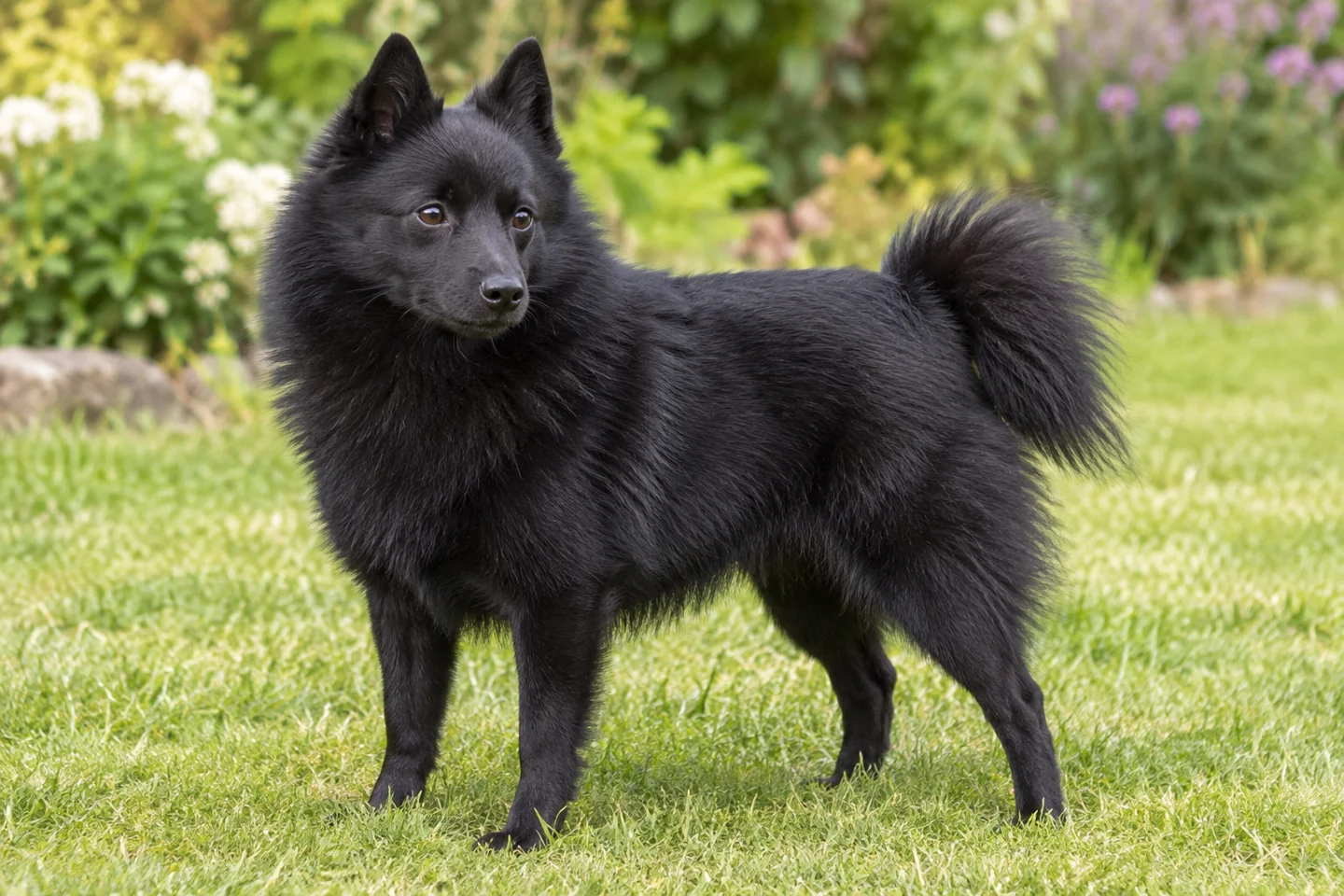
- Origin
- Belgium
- FCI adult weight
- 3–9 kg; 4–7 kg sought after
- Coat
- Dense black double coat with ruff and culottes
- Illustrated tail
- Natural full tail
General information for owners. These articles have not been reviewed by a veterinarian. Medical decisions need your dog's history and an examination.
A small Belgian guardian with a full-sized curiosity
The Schipperke is a compact Belgian dog with a foxlike head, pointed natural ears, and a dense black coat that forms a distinct ruff and heavier hair around the hindquarters. It is a separate breed from a miniature Belgian Shepherd or a small black Spitz. Its small body can fit many homes, but its interest in doors, movement, and household activity needs deliberate teaching rather than an assumption that a portable dog will be simple to manage.
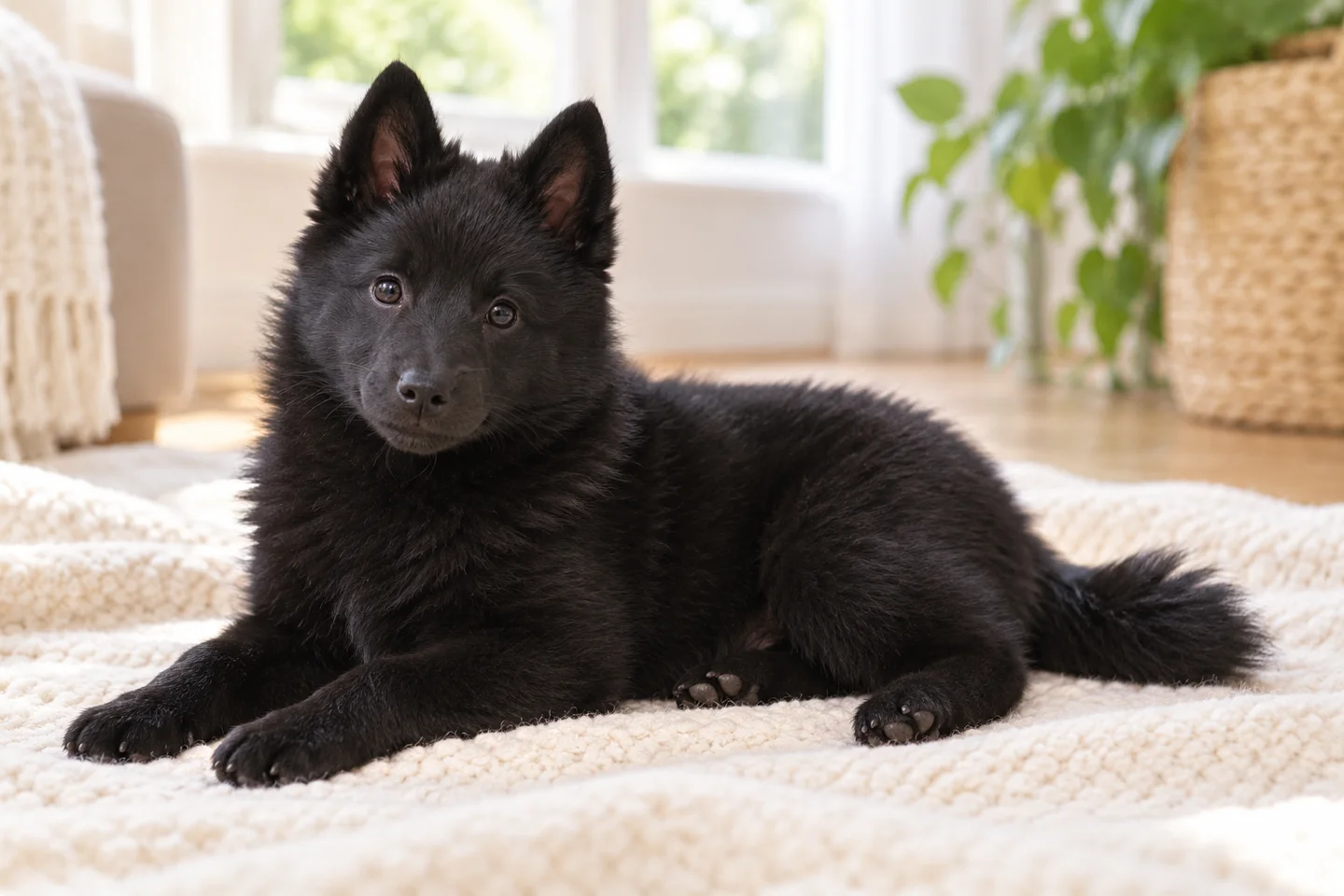
The illustrations show a solid black dog with a natural full tail. Docked images are common in older material, but absence of a tail should not become the only way an owner recognizes the breed. Ask a breeder about the individual puppy's anatomy and the registry used. Meet adults in ordinary life when possible. A dog that settles while its person talks may still need careful preparation for visitors, time apart, and the temptation to investigate an opening gate.
Belgian history and a name that is often oversimplified
The FCI standard gives Belgium as the origin and explains Schipperke through a Flemish expression meaning little shepherd. It describes connections to an older small black sheepdog type and the breed's place among working people in Brussels. Those details provide context without requiring an owner to choose between every popular story about boats or occupations. Historical descriptions cannot establish a modern puppy's personal ancestry beyond its documented records.
Use that background to ask practical questions about vigilance and activity. What does the dog do when a person approaches the home, and how easily can it return to rest? Does it investigate continuously when outside, or remain able to respond? A small guardian still needs instruction about which behavior works in a domestic setting. For a rescue, previous experience with doors, travel, and handling may be more immediately useful than a general origin story. Gather the information available and observe how the animal responds to the new environment.
Adult weight without manufacturing an official height
The FCI standard gives an adult weight range of 3–9 kg and seeks an average of 4–7 kg. It does not supply a corresponding required height range. Those figures are adult conformation references, not a reason to seek the tiniest puppy or restrict food during growth. Ask the veterinary team to assess ribs, waist, muscle, and the individual's frame beneath the coat.
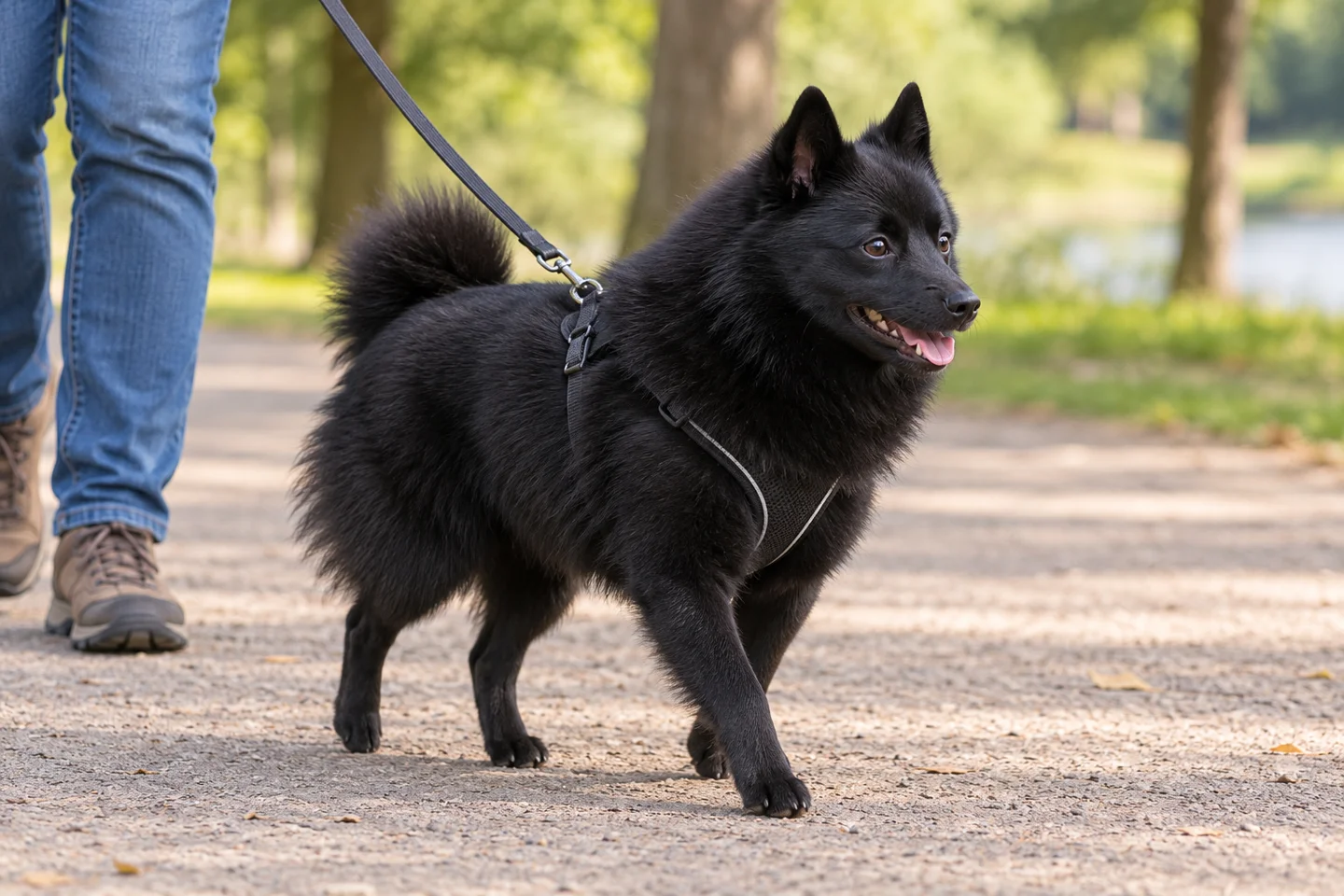
The ruff and dense hair can disguise gradual weight gain. Record changes rather than deciding condition from a front-facing photograph. Choose a harness that remains secure when the dog steps backward and check contact points beneath the hair. A small dog may fit in a travel carrier while still needing adequate room and ventilation. Measure the grown parents and discuss realistic development with the breeder, recognizing that no early estimate guarantees an exact adult weight. Comfortable movement and steady growth matter more than matching an advertised number at every age.
Coat and tail variation need clear descriptions
The FCI describes a black outer coat with a dense undercoat and different hair lengths over the body. The neck ruff, cape, and hindquarter furnishings create much of the silhouette. A puppy's coat develops with maturity and should not be expected to reproduce a fully furnished adult immediately. Greying with age also deserves a different interpretation from a seller advertising an unusual color as proof of rarity.
The illustrated natural tail helps owners see a complete dog rather than assuming docking is necessary for type. Ask how the relevant registry describes tails and how the particular dog's tail developed. A missing or unusual tail cannot be explained reliably from a photograph alone. When choosing equipment or a grooming routine, work with the actual anatomy and coat rather than a single show image. An AI illustration can demonstrate selected features, but it cannot prove parentage, sound movement, skin health, or freedom from inherited disease.
Training doors, windows, and useful pauses
Teach a Schipperke to move onto a mat before a door opens, return attention when named, and step away from food preparation. Practice while the environment is quiet and reward early responses. These skills help the dog understand a useful role during household activity. Repeatedly holding it back when excitement peaks does less teaching than rehearsing the routine before a real delivery arrives.
Window watching can become a habit if every passerby triggers a long response. Move furniture or provide screening when needed, then reward coming away and settling elsewhere. Avoid shouting over the dog or using lead jerks to interrupt investigation. Change the setting and make the next response easier to perform. A qualified reward-based instructor can help if barking, pulling, or intense monitoring already interferes with daily life. Small size should not be used as a reason to lift the dog through every problem without teaching a comfortable alternative.
Exercise with investigation and an actual off switch
Offer walks that include sniffing, short searches, and suitable play, adjusted to age and physical condition. A dog can be busy without receiving the kind of activity it needs. Constant high-speed games may leave it anticipating the next throw instead of learning to rest. Include calm exploration and quiet recovery, and notice whether the animal can sleep afterward rather than using exhaustion as the only goal.
Check enclosed areas for gaps, weak latches, and objects that make climbing possible. Practice recall on appropriate equipment before relying on it around wildlife or traffic. Puppies need manageable outings and rest, while older dogs may prefer shorter searches. Carry water and choose cooler periods in warm weather; a dense coat does not prevent heat illness. If the dog changes gait, tires unexpectedly, or becomes stiff afterward, revise the plan and obtain veterinary advice when needed. Motivation to continue playing is not a clinical assessment of safe activity.
Children and a portable dog that still needs choice
Children should not carry a Schipperke unless an adult has established that handling is safe and appropriate. A fall can injure the dog, while fear of being grabbed can change its response to approaching hands. Teach children to sit for calm contact, invite the dog closer, and pause touching so it can leave. Give it a resting area that children cannot enter and separate them when an adult cannot supervise actively.
Food, chews, and stolen objects remain an adult responsibility. A child should not remove a bowl or reach into the mouth to demonstrate trust. Safer participation includes helping with a supervised search or rewarding a known cue. Watch stillness, turning away, and repeated retreat before the animal needs to escalate a warning. Familiarity with one child does not establish comfort with a noisy group of visitors. Use barriers during running games and explain the same rules to visiting adults rather than expecting the dog to tolerate every interaction.
Aggression and the event behind a warning
A Schipperke that growls, snaps, or guards an object needs attention rather than laughter about a small dog acting large. Record the approach, touch, location, resource, and available escape route. A dog reacting during painful handling needs a different immediate plan from one defending food. The useful response is to prevent another incident and identify what should change, rather than assigning a broad label such as dominant or protective.
Arrange veterinary assessment for a sudden change and qualified reward-based support for recurring defensive behavior. Do not repeatedly reach toward a guarded item to test tolerance or punish warnings until they disappear. Move people away, use barriers, and separate resources while teaching develops. A basket muzzle can add protection if introduced gradually and fitted comfortably, but it cannot make an overwhelming encounter suitable. Following a bite, obtain appropriate medical advice and keep prevention reliable before attempting another meeting. Small teeth and a compact body do not remove the possibility of meaningful injury.
Dogs, cats, and other animals in the same home
Start dog introductions with separate handlers and enough space for parallel walking. Let both animals pause and choose whether to approach. A Schipperke may enjoy familiar companions while objecting to an unfamiliar dog crowding a bed or bowl. Stop repeated chasing when one dog tries to leave, and avoid assuming that silence means every part of the interaction is mutual.
At home, feed separately and provide several resting places so one animal cannot control all useful spaces. Introduce cats through barriers and preserve routes they can use without passing the dog. Prevent pursuit rather than allowing a trial run to see what happens. Rabbits, birds, and similar pets need reliable physical separation. Ask about previous behavior while recognizing that a new environment may create new responses. If safe separation cannot be maintained during cleaning, feeding, or absences, reconsider the arrangement before adoption instead of assuming that a small dog is harmless to other small animals.
Grooming the ruff down to the skin
Work through the dense coat methodically, checking beneath the surface rather than brushing only the visible tips. Pay attention to the ruff, hindquarters, and areas under a harness. A comb should pass without pulling skin into a tight knot. Ask an experienced groomer to demonstrate if repeated tangles or avoidance make care difficult. A characteristic dense outline should not conceal compacted hair, moisture, or irritation.
Dry appropriately after bathing and inspect skin that remains damp. Maintain nails and introduce tooth brushing through brief rewarded handling. Check ears for odor, discharge, soreness, or repeated head shaking, using veterinary advice rather than leftover medication. Avoid deep tools in the ear canal. If the dog suddenly objects to one part of grooming, investigate discomfort before increasing restraint. A stable nonslip surface and predictable pauses can make care easier. The puppy's developing ruff requires age-appropriate attention rather than an attempt to manufacture adult volume through products or excessive handling.
Health: the current club statement adds important distinctions
The Schipperke Club of America's September 2025 statement identifies eye, thyroid, patella, and hip assessment for its CHIC recommendations. It separately recommends MPS IIIB testing before breeding dogs of unknown status and a congenital cardiac examination, while noting these additional tests are not presently required for CHIC. That distinction matters when someone presents a CHIC number as the whole health discussion. Ask which individual results are available and how the proposed mating was evaluated.
Do not replace the full statement with an older summary list or assume every result is permanent. Ask the veterinary team which examinations need updating and how the dog's age affects interpretation. A clinical examination, radiograph, and DNA assay address different questions. For an adopted dog, available family information provides background while its own examination guides current care. A missing report is uncertainty to discuss, not proof of illness. Keep the named reports accessible so a future practice can see exactly what was assessed.
MPS IIIB and why a healthy-looking youngster still needs records
Mucopolysaccharidosis IIIB is an inherited lysosomal storage disorder documented in Schipperkes. The club's veterinary explanation links it to NAGLU and describes progressive problems with balance and coordinated movement. A DNA test distinguishes dogs with the relevant affected, carrier, or normal result. Because signs may emerge after puppyhood, a lively youngster's appearance cannot establish the genetic status of the parents or the puppy.
Ask for the actual result and laboratory interpretation rather than a verbal claim that the line is clear. Carrier and affected are different categories, and this disease should not be confused with unrelated conditions whose carrier interpretation differs. An adult developing tremor, difficulty on stairs, or altered balance needs prompt veterinary assessment, since those signs have several possible causes. Do not diagnose MPS IIIB from a clip or assume that every coat change points to it. The club explicitly cautions against estimating population frequency without suitable evidence, so avoid repeating unsupported percentages as a risk prediction for your dog.
Food, mouth care, and changes in daily comfort
Use balanced food appropriate to life stage and measure portions against condition and activity. Count training rewards and chews within the day's intake. A dense coat makes hands-on assessment especially useful, and an enthusiastic appetite does not establish that more food is needed. Discuss unexpected weight changes, persistent digestive signs, altered drinking, or a change in willingness to eat with the veterinarian rather than repeatedly adding richer toppings.
Keep medicines, rubbish, and dangerous products physically secured. Contact a veterinarian after suspected toxic ingestion and provide the product and amount when known. Collapse, severe breathing difficulty, major injury, or rapidly worsening distress requires urgent advice. Teach comfortable lip lifting and tooth brushing, and ask for routine dental assessment rather than relying on chewing alone. A homemade diet requires suitable formulation, while supplements should address a clear need. Record onset and progression of changes so the clinic can work from the individual history instead of a general breed description.
Mixes, expenses, and a workable ownership choice
A Schipperke mix can vary in size, coat, voice, pursuit, and comfort with unfamiliar people. A crossbreed label does not promise an easier version or remove inherited risk. For a planned mating, discuss relevant assessment in both parental backgrounds. For a rescue, use observed behavior and clinical findings as the practical starting point rather than trying to settle ancestry from a black coat or pointed ears.
Budget locally for food, preventive care, training, grooming tools, suitable equipment, transport, and emergency treatment or insurance. Find a carer who can follow gate and walking routines, and rehearse a handover before an absence. Consider neighbors, visitor traffic, and quiet rest as well as exercise. A household that enjoys patient teaching and can provide safe investigation may offer a suitable life. One expecting effortless silence, untrained recall, or constant carrying should reconsider those assumptions before choosing. The routine needs to work during ordinary inconvenient days, not only a pleasant outing when everyone has time.
dogsDating introductions with separate choices
Describe the Schipperke's actual social preferences on dogsDating, including whether it enjoys quiet parallel walks, becomes vocal near unfamiliar dogs, or needs space from rough play. Keep exact home coordinates and your address private. Choose a public meeting location from an approximate area, with broad paths and separate exits. Avoid a crowded first greeting beside a gate or inside the dog's home.
Have each responsible adult handler attend to one dog and begin moving in the same direction at a comfortable separation. Leave toys and shared food out of the encounter. Let contact remain optional and increase distance if either animal becomes stiff, repeatedly retreats, or cannot recover from excitement. A short peaceful walk provides useful information without requiring play. Discuss what both handlers noticed afterward before arranging another meeting. Nobody should feel obliged to continue because the dogs are small or expected to be sociable; the actual response determines whether the plan suits them.
Sources and editorial notes
Sources checked October 22, 2026. Breed measurements describe reference ranges, not a diagnosis or an individual dog's ideal weight. Images are AI-generated breed illustrations and do not document a particular dog or health condition.
- AVSAB: Humane Dog Training Position Statement
- VCA Animal Hospitals: Food aggression in puppies
- VCA Animal Hospitals: Common emergencies in dogs
- Orthopedic Foundation for Animals: CHIC health screening programs
- VCA Animal Hospitals: Aggression toward unfamiliar dogs, diagnosis
- VCA Animal Hospitals: Grooming and coat care for your dog
- VCA Animal Hospitals: Ear infections in dogs (otitis externa)
- AAHA: Feeding plans for healthy, appropriate weight cats and dogs
- VCA Animal Hospitals: Heat stroke in dogs
- AVSAB: Puppy Socialization Position Statement
- VCA Animal Hospitals: Dog behavior problems, aggression toward children
- FCI Schipperke standard 83: Belgian identity, coat, natural anatomy and adult weight
- Schipperke Club of America: September 2025 health statement and distinction between CHIC and additional recommendations
- Schipperke Club of America veterinary explanation: MPS IIIB, NAGLU testing, signs and interpretation
Keep getting to know dogs.
Read another guide or return to your dogsDating community.
Explore breed guidesBack to dogsDating