Kai Ken
A brindled Japanese hunting breed whose daily care needs secure exploration, thoughtful cooperation, coat access, and clearly interpreted family-health information.
How these guides are researched and reviewed

- Origin
- Japan; Kai district in Yamanashi
- FCI height reference
- Males 50 cm; females 45 cm, with the standard’s stated tolerance
- Coat
- Black brindle, red brindle, or brindle; puppy markings may develop
General information for owners. These articles have not been reviewed by a veterinarian. Medical decisions need your dog's history and an examination.
The brindle dog needs a practical home
A Kai Ken is an athletic Japanese hunting dog whose brindle coat should be the beginning of your research, not the deciding argument for ownership. Find out how the individual handles ordinary life: being alone, walking near wildlife, accepting equipment, and resting while people are busy. Ask a breeder or foster carer for examples. A medium frame can fit into many buildings, but space on a floor does not establish that the daily routine will work.
Think about secure outdoor access and support if you become ill or travel. Someone else must be able to follow the dog's handling plan, and you need equipment that fits before the first outing. Meet adult dogs where possible and observe their recovery after excitement. The purpose is to understand the likely care commitment while preserving individual variation. A description of loyalty or intelligence cannot replace information about what this dog has learned and the situations it has yet to encounter.
Kai district origins and a distinct identity
The FCI identifies the Kai district of Yamanashi as the breed's place of development and records hunting work involving boar and deer. It also notes the name Kai tora-ken and designation as a natural monument in 1934. The brindled coat is characteristic, while the Japanese Kishu, Shikoku, Hokkaido, and Akita have separate standards and backgrounds. Their shared broad spitz appearance should not collapse them into interchangeable versions of the same companion.
For a present-day placement, ask which registry records accompany the dog and who can explain the family. In rescue, distinguish documented ancestry from an informed appearance-based estimate. Both sources can provide valuable observations about behavior, but the degree of certainty should be clear. A breeding program's conservation interest does not automatically show that a puppy suits your home. Ask how social experience, health findings, and later owner feedback are used, and whether the source remains available when a placement needs adjustment.
Adult height brindling and the young coat
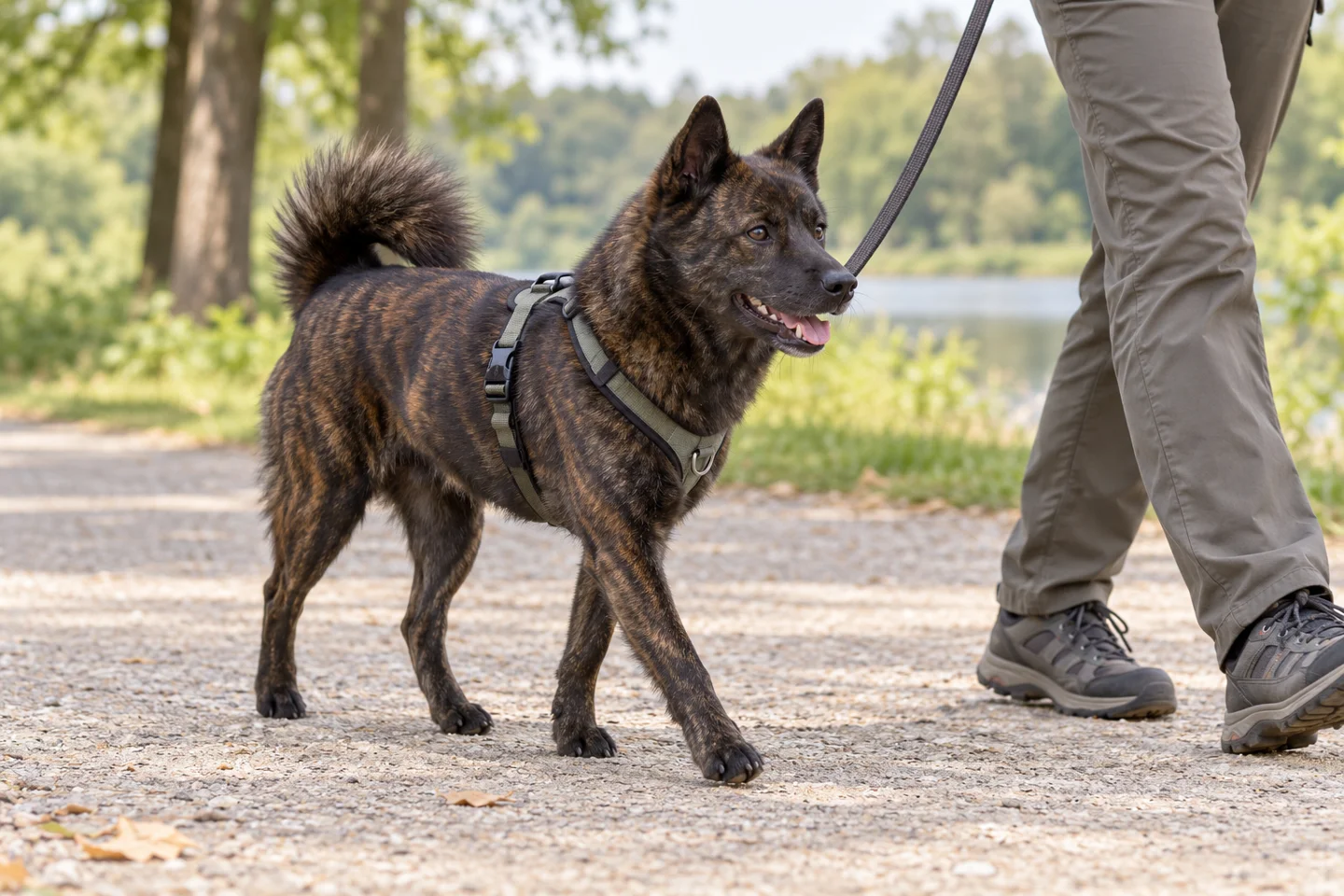
The FCI gives height references of 50 centimeters for males and 45 for females, with a stated tolerance in the standard. It describes black brindle, red brindle, and brindle, and notes that a puppy's initially solid-looking color may develop visible brindling as it grows. The outer coat is harsh and straight over a soft undercoat. Natural ears are upright and slightly inclined forward, with a thick tail curled or carried as a sickle over the back.
The illustrations select dark black brindle and retain a full natural tail. A puppy's markings may be less distinct, and an AI image cannot predict the final coat of a litter. Look beneath the visual pattern when meeting a real dog: comfortable movement, body condition, and practical equipment fit matter. Do not increase food to recreate an impressive adult silhouette. Standard dimensions give context for transport and space, while the actual animal needs assessment according to its stage of growth and condition.
Secure exploration starts before recall
A hunting background makes reliable containment worth discussing in detail. Inspect fences, gates, and the route through which visitors enter. Check gaps at ground level and places where furniture or stored objects create access over a boundary. Do not assume that a dog will remain nearby simply because it knows its owner. A familiar return cue is one skill within a broader system, and its reliability must be judged under the distractions in which it will be needed.
Use controlled equipment while learning about wildlife responses. Practice simple turns and checking in during quiet walks before expecting them near moving animals. A suitable enclosed area can permit exploration without making a busy road part of the lesson. Tell temporary carers exactly how handovers and exits work. The system should remain usable when the handler is tired or the animal is startled. Finding a secure alternative is more responsible than repeatedly testing the limits of a boundary and hoping attachment will compensate.
Training that builds cooperation
Begin with something useful and easy to recognize, such as looking toward you or moving a short distance to a target. Reward the response clearly and give the dog a manageable next step. Short lessons let you see whether the animal understands the task. If attention disappears, examine distraction and motivation before calling it stubborn. A Kai that is absorbed by scent outside may need a quieter starting point than the one that worked inside the kitchen.
Follow humane, reward-based methods as recommended by AVSAB. Avoid a trainer who presents pain or intimidation as a necessary response to independence. Ask how the desired action will be taught and how progress will be measured. Keep behavior goals specific: waiting while the lead is attached or turning away from a passing dog is easier to teach than a vague demand to behave. Record successful conditions so you can repeat them, then change one part of the situation gradually.
Exercise for body and attention
Offer the Kai appropriate walking and opportunities to investigate its surroundings, with activity matched to age and health. A mixed routine can include exploratory movement, a brief learning task, and rest. A single exhaustive outing is not the only way to meet an active dog's needs. Ask your veterinarian about growth, recovery from injury, or a proposed increase in sport. Pay attention to the next day's movement as well as enthusiasm at the start of a walk.
Keep a practical alternative for heat, bad footing, or household disruption. Short indoor searches or quiet handling practice may suit a day when the usual route is unavailable. In warm conditions, shorten activity and choose cooler surroundings. A double coat does not eliminate heat illness, and a dog continuing to follow an interesting trail may still need you to stop. Contact a veterinary service about serious distress. Treat a persistent change in stamina or willingness to move as information to investigate, not a failure of motivation.

Settling and the hours between walks
Before bringing a Kai home, decide how the quiet part of the day will work. Give it somewhere to rest without constant interruption and make access to the outside predictable. An animal that watches every window or follows every footstep may need help learning to disengage. Reduce avoidable triggers and reward calm choices. Ask the previous carer what has helped before, while remaining prepared for the dog to respond differently in unfamiliar surroundings.
Introduce absences at a level the animal can manage. A dog resting while you sit nearby has not necessarily learned to relax alone. Seek guidance if departure produces persistent distress. Avoid using another dog as an automatic solution; a second animal adds its own needs and may not change the cause. Arrange support during the transition so you do not have to leave the dog beyond its current ability immediately. A workable plan protects rest for the dog and keeps the household routine sustainable.
Socialization without forcing approach
A Kai puppy benefits from safe, manageable contact with the environments it will live in. Discuss vaccination and local disease risk with the veterinarian, then plan exposure accordingly. Let the puppy observe a person, noise, or surface from a distance where it can remain comfortable. Give it a way to retreat and end before it is overwhelmed. Holding it close to a frightening event does not become good social learning simply because it cannot move away.
For an adult, begin from known experience rather than the calendar. Ask about transport, household visitors, crowds, and handling. Introduce unfamiliar situations in small portions and record recovery afterward. A quiet encounter can be useful even when no greeting occurs. If avoidance, fear, or threatening behavior repeatedly prevents normal activity, seek qualified help. The desired outcome is a dog that can navigate ordinary life with appropriate support, not an animal required to accept every stranger's touch or every dog's approach.
Children and a predictable boundary around rest
Children should know where the dog can rest without being followed. Put the physical arrangement in place before the first busy visit and have an adult supervise interactions actively. Do not let children take food, pull equipment, or crawl into the bed. A dog walking away should be allowed to finish the interaction. Explain this as an ordinary household rule rather than waiting for the animal to growl before deciding it needs space.
Ask the source which ages and behaviors the dog has actually encountered. Experience with calm school-age children does not prove readiness for a toddler's sudden movements. Shared activities can involve the child preparing an easy search while an adult handles the dog, or quietly observing a short lesson. Stop when either participant becomes overexcited. If proper supervision is not possible, separate comfortably. A breed's medium size or affectionate relationship with familiar adults cannot supply a safety guarantee for a different situation.
Aggression and avoiding repeat confrontations
Write down the sequence when a Kai threatens or snaps: who approached, what was present, how close they were, and whether the dog could leave. Prevent repetition while seeking advice. A sudden change associated with touch or movement deserves a veterinary examination. Do not recreate the event to obtain a better recording or ask a visitor to prove the dog can cope. Clear information can usually be gathered without deliberately provoking another warning.
VCA notes that aggression toward dogs has different possible motivations. Maintain suitable distance until the pattern is assessed, and never remove a lead as an experiment with a lunging dog. At home, reduce competition and teach voluntary exchanges rather than repeatedly confiscating valued items. A qualified behavior professional can work with the veterinary team when risk or distress is significant. Give carers a factual account and an achievable plan. A reassuring adjective such as loyal does not explain what they should do when the animal becomes uncomfortable.
Other pets and responsible introductions
Ask about the Kai's response to small animals rather than assuming that living as a companion removes hunting interest. Protect cats with routes and resting places the dog cannot reach, and keep small pets in secure housing. An animal being still behind a barrier provides limited information about what will happen when it runs. Do not use a chase as an assessment tool or hold a pet in place for a forced investigation.
For another dog, compare energy, physical size, and preferred interaction. Start where handlers can move apart and maintain separate resources at home. Watch whether each can settle and leave without being pursued. A lively play partner may be too much for an older resident even when both appear friendly at first. Discuss the possibility of continuing management or an unsuitable pairing before placement. The household should choose an arrangement it can maintain rather than relying on the dogs to resolve conflict without help.
Grooming and the changing undercoat
Use regular gentle inspection to maintain access to the skin, particularly during shedding. Ask someone experienced with the coat to show suitable tools and how to work through small sections. Check behind the legs and beneath equipment where loose undercoat can collect. If a knot has tightened near the skin, obtain help rather than cutting blindly. A coat can look orderly on the surface while hiding irritation or packed hair beneath it.
Introduce bathing and drying calmly when needed, using products suited to the dog. Note itching, recurrent ear trouble, or altered hair growth and discuss them with the veterinarian. Avoid repeated food or shampoo changes without a reasoned plan, since that makes later interpretation harder. Foot and nail care also need teaching. A stable surface, a brief touch, and an easy reward can begin a cooperative routine. The purpose is comfortable maintenance that remains possible throughout life, including when a different person must provide care.
Health information across different programs
The Kai Ken Club of Great Britain recommends health screening while explaining that its local recognition and testing arrangements differ from those in more established populations. Its guidance includes orthopedic, cardiac, and eye assessments and relevant DNA testing. Ask which program a breeder follows and obtain the actual requirements and results. A list copied from another Japanese breed is not a reliable substitute. Read what was examined and what the finding means for the dogs involved.
The club discusses concerns including patellar luxation, allergies, and seizures, but a list of reports should not be turned into an invented prevalence estimate. Ask about diagnoses in relatives and how later information is collected. A DNA panel cannot rule out every cause of illness, and a healthy-looking adult demonstration cannot replace an assessment of current symptoms. If an adopted dog lacks family information, keep that gap explicit. Your veterinarian can still establish a useful preventive and diagnostic plan from the evidence available.
Feeding and signs that need a clinic
Review diet with the veterinary team, choosing a complete food for life stage and measuring what is offered. Include lesson rewards and other extras in the day's intake. Body condition and weight over time help judge whether the plan fits the individual. Do not assume every change in appetite is a harmless breed habit. Persistent loss of appetite, increased drinking, weight change, or repeated vomiting deserves advice with a clear record of timing and food consumed.
Keep an emergency contact and transport arrangement ready. Collapse, serious breathing difficulty, severe pain, suspected poisoning, or repeated unsuccessful attempts to vomit requires prompt clinical contact. Follow the receiving clinic's directions and provide relevant activity or exposure history. Avoid human medicines and another animal's prescription. Regular care should also include a mouth-care plan, appropriate parasite prevention, and discussion of handling needs before a painful procedure becomes urgent. A small amount of organization makes it easier to obtain help when the normal routine suddenly changes.
Mixes and the decision about a source
A brindled spitz-like dog is not automatically a Kai Ken. Ask what identity and ancestry documents exist and which parts of a description are guesses. A Kai cross can vary in coat, size, and response to other animals; a marketing name cannot guarantee the convenient traits of both parents. When parents are known, ask about relevant health and behavior information from each. When they are unknown, give greater weight to current examination and detailed observations of the adult.
Consider costs in your own area and the time needed for care. Obtain prices for suitable equipment, training support, veterinary prevention, and holiday arrangements. A source should explain what support is available after placement and what happens if the home proves unsuitable. Read written terms carefully. Avoid letting scarcity or an unusual coat pattern rush the decision. The right match depends on the routine you can sustain, including secure exploration and calm teaching, rather than the appeal of owning a dog few people recognize.
dogsDating walks with useful information
On dogsDating, state the Kai's actual experience with partners and the circumstances that help it stay comfortable. Mention pace, space, and any current restrictions. Keep home details and exact coordinates private, using an approximate area to agree on a public route. Pick a place with enough room to change direction. Confirm that each owner will handle their own dog and that neither expects a close greeting simply because they arranged the meeting.
Begin with parallel movement well apart. Let both dogs investigate the surroundings and respond to their handlers before reducing distance. Leave shared toys and close food games out of the first outing. End or create more space if either animal becomes rigid, repeatedly avoids the other, or cannot disengage. Afterwards, note something specific that can guide another plan, such as a quieter entrance or a more compatible pace. A familiar walking partner can be a successful outcome even when physical play never becomes part of the relationship.
Sources and editorial notes
Sources checked October 21, 2026. Breed measurements describe reference ranges, not a diagnosis or an individual dog's ideal weight. Images are AI-generated breed illustrations and do not document a particular dog or health condition.
- AVSAB: Humane Dog Training Position Statement
- VCA Animal Hospitals: Food aggression in puppies
- VCA Animal Hospitals: Common emergencies in dogs
- Orthopedic Foundation for Animals: CHIC health screening programs
- VCA Animal Hospitals: Aggression toward unfamiliar dogs, diagnosis
- VCA Animal Hospitals: Grooming and coat care for your dog
- AAHA: Feeding plans for healthy, appropriate weight cats and dogs
- VCA Animal Hospitals: Heat stroke in dogs
- AVSAB: Puppy Socialization Position Statement
- VCA Animal Hospitals: Dog behavior problems, aggression toward children
- FCI: Kai official breed standard
- Kai Ken Club of Great Britain: Health and screening guidance
Keep getting to know dogs.
Read another guide or return to your dogsDating community.
Explore breed guidesBack to dogsDating