Soft Coated Wheaten Terrier
A practical guide to the Wheaten's changing coat, enthusiastic greetings, PLN risk testing and everyday family care.
How these guides are researched and reviewed
- Origin
- Ireland
- FCI male height
- 46–48 cm; females somewhat smaller
- FCI male weight
- 18–20.5 kg; females somewhat lighter
- Coat
- Soft, silky, wheaten; changes through puppyhood
General information for owners. These articles have not been reviewed by a veterinarian. Medical decisions need your dog's history and an examination.
An Irish terrier with a coat that changes as it grows
The Soft Coated Wheaten Terrier is an Irish terrier with a soft, wheaten-coloured adult coat and a working farm-dog background. Its appearance can seem gentle and decorative, while everyday life still involves an active dog that needs training, occupation and clear routines. Before choosing one, consider how coat care will fit into the week and how an enthusiastic greeting will be managed. A household needs a plan that works during muddy weather and busy mornings, not only when there is time for a leisurely walk.
The FCI calls it the Irish Soft Coated Wheaten Terrier. That is the same breed discussed here, rather than an extra breed or a guarantee of one particular grooming style. Its account describes practical terrier work in Ireland. Historical work helps explain an interest in searching and movement, but it does not tell you exactly how a puppy will behave around your cat or visiting children. Ask about the actual family and meet adults when possible.
Adult size and the developing wheaten coat
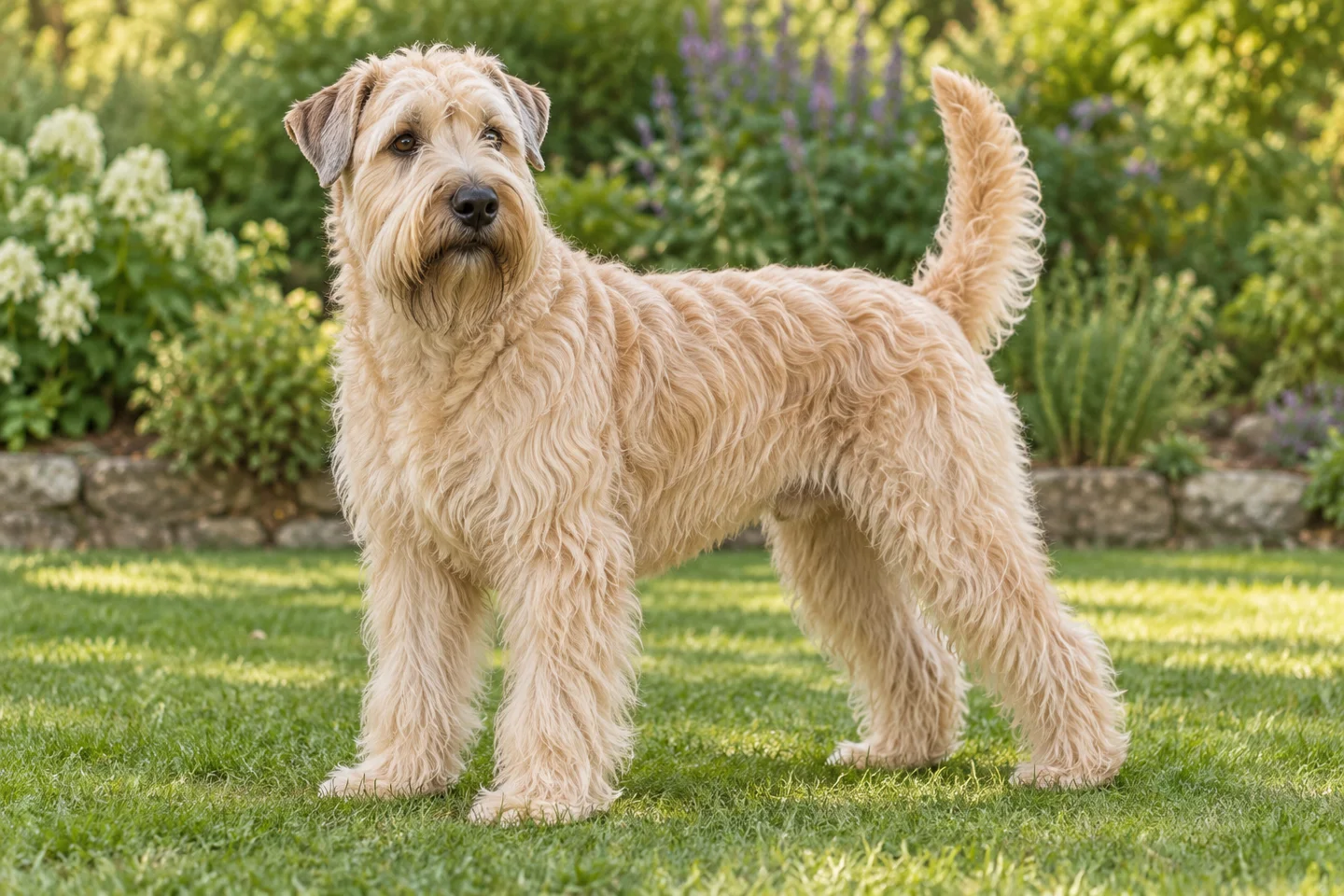
The FCI standard gives males a height of 46 to 48 centimetres and weight of 18 to 20.5 kilograms, with females described as somewhat smaller. It does not supply a separate exact female range in that text. A veterinarian should assess the individual dog's body condition rather than treating a standard measurement as an obligatory feeding target. A well-maintained coat can conceal changing weight, so feel the body as well as looking at its outline.
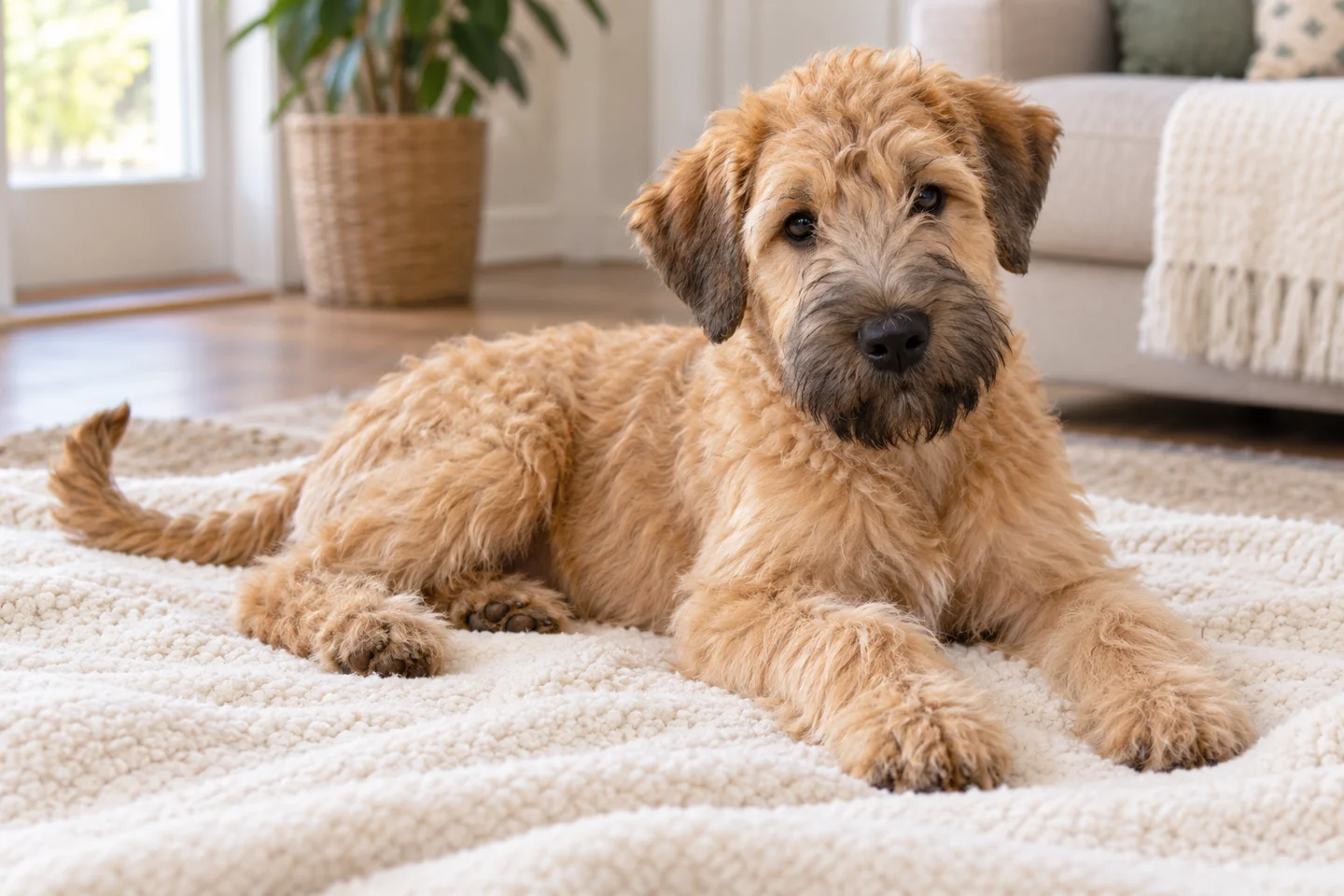
Puppy colour and texture can differ markedly from the adult coat. The standard describes reddish or greyish youngsters and darker markings that clear with development. The selected illustrations show a pale wheaten adult and a darker developing puppy, each labelled as an AI-generated illustration. They do not document a particular dog. The adult coat should be soft and silky, with waves or loose curls, rather than a deliberately fluffed imitation of a Poodle coat. Natural folded ears and a full tail complete the selected example.
Temperament and enthusiastic greetings
A Wheaten may approach company with considerable enthusiasm. Teach a useful arrival routine while it is small enough for mistakes to be easily managed. Place the dog behind a barrier before opening the door, reward standing or sitting with feet on the floor and invite contact only when the situation is comfortable. A visitor carrying a bag or walking aid should not need to absorb an excited leap while the owner explains that the dog is friendly.
The individual may be sociable in one setting and uncertain in another. Ask a breeder or rescue about handling, travel and the ability to settle after activity. A cheerful description is more useful when it includes the moments that require support. If the dog avoids attention, respect that choice instead of assuming a friendly breed must enjoy every approach. Predictable boundaries allow both sociable and cautious dogs to share a household without every visitor becoming a test of their temperament.
A home routine that includes rest and time apart
Give the dog a comfortable resting place away from the doorway and the busiest household route. After a walk or lesson, make room for quiet recovery rather than immediately offering another exciting game. Notice whether it actually sleeps or continues following every movement. A busy dog may need less stimulation in its resting space, a clearer routine or help with discomfort. Repeatedly increasing exercise is not the only response to difficulty settling.
Introduce short periods apart gradually. Begin with a manageable separation while the dog is comfortable and its needs have been met. If it becomes distressed, reduce the challenge and obtain suitable advice instead of leaving it to panic. Arrange backup company when work or travel exceeds what it can currently manage. Ask potential carers about coat maintenance, feeding arrangements and walking equipment before an absence becomes urgent. The household plan should continue to work when the usual person is unavailable.
Training useful alternatives to jumping and grabbing
Teach moving to a mat, following a hand target and returning to you in a quiet room. Use rewards that matter to the dog and finish before frustration builds. These small skills can help when a visitor arrives or a dropped object attracts attention. Practise around gradually increasing distractions rather than expecting a kitchen response to appear immediately on a busy pavement. Choose safe equipment and supervision while recall develops.
An exchange is especially useful when a curious terrier collects an unsuitable item. Practise with safe objects and a worthwhile reward, then prevent access to genuinely dangerous material. Chasing the dog through the house can turn retrieval into an exciting game or create a conflict over possession. If guarding is already occurring, stop rehearsing that situation and seek professional advice. Training should provide a practical way to end an activity, rather than a demand that the dog tolerate every hand reaching for its mouth.
Socialization and accepting coat care
Plan safe puppy experiences with the veterinary team's advice about infection protection. Give the youngster room to observe unfamiliar people, calm dogs and ordinary sounds without being pushed into contact. Watch whether it can look away, investigate and accept food. Freezing or repeatedly trying to leave means the situation needs to become easier. A single quiet experience can be enough for one outing; a crowded schedule of greetings does not automatically produce confidence.
Include grooming and clinical handling in that learning. Reward a brief touch near a foot, standing beside a brush and a comfortable moment on a stable surface. Introduce equipment before expecting prolonged contact. The coat will require attention throughout life, so a cooperative routine matters as much as walking manners. Ask a trainer and groomer to coordinate if handling is difficult. Holding the puppy through a long struggle may finish one appointment while making the next one harder.
Exercise that makes room for searching and recovery
Provide regular movement with opportunities to sniff, explore safely and learn. A varied walk can meet different needs from repetitive ball chasing. Use secure boundaries where recall is uncertain, and maintain control around wildlife, traffic and livestock. A terrier noticing movement may need practice turning back to its handler even when it normally stays close. Choose routes where you can create space instead of being trapped in a narrow stream of approaching dogs.
Activity must fit age, health and condition. Puppies need suitable movement and rest rather than forced adult-distance running. Build new exercise gradually and watch how the dog moves after resting. Carry water and choose cooler conditions when needed. If it repeatedly slows, becomes stiff or struggles to recover, arrange an assessment rather than interpreting enthusiasm as proof that everything is comfortable. A successful outing should leave the dog able to eat, sleep and move normally afterward.
Aggression, warnings and uncomfortable handling
A Wheaten can guard an object, react to another dog or bite when frightened or painful. Coat softness does not establish individual safety. Record the circumstances of a warning: what was being touched, who approached and whether the dog could leave. Create a safer arrangement while the cause is investigated. A sudden refusal of brushing near one area may point to discomfort, so a veterinary conversation belongs alongside any training discussion.
Do not punish growling while continuing the same unwanted handling. Suppressing a warning can make later incidents harder to anticipate without making the dog comfortable. Keep food and valued items protected from competition, and separate when necessary. A qualified behaviour professional can help with persistent guarding, fear or animal conflict. Give future carers a factual account of bites or close calls. If protective equipment is advised, learn its fit and gradual introduction while retaining the distance and barriers the dog still needs.
Children, other dogs and smaller pets
Adults need to supervise children with the dog and arrange separation when attention moves elsewhere. Excited jumping can knock a child over, while pulling coat or following the dog into its bed can create discomfort. Teach invitations to contact and respect for walking away. Children should not take chews or participate in restraining the dog for grooming. A familiar pleasant relationship is useful history, but it cannot supervise the next interaction.
Introduce other dogs with space and separate handlers. Parallel walking can show whether both animals can remain comfortable without demanding play. Remove shared food and toys from an initial meeting. Cats and small pets need protected areas and a gradual assessment; do not release them together to test the terrier's reaction. Comfort with a familiar animal at home cannot guarantee the same response to movement outdoors. Choose a household arrangement in which every animal can rest and move without being repeatedly followed or cornered.
Grooming through to the skin
Work through the coat gently in sections, checking the armpits, behind the ears and places rubbed by equipment. A tidy surface can hide a tangle beneath it. Ask a groomer to show how to brush and comb without pulling the skin. Schedule care around the individual coat and the dog's tolerance, rather than waiting until mats require a long uncomfortable session. Puppy coat changes can alter the amount and kind of work needed.
When a mat is tight against the skin, seek help instead of cutting blindly with scissors. Discuss a practical trim that preserves comfort, clear vision and hygiene. Keep the beard clean and dry appropriately after meals or water. Check nails, ears and teeth using short familiar routines. Persistent odour, redness, discharge or sudden sensitivity deserves clinical advice. Tell the groomer about skin findings and handling limits before the appointment. Retaining a particular outline is less important than avoiding pain and making future care manageable.
Health screening includes repeat blood and urine assessment
The American club's published breeding-stock protocol identifies hip assessment, eye certification, a PLN-associated variant test and biochemical monitoring that includes blood and urine work. It describes schedules and conditions for its members, and lists additional recommendations separately. Ask which current programme governs a proposed mating. A dog described as tested may have a permanent genetic result but still need a more recent clinical assessment under the relevant protocol.
The distinction matters for a buyer comparing paperwork. Ask whether hip imaging was preliminary or final, when the eye examination occurred and which blood and urine results informed the breeding discussion. Read reports linked to the actual parents. A vaccination booklet is useful for another purpose, while a large commercial panel cannot answer every clinical question. For a rescue without family records, start with the individual's examination and available history. Missing information should remain clear rather than being filled by a promise that the dog must be healthy.
PLN-associated variants describe risk, not a diagnosis
Protein-losing nephropathy concerns loss of protein through diseased kidneys. The SCWTCA Endowment's April 2026 explanation distinguishes the PLN-associated DNA result from current disease. Dogs with two copies of the associated variant package have higher relative risk, one copy carries intermediate risk and no copies carries lower risk. These categories do not mean that every high-risk dog becomes ill or that a low-risk dog can never develop a protein-losing kidney problem.
Keep the original laboratory wording and ask the veterinarian how it affects monitoring for this animal. Do not translate a result into a generic healthy, carrier or affected label without its specific interpretation. PennGen describes complex inheritance, rather than a simple guarantee that genotype determines clinical outcome. The genetic result can support breeding and monitoring decisions, while blood and urine assessment provides different information. A dog with signs or abnormal urine still needs an investigation of possible causes instead of a diagnosis made solely from its DNA report.
PLE, renal dysplasia and persistent symptoms
Protein-losing enteropathy concerns protein loss through the digestive tract. It is distinct from PLN, and the PLN-associated test should not be presented as a clearance for PLE. The British club also discusses renal dysplasia and Addison's disease among breed health concerns. Naming these conditions supports specific family questions, but it does not establish a current population frequency or diagnose the reason an individual has vomiting, diarrhoea or changing appetite.
Report persistent digestive trouble, increased drinking, weight change or unusual weakness to the veterinarian. Keep a clear food and medication history, including products added while trying to solve the problem. Repeatedly switching foods can make that history harder to interpret. Follow the patient's clinical plan if a condition is diagnosed, and make sure carers can find it. Collapse, serious breathing trouble or rapid deterioration needs urgent contact. Do not wait for a breeder group to decide which inherited condition seems most likely before seeking help.
Nutrition without an improvised kidney diet
Use a complete diet appropriate to life stage unless the treating veterinarian advises a different plan. Measure intake and include training rewards, dental products and food supplied by visitors. Ask the clinic to demonstrate body-condition checks beneath the coat. A breed association with kidney disease does not mean every healthy Wheaten should be placed on a restricted therapeutic diet. The right feeding decision depends on the individual's findings and nutritional needs.
If illness changes the diet, obtain written directions and clarify what treats or supplements are suitable. Do not copy another dog's renal or digestive plan simply because the breed is the same. Monitor appetite and weight as instructed, and ask when poor intake requires a call. Feeding separately from other pets can show how much this dog actually consumes. Keep fresh water available and avoid making unsupervised changes to a prescribed treatment while experimenting with food.
Wheaten mixes and grooming promises
Crosses sometimes advertised as Whoodles involve claimed Wheaten and Poodle ancestry. That name cannot guarantee one coat texture, adult size or personality. Ask what is documented about both parents and which medical assessments are relevant to them. Poodle ancestry does not remove the need to ask about Wheaten family health, and an attractive coat does not show the outcome of a genetic test. A cross can require substantial grooming even when a seller promises easy maintenance.
No dog can be promised suitable for every person with allergies. Where allergies affect the household, seek appropriate medical advice and consider the actual animal before committing when possible. For a rescue of uncertain ancestry, observed behaviour, care needs and clinical findings are often more useful than insisting on a precise label. Describe uncertainty honestly to carers and other owners. A practical placement should explain how the dog handles brushing, separation and animal contact, whether its parentage is documented or not.
Care costs and choosing a suitable placement
Budget for ongoing grooming, preventive care, appropriate food and an emergency reserve alongside the initial fee. Ask local clinics and groomers for current estimates rather than relying on a universal breed cost. Routine clinical monitoring may need a specific place in the budget after discussion with the veterinarian. Arrange transport and backup care before they become urgent, including someone who can follow the coat-care routine and recognise a change that needs a call.
Meet adult relatives where possible and ask about ordinary life beyond the first enthusiastic greeting. A responsible source should explain completed assessments, known family diagnoses and how later owner reports are handled. A rescue can offer observed behaviour while acknowledging gaps. Choose according to the household's available time and care arrangements now. Waiting while grooming skills or support are organised is a practical option if the current plan would repeatedly leave the dog uncomfortable or its needs unmet.
dogsDating meetings with manageable greetings
Describe your Wheaten's actual walking pace, play preferences and greeting habits on dogsDating. Share an approximate area and keep exact home coordinates private. Choose a quiet public starting point with room for both handlers to move apart. Agree on a route, timing and an easy way to leave. If excitement tends to build at a gate or greeting, begin farther apart and let the dogs investigate separately while the owners talk.
Use parallel movement before deciding whether contact is appropriate. Keep food, chews and vigorous retrieving out of the first introduction. Look for comfortable breaks and the ability to turn away rather than judging success by energetic activity alone. End when a dog repeatedly avoids contact, becomes stiff or cannot settle after excitement. A calm walk can be worthwhile even if the dogs never play. Note the conditions that helped so any later meeting begins with information about these individuals rather than assumptions about two breed names.
Sources and editorial notes
Sources checked October 22, 2026. Breed measurements describe reference ranges, not a diagnosis or an individual dog's ideal weight. Images are AI-generated breed illustrations and do not document a particular dog or health condition.
- AVSAB: Humane Dog Training Position Statement
- VCA Animal Hospitals: Food aggression in puppies
- VCA Animal Hospitals: Aggression toward unfamiliar dogs, diagnosis
- VCA Animal Hospitals: Grooming and coat care for your dog
- AAHA: Feeding plans for healthy, appropriate weight cats and dogs
- VCA Animal Hospitals: Heat stroke in dogs
- VCA Animal Hospitals: Common emergencies in dogs
- Orthopedic Foundation for Animals: CHIC health screening programs
- AVSAB: Puppy Socialization Position Statement
- VCA Animal Hospitals: Dog behavior problems, aggression toward children
- FCI Standard 40: Irish Soft Coated Wheaten Terrier, origin, adult size and coat development
- SCWTCA breeding-stock protocol: required assessments and separate recommended screening
- SCWTCA Endowment April 2026: PLN-associated variants and annual clinical monitoring
- PennGen: PLN-associated variant gene test and complex inheritance
- American Kennel Club: Soft Coated Wheaten Terrier care and health recommendations
- Soft-Coated Wheaten Terrier Club of Great Britain: conditions affecting the breed
Keep getting to know dogs.
Read another guide or return to your dogsDating community.
Explore breed guidesBack to dogsDating