Staffordshire Bull Terrier
A practical guide to Staffordshire Bull Terrier care, clinical screening, cooperative training and individual safety around people and animals.
How these guides are researched and reviewed
- Origin
- Great Britain
- FCI desirable height
- 35.5–40.5 cm
- FCI adult weight
- Males 12.7–17 kg; females 11–15.4 kg
- Coat
- Short, smooth and close
General information for owners. These articles have not been reviewed by a veterinarian. Medical decisions need your dog's history and an examination.
Staffordshire Bull Terrier identity
The Staffordshire Bull Terrier is a compact British terrier with a smooth coat, substantial strength for its height and an active daily life. It is a distinct breed from the American Staffordshire Terrier. Informal names and photographs can obscure that distinction, especially in advertisements for mixes. Ask what is documented when parentage matters. When adopting an individual with uncertain ancestry, its actual behaviour and veterinary history give you practical information that an assumed label cannot supply.
Breed descriptions often emphasise affection and courage. Those qualities should not become a promise that a particular dog will enjoy every person or animal it meets. A useful placement discussion covers ordinary situations: waiting at a doorway, surrendering a toy, being examined and encountering an unfamiliar dog on a narrow path. Ask for examples from the adult dogs involved, and choose according to the handling, supervision and activity your household can reliably provide.
A strong small dog with natural ears and tail
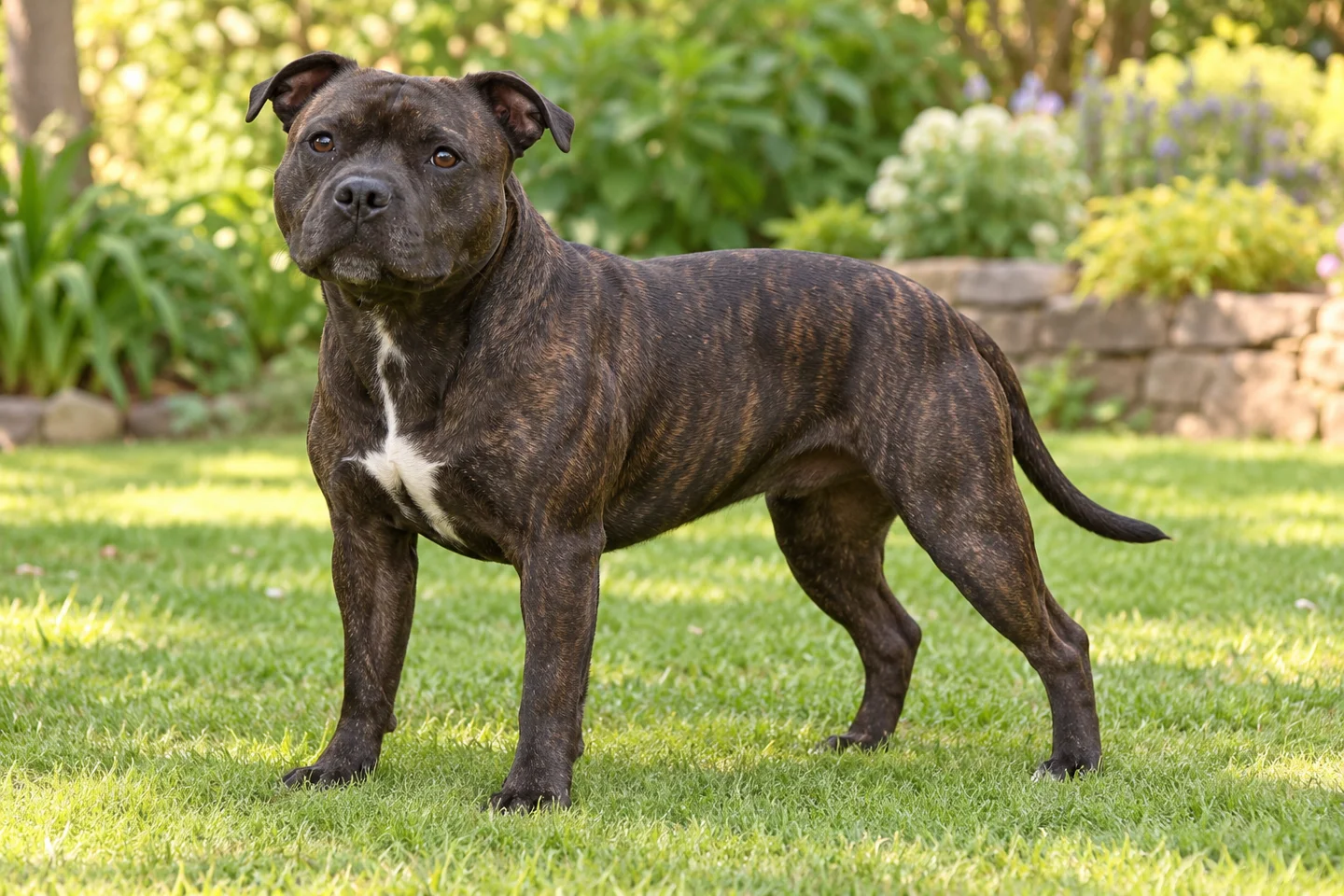
The FCI standard dated October 2026 gives desirable height as 35.5 to 40.5 centimetres, related to weight. It lists males at 12.7 to 17 kilograms and females at 11 to 15.4 kilograms. These describe the standard rather than an individual feeding target. A dog should remain able to move comfortably and maintain suitable body condition. Deliberately building an exaggerated heavy outline can make ordinary activity harder without improving companionship or function.
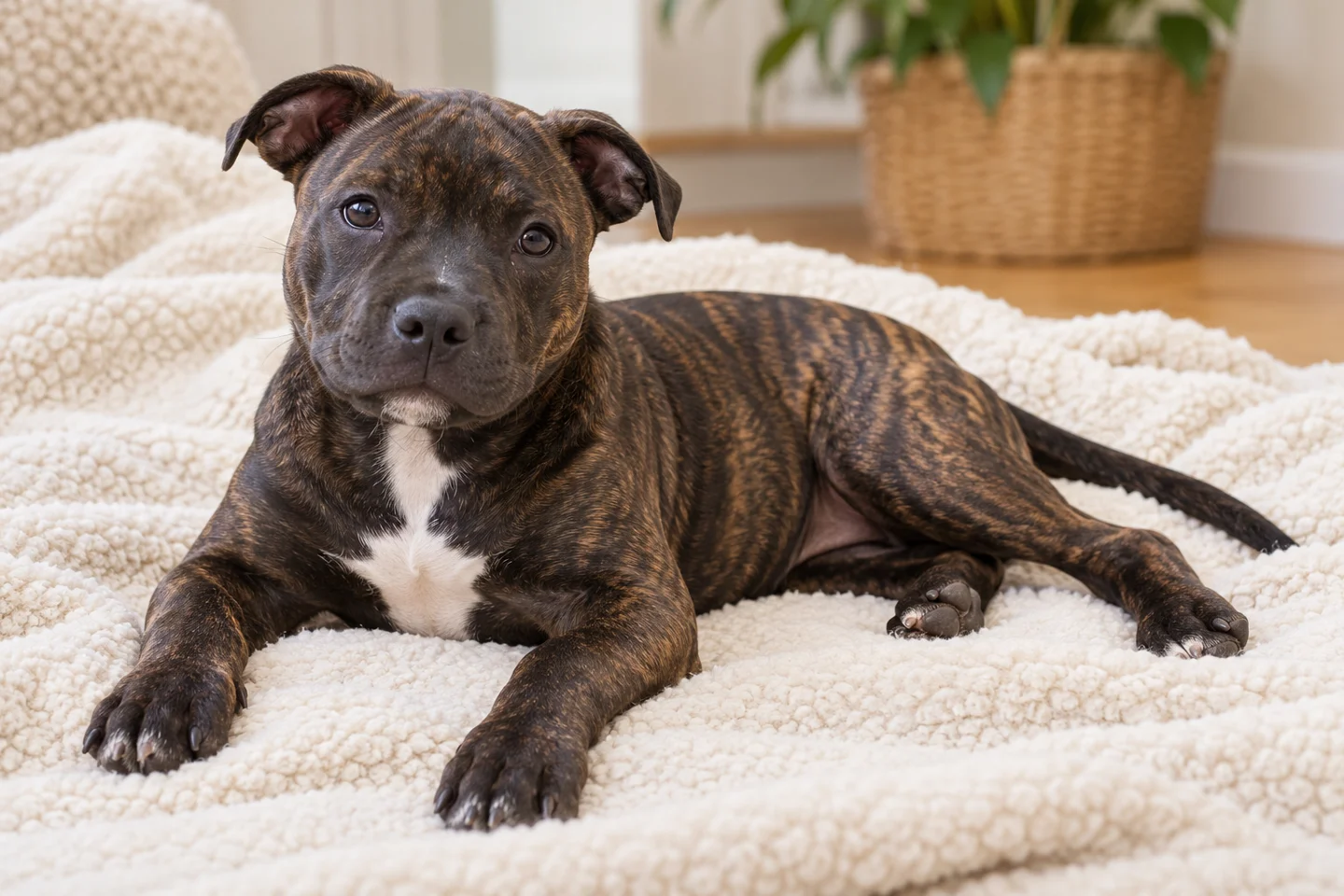
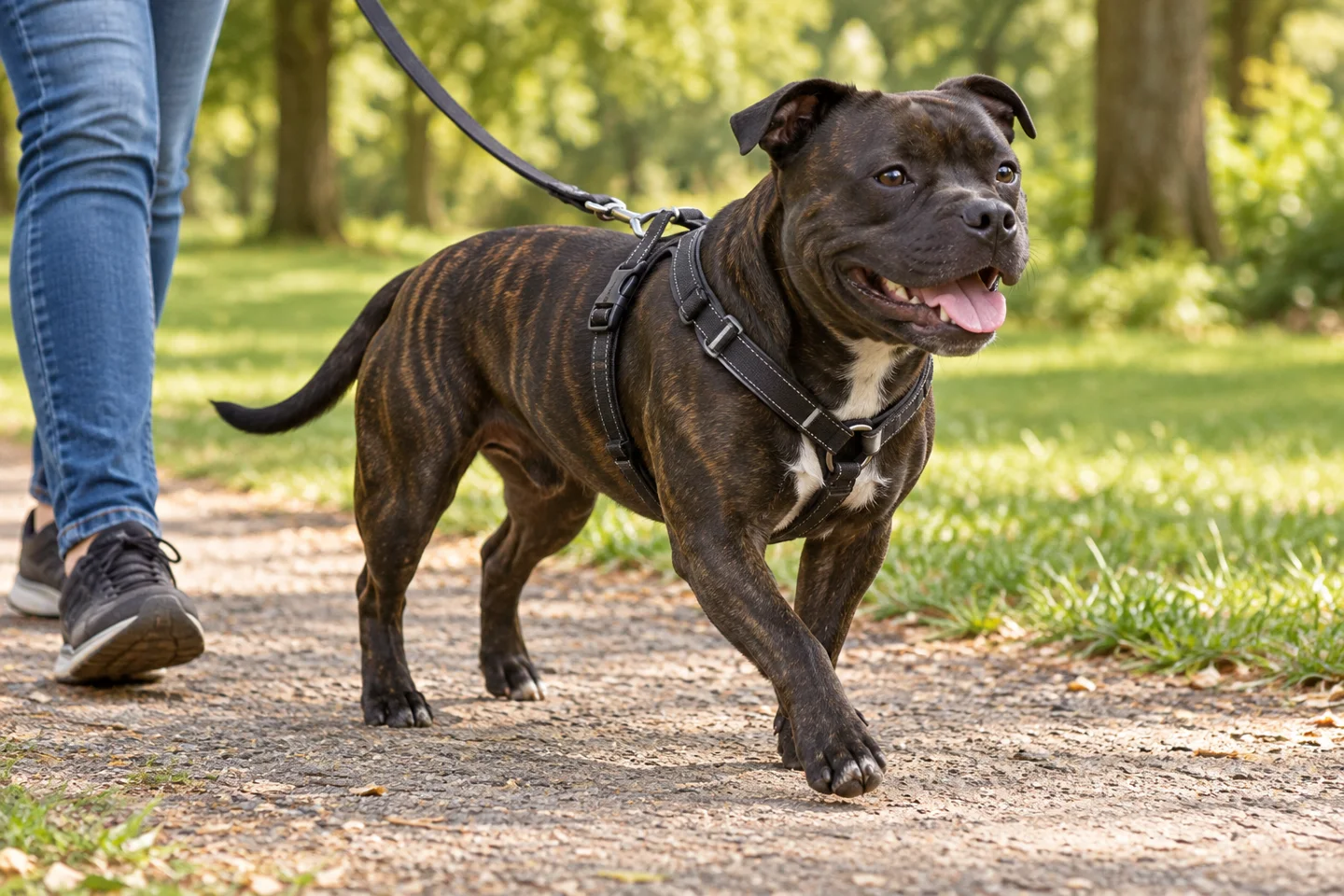
The selected example is black-brindle with a small white chest mark, natural rose ears and a complete tapering tail carried low. The illustrations show an adult, a developing puppy and a harness walk. Each is labelled AI-generated, so none should be treated as a photograph of a specific dog or proof of its health. The standard describes open nostrils and a definite muzzle proportion. Owners should take comfortable breathing and movement seriously when discussing appearance.
Daily expectations beyond a friendly greeting
An enthusiastic dog may need help learning that arrivals do not always lead to immediate physical contact. Practise waiting behind a gate while someone enters, then reward a calm approach when the visitor is ready. The person should be able to put down bags and stand securely before greeting. If the dog struggles to settle, increase space and reduce excitement rather than inviting several people to hold it in place.
Choose a sleeping place where family movement does not continually disturb the dog. Keep a clear routine for walks, meals and quiet time. A companion can enjoy closeness while also needing uninterrupted rest. Explain to everyone that moving away ends an interaction. Where work requires periods alone, introduce manageable absences gradually and arrange support if distress appears. Do not judge success only by silence; consider whether the dog actually rests and returns to normal activity comfortably afterward.
Using history without turning it into a prediction
The breed's bull-and-terrier background belongs in an accurate history, including its connection with historical blood sports. It does not justify encouraging confrontation, testing a dog against another animal or treating pain tolerance as something to demonstrate. Modern ownership depends on preventing harm and teaching cooperation. Select activities that allow the dog to search, learn and move safely without reproducing dangerous historical work.
Ask how a breeder or rescue evaluates the dog's present behaviour rather than relying on a dramatic account of ancestry. A young animal's response can also change as it develops and gains experience. Keep observing its tolerance of excitement, handling and unfamiliar animals. A household that is willing to adjust routes and introductions has more useful control than one that expects a historical label to explain every action. History provides context, while decisions today need evidence about this dog.
Training practical control and cooperative handling
Begin with a hand target, moving to a mat and returning from a short distance. Reward the specific response you want and practise in situations where the dog can succeed. Add distractions gradually. A loose-lead turn away from something interesting can be especially useful when another dog appears unexpectedly. Rehearse that movement on quiet walks before expecting it beside a busy gate.
Use games with clear beginnings, pauses and endings. Teach an exchange for a toy instead of routinely wrestling it from the mouth. Keep equipment suitable for the dog's size and inspect it for wear. Introduce a muzzle through small rewarded steps if it may be useful for care or management, obtaining guidance on fit. Painful corrections and intimidation can create further difficulty around a task that was already uncomfortable. A competent reward-based trainer should explain how to reduce the challenge and build a reliable response.
Socialization with room to watch and withdraw
Give a puppy safe experiences with people, ordinary sounds and appropriate dogs, following veterinary advice about infection risks. Choose a location with room to increase distance. A relaxed look at another dog can be a worthwhile lesson without any greeting. If the puppy becomes stiff, repeatedly tries to leave or cannot recover from excitement, make the situation easier. Socialization should produce manageable experiences rather than a large count of physical encounters.
Care routines need the same approach. Reward standing on a stable surface, accepting a brief paw touch and remaining comfortable near examination equipment. Let visitors know what the puppy already accepts instead of allowing surprise handling. For an adopted adult, ask what previous carers observed and introduce unfamiliar tasks gradually. A dog that enjoys meeting people outdoors may still find close restraint difficult. Address that particular task rather than assuming more general social contact will resolve it.
Exercise, play and recovery
Offer regular walks with time for scent and exploration, together with suitable short games and rest. Activity should reflect age, condition and comfort. Avoid using a fixed distance or an exhausting game as the only measure of a good day. A puppy's enthusiasm does not establish readiness for repeated high-impact work. Ask about safe preparation before starting a demanding sport, and increase unfamiliar exercise in manageable stages.
Observe breathing effort and recovery, especially in warm conditions. Choose cooler timing, carry water and leave an easy route home. A short muzzle does not make snorting, collapse or serious exercise intolerance an acceptable breed characteristic. Recurring difficulties deserve clinical assessment, while severe respiratory distress requires urgent contact. The dog may still want to play when stopping is appropriate. Owners need to make that decision using the whole picture, including movement, temperature and how the animal recovers after a pause.
Aggression and a factual safety plan
No breed description can guarantee that an individual will never bite. Record what occurred before a warning or incident, including handling, access to food and the presence of other animals. Prevent another exposure while seeking help. A dog that reacts when lifted or touched may need an assessment for pain, while repeated conflict around a valued object calls for management and suitable behavioural support. Those situations need their own explanation.
Do not provoke a reaction to demonstrate toughness or dismiss a warning as something the dog would never follow through. Punishing growling can remove information while leaving discomfort unchanged. Use barriers and distance that the household can maintain, and give carers an accurate account of contact and injury where relevant. A behaviour professional can help establish realistic goals. Improvement may involve learning easier responses while some restrictions remain. A sociable moment should not cancel the precautions needed for a documented difficult situation.
Children and the meaning of family suitability
Adults must supervise children with the dog. Affectionate descriptions of this breed do not turn it into a child supervisor or establish safety during every game. Keep running, wrestling and crowded arrivals separate when they make the dog overexcited. Children should leave sleeping areas, meals and chews alone. Teach them to invite contact and let the animal move away without being followed or held.
A strong compact dog can knock someone over during play without intending harm. Adults should manage leads, exchanges and unfamiliar introductions. Use a comfortable separate space whenever attention moves to cooking, another child or a visitor. Ask about the ages and situations the individual has actually experienced. A pleasant litter visit is not evidence about an unsupervised afternoon. Suitability includes the adults' ability to maintain a predictable arrangement, rather than relying on a flattering breed nickname.
Other dogs and animals in a shared home
A dog may live comfortably with a familiar companion while needing space from unfamiliar animals. Begin introductions with separate handlers and sufficient distance for both dogs to disengage. Watch whether each can look away and investigate the environment. Repeated staring, pulling toward the other animal or attempts to retreat are reasons to create more space. Do not use a busy off-leash group as the first assessment of compatibility.
Keep food and valuable objects separate while household relationships develop. Cats and smaller pets require protected areas and a cautious plan that does not depend on calling the dog away after pursuit begins. A history of comfort with one animal applies to that relationship, not every future encounter. Some dogs are better suited to shared walks than physical play. Owners can still enjoy company while respecting the animals' limits and maintaining separate rest, feeding or access where necessary.
Health screening: eyes, joints and named genetic tests
The current AKC national-club recommendations include ophthalmologist evaluation, hip and elbow assessment, hereditary cataract DNA testing and L-2-HGA testing. The page repeats cataract wording in its list, which should not be interpreted as proof that two unrelated cataract tests are always required. Ask the breeder which current protocol applies and obtain the named reports for both parents. A brief statement that everything is clear does not explain what was actually examined.
Check identity, result and date before drawing a conclusion. A clinical eye assessment can identify concerns that a particular DNA result does not cover. Likewise, looking athletic during a visit cannot replace joint assessment. Ask about family diagnoses and later owner updates in addition to formal screening. A completed programme reduces uncertainty in specified areas; it cannot certify that every puppy will remain healthy. For an adult without parental records, current examination and available medical history give the veterinarian a practical starting point.
L-2-HGA results and clinical symptoms
L-2-hydroxyglutaric aciduria is a metabolic disorder for which a breed-relevant DNA test is available. The Royal Kennel Club lists autosomal recessive inheritance for the Staffordshire Bull Terrier scheme. Ask for the actual laboratory interpretation when a seller describes clear, carrier or affected status. A carrier category has a different meaning from having clinical disease, and a result concerns the specific disorder tested rather than every possible neurological problem.
Unusual movement, seizures or changes in responsiveness require veterinary assessment even when ancestry paperwork appears reassuring. Keep the environment safe during an episode and contact the clinic for instructions. Do not place hands into the mouth or try another animal's medication. A safely obtained video and a record of duration may help, but recording should not delay urgent care. The clinician needs the current signs and exact reports, rather than a diagnosis chosen because an inherited condition appears in a breed article.
Cataracts, eye examinations and breathing assessment
A DNA result for the known hereditary cataract variant cannot exclude every cause of cataract or eye discomfort. The AKC discussion also identifies clinical eye concerns such as persistent hyperplastic primary vitreous. Preserve the distinction between a variant result and an ophthalmologist's examination. A painful-looking eye, repeated squinting or sudden change in sight deserves prompt advice regardless of previous screening. Leftover drops from another problem may be unsuitable.
The 2026 study by Tomlinson and colleagues included Staffordshire Bull Terriers when assessing brachycephalic obstructive airway syndrome across fourteen breeds. That research supports taking respiratory concerns seriously beyond the most familiar short-muzzled breeds. Its sampled results do not diagnose an individual dog. Tell the veterinary team about noisy breathing, unusual recovery, heat intolerance and previous anesthesia problems. Ask what clinical assessment is appropriate rather than assuming either a breed reputation for fitness or a short nose provides the answer.
Grooming and checking a short coat
Gentle regular brushing can remove loose hair and provide a chance to inspect skin and equipment contact points. Look at the feet after appropriate outdoor activity and maintain nails at a comfortable length. Teach these checks when the dog is well, using rewards for brief cooperation. An injury should not be the first occasion on which someone attempts to hold its paw. Stop and obtain help when a task becomes painful or unsafe.
Ask the veterinary team about persistent scratching, redness, discharge or recurrent ear problems. Do not treat every irritation with the same product or use deep tools in the ears. Tooth brushing requires a separate familiar routine and appropriate materials. Tell a groomer about sensitive areas and any previous difficulty with handling. Short hair can make some changes easier to notice, but a clean coat is not a clinical clearance. New sensitivity around one area needs investigation rather than a contest over obedience.
Nutrition and avoiding an exaggerated build
Measure a complete life-stage diet and review condition with the veterinarian. Include food used in training and snacks offered by other household members. Muscle, frame and fat are different parts of body assessment, so a number from the breed standard cannot tell you what this dog should eat. A growing animal does not need to become as heavy as possible as quickly as possible.
Keep water accessible and meals undisturbed. If appetite, thirst or weight changes persistently, bring the pattern to the clinic instead of immediately changing to a richer product. Discuss supplements and homemade recipes before relying on them. A heavily marketed product for muscular dogs does not demonstrate that it fits the individual. Where illness requires a prescribed ration or medication, obtain clear instructions and ensure temporary carers follow the same plan. Avoid improvised adjustments based on another owner's experience.
Mixes, names and uncertain parentage
A Staffordshire Bull Terrier mix can vary in adult size, coat, behaviour and health. A photograph cannot establish the exact parents, and informal bull-breed labels are often used inconsistently. Ask what is documented, what is reported and what remains uncertain. For a deliberately bred cross, medical questions relevant to both parents deserve attention. Mixing does not guarantee freedom from inherited conditions or a predictable average of two temperaments.
For rescue dogs, focus on evidence from the animal's present life. How does it cope with a lead change, rest around another pet or respond to necessary touch? What treatment and management are already in place? Those answers help planning even when ancestry remains unknown. Describe the dog accurately when arranging care or social meetings, including incidents and restrictions. A more appealing label cannot make an unsuitable pairing safer, while honest uncertainty allows decisions to rest on the information that is actually available.
Choosing a placement and planning for ongoing care
Budget for suitable equipment, training support, preventive care, food and unexpected veterinary treatment. Ask local providers for current estimates and discuss any known condition before choosing insurance or setting an emergency reserve. A backup carer needs to understand the individual's animal preferences and handling routine. Arrange an introduction before travel becomes urgent, and check that the person can follow separation and walking plans reliably.
When meeting a breeder or rescue, ask for concrete evidence about ordinary routines alongside medical records. Observe without provoking the dog or asking it to tolerate an unnecessary demonstration. Find out how problems after placement will be supported and how important family information will be shared. Choose for the home you can provide now. If supervision, boundaries or backup care cannot be arranged, resolve those practical limits before arrival rather than expecting affection alone to make every situation manageable.
dogsDating meetings with clear individual information
Use dogsDating to describe what this Stafford enjoys, the space it needs and whether it prefers walking to physical play. Keep exact home coordinates private and share an approximate area. Choose a quiet public route with enough width for separate movement. Tell the other owner about restrictions before meeting. Neither handler should need to discover a known difficulty while passing through a narrow entrance together.
Begin with parallel walking at a comfortable distance and avoid shared toys or food. Observe both animals rather than relying on the owners' hopes for a match. If one becomes tense, repeatedly avoids the other or cannot disengage, end the encounter calmly. A relaxed walk can still let people meet in real life without requiring their dogs to wrestle or greet closely. Use what you learned about timing, route and distance to decide whether another outing in similar conditions would be worthwhile.
Sources and editorial notes
Sources checked October 22, 2026. Breed measurements describe reference ranges, not a diagnosis or an individual dog's ideal weight. Images are AI-generated breed illustrations and do not document a particular dog or health condition.
- AVSAB: Humane Dog Training Position Statement
- VCA Animal Hospitals: Food aggression in puppies
- VCA Animal Hospitals: Aggression toward unfamiliar dogs, diagnosis
- VCA Animal Hospitals: Grooming and coat care for your dog
- VCA Animal Hospitals: Ear infections in dogs (otitis externa)
- AAHA: Feeding plans for healthy, appropriate weight cats and dogs
- VCA Animal Hospitals: Heat stroke in dogs
- VCA Animal Hospitals: Common emergencies in dogs
- Orthopedic Foundation for Animals: CHIC health screening programs
- AVSAB: Puppy Socialization Position Statement
- VCA Animal Hospitals: Dog behavior problems, aggression toward children
- FCI Standard 76, October 2026: Staffordshire Bull Terrier structure and measurements
- American Kennel Club: Staffordshire Bull Terrier identity, health and care
- The Royal Kennel Club: DNA tests, autosomal recessive inheritance and relevant breed schemes
- Tomlinson and colleagues, PLOS One 2026: BOAS assessment across fourteen brachycephalic breeds
Keep getting to know dogs.
Read another guide or return to your dogsDating community.
Explore breed guidesBack to dogsDating