Australian Kelpie
An agile Australian sheepdog whose care needs purposeful activity, learned rest, training around movement, and careful interpretation of ataxia tests.
How these guides are researched and reviewed
- Background
- Australian sheep-working dog
- Coat
- Short double coat; several colors
- Care priorities
- Cooperation, rest, stock safety, and health records
General information for owners. These articles have not been reviewed by a veterinarian. Medical decisions need your dog's history and an examination.
A Kelpie needs a workable weekday
An Australian Kelpie needs purposeful activity and teaching that make sense in the home it actually lives in. A long walk alone will not necessarily address chasing, restless anticipation, or difficulty coping when work stops. Before adopting, decide how the dog will exercise, learn, rest, and spend time without constant instruction. A farm background can explain some tendencies, but it cannot replace a daily plan for the particular puppy or adult you bring home.
Ask owners and breeders what their dogs do on quiet days. Find out whether they sleep indoors, tolerate short absences, and recover after excitement. A dog that performs impressively around sheep may need substantial help learning companion life. Conversely, an adult already living comfortably in a home may provide clearer evidence of suitability than a puppy chosen mainly for working ancestry. Match the individual to your environment and capacity rather than buying an imagined future sporting partner.
Australian origins and different breeding priorities
The Kelpie developed in Australia from imported sheep-working dogs and subsequent selection for local stock work. The Working Kelpie Council maintains records and breeding priorities centered on working Kelpies. Dogs bred within conformation-focused programs may have different selection histories. Those differences deserve questions about the actual parents and offspring rather than a blanket claim that one label predicts easy household behavior. Ask which registry holds the pedigree, what work the family does, and how puppies are raised.
Australian Kelpie and Australian Working Kelpie can be used within different organizational contexts. Clarify the seller's meaning before comparing records or expectations. Avoid treating every black-and-tan farm dog as a confirmed Kelpie or repeating a precise early ancestry story without documentation. The practical link to sheep work is well established, while an individual dog's temperament and health still need their own evidence. Registration records identify a breeding context; they do not show how comfortably a dog will handle your street or living room.
Athletic proportions and everyday movement
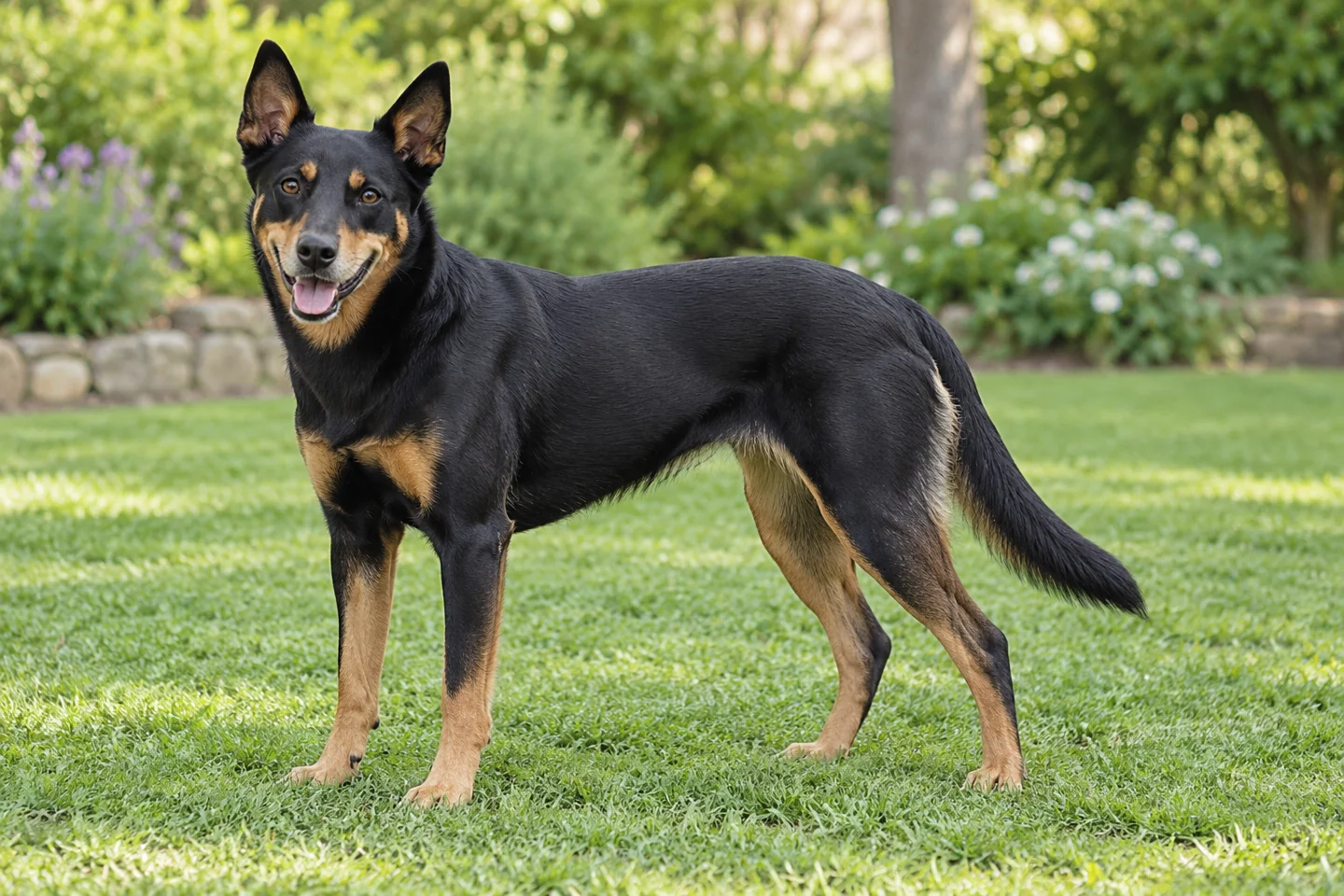
A Kelpie generally has a lean, agile outline, erect ears, and a short double coat. Colors vary, including black and tan and red-based coats. The illustrations show one black-and-tan example with a natural long tail. They cannot establish pedigree, working merit, or a universal body shape. Watch an actual dog walk, turn, and rise. An owner should be able to discuss persistent stiffness or an uneven gait rather than dismissing it because the dog still wants to run.
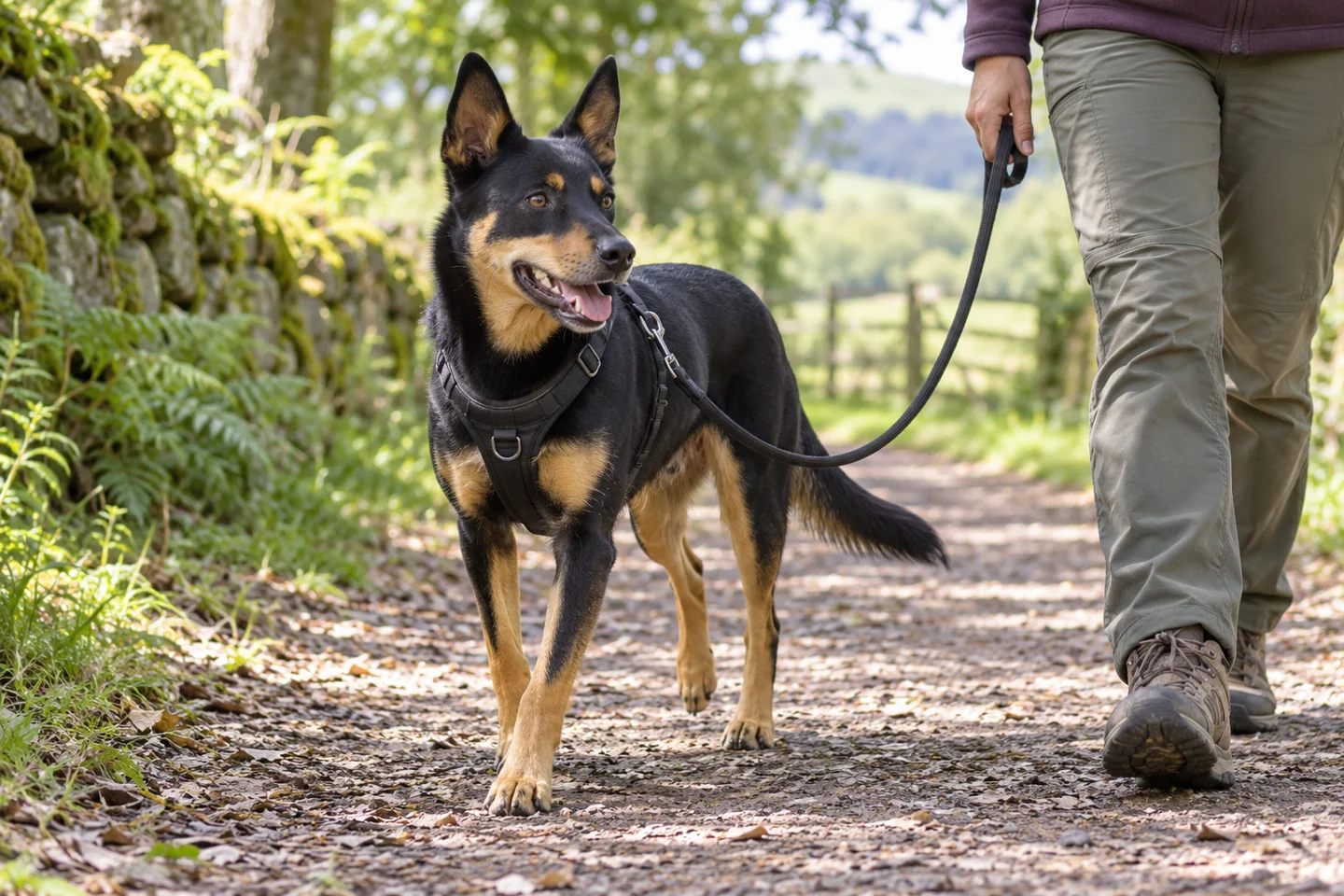
Choose equipment that allows comfortable shoulder movement and remains secure when the dog backs away. A growing puppy needs regular fitting checks. Inspect clips, stitching, and identification before countryside outings. Vehicle travel also needs a secure arrangement that prevents the dog jumping into traffic when a door opens. Teach waiting and calm loading separately from an exciting destination. Practical handling is easier to establish in short everyday rehearsals than during a first long journey to an unfamiliar class.
Sheep work and what instincts do not teach
A Kelpie may show interest in controlling movement, but livestock training requires skill, suitable stock, and controlled facilities. A novice owner should work with an experienced instructor who can assess both dog and animals. Do not put an untrained youngster into a pen and assume instinct will produce safe work. Chasing, gripping, or excessive pressure can injure stock and expose the dog to kicks or collisions. The owner's ability to interrupt and separate remains essential.
For a companion home, substitute outlets should be chosen for safety and enjoyment rather than an attempt to recreate a farm job indoors. Learning to find objects, follow scent, or perform cooperative tasks can be absorbing without involving another animal. Avoid encouraging the dog to circle children or chase household pets as entertainment. The same behavior can become harder to manage when the target runs faster or the owner wants the game to stop.
Training attention before adding speed
Begin with skills that create communication: responding to a name, a hand target, a short recall, and a comfortable turn away. Reward promptly in easy conditions, then increase distraction gradually. A Kelpie may learn sequences quickly, including ones the owner did not intend. If barking reliably starts a ball game, barking may become part of the routine. Review what access and attention follow the behavior instead of assuming the dog understands a verbal explanation issued afterward.
Teach precision without making every session a test of endurance. Clear reward placement, short repetitions, and breaks can improve learning while protecting patience. If the dog becomes frantic around a toy, lower the intensity and rebuild calmer starts and finishes. Reward-based coaching can help the handler choose an appropriate difficulty. A dog that cannot eat, disengage, or respond near a distraction needs a change in setup, not stronger commands delivered from the same impossible position.
Rest is a skill worth practicing
A capable working dog still needs sleep and recovery. Create a comfortable place away from constant household movement and introduce settled periods while you remain nearby. Reward relaxed behavior without repeatedly exciting the dog to deliver a treat. Use a predictable end to activity so the dog can learn that toys sometimes remain put away. An endless cycle of requests and games may teach constant anticipation, even when the owner believes every request is enrichment.
Watch whether the dog genuinely relaxes. Lying down while tracking every hand movement can be different from sleeping. Consider noise, window access, and the timing of stimulating play when settling is difficult. Persistent pacing or inability to rest deserves veterinary and behavioral assessment. Exercise can be one part of the plan, but adding distance indefinitely may build more fitness without resolving anxiety or arousal. A sustainable routine needs to work when the owner is tired, busy, or recovering from illness.
Children, running, and safe boundaries
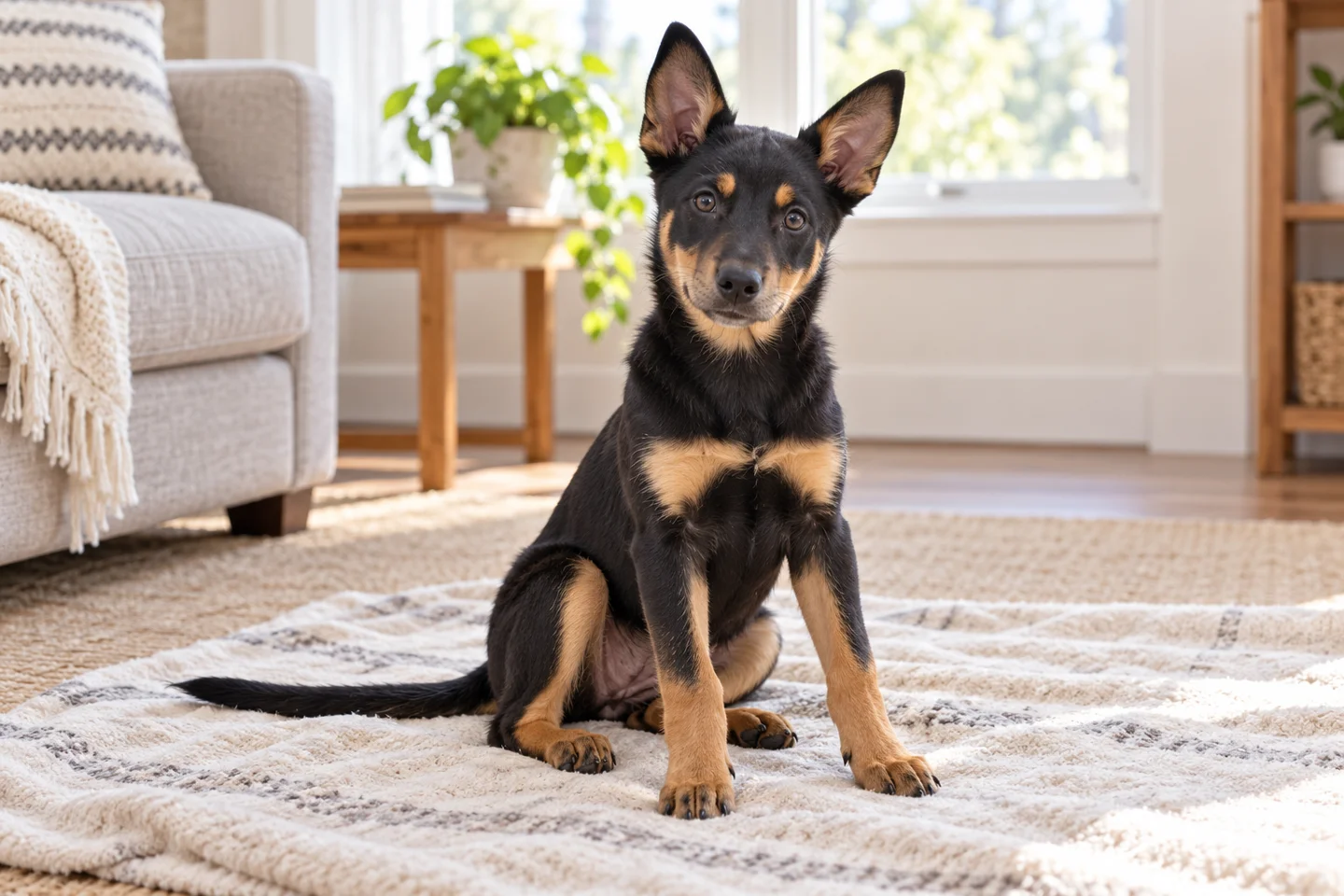
Running children can attract a movement-focused dog. Prevent chasing and clothing grabs with supervision and physical separation before games start. Teach an alternative at a manageable difficulty, and stop access if the dog repeatedly pursues. Calling the behavior herding does not make it comfortable for a child or remove the risk of injury. Adults should manage the situation rather than telling children to outrun, correct, or physically restrain an excited Kelpie.
Quiet interactions also need boundaries. Children should leave meals, chews, and sleeping places alone, invite contact calmly, and allow the dog to walk away. Avoid hugging or leaning over its face. Visiting children may be less predictable, so explain the rules and separate when adult attention is divided. A dog that has behaved well in one family routine still needs assessment when a new baby, new friends, or different games change the household environment.
Other dogs and animals that move quickly
A Kelpie's social preferences vary. Some enjoy selected companions while others become controlling or overwhelmed in fast group play. Begin unfamiliar dog meetings with parallel walking and space to disengage. At home, separate resources and provide independent resting areas. Watch whether play pauses naturally and whether both dogs willingly return. Repeated circling, blocking, or pursuit needs interruption when the recipient is trying to leave, even if the more active dog appears enthusiastic.
Cats and small animals need secure protection and gradual assessment. Familiarity with sheep cannot establish safety around a household rabbit or a cat running across the garden. Use barriers and dog-free escape routes, and avoid leaving animals together until a suitable assessment supports the arrangement. Persistent fixation or chasing calls for professional help. When access cannot be managed reliably, acknowledge the mismatch rather than relying on the dog's trainability to guarantee that a future interruption will always work.
Aggression, fear, and frustration
Threatening behavior should be assessed in context. Stiffness, freezing, growling, snapping, or attempts to escape can indicate fear, pain, resource concern, or excessive pressure. Create distance and remove the immediate demand. Do not provoke another reaction to test whether the dog means it. Breed reputation for intelligence or responsiveness cannot establish safety, and an explanation involving frustration still requires a plan that protects people and animals from injury.
Arrange veterinary examination when behavior changes or handling becomes difficult. Keep a record of triggers, distances, and recovery, then consult a veterinary behaviorist or appropriately qualified reward-based professional for recurring problems. Avoid corrections that suppress warnings without changing the underlying concern. A basket muzzle introduced with rewards may be useful in a broader plan. Barriers and carefully selected routes reduce rehearsal while treatment and training proceed, and everyone handling the dog needs to understand the same practical arrangements.
Exercise and physical conditioning
Build adult exercise around varied movement rather than repeated maximum-speed effort. Walks with sniffing, appropriate hiking, controlled games, and training can fit together. Increase duration and difficulty gradually, especially before sports or stock work after a quiet period. Puppies need suitable activity and sleep, with demanding exercise discussed with their veterinarian. An eager dog may continue despite fatigue, so the handler needs to watch gait, attention, and recovery instead of waiting for refusal.
Persistent lameness, reluctance to jump, or an altered stride needs assessment. Choose terrain that fits conditioning and inspect paws after unfamiliar ground. In heat, shorten activity, use cooler hours, and provide water and shade. Working background does not prevent heat illness. Severe breathing difficulty or collapse requires urgent veterinary advice. A plan for days with limited exercise should include manageable walks and quiet tasks, without replacing outdoor time with frantic indoor chasing that creates additional handling problems.
Cerebellar abiotrophy and interpreting tests
The Working Kelpie Council discusses inherited cerebellar abiotrophies, often called Kelpie ataxias, and recommends screening breeding animals for relevant known markers. Its current guidance describes available testing while acknowledging remaining unknowns. Some older research pages describe a period before tests were developed, so check the date and laboratory explanation. Ask which variants or markers a report covers and how the result applies to the proposed mating. Do not assume that every report labeled ataxia tests the same condition.
Changes in coordination, tremors, unusual stepping, or difficulty managing ordinary movement need veterinary investigation. Those signs cannot be diagnosed from a breed guide or short video alone. A clear result for known markers does not exclude every cause of neurological illness, and a carrier result needs interpretation for the specific inherited condition. Share records with the veterinarian and discuss family history. Avoid breeding decisions based solely on a summary label without understanding the test's scope and the other parent's results.
Health records beyond a DNA panel
Ask for the actual health program followed by the breeder, including available joint and eye assessments, family illness, and identifiable reports. Do not invent a universal Kelpie screening checklist where organizations use different approaches. A dog working comfortably today can still carry an inherited variant or develop illness later. Conversely, a report needs its exact result read rather than a buyer assuming the mere existence of testing establishes a problem.
A routine puppy visit, formal imaging, specialist eye examination, and DNA panel answer different questions. Bring all available documents to your veterinarian and agree preventive care suited to local risks. Watch for persistent changes in movement, appetite, thirst, skin, or behavior. For an adopted adult with missing records, note the gaps and make a plan from current findings. A practical examination and continued observation are more useful than reassurance that a working dog must be healthy because it remains enthusiastic.
Grooming, feet, and handling
The short double coat needs brushing and regular skin inspection, with more attention during shedding. Look under equipment and check feet after rough terrain. Remove loose surface debris carefully and seek veterinary help for painful swelling, embedded material, or wounds. A simple-looking coat does not mean the dog needs no grooming routine. Introduce brief care sessions while the dog is comfortable so necessary inspection does not always predict restraint or an unpleasant surprise.
Teach tooth brushing, nail care, ear checks, and standing still in small rewarded stages. Let the dog participate where possible and stop to assess new discomfort. Persistent ear odor, discharge, or head shaking needs veterinary advice rather than improvised cleaning or reused medication. Tell professionals about handling concerns before an appointment. Cooperative care becomes particularly useful when an injury requires examination of an area the dog would normally prefer to move away from.
Feeding through work and rest periods
Use a complete diet suited to life stage and health, then adjust the amount according to body condition and actual activity. A companion's needs may differ substantially from those of a dog doing sustained farm work. Measure portions and account for training rewards. Ask the veterinarian to demonstrate how to assess ribs, waist, and muscle condition. Do not assume that a lean-looking working breed should remain underweight or that constant hunger automatically means more food is needed.
Feed away from children and other animals and keep high-value chews out of early dog introductions. Teach a comfortable exchange rather than repeatedly removing meals to test tolerance. Avoid supplements without a veterinary reason, and obtain qualified nutritional advice for home-prepared diets. Persistent digestive changes or unexplained weight loss deserve assessment. During injury or reduced activity, review intake promptly so a previous work allowance does not continue unchanged while the dog spends more time resting.
Kelpie mixes and choosing a source
A Kelpie cross can vary in coat, size, endurance, and response to movement. Names such as Kelpie and Border Collie mix describe proposed ancestry rather than one standardized outcome. Ask what is documented and what was inferred from appearance. A DNA ancestry report can add context while leaving individual behavior and many health questions unresolved. Mixed ancestry does not guarantee fewer care needs or eliminate inherited concerns relevant to either parent population.
For a puppy, ask how the litter experiences household sounds, handling, and rest, and what support remains after placement. For an adult, request observations about absences, visitors, transport, cats, and other dogs. An honest foster description can be more useful than a broad claim that the dog needs a job. Clarify what that phrase means in daily practice. A suitable source should be willing to discuss limitations and help the household decide when a particular dog would be a poor fit.
Costs, travel, and later-life planning
Budget for appropriate training, secure equipment, veterinary care, food, and backup care. A sporting or working plan can add transport and instruction costs, while behavior support may matter more than specialized gear. Arrange a carer who can follow the dog's walking and settling routine, then practice a short visit before a longer absence. Written instructions should include medication, resource management, gates, and veterinary contacts. A capable dog still benefits from predictable arrangements when the owner is unavailable.
As the dog ages, review footing, vehicle access, and recovery after activity. A dog may continue offering work despite pain, so adjust duties with veterinary guidance. Know where emergency care is available for collapse, serious injury, severe breathing difficulty, or rapidly worsening illness. Keep transport equipment ready and identification current. Older Kelpies can continue enjoying suitable searches and learning when the physical demands are reduced, allowing the owner to retain familiar interests without insisting on previous speed or distance.
A Kelpie-friendly dogsDating walk
Describe the individual dog's experience, activity level, and tendency to control movement in its dogsDating profile. Keep exact home coordinates private. Choose a quiet public route with visibility and room for parallel walking. Separate adult handlers should begin at a distance where both dogs can investigate and respond to familiar cues. Avoid starting beside a busy entrance or allowing an immediate fast chase game simply because both dogs appear energetic.
Watch whether each dog can disengage and recover after excitement. Increase distance or end the outing if one repeatedly blocks, circles, pursues, or becomes fixed on the other. Leave shared toys and food out of the first meeting. A calm walk can be a useful success without physical greeting. Discuss the conditions that worked afterward, and avoid assuming the same comfort will transfer automatically to a garden, shared vehicle, or highly stimulating group activity.
Sources and editorial notes
Sources checked October 21, 2026. Breed measurements describe reference ranges, not a diagnosis or an individual dog's ideal weight. Images are AI-generated breed illustrations and do not document a particular dog or health condition.
- Working Kelpie Council of Australia: Current cerebellar abiotrophy testing guidance
- VCA Animal Hospitals: General feeding guidelines for dogs
- VCA Animal Hospitals: Food aggression in puppies
- Orthopedic Foundation for Animals: Disease screening information
- VCA Animal Hospitals: Heat stroke in dogs
- FCI: Australian Kelpie history and breed standard number 293
- VCA Animal Hospitals: Aggression toward unfamiliar dogs, diagnosis
- Research study: Cerebellar abiotrophy risk loci in Australian Working Kelpies
- AVSAB: Humane Dog Training Position Statement
- Working Kelpie Council of Australia: Registry and working priorities
Keep getting to know dogs.
Read another guide or return to your dogsDating community.
Explore breed guidesBack to dogsDating