Australian Shepherd
An American-developed stock dog whose care includes movement training, feathered coat maintenance, merle questions, and MDR1-informed veterinary decisions.
How these guides are researched and reviewed
- Development
- Modern breed developed in the United States
- Coat
- Medium-length double coat with feathering
- Care priorities
- Activity, rest, coat, eyes, and medication records
General information for owners. These articles have not been reviewed by a veterinarian. Medical decisions need your dog's history and an examination.
Choosing an Australian Shepherd for everyday life
An Australian Shepherd needs a household prepared for activity, learning, coat care, and deliberate teaching around excitement. A striking coat and attentive expression can make the breed appealing before the owner has considered noise, visitors, movement, and time alone. Start with an ordinary weekday. Decide who will walk the dog, provide suitable training, supervise interactions, and help it rest. An active owner still needs a plan for quiet days, illness, bad weather, and a dog whose social preferences differ from expectations.
Meet adults and ask practical questions about their routines. Find out how they respond to a bicycle, an unfamiliar visitor, grooming, or the end of a game. A puppy's behavior is one part of the picture; family history and upbringing provide additional context without guaranteeing an outcome. An adult with a well-described foster history may offer clearer information for some households. Choose the dog whose needs you can meet rather than a future image of agility competitions, hiking holidays, or constant off-lead companionship.
An American breed with an Australian name
The Australian Shepherd developed into its modern breed in the United States, with a history tied to western livestock work. Its name reflects a complicated background involving imported sheep and working dogs. Popular accounts often simplify the route of every ancestor, so distinguish a documented broad history from a precise story that cannot be verified. The useful point for an owner is the sustained selection for versatile stock work and responsiveness to activity in a human working environment.
The Australian Cattle Dog and Australian Kelpie are separate breeds. The Miniature American Shepherd also has its own recognized identity, although sellers may use terms such as mini Aussie in different ways. Ask which registry issued the pedigree and the exact breed recorded. A small Australian Shepherd, a registered Miniature American Shepherd, and an uncertain crossbreed should not be treated as interchangeable paperwork categories. Clarifying the name helps an owner compare health programs and expectations without assuming size predicts an easier household temperament.
Coat patterns, tails, and functional structure
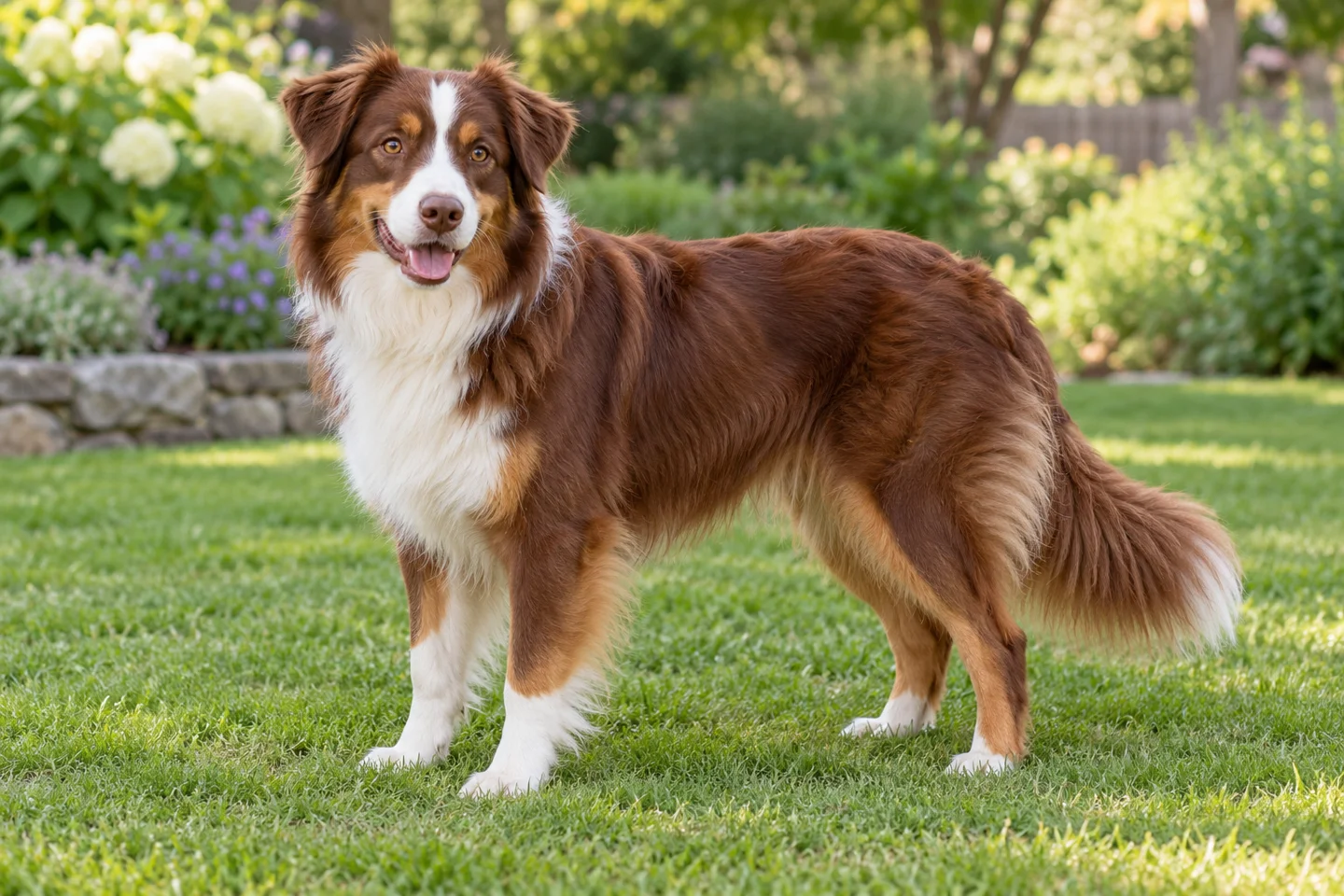
Australian Shepherds have a medium-length coat with feathering and a sturdy athletic outline. Black, red, blue merle, and red merle descriptions refer to coat patterns and colors, with permitted markings defined by the relevant standard. Color does not establish intelligence, working ability, or friendliness. Look at comfortable movement and appropriate body condition when assessing a dog. Ask about repeated stiffness, an uneven stride, or reluctance to rise rather than allowing a photogenic appearance to dominate the decision.
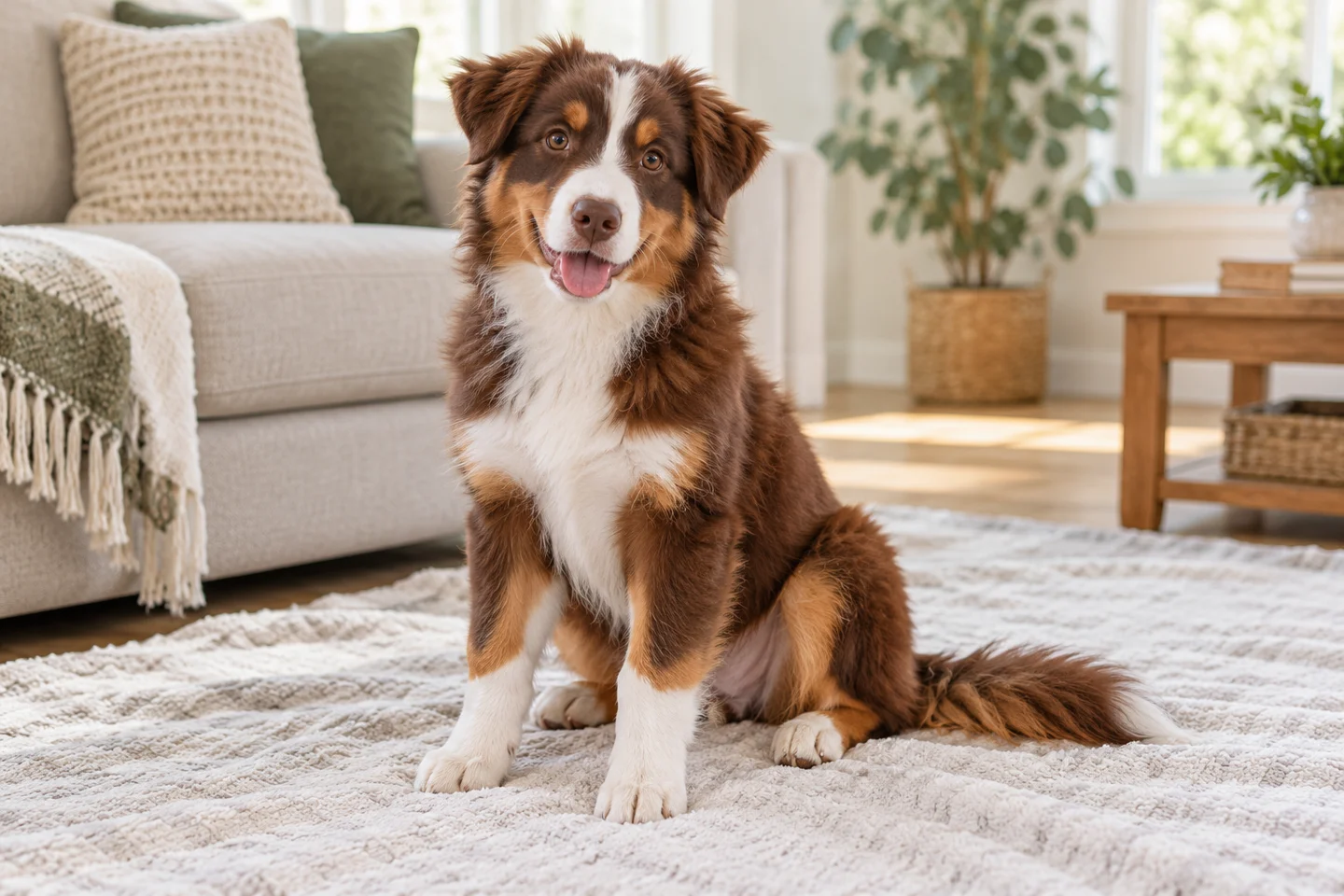
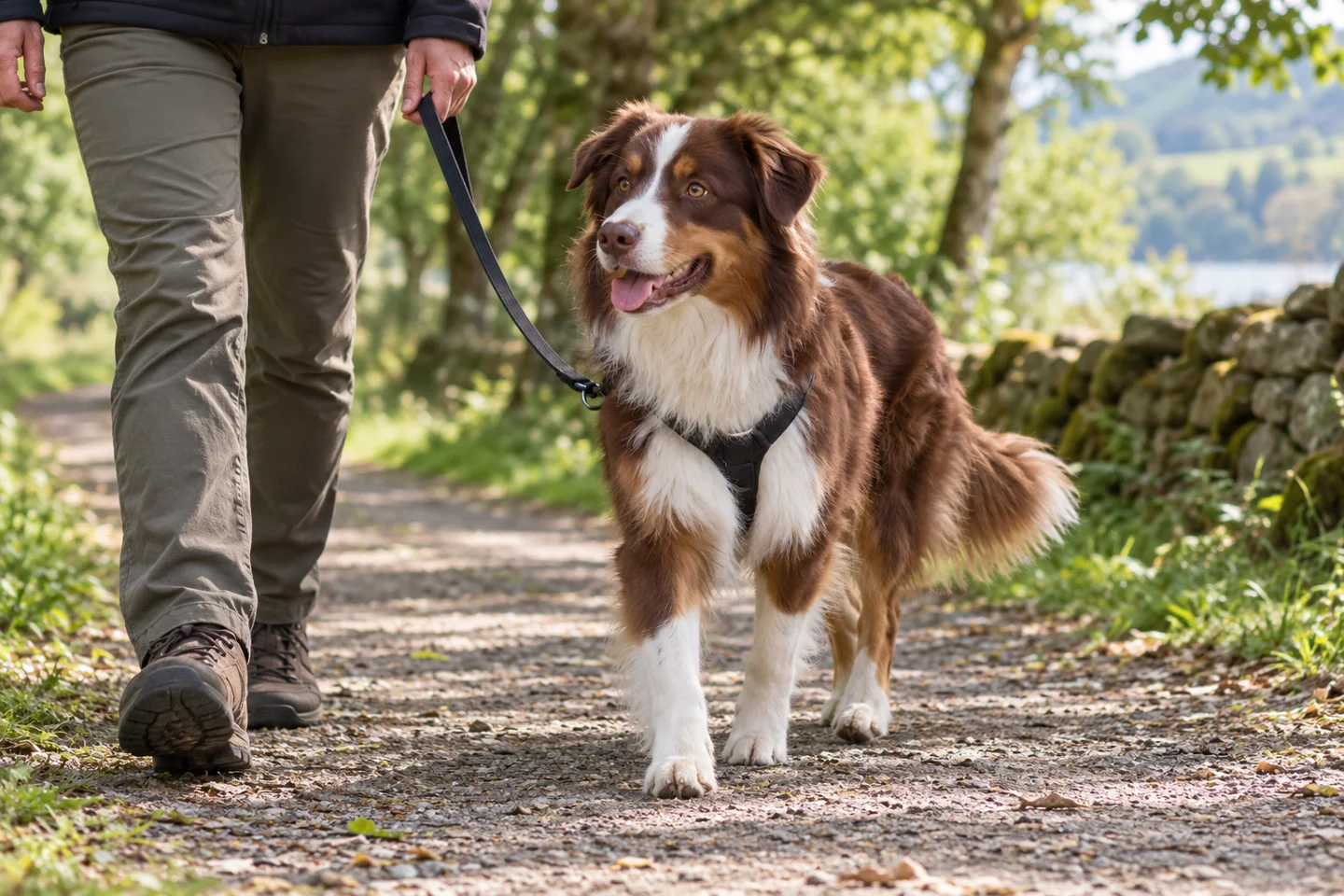
Tail length can vary, and the illustrations show a long natural tail. They are generated examples rather than records of a particular dog. Ear carriage and coat also vary within the breed's described range. Fit a harness to the individual's chest and shoulders and check it through growth or coat changes. Identification, secure lead fittings, and a suitable vehicle restraint are ordinary necessities. Teach calm equipment handling before a crowded outing makes the task more difficult for both owner and dog.
Merle inheritance and avoiding appearance-based promises
Merle is an inherited coat pattern with important breeding considerations. UC Davis explains that some merle combinations can increase the risk of hearing and vision problems. Ask what testing and professional interpretation support a mating, particularly when appearance does not make a dog's genetic status obvious. Avoid relying on a seller's casual statement that a dog looks solid. Genetic reports should identify the animal, the tested variant or allele, and the laboratory's interpretation.
A merle dog is not automatically unhealthy, and a solid-colored dog is not automatically free from inherited concerns. Eye color also cannot certify hearing or vision. Ask for individual examinations and relevant screening, and have any suspected sensory problem assessed. A dog with hearing or vision impairment can learn suitable cues and routines, but needs management around surprise approaches, traffic, and unfamiliar environments. Never select or reject a puppy solely through assumptions drawn from a coat photograph.
Children and movement in the household
A dog interested in moving animals may also respond to running children. Prevent pursuit, circling, and clothing grabs before those behaviors become a regular game. Use barriers during energetic play and teach an alternative response at a manageable distance. Calling unwanted contact herding does not make it safe or pleasant for a child. Adults need to supervise and manage access. A child should never be responsible for stopping an excited dog or protecting younger children from it.
Quiet interactions need boundaries too. Keep children away from bowls, chews, and sleeping places, and avoid hugging or leaning over the dog's face. Let it leave when contact becomes uncomfortable. Visiting children may not know the rules, so explain them and separate the dog if adult attention is divided. A familiar family routine does not establish tolerance of every party or sleepover. Review the arrangement when children grow, the dog ages, or a new baby changes the home's sounds and movement.
Other dogs, cats, and controlled introductions
Australian Shepherds have individual social preferences. An energetic dog may enjoy selected companions while finding fast group play overwhelming or becoming controlling around movement. Begin introductions with parallel walking in a suitable neutral area and enough space for both dogs to disengage. At home, provide separate rest areas and manage food, toys, and entrances. Watch whether each dog chooses to return to play. Repeated blocking or pursuit needs interruption when the other dog is trying to leave.
Cats need secure escape routes and dog-free areas. Familiarity with one cat does not establish safety with an unfamiliar animal running outdoors. Small pets require protection rather than an informal test of the dog's intentions. Stop access if sustained fixation, stalking, or chasing occurs and seek qualified help. Livestock work also requires an experienced instructor and appropriate facilities. A pedigree does not teach a puppy how much pressure is safe for stock or guarantee that the owner can interrupt every mistake.
Aggression, guarding, and recognizing pressure
No breed description can determine whether a particular interaction is safe. Notice stiffness, freezing, hard staring, growling, and attempts to withdraw. Increase space and review what preceded the response. A dog may be frightened, uncomfortable, or concerned about a resource, and the owner needs to address that situation rather than recreate it to test tolerance. Avoid taking objects by force or cornering the dog during a dispute. Physical arrangements can prevent repeated confrontations while help is obtained.
A sudden behavior change warrants veterinary assessment because pain, sensory changes, and illness can affect tolerance. Record the context of recurring problems and consult a veterinary behaviorist or qualified reward-based professional. Punishing warnings can obscure risk while leaving the underlying concern unresolved. A basket muzzle introduced gradually with rewards may be useful alongside barriers and treatment. It is an additional precaution, not evidence that the dog now welcomes close contact. Everyone providing care needs to understand the same management plan.
Training useful skills and ending activity
Reward choices that make daily life easier: attention to the handler, waiting at a door, releasing an object in exchange, and settling while people move around. Begin in quiet conditions and add duration or distraction gradually. Australian Shepherds can learn complex sequences, including ones an owner accidentally rewards. If barking reliably starts a game, the dog may learn to use barking to request it. Review what the behavior achieves before assuming more verbal correction will explain a different choice.
Teach a predictable finish to play and training. Put equipment away, provide water, and allow a comfortable rest period. A dog should not need constant entertainment to remain in the room with its family. Short clear sessions can be easier to sustain than long drills, especially when the dog becomes excited by a toy. Ask an instructor to help adjust reward placement and difficulty when progress stalls. Intelligence does not remove the need for patient instruction or make physical punishment necessary.
Exercise, sports, and recovery
Provide suitable daily movement with opportunities to investigate and learn. Walks, scent games, controlled retrieving, and age-appropriate training can create variety without repeated maximum-speed effort. Build conditioning before long hikes or sports involving jumping and rapid turns. Young dogs need appropriate activity and sleep, with demanding exercise discussed with their veterinarian. An eager dog may continue despite fatigue or discomfort, so the handler needs to monitor movement and recovery rather than relying on the dog's willingness to continue.
Persistent lameness, reluctance to jump into a vehicle, or slow recovery deserves assessment. Shorten activity in heat, choose cooler conditions, and provide shade and water. A thick coat and working history do not prevent heat illness. Severe breathing trouble or collapse needs urgent veterinary advice. Rest days can still include a manageable sniffing walk and quiet learning. Avoid compensating for every missed outing through frantic indoor games that make it harder for the dog to learn comfortable rest.
Grooming a feathered double coat
Brush through the coat to the skin in manageable sections, paying attention behind ears, under equipment, and around feathered areas where tangles can develop. Check for parasites, wounds, redness, and damp skin after wet outings. A smooth-looking outer coat can conceal mats or irritation underneath. Ask an experienced groomer for help when necessary rather than pulling through painful tangles. Routine coat clipping should be based on an actual need, with veterinary or grooming advice for the specific situation.
Introduce nail care, tooth brushing, ear inspection, and standing for handling in short rewarded steps. Stop to investigate new sensitivity. A dog that objects to a familiar procedure may be uncomfortable rather than uncooperative. Persistent odor, discharge, or painful ears needs veterinary assessment. Tell the clinic or groomer about handling concerns before arrival. Cooperation is easier to develop through calm practice than during an urgent attempt to finish a task while the dog is already frightened or hurting.
Health screening and family information
The AKC lists hip, elbow, and ophthalmologist evaluations among the national club's recommendations for Australian Shepherd breeding dogs. Request actual identifiable reports rather than a summary that the parents were checked. Confirm the method, date, result, and issuing organization. A puppy examination answers different questions from adult joint screening or specialist eye assessment. A CHIC number records completion and disclosure of specified testing, and should not be interpreted as proof that every result was normal.
Ask about relevant DNA testing and illness in close relatives as well. The Australian Shepherd Health and Genetics Institute discusses several inherited concerns, including epilepsy and eye disease, for which family information and clinical assessment remain important. A large commercial panel does not exclude every genetic condition or provide a complete prediction of future health. Bring documents to the veterinarian and agree an individual plan. Avoid presenting any one set of test results as a lifetime warranty or assuming a healthy-looking parent has no relevant history.
MDR1 and medication decisions
Some Australian Shepherds have an MDR1, also called ABCB1, variant that can affect their response to certain medications. Washington State University's veterinary program explains testing and drug sensitivity. Ask your veterinarian whether the dog's status is known and make sure the result is recorded where treating clinicians can see it. A dog's coat color cannot establish its MDR1 status. Share the information when using another clinic, arranging surgery, or discussing a new prescription.
Do not stop essential treatment or choose replacement drugs from an informal internet list. The risk depends on the medication, dose, genotype, and clinical situation, so the veterinarian needs to make the decision. Avoid giving human or livestock medicines without advice, and keep access to discarded medications controlled. If an adverse reaction is suspected, contact a veterinarian promptly and provide the product details. A genetic result is useful information for care, not a reason to assume the dog cannot receive any effective parasite prevention or anesthesia.
Neurological changes and emergency planning
Seizures, new incoordination, collapse, or marked behavioral changes need clinical assessment. A breed-associated concern does not identify the cause of a particular episode. If safe, a brief video can help the veterinarian understand an intermittent event, but recording must not delay urgent care. Keep the dog away from hazards and obtain instructions from the clinic. Avoid placing hands in its mouth during a seizure or attempting treatment based on another owner's description of similar signs.
Know which emergency clinic is available and how the dog will travel securely. Keep current medications, health reports, and contacts accessible. Routine care should address vaccination, parasites, teeth, body condition, and any region-specific travel risks. As the dog ages, review footing and vehicle access rather than attributing reluctance to jump to stubbornness. An active dog may continue offering games while uncomfortable, making observations after rest and the next morning useful information for the veterinary team.
Feeding and managing valuable resources
Feed a complete diet appropriate to age and health, using measured portions and body-condition trends to adjust the amount. Include training rewards in the daily allowance. Sporting ambitions do not establish that a dog needs the intake of a heavily working adult. Ask the veterinarian to assess growth and condition. Avoid adding supplements to a complete puppy diet without a reason, and obtain qualified nutritional advice if you want to prepare food at home.
Provide meals away from children and other animals, and remove shared chews before visiting dogs arrive. Teach comfortable exchanges instead of repeatedly taking food away to test tolerance. Keep rubbish, medications, and unsafe foods inaccessible. Persistent digestive changes, altered thirst, appetite loss, or unexplained weight change needs veterinary advice. During injury or a quieter season, review intake promptly so the previous activity allowance does not continue while the dog spends more time resting and recovering.
Mixes and miniature labels
Aussiedoodle commonly describes an Australian Shepherd and Poodle cross, while Texas Heeler often describes an Australian Shepherd and Australian Cattle Dog cross. Neither name establishes a standardized coat, activity level, or temperament. An Australian Shepherd mix can inherit varied traits and still need substantial grooming or movement management. Ask what parentage is documented and what health records exist. Mixed ancestry does not guarantee fewer inherited concerns or remove the need to assess the actual dog.
Clarify miniature labels separately. A registered Miniature American Shepherd has its own identity, while a seller's mini Aussie description may refer to a different registration context or an uncertain cross. Read the paperwork and discuss expected adult size without assuming a smaller dog has simpler behavior. No Poodle cross is guaranteed to suit a person with allergies. Individual contact and appropriate clinical advice matter, because allergens are not confined to loose hair and a marketing name cannot predict personal tolerance.
Costs, backup care, and a dogsDating outing
Budget for grooming tools or appointments, food, preventive care, training support, and unexpected treatment. Find a backup carer who can follow the dog's resource, walking, and rest routines. Practice a short visit before a necessary long absence and provide written instructions with veterinary contacts. A dog accustomed to one person's cues may need time to learn another handler's routine. Plan these arrangements before travel or an emergency forces a hurried choice of care.
Use the dogsDating profile to describe individual experience and preferred distance while keeping exact home coordinates private. Start with parallel walking on a quiet public route and separate capable adult handlers. Leave toys and shared food out of the meeting. Increase distance or end if either dog becomes stiff, controlling, or unable to disengage. A relaxed walk can be a useful result without physical greeting. Describe that experience accurately rather than assuming it proves comfort in a shared home, vehicle, or exciting group game.
Sources and editorial notes
Sources checked October 21, 2026. Breed measurements describe reference ranges, not a diagnosis or an individual dog's ideal weight. Images are AI-generated breed illustrations and do not document a particular dog or health condition.
- VCA Animal Hospitals: Hypoallergenic dog breeds
- Orthopedic Foundation for Animals: CHIC program and interpretation of numbers
- VCA Animal Hospitals: Ear infections in dogs
- VCA Animal Hospitals: Common emergencies in dogs
- VCA Animal Hospitals: General feeding guidelines for dogs
- Australian Shepherd Health and Genetics Institute: Inherited concerns and family information
- VCA Animal Hospitals: Food aggression in puppies
- American Kennel Club: Herding group health screening recommendations
- VCA Animal Hospitals: Heat stroke in dogs
- American Kennel Club: Australian Shepherd history
- VCA Animal Hospitals: Aggression toward unfamiliar dogs, diagnosis
- Washington State University: MDR1 drug sensitivity and individualized veterinary care
- UC Davis Veterinary Genetics Laboratory: Merle inheritance and health implications
- American Kennel Club: Miniature American Shepherd identity and naming
- American Kennel Club: Official Australian Shepherd standard
- AVSAB: Humane Dog Training Position Statement
Keep getting to know dogs.
Read another guide or return to your dogsDating community.
Explore breed guidesBack to dogsDating