Azawakh
A lean West African sighthound whose care needs secure running, respectful introductions, weather-aware routines, and individual assessment of health and body condition.
How these guides are researched and reviewed
- Origin
- Sahel region of West Africa
- Outline
- Long-legged, deep-chested, and naturally lean
- Care priorities
- Secure exercise, social comfort, and condition
General information for owners. These articles have not been reviewed by a veterinarian. Medical decisions need your dog's history and an examination.
Choosing an Azawakh
An Azawakh needs an owner prepared for a sensitive, athletic sighthound whose comfort with unfamiliar people and animals must be assessed individually. Secure exercise space, thoughtful handling, and a quiet place to rest matter as much as opportunities to run. Its lean outline can attract attention before a prospective owner has considered recall, prey-sized animals, weather, and visitors. Begin with the practical routine your household can provide rather than an image of effortless companionship on every public outing.
Meet adults in ordinary circumstances and ask how they behave after the initial excitement of an encounter. Find out whether the dog settles indoors, tolerates necessary care, and copes with short absences. A puppy's behavior provides useful information without predicting every adult response. An experienced source should discuss reserve and management honestly, alongside appealing traits. Choosing an uncommon breed is a long-term care decision, and the individual dog's needs should remain more important than rarity or a striking photograph.
West African origins and naming
The Azawakh comes from the Sahel region of West Africa, including the area associated with the Azawagh valley. Breed organizations describe connections with pastoral communities and use involving hunting and guarding. The AKC discusses origins across Mali, Niger, and Burkina Faso, while the FCI lists Mali as country of origin and France as patronage country. Those registry descriptions have different purposes and should not be turned into a claim that the breed's cultural history belongs to only one modern boundary.
The Azawakh is distinct from the Sloughi, Saluki, and other sighthounds, despite features that can look similar to an unfamiliar observer. Ask which organization issued a pedigree and what is known about recent ancestry. Avoid repeating an exact ancient family tree without evidence. For an adopted dog, acknowledge when identification relies on appearance. A narrow body, long legs, or regional rescue story cannot by itself establish a documented breed identity or predict how the animal will behave in your home.
A lean outline and a veterinary body assessment
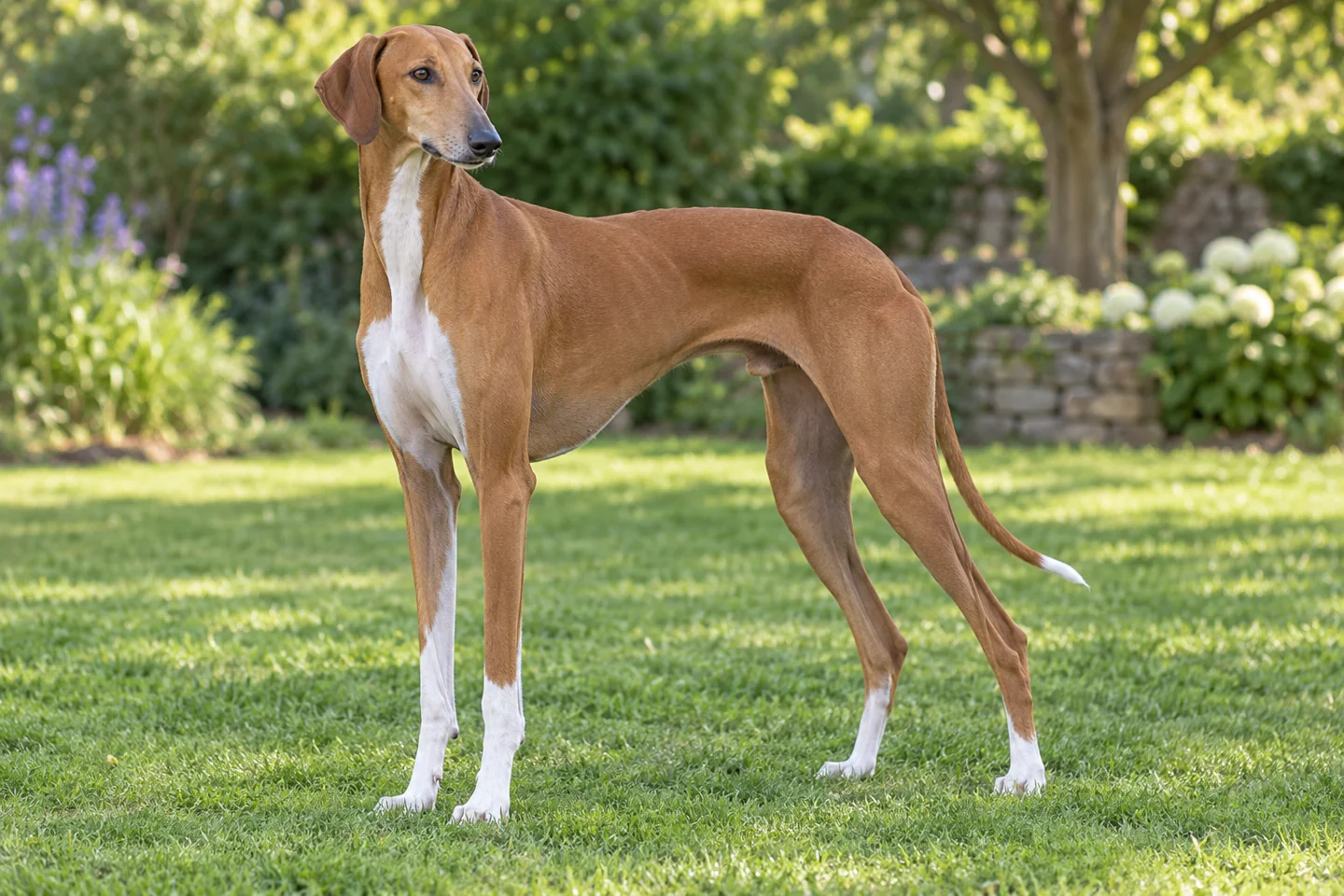
The Azawakh has long legs, a deep narrow chest, a pronounced abdominal tuck, and a short fine coat. Its outline is naturally lean, with visible structure that may differ from what an owner expects in a heavily coated or stockier breed. That does not make every thin dog healthy. Ask a veterinarian familiar with sighthounds to assess weight trends, muscle, condition, appetite, and clinical signs rather than judging only by whether some ribs can be seen.
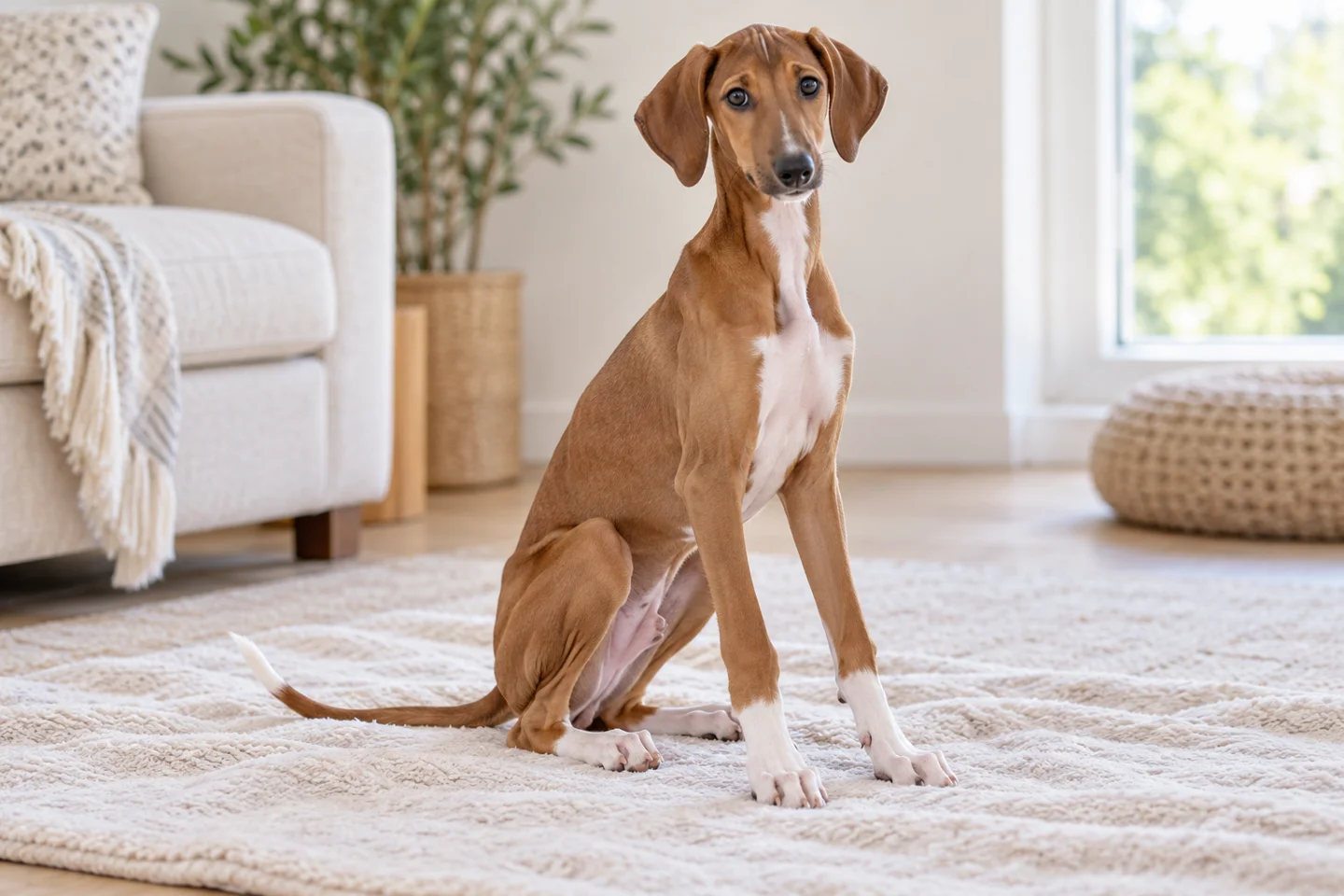
Unexplained weight loss, poor muscle, digestive problems, or reduced stamina needs investigation. Conversely, feeding simply to conceal the breed's natural structure can produce excess body fat. The illustrations show a red-fawn example with white markings, natural dropped ears, and a long tail. They are generated illustrations, not medical reference images or proof of ideal condition. Evaluate a real dog through examination and records, including comfortable movement and the ability to rise, turn, and rest without persistent difficulty.
Secure running and the limits of recall
Sighthounds can respond rapidly to moving animals. Practice recall in secure surroundings and reward it well, but retain barriers where traffic, wildlife, or livestock create danger. A response on a quiet walk does not establish reliability when a small animal runs. Use a lead outside safely enclosed areas and inspect a rented field before releasing the dog. Check fence condition, gates, and space for safe turns rather than assuming a booking guarantees suitable boundaries.
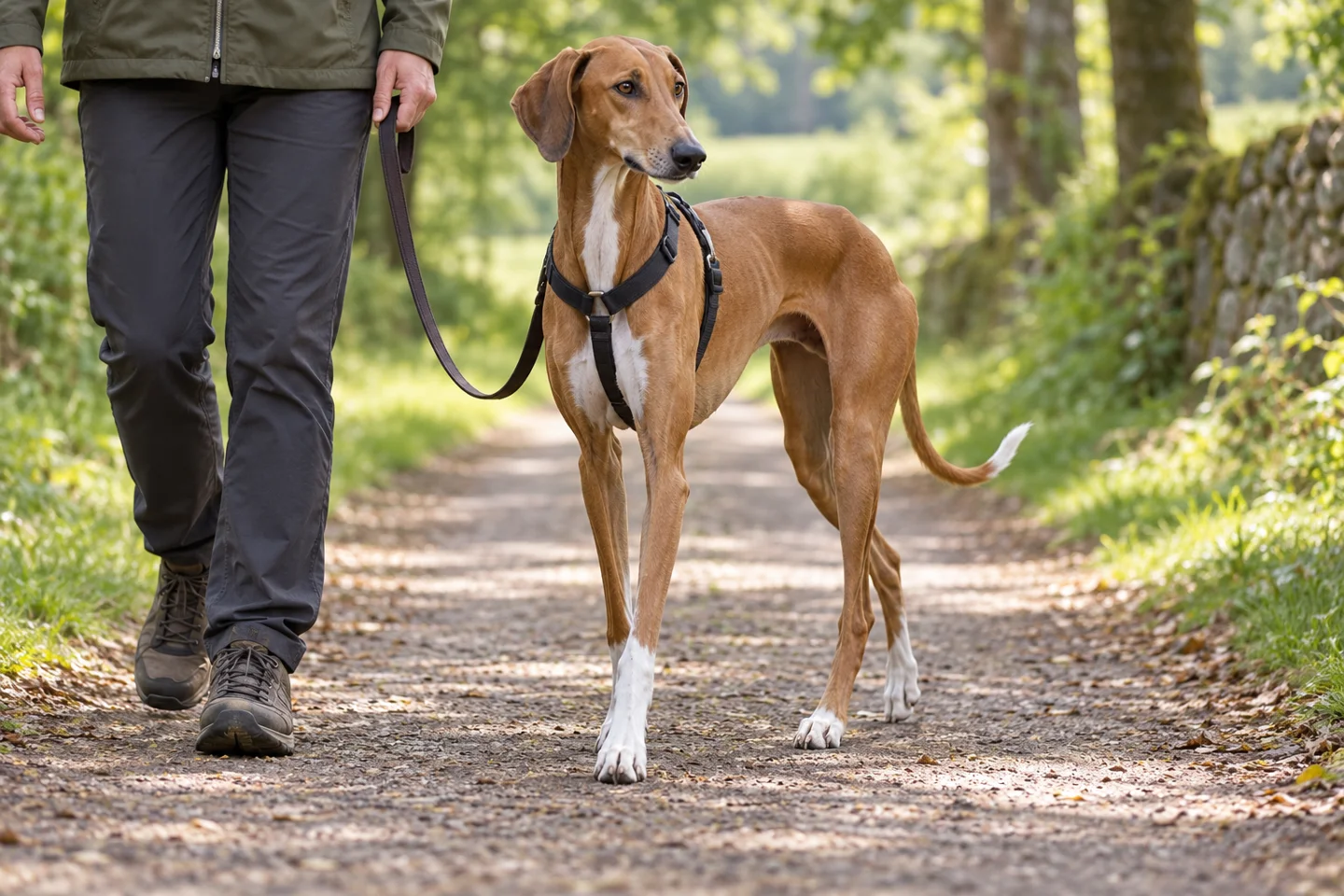
Equipment needs to fit the narrow head and deep chest. Ask an experienced professional about a secure harness and appropriate collar arrangement for the individual. Teach calm fitting and walking before a busy outing. Long lines require careful handling because sudden speed, entanglement, and impact at the end can cause injury. Identification, a microchip, and a tracker are useful backup measures while leaving the owner responsible for preventing escape. Avoid using an off-lead failure as an experiment in a setting where others could be harmed.
Reserve, strangers, and consent to contact
Some Azawakhs are reserved around unfamiliar people. Observe what the individual does instead of interpreting reserve as either inevitable aggression or a promise of dignified calm. It may watch, withdraw, freeze, or become more comfortable after time and distance. Guests should not reach over, stare at, or follow a dog that moves away. A comfortable separate resting area can allow a visit to proceed without requiring the dog to become the center of attention.
Teach manageable visitor routines and reward relaxed observation. There is no obligation for a dog to accept touch from every person who admires its appearance. Explain that boundary to guests before they approach. If the dog repeatedly threatens or cannot recover, obtain qualified help and review the environment. A breed's guarding history cannot establish that it recognizes suitable targets. The owner remains responsible for managing access and preventing confrontations rather than asking a stranger to prove friendly intentions through continued approach.
Children and a calm home environment
Children need active adult supervision with an Azawakh. A quiet dog can still be startled, uncomfortable, or unable to leave a crowded space. Avoid hugging, climbing, pulling, and leaning over its face. Give it a resting area children cannot enter, and keep meals and chews separate. Teach children to invite contact and stop when the dog withdraws. They should call an adult when an object is near the dog rather than attempting to move it themselves.
Running games and visiting children need additional planning. Use separation if excitement, sudden movement, or uncertainty makes close supervision difficult. A dog comfortable with familiar family members may react differently to a crowded gathering. Adults should manage leads and doors, particularly when the dog notices movement outside. Previous friendly encounters do not remove the need for these arrangements. Review them when a child becomes mobile, the dog develops pain, or the household's social routine changes in ways that increase noise and traffic.
Dogs, cats, and pursuit risk
Assess dog compatibility individually. Begin with parallel walking on suitable neutral ground and enough space for either dog to disengage. At home, separate resources and resting places while observing comfort. A dog may enjoy one familiar companion while finding unfamiliar groups overwhelming. Watch for stiff attention, repeated blocking, or pursuit of an animal trying to leave. Fast play can also create collisions and injury, so a size or speed mismatch deserves management even when there is no obvious aggression.
Cats need careful gradual introductions and dog-free escape routes. Familiarity with one household cat does not establish safety with an unfamiliar cat running outdoors. Rabbits, rodents, and other small pets require secure protection rather than a test of intentions. Stop access when stalking, fixation, or chasing occurs and obtain help. A calm response to people provides little information about prey-related behavior. The owner should be able to maintain separation reliably before deciding that a mixed-animal household can accommodate the individual dog safely.
Aggression, fear, and preserving warnings
Stiffness, freezing, growling, snapping, and attempts to retreat indicate that an interaction needs to change. Create distance and remove the immediate pressure. Avoid cornering the dog, forcing handling, or taking a valued object repeatedly to test tolerance. A reserved dog should not be pushed into contact until it reacts and then blamed for failing a social test. Breed identity cannot establish safety, and an owner needs an individual account of triggers, health, experience, and recovery.
New irritability or handling sensitivity warrants veterinary examination. Pain and illness can affect behavior, including responses that appear social. For recurring threats, consult a veterinary behaviorist or qualified reward-based professional and keep a factual incident record. Punishing warnings can make risk less visible while leaving fear unresolved. A basket muzzle introduced gradually with rewards may be useful alongside management and treatment. Fit matters for a narrow face, and the muzzle cannot make close contact comfortable or replace the dog's opportunity to keep distance.
Training cooperation through clear rewards
Teach practical cues in quiet conditions: attention to a name, a hand target, waiting at a door, and standing for equipment. Reward choices the dog can understand and add difficulty gradually. Food, access to a suitable sniff, or another individually valued activity can support learning. Short sessions make it easier to stop while the dog remains comfortable. Avoid assuming a delayed response reflects contempt or a need for firmer physical handling; the task, motivation, or setting may need adjustment.
Practice useful alternatives before they are needed near a moving animal or unfamiliar person. A comfortable turn away can help maintain distance, and a resting station can simplify visitor arrangements. Teach exchanges for objects without confrontation. A reward-based instructor familiar with sensitive dogs can help the owner adapt timing and expectations. The goal is reliable cooperation in ordinary care, not an elaborate display performed while the dog is tense. Secure barriers remain necessary where an error would have serious consequences.
Exercise, sprinting, and physical preparation
Provide daily activity suited to age, health, and fitness. Walks with time to investigate can sit alongside safely enclosed opportunities for faster movement. Build conditioning gradually before demanding sports or long outings, and inspect running surfaces for holes, hazards, and slippery areas. A sudden high-speed turn can be physically demanding even when the dog appears eager. Puppies need suitable activity and sleep, with repeated high-impact exercise discussed with their veterinarian rather than encouraged until exhaustion.
Monitor gait and recovery after exercise and again after rest. Persistent limping, reluctance to rise, or reduced stamina needs assessment. A lure-coursing or sporting plan should include appropriate instruction and veterinary consideration of fitness. Fast pursuit is not the only meaningful activity available. On quieter days, suitable sniffing walks and learning can provide interest without substituting frantic indoor chasing. A sustainable routine should fit the owner's work and health as well as the dog's most energetic days.
Weather and comfortable rest
The short fine coat means an individual may need additional protection in cold or wet conditions. Assess comfort, fit any clothing carefully, and check for rubbing around shoulders and chest. Provide dry bedding and a warm resting area. Avoid leaving the dog exposed simply because its ancestry includes demanding environments. A modern companion's condition, age, acclimatization, and health need attention. Protective clothing is one tool alongside suitable duration, shelter, and a route that allows an early return.
West African origins do not make the dog immune to heat illness. Provide water and shade, avoid demanding activity in hot conditions, and watch breathing and recovery. Collapse or severe breathing trouble needs urgent veterinary advice. Indoors, comfortable padded rest can matter for a lean dog, but new reluctance to lie down or rise should be assessed medically. Check pressure areas and skin during routine care, and make practical changes before discomfort becomes part of every rest period.
Grooming and cooperative body care
The coat needs regular gentle brushing and skin checks rather than elaborate styling. Look for wounds, parasites, redness, and equipment irritation, especially after countryside activity. A fine coat can make changes visible while leaving the cause uncertain. Bathe when needed with suitable products and dry the dog comfortably. Introduce handling in brief rewarded steps, allowing the dog to learn what happens next. Do not wait until an injury requires prolonged restraint to begin teaching foot or mouth handling.
Maintain nails and dental care with veterinary guidance. Persistent ear odor, discharge, or painful handling needs assessment rather than reused medication or improvised treatment. Tell the clinic about reserve or previous handling difficulties before arrival so staff can prepare a suitable appointment. A quieter setting and cooperative-care plan may help, while necessary medical care should not be postponed for perfect training. Stop and investigate when a previously comfortable procedure becomes difficult; discomfort can look like an unexpected change in temperament.
Health evidence and family records
The AKC's hound-group page currently lists no recommended health tests for the Azawakh, while the linked association letter names known concerns. An empty formal list is not evidence that screening or veterinary care has no value. Ask what the breeder actually evaluates, request identifiable reports, and discuss relevant family illness. Avoid inventing a universal testing checklist or presenting a small collection of owner reports as a reliable population-wide estimate of disease frequency.
The association's 2015 letter lists seizures or epilepsy, hypothyroidism, masticatory myositis, spinal stenosis, and autoimmune problems. It does not provide prevalence figures or diagnose a particular dog. Use that information to ask focused questions and discuss appropriate assessment with the veterinarian. A DNA panel tests selected variants and cannot exclude every inherited or acquired condition. A healthy appearance today cannot guarantee future health, and an adopted adult with missing records needs a plan based on current examination and observed changes.
Illness, medication, and emergencies
Report seizures, weakness, persistent pain, difficulty eating, unexplained weight change, or new behavioral changes promptly. A breed-associated concern cannot determine the cause of an individual symptom. A short safe video may help describe an intermittent event, but recording should not delay care or provoke symptoms. Keep medication and health records available. Avoid blanket claims that every sighthound reacts identically to anesthesia or medication; the veterinarian needs to make decisions using the individual dog's findings and proposed procedure.
Know where urgent care is available and how the dog would travel if injured. Collapse, severe breathing difficulty, major trauma, or rapidly worsening illness requires prompt advice. Tell staff about handling concerns and any current prescriptions. Routine preventive care should address local parasite risks, vaccination, teeth, and body condition. As the dog ages, review footing and vehicle access rather than attributing every hesitation to reserve or stubbornness. Pain assessment and adjustments to activity can preserve suitable interests without requiring the dog to maintain its previous speed.
Feeding, mixes, and allergy expectations
Feed a complete diet suited to age and health, using measured portions and veterinary body-condition assessment. Include training rewards in the allowance and adjust for actual activity. Do not feed toward a stockier breed's outline or accept unexplained thinness as automatically normal. Keep meals separate from children and other animals and teach exchanges without confrontation. Home-prepared diets need qualified nutritional advice, and persistent digestive changes or altered thirst should be investigated rather than managed through repeated unplanned food changes alone.
An Azawakh mix can vary in outline, coat, reserve, and pursuit behavior. A crossbreed name does not establish a standardized outcome, and visual ancestry guesses need acknowledgment. DNA information may add context without predicting every trait or excluding disease. A short coat also cannot guarantee tolerance for someone with allergies, because allergens are not confined to loose hair. Discuss personal allergy concerns with the affected person's clinician and assess the actual dog appropriately rather than relying on a marketing description.
Costs, care arrangements, and dogsDating
Budget for secure equipment, suitable fencing or enclosed exercise access, food, preventive care, training support, and emergency treatment. Arrange a backup carer who understands the dog's response to strangers and moving animals. Practice a short visit before a necessary absence, leaving written routines and veterinary contacts. Check housing rules and travel arrangements in advance. A dog that is comfortable with its owner may need gradual learning before another person can fit equipment, open doors, and walk it safely.
For dogsDating, describe individual experience and preferred distance while keeping exact home coordinates private. Choose a quiet public route for parallel walking with separate capable adult handlers. Avoid immediate fast chase games, shared food, and pressure for physical greeting. Increase space or end if either dog becomes stiff, persistently pursued, or unable to recover. A relaxed walk can be useful without close contact. It does not establish comfort in a shared home, vehicle, or exciting group setting without further assessment.
Sources and editorial notes
Sources checked October 21, 2026. Breed measurements describe reference ranges, not a diagnosis or an individual dog's ideal weight. Images are AI-generated breed illustrations and do not document a particular dog or health condition.
- VCA Animal Hospitals: Hypoallergenic dog breeds
- American Azawakh Association: Breed background and pastoral connections
- VCA Animal Hospitals: Ear infections in dogs
- VCA Animal Hospitals: Common emergencies in dogs
- FCI: Azawakh country of origin and patronage
- VCA Animal Hospitals: General feeding guidelines for dogs
- VCA Animal Hospitals: Food aggression in puppies
- American Kennel Club: Hound group health testing field for Azawakh
- VCA Animal Hospitals: Heat stroke in dogs
- American Kennel Club: Azawakh origins and identity
- VCA Animal Hospitals: Aggression toward unfamiliar dogs, diagnosis
- American Azawakh Association: February 2015 letter listing known health concerns
- AVSAB: Humane Dog Training Position Statement
Keep getting to know dogs.
Read another guide or return to your dogsDating community.
Explore breed guidesBack to dogsDating