Saluki
A lean Middle Eastern sighthound with smooth and feathered coats, whose speed, reserve, and need for secure running shape everyday care.
How these guides are researched and reviewed
- Origin
- Middle East
- Adult standard size
- FCI average 58–71 cm; females proportionally smaller
- Illustrated coat
- Golden-fawn feathered variety
General information for owners. These articles have not been reviewed by a veterinarian. Medical decisions need your dog's history and an examination.
A sighthound whose stillness can be misleading
The Saluki is a Middle Eastern sighthound with a lean body, long legs, a deep chest, and a narrow head. A resting dog can appear remarkably composed, yet movement in the distance may prompt a very different response. An owner needs to plan for that transition rather than assuming quiet behavior indoors predicts reliable off-lead behavior outside. Speed and visual pursuit are central practical considerations when choosing this breed.
The FCI standard describes variation shaped by the broad region in which Salukis developed. The breed should not be reduced to one invented national origin story or a claim that every historical population looked identical. Modern registration establishes a particular pedigree framework, while a resemblance in a photograph does not prove ancestry. Ask what is known and documented about the dog rather than treating an elegant outline as sufficient evidence.
Prospective owners should meet adult Salukis and discuss everyday routines. Ask how they travel, respond to unfamiliar people, settle during absences, and behave around animals outdoors. These conversations can clarify whether the household enjoys a dog that may prefer space and deliberate introductions. Appearance alone cannot answer that question, and public descriptions of grace or nobility offer little guidance for an ordinary morning walk beside a busy road.
Adult height, lean condition, and coat varieties
The FCI standard gives an average height range of 58 to 71 centimeters and states that females are proportionally smaller. It does not supply a separate exact female range in that description. Avoid inventing one from a generic chart. Height is measured at the withers, and body condition requires assessment of the individual. A lean sighthound outline should be interpreted with veterinary guidance rather than used to justify either excessive feeding or neglect of genuine weight loss.
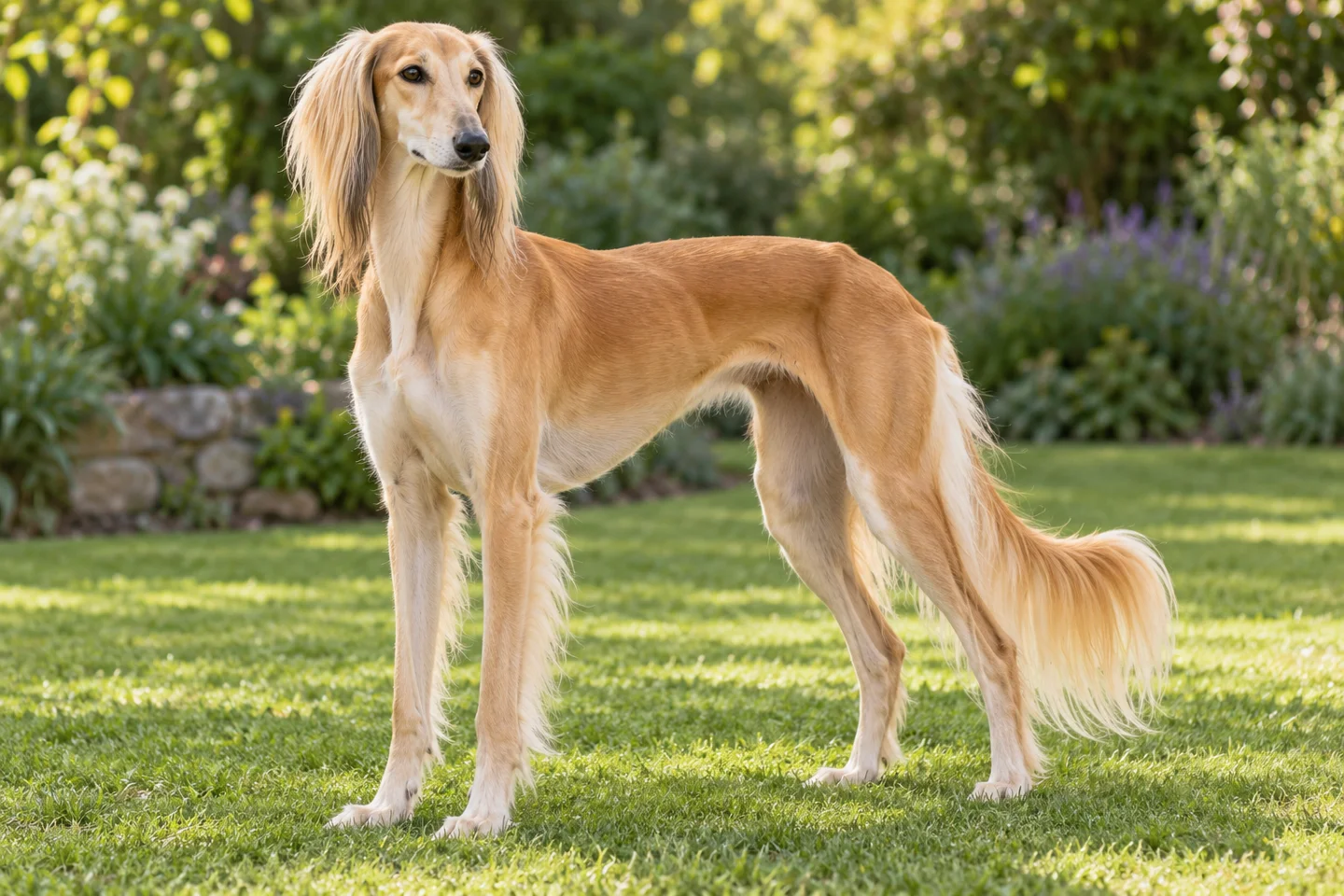
Salukis occur in feathered and smooth coats. In the feathered variety, the ears, tail, and parts of the limbs carry longer hair, while the body remains relatively smooth. A heavily coated Afghan Hound outline would be misleading. The smooth variety lacks the same feathering. Both are Salukis, and coat variety should not be treated as a promise of a particular personality or exercise requirement.
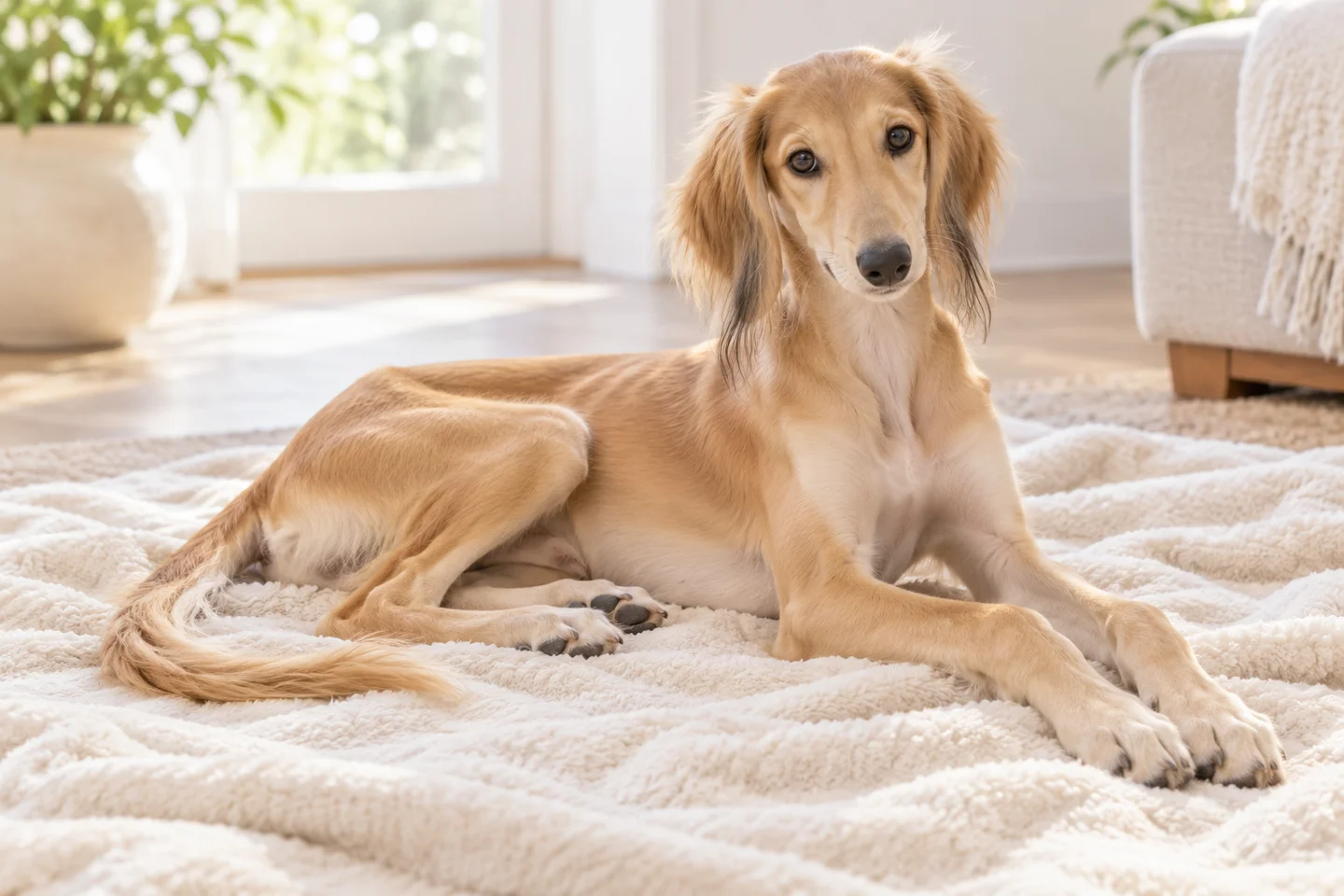
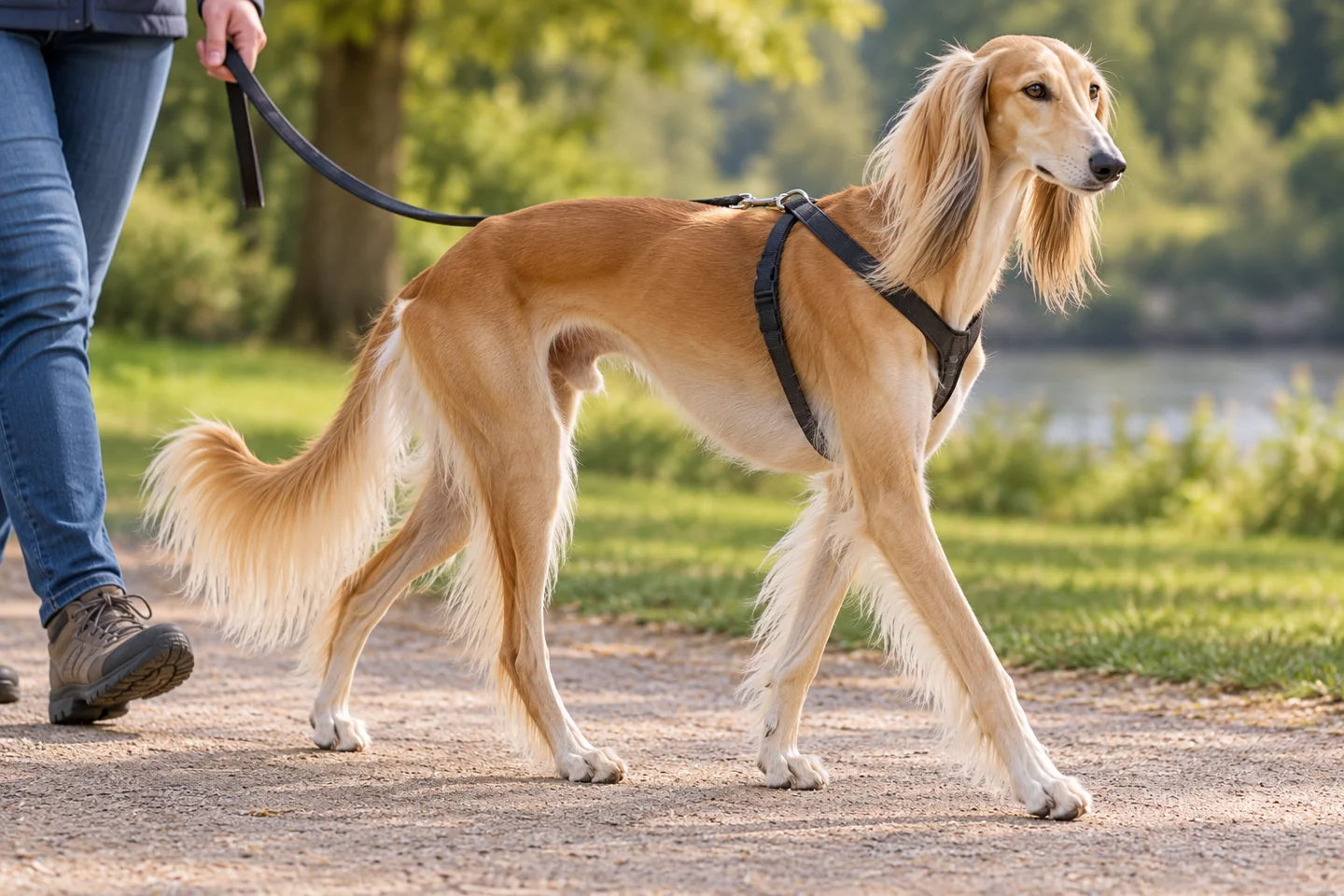
Our illustrations show a golden-fawn feathered dog with naturally hanging ears and a complete, long tail. They are AI-generated illustrations and cannot serve as documentary photographs. Fit equipment to the actual narrow head, chest, and neck. A collar or harness that looks secure may behave differently when the dog backs away. Ask an experienced professional about suitable fit and safe use, and recheck during growth or changes in condition.
A home that offers comfort and choice
Provide comfortable bedding and enough space for the dog to stretch without being repeatedly stepped over. A lean dog resting on a hard or slippery surface may choose a different location from the one the owner intended. Make the preferred place genuinely comfortable and reward its use. If furniture access is allowed, teach a calm cue for moving away instead of relying on physical removal when guests arrive.
A Saluki may choose to watch an unfamiliar person before approaching. Let that be part of the introduction. Visitors can sit quietly and avoid reaching over the head or following the dog into its retreat. A dog that remains at a comfortable distance has not failed a sociability test. The owner can protect that space while separately teaching the handling required for veterinary and grooming care.
Practice short absences and observe the response. A household should know whether the dog can rest, whether it repeatedly watches the exit, and whether distress escalates. If problems occur, adjust the schedule and obtain appropriate advice. Another dog can provide companionship in some homes, but it is not a guaranteed treatment. Plan work, travel, and backup care around the individual animal's actual needs.
Training a dog that can choose another reward
Start in a quiet area and make the task clear. Reward looking toward the handler, following a change of direction, or arriving at a recall. Short successful practice is more useful than a prolonged session in which the dog has stopped engaging. Identify what matters to this individual, including food, exploration, and an opportunity to continue a safe activity. A reward does not have to be the same in every setting.
Build recall in secure places and avoid turning the exercise into a roadside test. A dog that returns when little is happening may still pursue an animal moving suddenly across its view. Managed equipment and appropriate fencing remain essential. Calling repeatedly while the dog is already accelerating does not create a reliable response. Arrange conditions in which returning can be practiced successfully before adding difficulty.
Teach handling with small steps. Accepting a harness, standing for a brief examination, and allowing a foot check are useful life skills. A reward-based trainer should explain how the plan changes when the dog is worried or distracted. Physical intimidation can make a reserved dog less willing to participate. If a previously manageable task becomes difficult, check for pain and changes in the environment instead of assuming the dog has decided to be difficult.
Exercise and safe opportunities to run
A Saluki needs opportunities for movement and exploration, with any running arranged in a suitable secure setting. Inspect the enclosure before releasing the dog. Look at gates, fence condition, obstacles, and the animals beyond the boundary. A large open area is not automatically secure, and a dog moving at speed can reach a hazard before a person can react. Practice a calm entry and exit as part of the routine.
Build fitness gradually. A growing puppy, an adult returning after a quiet period, and a conditioned dog need different workloads. Avoid repeated hard turns or strenuous running simply to make the dog tired. Watch gait and recovery afterward, including willingness to rise and move later in the day. If the dog becomes sore or unusually reluctant, seek advice before repeating the same session.
Walks and scent exploration still matter when running is unavailable. A varied route at a comfortable pace can offer useful experience without constant speed. In warm weather, choose cooler conditions and take water. In cold or wet weather, consider the individual dog's comfort and suitable protection if needed. Clothing should fit without restricting movement. An activity plan should respond to the dog and conditions, rather than rely on a fixed breed-wide mileage target.
Socialization with room to retreat
Arrange exposure to people, vehicles, surfaces, and dogs at a level the puppy can process. Useful signs include investigating, accepting familiar rewards, and recovering after a surprise. Repeated attempts to leave or prolonged freezing mean the setup needs changing. A quiet experience from a generous distance can teach more than a busy encounter in which the dog has no choice about proximity.
Reserve with strangers should not be treated as permission to neglect social experience. A Saluki still needs practice with the people and settings required for its life. The difference lies in how that practice is arranged. A veterinary waiting area, a car park, and a grooming table can each be introduced through manageable steps. Tell professionals about the dog's comfort and previous experiences so the first necessary appointment is not also its first exposure to every part of the situation.
Visitors should avoid trying to win the dog over through persistent touching. Let the owner explain the plan and offer space. Reward a voluntary approach without closing off the retreat route. A dog can learn that a visitor predicts calm household activity even when it never chooses close contact. That is a useful outcome for a companion expected to live safely among people with different habits and levels of experience.
Aggression, fear, and guarding space
A Saluki's reserved appearance cannot establish that it will never bite. Fear, pain, and conflict over resources can affect any dog. If the dog stiffens during handling, threatens over a bed, or snaps when approached, change the immediate arrangement and seek appropriate assessment. A new reaction may have a medical component. Prevent repeated close encounters while the cause and teaching plan are investigated.
Avoid dragging the dog from a resting place or taking a valued object to demonstrate control. Teach movement and exchanges during easy practice, and manage access to tempting unsafe items. Meals and chews should be offered where children and other pets cannot interrupt. If guarding is established, qualified help should guide the process. A household needs specific instructions about space and barriers rather than a vague promise to be more careful.
Disclose known incidents to sitters, walkers, and veterinary staff. Describe what occurred, the injury if any, and the circumstances. A calm dog in one setting may react differently during restraint or close contact. Where a muzzle is part of an individual plan, introduce a suitable basket design gradually and retain the other management. Equipment should support safer care, not justify forcing the dog into a frightening encounter.
Children, companions, and pursuit outdoors
Children should learn to let a resting Saluki remain undisturbed. No climbing over the dog, grabbing the tail, or following it into a quiet area should be part of play. Arrange contact while an adult can watch closely and stop if the dog moves away. A child can help prepare a search or reward an established cue without needing to hold or restrain the dog.
Fast running games can create a difficult situation when a sighthound becomes excited by movement. Adults should select activities and intervene early rather than waiting for chasing or mouthing to escalate. A visiting group of children may require separation even when the dog is comfortable with the household's usual routine. Familiarity with one child cannot be generalized to all children in all circumstances.
With other dogs, evaluate size, speed, and the ability to stop play. A small companion may be overwhelmed by pursuit even if the Saluki appears playful. Cats and smaller animals require careful individual assessment and secure protection. Indoor coexistence with a familiar cat does not establish safety with a fleeing animal outdoors. Use appropriate physical control around livestock and wildlife, and do not stage a chase to discover whether the dog can be called away.
Grooming fine hair and checking the skin
The body coat needs gentle brushing and skin inspection. In a feathered dog, work carefully through ear fringes, tail hair, and the longer hair on the limbs. Check for small tangles before they tighten against the skin. Support the hair and use suitable tools rather than pulling. A groomer can demonstrate a routine that keeps the dog comfortable without turning ordinary care into a prolonged restraint session.
After outdoor activity, inspect feet and equipment-contact areas. Remove ordinary surface debris gently, and seek help for an embedded object, split nail, or painful spot. A dog that suddenly refuses a foot check may have a reason beyond reluctance to cooperate. Record what changed and bring the information to the clinic. Skin wounds or recurrent irritation need appropriate treatment rather than repeated washing with stronger products.
Check ears without inserting implements into the canal. Persistent discharge, pain, odor, or head shaking should be assessed. Nail maintenance and toothbrushing also belong in the routine, introduced in short rewarded steps. A tidy coat cannot establish dental health or comfortable joints. Grooming is an opportunity to observe the whole dog, including changes in movement and tolerance that may deserve professional attention.
Health records and interpreting thyroid results
The AKC hound testing summary lists cardiac examination and thyroid evaluation for the Saluki. Ask for identifiable parental reports and confirm the current breed-club protocol. A claim that a dog runs well is not equivalent to a cardiac assessment. Likewise, a DNA package cannot replace every clinical screening question. Read the actual findings and ask the veterinary team about any explanation that is unclear.
The Saluki Club of America's published health statement notes that some Salukis can have lower thyroid values than other dogs and recommends interpretation with appropriate sighthound expertise when disease is suspected. A single result should not be used by an owner to diagnose hypothyroidism or to dismiss genuine illness. Clinical signs, the tests performed, medication, and the clinician's assessment all matter. Treatment decisions belong with the veterinary team.
Ask about close relatives and previous diagnoses without turning a family anecdote into a population prevalence claim. A breeder or rescue should provide the history available and distinguish confirmed findings from suspicion. For the pet you own, record changes in stamina, appetite, weight, and behavior. Satisfactory parental results cannot explain away a new symptom, and a normal wellness visit does not mean future follow-up will never be needed.
Before any procedure, provide the veterinarian with the dog's full medication and anesthesia history, including any previous reaction. Do not apply a drug dose or prohibition copied from an owner's anecdote. The team needs to select and monitor the individual plan. If a specialist assessment is recommended, ask what question it is intended to answer and what preparation is needed. Accurate records support that decision more effectively than a broad statement that all sighthounds react identically.
Feeding, mixes, and planning the expense
Offer a complete life-stage diet and assess condition with the clinic. A naturally lean frame can make casual comparisons with heavier-bodied breeds misleading. It can also tempt owners to overlook a real change. Keep track of weight and intake, include rewards, and investigate persistent appetite loss or gastrointestinal trouble. Do not add supplements to chase an imagined ideal outline without a reason supported by the veterinary plan.
A Saluki mix may have different proportions, coat, and pursuit behavior. Ask what is known about both parents and which claims are based only on appearance. A crossbreed name cannot guarantee recall, a quiet home routine, or freedom from inherited disease. An adult's observed history is useful, while a puppy still carries uncertainty about its eventual size and needs. Describe that uncertainty honestly rather than converting it into an optimistic promise.
Budget for secure exercise arrangements, suitable equipment, transport, veterinary care, training, and reliable cover during absences. Obtain local quotes and check insurance exclusions. A boarding provider should understand gate security and the dog's comfort with handling. Introduce a backup carer before urgent travel makes it necessary. The household fit depends on accepting these routines alongside the pleasures of living with the dog, rather than assuming elegance makes practical care effortless.
A dogsDating walk that respects pace and space
On dogsDating, describe the Saluki's current social preferences and pursuit precautions. Explain whether it enjoys walking beside another dog, prefers a gradual introduction, or needs to avoid high-speed play with smaller companions. Ask the other owner how their dog responds when a partner disengages. A shared walk can be the complete goal; free running is a separate decision requiring a suitable secure location and compatible individuals.
Start on a wide public route where both handlers can change direction. Leave enough space for the dogs to investigate independently rather than arranging a tight face-to-face greeting. Avoid the first meeting beside livestock or abundant running wildlife. If either dog repeatedly stiffens, cannot disengage, or tries to leave, increase distance and finish calmly. The experience provides information even when it ends early.
Keep exact user coordinates private. Approximate discovery and a chosen public landmark can arrange the meeting without sharing a home address. Afterward, note whether each dog could settle briefly, recover after movement, and depart comfortably. Use those observations to decide the next step. A photograph of two elegant dogs together is less important than an outing both animals could manage safely.
Sources and editorial notes
Sources checked October 22, 2026. Breed measurements describe reference ranges, not a diagnosis or an individual dog's ideal weight. Images are AI-generated breed illustrations and do not document a particular dog or health condition.
- AVSAB: Humane Dog Training Position Statement
- VCA Animal Hospitals: Food aggression in puppies
- Orthopedic Foundation for Animals: CHIC health screening programs
- VCA Animal Hospitals: Aggression toward unfamiliar dogs, diagnosis
- VCA Animal Hospitals: Grooming and coat care for your dog
- VCA Animal Hospitals: Ear infections in dogs (otitis externa)
- AAHA: Feeding plans for healthy, appropriate weight cats and dogs
- VCA Animal Hospitals: Heat stroke in dogs
- AVSAB: Puppy Socialization Position Statement
- VCA Animal Hospitals: Dog behavior problems, aggression toward children
- American Kennel Club: Hound group health testing requirements
- Saluki Club of America: Health statement
- Fédération Cynologique Internationale: Saluki official breed standard
Keep getting to know dogs.
Read another guide or return to your dogsDating community.
Explore breed guidesBack to dogsDating