Hungarian Greyhound
The Magyar Agár is a substantial Hungarian sighthound whose household needs include secure running, patient introductions, sensible conditioning, and clear health evidence.
How these guides are researched and reviewed
- Origin
- Hungary
- Adult standard size
- Ideal males 65–70 cm; females 62–67 cm
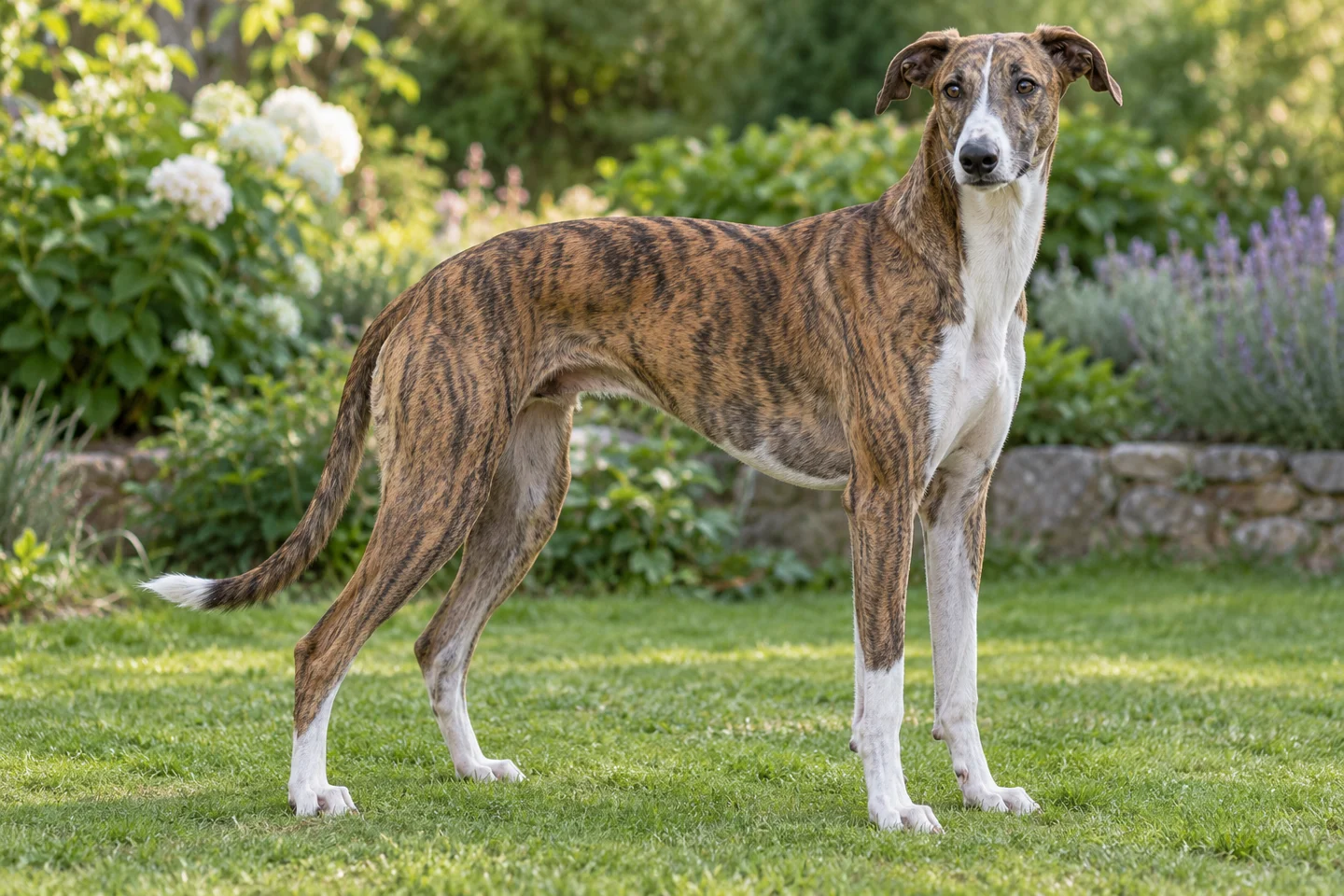
- Illustrated coat
- Brindle and white, short coat
General information for owners. These articles have not been reviewed by a veterinarian. Medical decisions need your dog's history and an examination.
Know which greyhound you are meeting
The Hungarian Greyhound, or Magyar Agár, is a distinct breed. It should not be treated as another name for the Greyhound or as a cross created whenever a Hungarian dog resembles a racer. Ask a breeder or rescue how identity is documented and what is known about the individual. A pet owner's practical questions concern secure exercise, everyday handling, other animals, and the ability to rest at home. The answers need observation and history alongside any registration record.
The FCI describes a Hungarian hunting and coursing dog that uses sight while also having a useful nose. Its history records nineteenth-century crossing with other sighthounds to increase speed. That account supplies context without establishing that a modern companion has already learned recall, travel, or urban manners. Ask how the adults live between activities and what a puppy experiences before placement. If the dog comes from a working or sporting environment, discuss the transition to your particular household. An owner's hopes for quiet evenings should be matched by a plan for the rest of the day.
A stronger outline than a racing stereotype
FCI ideal heights are 65–70 cm for males and 62–67 cm for females. The standard emphasizes overall balance and describes substantial bone, a deep ribcage, broad muscular loin, and large rose ears. The coat is short and dense, and the illustrations use brindle and white. A long tail hangs low at rest. Those features help distinguish the breed's general outline, but an illustration cannot confirm an animal's ancestry or whether a particular body condition is appropriate.
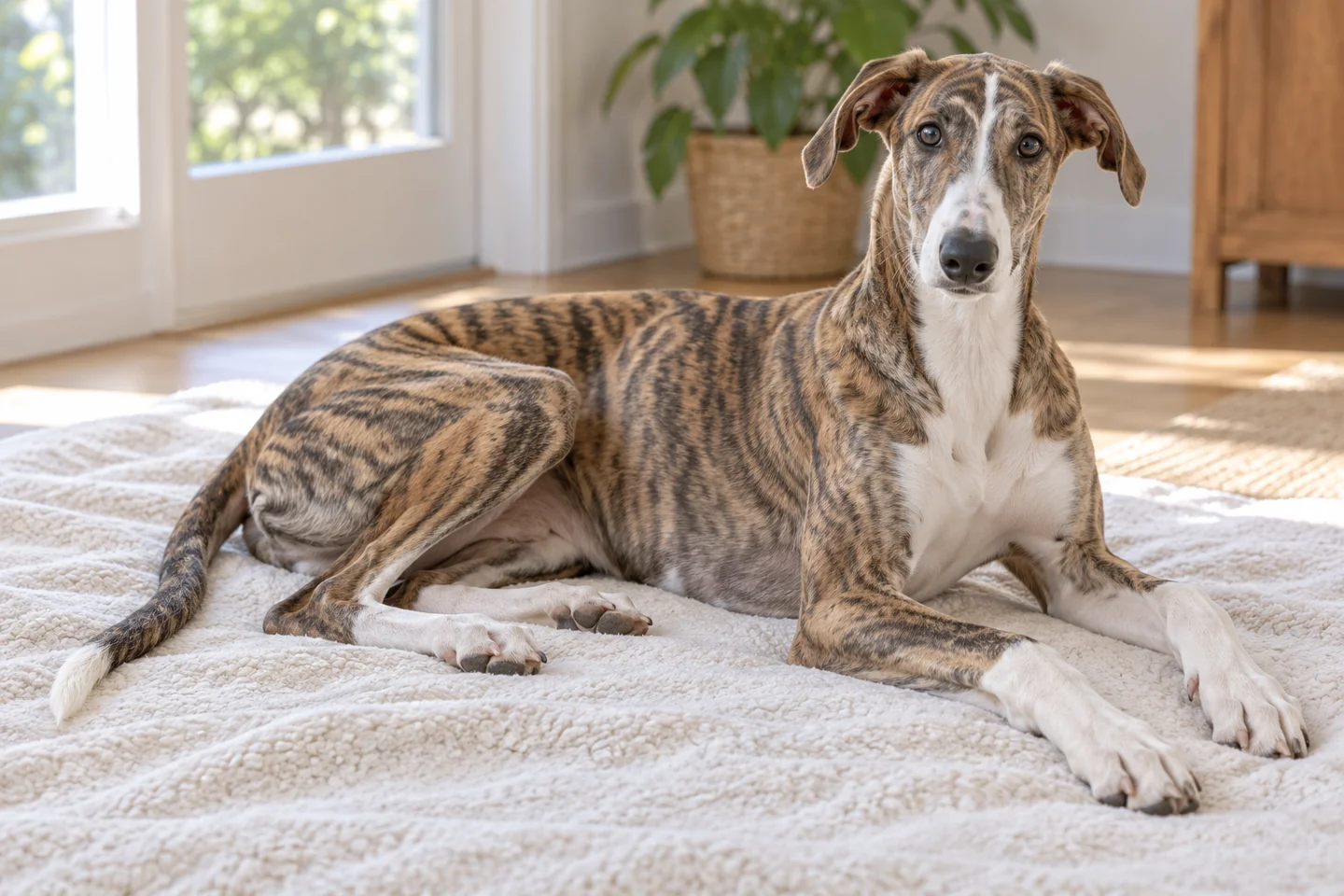
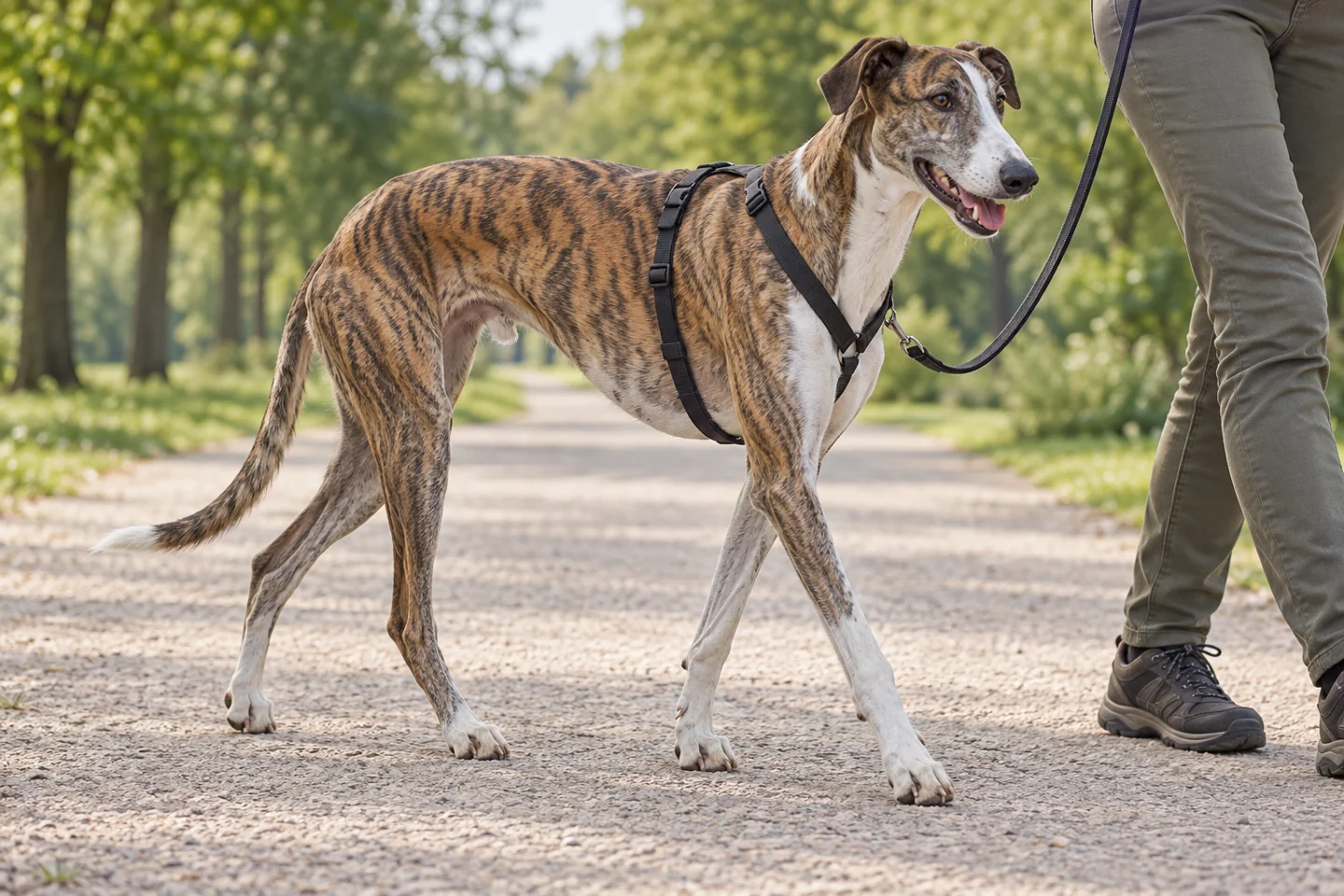
Plan space for a tall dog to stretch out and turn comfortably. Check the vehicle restraint area with the adult's actual measurements and provide a bed clear of busy walkways. Equipment needs individual fitting around a deep chest and narrower head. Ask a knowledgeable professional to demonstrate how to prevent a backward escape without overtightening straps. Do not add weight to make the dog look powerful or restrict food merely to create a pronounced racing silhouette. Your veterinary team's examination can guide condition and muscle assessment more usefully than comparison with a single photograph.
Home life begins with observation
A reserved first response does not necessarily mean a dog wants to be persuaded into contact. Give an unfamiliar Magyar Agár room to watch and approach in its own time. Ask visitors to avoid leaning over it or reaching directly for its face. Provide a resting place where people will not repeatedly step across it. Notice which interactions the individual chooses and which it attempts to leave. The standard's description of intended temperament is not a substitute for this daily information.
Learn the dog's quiet behaviors as well as its active ones. Does it sleep when the household settles, remain comfortable behind a gate, and recover after a delivery? If those skills are missing, teach them gradually instead of assuming exercise will resolve every difficulty. A short diary can help identify patterns: time of day, people present, preceding activity, and what made rest easier. Discuss persistent distress or a marked change with your veterinarian and an appropriate behavior professional. Clear observations make it easier to distinguish a training need from a situation that requires broader assessment.
Exercise that allows speed safely
Arrange opportunities for appropriate movement in places where access and boundaries can be checked. Before using an enclosed field, inspect gates, gaps, footing, and anything the dog could collide with. Other animals or people may change whether the space is suitable that day. A sighthound's capacity for speed makes the consequences of a poor choice more immediate. Keep reliable control near roads, livestock, and wildlife rather than using an exciting chase as an informal assessment of recall.
Build fitness in steps and judge the response after activity as well as during it. A puppy, an older dog, or an adult returning after injury needs a plan suited to its stage. Ask your veterinarian before starting sustained running or demanding sport. Warm weather, hard surfaces, and unfamiliar terrain can require an easier outing. If the dog becomes distressed, stop and obtain advice. Enthusiasm does not rule out discomfort. Keep a practical alternative for days when free movement is unsuitable, such as a controlled exploratory walk or a quiet search in a secure area.
Training a return before testing a chase
Begin return practice somewhere quiet and enclosed. Reward turning toward you and arriving, and avoid making the cue predict only the immediate end of every enjoyable activity. Gradually practice around manageable distractions with appropriate supervision. A long lead can assist in a suitable setting when used correctly, but its length also creates handling and tangling risks. Get instruction if you are unsure how to use it with a fast dog. Never attach a long line and then invite a full-speed sprint to its end.
Teach practical skills that prevent avoidable struggles: standing for equipment, following a turn, waiting briefly at an exit, and settling during a pause. AVSAB recommends reward-based methods. A dog distracted by movement needs a clearer, easier learning arrangement rather than an escalating correction. Ask which cue the animal already knows and use it consistently between carers. Record the places where a skill works so that confidence does not outrun training. A response achieved in the garden should not be treated as ready for an unfenced area containing running animals.
Socialization and the transition into unfamiliar places
For a young Magyar Agár, plan safe exposure with your veterinary team while preventive care is developing. Let it observe normal activity from a comfortable distance and give it a way to leave. A calm encounter with one person can be more useful than several forced greetings. Introduce travel, surfaces, and household noises in manageable stages. Avoid arranging every new experience in the same exhausting afternoon. If a puppy repeatedly becomes frightened or cannot recover, seek help rather than intensifying exposure in the hope that it will give up reacting.
An adult may need specific teaching about the environments it has never used. Ask a previous carer about steps, smooth floors, traffic, and being alone. Provide secure footing and a simple route through the first rooms. Keep early outings predictable, then add difficulty as the dog shows comfort. Explain the plan to visitors so they do not undermine it with well-meant pressure. The purpose is to build usable familiarity. A dog that tolerates one event while unable to move away has supplied different evidence from a dog that comfortably chooses to participate.
Prepare travel in the same gradual way. Let the dog investigate the stationary vehicle safely, practice entering with appropriate support, and keep the first journeys purposeful and manageable. Secure it before opening a door at the destination. A tall hound can emerge quickly if an excited person opens the vehicle without checking the restraint. Explain the loading sequence to every carer and rehearse it during calm conditions. If nausea, fear, or discomfort interferes, ask the veterinary team to help identify the problem rather than repeatedly extending the journey.
Aggression and warnings around resting places
Any dog can threaten or bite in a particular situation. A quiet manner or a sighthound label cannot guarantee otherwise. Pay attention if the animal stiffens when someone approaches its bed, guards an item, or snaps during handling. Stop the approach, provide space, and prevent another confrontation while obtaining advice. Record what the dog had, who moved toward it, and whether it could retreat. Avoid asking another person to repeat the event as a test of whether the warning was serious.
New sensitivity needs veterinary attention, especially if rising, turning, or touch seems uncomfortable. A behavior professional can help assess the pattern and design humane management in coordination with clinical care. Do not punish warning signals or take possessions by force. Teach voluntary movement away from a resting area during comfortable practice rather than pulling a tired dog off furniture. If muzzle use forms part of an advised plan, introduce an appropriate basket gradually and preserve room to pant. Equipment should support safer choices, not justify placing the dog in a conflict it cannot handle.
Children around a tall, resting hound
A Magyar Agár's height brings its head and body close to children even when it is simply moving through the house. Keep active games away from narrow passages and give the dog a place where children cannot disturb its rest. An adult should supervise interaction actively. If attention is divided, separate them comfortably. Explain that a dog turning or walking away has ended the contact. Children should not hug, climb on, wake, or remove objects from the animal.
Choose activities that fit both participants. An adult can manage the lead while an older child helps select a quiet route or prepares a small search elsewhere. Avoid making fast running and pursuit the default game. Ask a source to describe any previous experience with children precisely, including ages and circumstances. A dog relaxed around a familiar school-age child may have no experience of a toddler's sudden movements. If history is missing, acknowledge it and arrange a placement assessment with that uncertainty in view. A favorable general reputation does not resolve an individual safety question.
Cats, wildlife, and the distinction between familiarity and safety
A dog that hunts by sight needs careful assessment around smaller animals. Ask about actual responses to cats, birds, and other moving animals, including what happened outdoors rather than only in a quiet room. Familiarity with one resident cat does not establish safety around an unfamiliar cat running through the garden. Keep barriers reliable and give a household cat protected routes and resting places. Do not release the dog to discover whether a chase will occur. Some combinations need ongoing separation, and some homes will be unsuitable.
Maintain similar care on walks near wildlife or farm animals. A lead or appropriate enclosure allows you to choose an activity without putting another animal at risk. Practice calm observation from enough distance that the hound can still respond. If it becomes fixed on movement, leave rather than remaining close until control fails. Explain these arrangements to everyone who walks the dog. A sitter should know the actual route and equipment plan, not receive only a general statement that the dog usually ignores animals when its owner is present.
Grooming a short coat and protecting comfortable skin
The short dense coat still needs regular inspection and gentle maintenance. Use a tool suited to the individual and check the skin as you remove loose hair or debris. Pay attention to areas beneath equipment, between toes, and around any spot the dog repeatedly licks. A short coat makes some injuries easier to see, but it does not prevent irritation or trapped material after an outing. Ask a groomer or veterinary nurse to demonstrate comfortable handling if the animal finds routine care difficult.
Introduce bathing, toweling, and foot checks in separate small steps. Use suitable products and seek advice when a persistent skin problem changes the normal routine. Report odor, redness, hair loss, or tenderness instead of applying stronger products without a diagnosis. Check the bed and resting surface for friction or pressure concerns when the dog spends long periods lying down. A comfortable place to rest and a manageable care routine are everyday welfare decisions. They also help another carer notice a change rather than assuming a new sore area is normal for a lean hound.
Health questions about eyes, thyroid, and seizure history
The North American Magyar Agár Association's breed account reports epilepsy, thyroid disease, and progressive retinal atrophy in some individuals or lines. That is a reason to ask focused family questions, not to assign a prevalence figure to the entire breed. Ask whether either parent or a sibling has had a diagnosed seizure disorder, thyroid condition, or retinal disease, and how the source followed up. A useful answer identifies the affected relative and veterinary finding. It should not turn an unexplained collapse into epilepsy or treat any eye test as excluding every retinal problem.
For a puppy, review the source's eye and other screening documentation before making the placement decision. For an adult, ask whether any change in vision has altered navigation at dusk or whether a thyroid problem is being treated. These are history questions for a clinician, not instructions to diagnose from behavior. Keep the medication name, current veterinary instructions, and previous investigations together. A sporting demonstration cannot answer those clinical questions, and the absence of a complaint during activity is different from documented assessment.
The association encourages recording health findings through established schemes. Ask which program and current recommendations the breeder uses, then have unfamiliar reports interpreted. Do not substitute a Greyhound checklist simply because both are sighthounds. The practical outcome should be a clear account of what is known about this family and a plan for matters that still need examination.
Food, costs, and choosing realistic support
Feed a complete diet appropriate to life stage and review the amount with your veterinary team. Learn to assess condition on this individual rather than assuming every visible rib is either desirable or a problem. Include training food in the daily record and keep instructions consistent across the household. Ask before using supplements to increase muscle or speed. A dog's sporting background does not create a universal feeding formula. If weight or appetite changes unexpectedly, investigate the cause rather than continually adjusting portions without a plan.
Obtain local prices for routine veterinary care, food, transport equipment, training, and suitable holiday care. Read insurance conditions and decide how an urgent bill would be handled. Ask potential carers to meet the dog and understand its movement and animal-management needs. A source should discuss support after placement and how a failed match would be managed. If secure exercise, transport, or competent backup care is unavailable, resolve that before adoption. A large resting space alone cannot supply the daily arrangements a fast, observant hound needs.
Mixes and dogsDating plans for a Magyar Agár
A Hungarian Greyhound mix is not automatically a recognized variety of either parent. Separate documented ancestry from a visual guess, and ask about the actual dog's size, coat, handling, and animal responses. Known parents warrant relevant health questions for both, while an unknown history should remain clearly described. Crossing breeds does not guarantee an average temperament or remove inherited risks. For a companion placement, use observed needs to decide whether the household can provide a suitable routine.
On dogsDating, describe the individual and choose a public meeting point using an approximate area. Keep your home address and exact coordinates private. Agree on a quiet route with enough room for two adult handlers to walk apart. Begin without shared toys or a demand for direct greeting. If either dog becomes fixed, tense, or persistently avoidant, increase distance or finish. Record how the walk actually went and use that information for any next arrangement. Comfortable parallel walking can be the entire purpose of a useful match; racing or physical play is optional.
Sources and editorial notes
Sources checked October 21, 2026. Breed measurements describe reference ranges, not a diagnosis or an individual dog's ideal weight. Images are AI-generated breed illustrations and do not document a particular dog or health condition.
- AVSAB: Humane Dog Training Position Statement
- VCA Animal Hospitals: Food aggression in puppies
- Orthopedic Foundation for Animals: CHIC health screening programs
- VCA Animal Hospitals: Aggression toward unfamiliar dogs, diagnosis
- VCA Animal Hospitals: Grooming and coat care for your dog
- AAHA: Feeding plans for healthy, appropriate weight cats and dogs
- VCA Animal Hospitals: Heat stroke in dogs
- AVSAB: Puppy Socialization Position Statement
- VCA Animal Hospitals: Dog behavior problems, aggression toward children
- Fédération Cynologique Internationale: Hungarian Greyhound official breed standard
- North American Magyar Agár Association: Breed description and health
Keep getting to know dogs.
Read another guide or return to your dogsDating community.
Explore breed guidesBack to dogsDating