Bergamasco Sheepdog
An Italian sheepdog whose care requires informed flock development, skin access, practical drying and handling, suitable activity, and clear joint-screening records.
How these guides are researched and reviewed
- Origin
- Northern Italian sheep-working background
- Coat
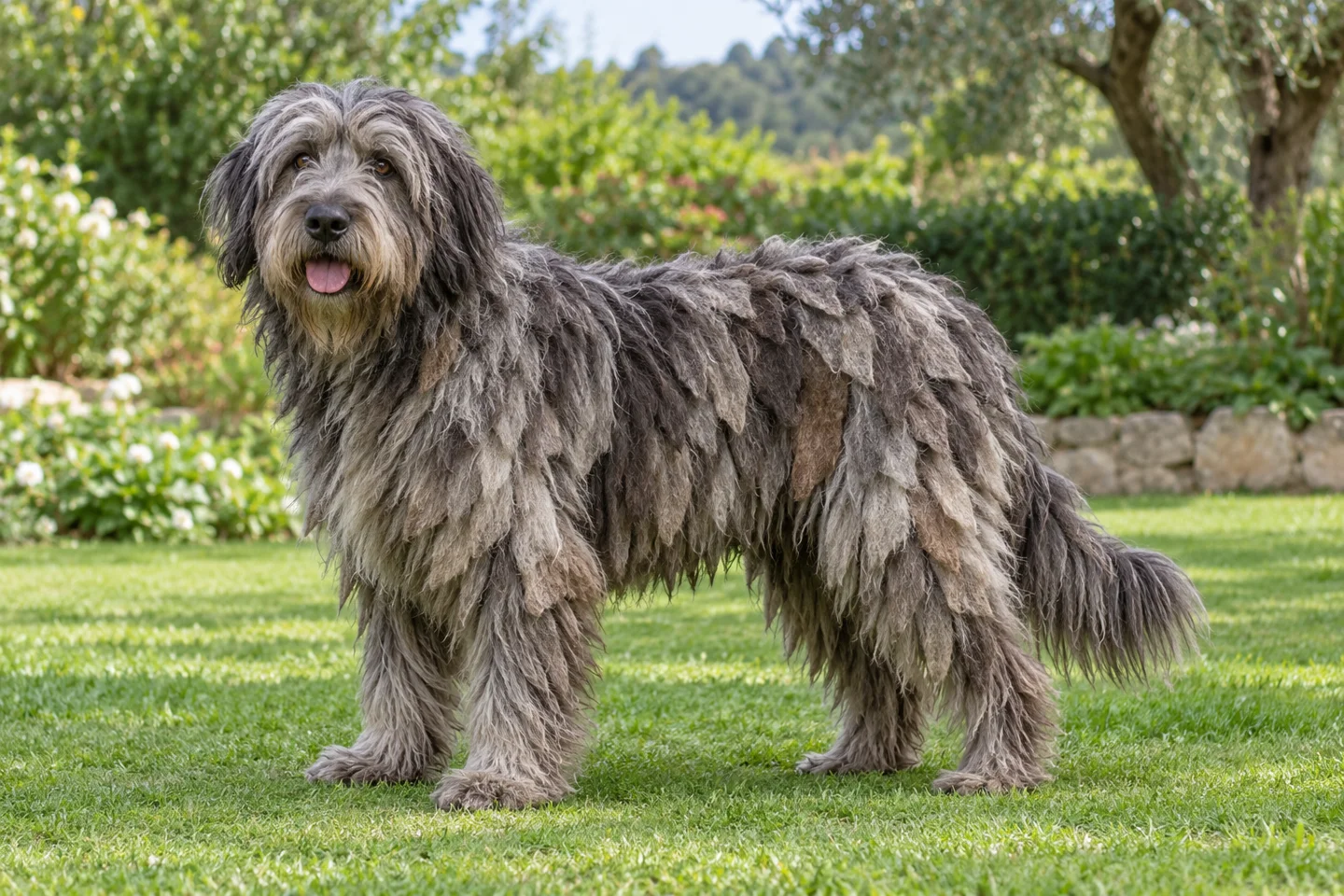
- Adult broad felted flocks; fluffy puppy coat
- Care priorities
- Coat development, skin, drying, and cooperation
General information for owners. These articles have not been reviewed by a veterinarian. Medical decisions need your dog's history and an examination.
Choosing a Bergamasco Sheepdog
A Bergamasco Sheepdog needs an owner prepared to learn its developing coat, provide suitable activity and company, and teach comfortable everyday cooperation. The adult flocks can dominate first impressions, but they are one part of a dog's care. Consider your actual week before adopting. Decide who will inspect skin, manage wet outings, provide walks, supervise introductions, and help the dog rest. A description of low maintenance can be misleading when it is interpreted as permission to ignore coat development or ordinary health care.
Meet adults and ask to see routine handling as well as a striking photograph. Find out how the dog settles, travels, responds to visitors, and spends short periods without familiar people. A puppy's soft coat can give little warning of the learning required later. An adult with a well-described home history may provide useful information for some households. Choose according to the individual and your ability to maintain care over years, rather than assuming an unusual coat predicts either difficult behavior or universal patience.
An athletic dog under broad flocks
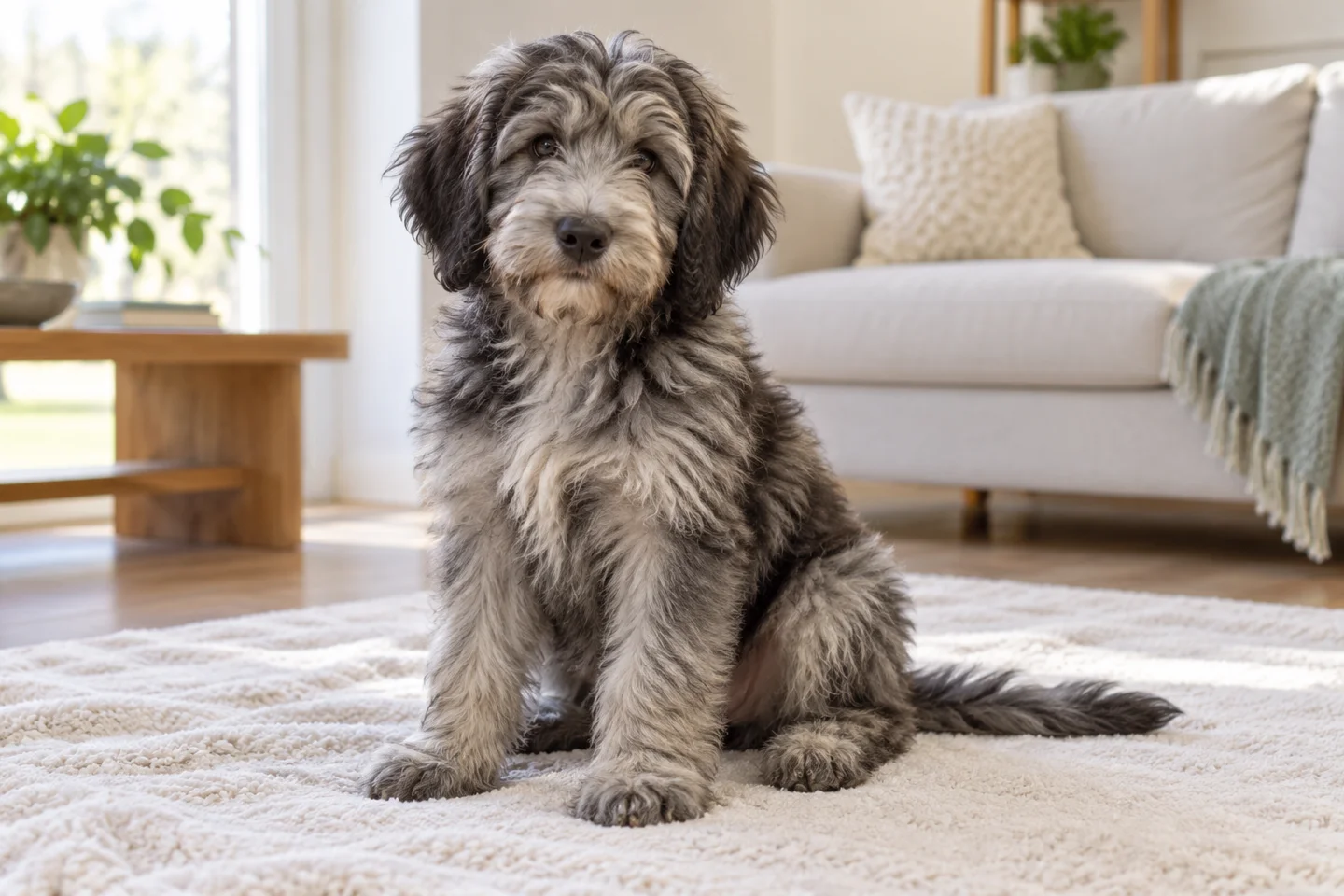
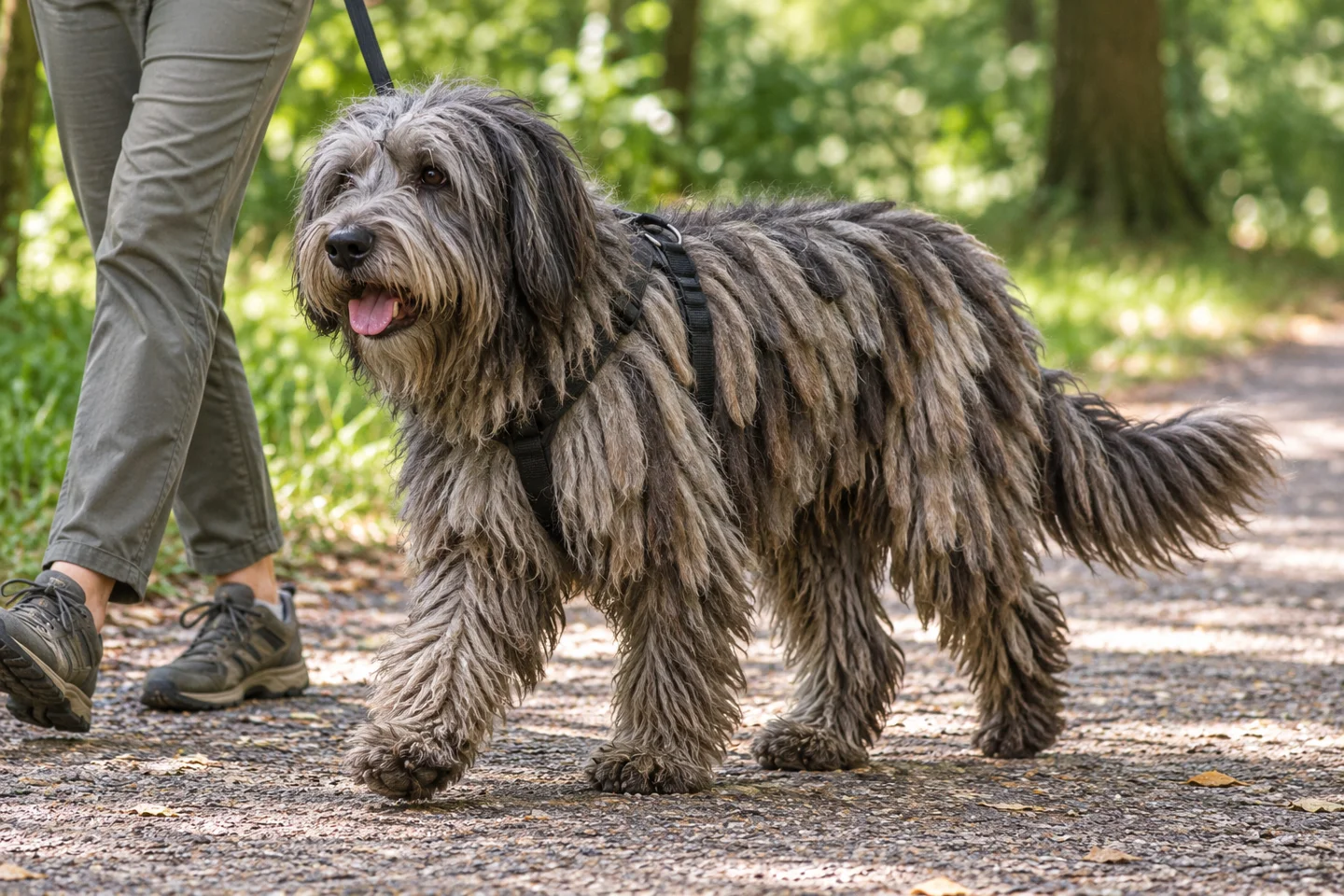
The breed has a substantial, functional sheepdog outline, natural dropped ears, and a long tail. The adult coat forms broad felted sections called flocks, which differ from the more cylindrical cords readers may know in other breeds. The illustrations show generated examples, including a fluffy puppy before adult coat formation. They are not documentary records or medical reference images. A single illustration cannot represent every stage, color, texture, or grooming choice, and coat appearance alone cannot establish healthy skin.
Watch the real dog move, turn, rise, and recover after activity. Use hands as well as sight to assess body condition beneath the coat, with a veterinarian demonstrating ribs, waist, and muscle checks. Persistent stiffness or repeated limping needs investigation even when the dog remains keen to accompany people. Fit equipment to actual measurements and check contact areas carefully. A growing puppy needs repeated adjustment, and developing coat can change apparent fit. Teach standing for care before body handling becomes more time-consuming.
Puppy coat and the transition to flocks
A Bergamasco puppy begins with a softer coat that changes during development. As different hair textures develop, sections begin to combine. Ask an experienced breeder or groomer to show what healthy formation looks like on this individual and how to separate developing flocks without pulling painfully at the skin. The timing and amount of work can vary. Avoid relying on one photograph or a rigid age deadline to decide whether the coat is progressing correctly.
Arrange support before the transition rather than waiting until large areas become difficult to inspect. Ask how to check roots, movement between sections, and sensitive body areas. A neglected tangled coat is not equivalent to properly managed flocks. The owner needs continued observation and suitable maintenance, even when daily brushing differs from the routine for a long feathered breed. If a task feels unclear or painful, stop and obtain a demonstration instead of experimenting with force or scissors close to hidden skin.
Grooming adult flocks and practical choices
Established flocks still need inspection. Check that sections remain appropriately separate and that the skin can be assessed, especially where equipment rests or moisture collects. Remove loose vegetation carefully and investigate persistent odor, redness, discharge, or sensitivity. An owner should know what the coat feels and smells like when healthy so changes can be described accurately. A claim that no brushing is needed should not become a claim that no ongoing care or professional advice will ever be necessary.
Companion care can involve practical choices about length or clipping, discussed with someone who understands the coat and the dog's circumstances. Breed organizations differ in how they describe presentation, while medical needs and comfort require individual judgment. Do not preserve an appearance at the expense of painful skin or unmanageable maintenance. A clipped coat also needs an ongoing routine, and the owner should understand how regrowth will be managed. Ask for clear instructions rather than assuming clipping either solves every problem permanently or is always forbidden regardless of welfare.
Bathing, drying, and skin access
Plan wet outings and bathing around the ability to dry the coat thoroughly and comfortably. Dense sections can retain moisture, so ask a professional to demonstrate suitable methods and equipment for the individual. Introduce dryers gradually with rewards and distance where needed. A brief surface drying does not necessarily show that deeper areas are ready for rest. Check beneath harnesses and around sensitive areas, and avoid leaving wet equipment in place simply because the outer coat appears resilient.
Persistent skin odor, redness, wounds, or discomfort needs veterinary advice. Do not assume every problem can be solved by another bath or by separating more coat at home. Tell the clinic about the coat and any handling difficulties before arrival so staff can prepare. A medical procedure may require access to a particular area, and the veterinarian can explain necessary changes. Cooperative care and accurate observations help without delaying assessment while an owner tries to preserve every flock or complete an extensive home examination.
Children and respectful contact
Children need active adult supervision with a Bergamasco. Prevent pulling flocks, hugging, climbing, and leaning over the face. Teach calm invitations and let the dog leave. Keep children away from meals, chews, and sleeping places. They should call an adult when something is beside the dog rather than attempting to move it or use the coat as a handle. A patient-looking demeanor or a breed description about children cannot establish tolerance of repeated unwanted contact.
Visiting children create different movement and noise from the usual routine. Use separation before energetic games when close supervision is impractical and provide a retreat children cannot enter. Watch freezing, turning away, hiding, or repeated efforts to leave. A dog should not have to escalate warnings to obtain space. Review arrangements when children become mobile or the dog develops pain. Comfortable behavior with familiar family members does not promise tolerance of every crowded gathering, unfamiliar friend, or sudden touch to a sensitive area.
Dogs, cats, and livestock
Assess dog compatibility individually. Begin introductions with parallel walking in suitable neutral surroundings and room to disengage. At home, separate resources and rest areas while observing comfort. Both dogs need pauses and the ability to leave. Repeated blocking or pursuit deserves interruption when the recipient is trying to rest. A substantial coat can make body signals harder for an unfamiliar observer to read, so allow enough distance and time to assess the whole interaction instead of assuming quietness means comfort.
Cats need gradual introductions and dog-free escape routes. Familiarity with one household cat does not predict safety with an unfamiliar animal running outside. Small pets require secure protection rather than a test of intentions. Stock work needs experienced instruction, suitable animals, and controlled facilities; ancestry does not teach a puppy the right amount of pressure. Stop access when stalking, fixation, or chasing appears and seek help. Reliable separation is necessary while deciding whether this individual and the home's resident animals can be accommodated safely together.
Aggression, handling discomfort, and warnings
Stiffness, freezing, growling, snapping, or attempts to retreat mean pressure should stop. Increase space and consider the context, including resources, rest, grooming, and escape routes. Avoid cornering the dog or repeatedly taking a valued object to establish control. Breed identity cannot determine safety in a particular encounter. Barriers and separate resources protect people and animals while the owner obtains an assessment rather than asking someone else to repeat the same unresolved pressure or test whether a warning is serious.
New irritability or coat-care sensitivity warrants veterinary examination. Pain and illness can affect tolerance before obvious loss of activity. Keep a factual incident record and consult a veterinary behaviorist or qualified reward-based professional for recurring threats. Punishing warnings can obscure risk while leaving discomfort or fear unresolved. A basket muzzle introduced gradually with rewards may add protection within an appropriate plan, alongside management and treatment. It cannot make painful grooming comfortable or replace supervision, suitable distance, and an opportunity to leave contact.
Exercise, rest, and time alone
Provide daily movement matched to age, health, and conditioning. Walks with investigation, scent searches, controlled games, and suitable training can create variety. Build endurance before long hikes or demanding sports, and discuss repeated high-impact exercise for a puppy with the veterinarian. Puppies need sleep and age-appropriate exploration. Watch gait and recovery rather than relying only on eagerness, and obtain assessment for persistent limping, reluctance to rise, or slow recovery after activity and rest.
Provide a comfortable sleeping area and a predictable finish to activity. Build short comfortable absences gradually and observe what happens after departure; a recording can reveal pacing, persistent calling, or escape attempts. Seek qualified help for distress rather than assuming another dog or more exercise will solve it. In heat, shorten outings and provide shade and water. Collapse or severe breathing difficulty requires urgent advice. A flocked coat does not remove the need for weather-aware decisions, suitable shelter, and an individual assessment of comfort.
Health screening and interpreting DNA results
The AKC lists hip and elbow evaluations and a common-variant degenerative myelopathy DNA test among national club recommendations for Bergamascos. Request identifiable reports for both parents and read dates, methods, and findings. A routine puppy examination answers different questions from formal adult screening. Ask how the breeder's current program accounts for significant illness in close relatives. A dog working comfortably today can still have a relevant inherited concern, while the existence of testing does not imply disease until the actual result is interpreted.
A degenerative-myelopathy risk result is not a diagnosis of every future movement problem. Weakness, incoordination, pain, or changes in gait need veterinary investigation, including other possible causes. A CHIC number records completion and disclosure of specified tests rather than guaranteeing normal results. Broad panels cover selected variants and cannot exclude all inherited or acquired conditions. For an adopted adult with missing records, acknowledge gaps and plan from current findings, alongside ordinary vaccination, parasite, dental, and travel considerations. New symptoms still need assessment regardless of earlier screening.
Feeding, mixes, and allergy claims
Use a complete diet appropriate to age and health, measure portions, and count training rewards within the allowance. A full coat can conceal change, so use hands-on body assessment and weight trends. Feed separately from children and other animals and teach exchanges without confrontation. Avoid supplements without a veterinary reason and seek qualified guidance for home-prepared meals. Persistent changes in appetite, thirst, weight, or digestion need assessment rather than repeated unplanned food switches or an assumption that a traditional working breed regulates every nutritional need automatically.
A Bergamasco mix can vary in size, coat development, activity, and social preferences. A felted coat cannot confirm ancestry, and mixed parentage does not guarantee easier maintenance or fewer inherited concerns. Ask what is documented and assess actual needs. No coat or cross guarantees tolerance for someone with allergies, because allergens are not confined to loose hair. Discuss personal concerns with the affected person's clinician and assess contact with the individual appropriately rather than relying on a low-shedding claim or an appealing crossbreed name.
Costs, later years, and dogsDating
Budget for suitable coat support, equipment, food, preventive care, training help, emergency treatment, and backup care. Arrange a trial stay with someone who understands skin checks and drying as well as walks and meals. Leave written routines and veterinary contacts. In later life, review footing, bedding, vehicle access, and recovery. New reluctance to rise or sensitivity during care can indicate pain. Know how the dog would reach urgent treatment if it could not walk normally, retaining suitable exploration and learning with physical demands adjusted to comfort.
For dogsDating, describe the dog's actual social history and preferred distance while keeping exact home coordinates private. Choose a quiet public route with room for parallel walking and separate adult handlers. Keep shared food and toys out of the first outing. Add space or end when either dog becomes stiff, overwhelmed, or persistently pursued. Allow pauses so both can disengage and recover. A pleasant walk gives information about that setting without proving comfort in a shared home, vehicle, or situation involving valued resources.
A coat-care handover and a realistic household budget
Invite the backup carer to a practical coat lesson before relying on them overnight. Show how to check the roots of established flocks, where equipment contacts the skin, and which changes need professional advice. Let the carer complete a small routine check while you remain available. Written instructions are useful, but a demonstration gives the person a clearer idea of normal texture and access than a photograph can provide.
Agree who will dry the dog after an unexpected wet outing and what equipment is actually available. A boarding facility may be comfortable with walks and meals while unfamiliar with flocked coat care. Ask specific questions before booking and arrange a short trial. If the stay cannot support a necessary routine, choose an alternative arrangement rather than assuming the coat can simply be left untouched until the owner returns.
Budget time as well as the cost of tools or appointments. A developing coat, a medical problem, or an older dog that needs shorter handling sessions can change the effort required. Review the routine periodically with the breeder, groomer, or veterinarian as appropriate. The household should be able to ask for practical help without feeling compelled to preserve a particular appearance at the expense of comfort, skin access, or manageable care.
A dated care record also helps the next professional understand which changes are recent and which features are normal for this particular coat.
Sources and editorial notes
Sources checked October 21, 2026. Breed measurements describe reference ranges, not a diagnosis or an individual dog's ideal weight. Images are AI-generated breed illustrations and do not document a particular dog or health condition.
- VCA Animal Hospitals: Hypoallergenic dog breeds
- Orthopedic Foundation for Animals: CHIC program and interpretation of numbers
- National Bergamasco Sheepdog Alliance: Flock care, skin access, and companion coat choices
- American Kennel Club: Bergamasco flocked coat and development
- VCA Animal Hospitals: Food aggression in puppies
- American Kennel Club: Relevant national breed-club health testing recommendations
- VCA Animal Hospitals: Heat stroke in dogs
- American Kennel Club: Bergamasco Sheepdog breed identity and care
- VCA Animal Hospitals: Aggression toward unfamiliar dogs, diagnosis
- AVSAB: Humane Dog Training Position Statement
Keep getting to know dogs.
Read another guide or return to your dogsDating community.
Explore breed guidesBack to dogsDating