Clumber Spaniel
A substantial low-built spaniel needing healthy weight, comfortable access, measured exercise, coat and ear care, and documented orthopedic, eye, and genetic screening.
How these guides are researched and reviewed

- Origin in the FCI standard
- Great Britain
- FCI ideal weight
- Males 29.5–34 kg; females 25–29.5 kg
- Outline
- Substantial, low, and rectangular
- Care priorities
- Weight, mobility, skin and ears, and suitable conditioning
General information for owners. These articles have not been reviewed by a veterinarian. Medical decisions need your dog's history and an examination.
Think about the step into the car
A Clumber Spaniel's low outline can make its substantial weight easy to underestimate. Before selecting one, consider a step into a vehicle, a flight of stairs, and the possibility of moving an injured adult to a clinic. Those ordinary tasks belong in the placement decision alongside its appealing face. A household should be able to provide comfortable access and regular activity without relying on repeatedly lifting the dog. Ask a veterinarian or experienced owner about practical equipment and how it would be introduced gradually.
Meet adults outside a posed photograph. Watch how they rise, turn, investigate, and settle after an outing. Discuss what care takes time and what medical issues have occurred in the family. An adult foster assessment can be useful for a person needing clearer information about handling, company, and house habits. A puppy's calm appearance during a short visit cannot establish its adult needs or future comfort. Select a source prepared to explain limitations and remain available when the dog develops or circumstances change.
Clumber identity and cautious historical claims
The FCI standard gives Great Britain as the origin and identifies the Clumber as a flushing dog. It links the name and development with Clumber Park while presenting parts of the earlier French account cautiously. Keep that distinction in a practical history: the established spaniel identity does not require every traditional origin story to be stated as proven fact. Recent family information about health, working use, and household behavior offers more direct help when deciding whether a particular placement is suitable.
The Clumber is distinct from Sussex, Field, Cocker, and Springer Spaniels. Predominantly white coloring and a heavy head are not enough to identify ancestry in an unrecorded rescue. Ask which registry issued the pedigree or how a visual label was chosen. A mixed dog may share some practical needs while remaining a mix. Whatever the label, assess actual size, movement, coat, and care tolerance. A familiar breed name should help organize useful questions rather than replace looking carefully at the individual animal.
A broad frame without making heaviness the goal
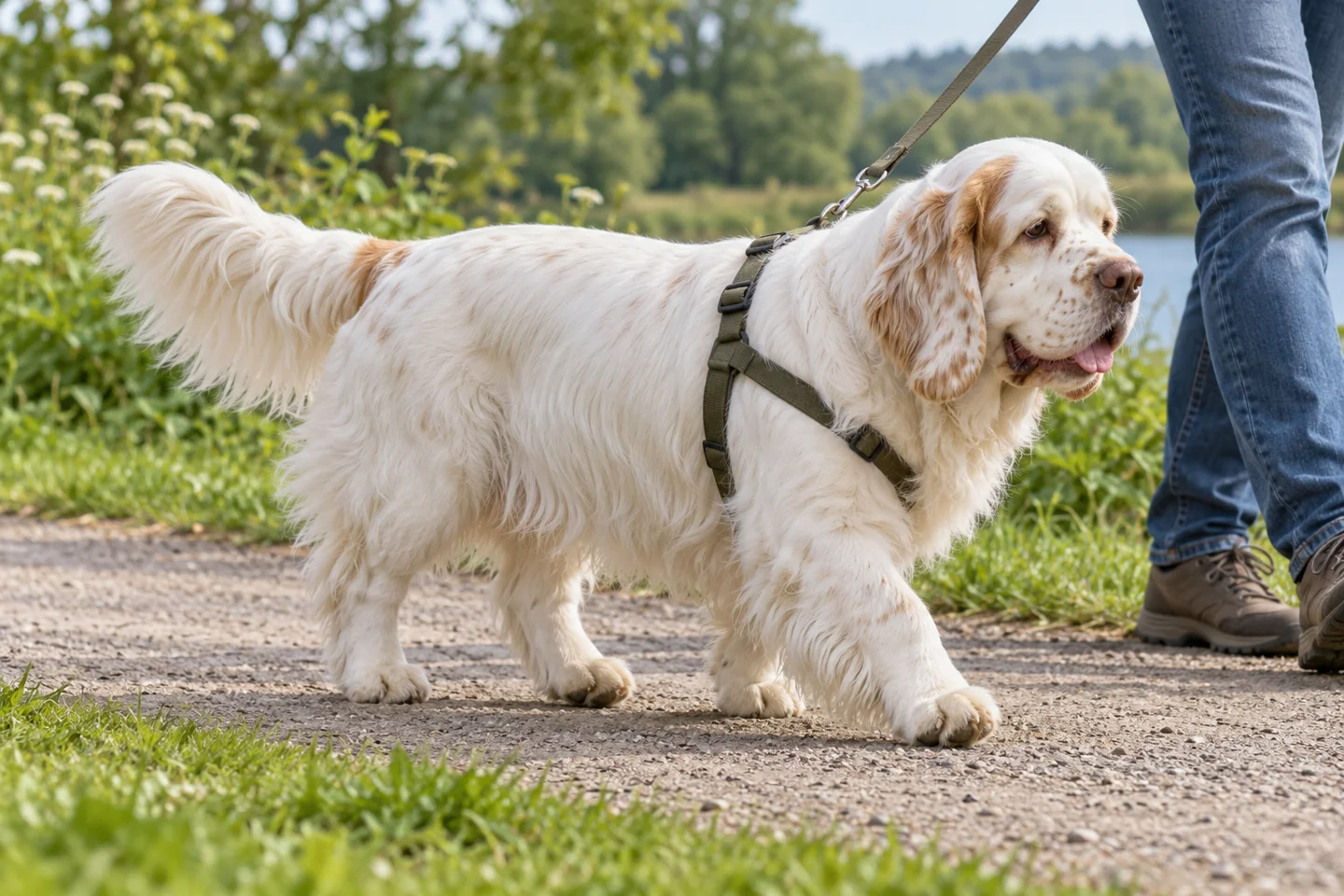
The breed has a substantial rectangular body, heavy bone, a broad head, and naturally dropped ears. The coat is predominantly white, with lemon or orange markings described by the standard. Illustrations here select restrained lemon head markings and an intact natural feathered tail. The standard's substantial outline is not an instruction to maximize weight. Watch for comfortable movement and visible eye comfort instead of rewarding an exaggerated appearance that makes ordinary activity harder.
Use hands-on assessment to distinguish body fat, muscle, and coat. A veterinarian can demonstrate an appropriate rib and waist check and help interpret changes during growth or aging. Avoid comparing a real dog only with heavily groomed photographs. Keep an accurate weight trend and note whether rising or walking has changed. An enthusiastic response to food or a toy cannot rule out discomfort. Ask about a persistent limp or hesitation rather than assuming a heavy spaniel is naturally expected to move reluctantly.
FCI ideal weights are 29.5–34 kg for males and 25–29.5 kg for females. These substantial figures help explain the importance of access and emergency transport, but they should not encourage feeding an individual to a number. Body condition, frame, and medical findings determine what is appropriate for the dog in front of you.
Access, flooring, and practical transport
Introduce a stable ramp or low step gradually if it helps the individual enter a vehicle or reach an approved resting place. The surface needs traction and the setup must fit the real location. A loose board or steep improvised ramp can create a frightening fall. Reward small voluntary steps and let the dog learn without urgency. Secure it appropriately during travel and confirm that it can lie down comfortably. Car space should be measured with the dog in mind, not merely described as suitable for medium breeds.
Inside, provide nonslip routes and a bed positioned away from narrow traffic areas. Stairs and jumping may need restrictions according to age, health, or veterinary advice, but access decisions should be individual. A puppy should not rehearse uncontrolled drops simply because it is still easy to carry afterward. Plan how another adult would help if the usual owner were unavailable. Written instructions, equipment practice, and accessible clinic details become especially valuable when an unexpected injury makes ordinary loading impossible.
Scent and retrieval in a manageable routine
A Clumber remains a sporting spaniel even when its usual pace appears measured. Offer opportunities to investigate scent, search for a suitable object, and learn retrieval cooperatively. Hide a toy in easy cover rather than relying only on repeated fast throws. Keep the search area safe and choose objects that cannot be swallowed or fragment easily. The point is useful engagement at the dog's level, not a demonstration that every companion must reproduce a hunting performance.
Teach bringing and releasing through rewarding exchanges before a stolen object creates conflict. Secure laundry, medicines, food packaging, and children's toys while the habit develops. Chasing the dog and forcing its mouth open may encourage swallowing or guarding. If a dangerous item has been swallowed, contact a veterinarian promptly rather than relying on a training cue. A well-organized home gives the spaniel legal opportunities to carry things and reduces the number of moments in which people must intervene urgently.
Exercise with fitness and recovery in view
Build activity steadily through ordinary weeks. A substantial low-built dog needs regular comfortable movement, while forced distance or repetitive impact is not a shortcut to fitness. Consider age, medical findings, surface, weather, and previous conditioning. Ask for guidance if the dog has been inactive or has a known mobility concern. Observe the evening and following morning as well as the outing itself. Stiffness or a changed gait after rest can be useful information even when the dog was keen to continue outdoors.
Choose cooler times in warm weather, bring water, and allow pauses. Do not use the breed's working background to justify pushing through reluctance or obvious fatigue. Collapse or marked respiratory distress needs urgent veterinary contact. On less suitable days, a gentle search, short training session, and manageable walk can preserve occupation without an exhausting physical demand. A garden alone does not show that meaningful exercise occurs, and a long weekend outing cannot make a consistently sedentary week medically appropriate.

Children beside a low substantial dog
The Clumber's head may be conveniently close to a small child's face, which calls for clear boundaries. Prevent neck-hugging, climbing, grabbing ears, and leaning over a resting dog. Give the spaniel a private bed away from the route to the kitchen or bathroom. A child should not need to step over it. An adult must observe closely enough to notice withdrawal, stiffening, or an attempt to leave before a child follows and removes the dog's option for distance.
Keep meals and chews protected. Adults should retrieve a child's object if the dog takes it, using an appropriate plan rather than asking the child to reach toward its mouth. Calm supervised searches can give children a useful role without physical struggle. Separate before noisy visiting games when close supervision is impractical. Prior comfort with a familiar child is valuable history but does not establish safety under every condition, especially if the dog is tired, sore, startled awake, or crowded by several unfamiliar people.
Aggression and a spaniel's warning
A calm-looking Clumber can still guard a chew, object to painful handling, or react defensively to pressure. If the dog freezes or growls, stop the approach and make space. Repeatedly reaching to prove authority does not teach a safe exchange. Arrange separate resources and prevent access to unresolved conflicts while a qualified professional helps assess the behavior. Children should not be involved in training around a threat. The first task is protecting people and animals, followed by understanding what needs to change.
AVSAB recommends reward-based methods. Punishing a warning can leave fear or discomfort in place while making the signal harder to recognize. A sudden objection to brushing, lifting, or foot care needs veterinary attention. Record incidents accurately, including the setting, approach, object, response, and any injury, so professionals and carers have practical information. Labels such as stubborn or placid are insufficient. A household needs a plan that remains workable when the usual handler is absent or a necessary treatment cannot be postponed.
Training body cooperation before a care problem
Teach a comfortable stand, a chin rest, moving onto a mat, and approaching a harness in small rewarded steps. Those skills help a substantial dog take part in examination and grooming without every task requiring physical restraint. Begin away from painful episodes and coordinate with the veterinary team when treatment is necessary. A dog may need a different position or shorter session because of discomfort. Completing a task while it struggles does not demonstrate that the procedure has become comfortable.
Lead skills and door pauses also deserve regular practice. Reward a slack lead and checking in before pulling becomes the normal way to reach a smell. Choose a quiet location and add distractions gradually. If the dog stops responding beside birds or another dog, increase distance and simplify the lesson. An instructor can help improve reward timing and task design. Sporting identity does not justify harsh equipment or an expectation that the dog should understand a cue that has never been taught in that environment.
Grooming the white feathered coat
Brush and comb through the coat rather than maintaining only a clean surface. Feathering, areas behind ears, and hair beneath equipment can retain tangles or debris. After outdoor activity, check the feet and underside before vegetation tightens into mats. A practical trim may simplify companion care, but skin still needs inspection. Ask a groomer to demonstrate tools and handling that suit the individual. Coat appearance should not take priority over comfort when the dog cannot stand for a prolonged session.
Dry damp areas thoroughly, including places where ears or skin contact can retain moisture. Persistent odor or redness deserves investigation instead of perfume or repeated unplanned product changes. If a mat is tight against skin, obtain professional help rather than cutting blindly with scissors. Introduce the grooming surface and tools calmly, with rewards and breaks. Tell professionals about mobility or handling concerns before arrival so the appointment can be arranged realistically. A shorter comfortable session may achieve more useful maintenance than a struggle to finish everything at once.
Ears, eyes, mouth, and daily observations
Naturally hanging ears need gentle observation. Pain, discharge, repeated scratching, or head shaking should prompt veterinary advice, not deep cleaning with swabs or reuse of a previous prescription. A dog may have a different cause for a new episode even when the signs seem familiar. Watch eyes for squinting, redness, cloudiness, or discomfort and seek prompt attention. A familiar drooping expression should not normalize an inflamed or painful eye. Necessary medical care should not wait for perfect home-handling skills.
Prepare for toothbrushing and nail care through brief cooperative practice. The veterinary team can demonstrate suitable products and a workable technique. Eating readily does not exclude oral pain, and nails hidden among feathering still affect comfortable movement. Notice repeated licking, a changed chewing pattern, or new resistance to a familiar touch. These observations are useful to report even if the dog appears cheerful during an appointment. Avoid deliberately provoking the symptom to make a dramatic demonstration; describe the circumstances and provide a safe recording when appropriate.
Health screening and PDP1 documentation
The AKC currently lists hip, elbow, and ophthalmologist evaluations and a DNA test for pyruvate dehydrogenase phosphatase 1 deficiency, abbreviated PDP1, for Clumber Spaniels. Ask for the parents' identifiable reports and have unfamiliar results explained by a veterinarian or laboratory. A statement that a puppy has been checked does not establish those parental assessments. Discuss orthopedic treatment, eye disease, and other significant diagnoses in close relatives, together with the breeder's follow-up and support when owners report a later problem.
A PDP1 report addresses a named inherited concern; it does not explain every future episode of weakness or certify the whole dog free of disease. New symptoms need an individual examination. Likewise, a parent hip evaluation does not make a puppy's current limp harmless. Keep records and treatment summaries accessible if care moves between clinics. For a rescue with unknown family information, acknowledge the gap and plan from present findings. A substantial appearance or reassuring temperament is not medical evidence that formal screening took place.
Feeding, mixes, costs, and dogsDating
Choose a complete diet for life stage and expected adult size, measure portions, and monitor condition beneath the coat. Avoid feeding for maximum bulk or accelerating puppy growth. Include training food in the total and seek advice for persistent appetite or digestive changes. Clumber mixes can vary in size, coat, activity, and health needs; a combined name does not standardize outcomes. Budget for grooming, preventive care, mobility support when necessary, dependable holiday care, and unexpected treatment throughout the dog's life.
On dogsDating, state comfortable walking pace, play style, lead needs, and relevant mobility or handling limits. Keep exact home coordinates private. Choose a quiet public route with space to separate and begin with a short parallel walk. Avoid repeated fast collisions or toys that could create competition. Let either dog pause or leave. A calm shared outing can be enough, while future meetings should follow the individuals' continuing comfort and recovery rather than an assumption that every friendly spaniel wants vigorous play.
A carer who can manage the adult comfortably
Visit a potential boarding arrangement before a long absence and discuss access, flooring, transport, and rest. A facility may welcome spaniels while still relying on high steps or busy group play that does not suit this dog. Demonstrate equipment and explain the actual routine, including any medication or veterinary restrictions. A brief trial can show whether the Clumber eats, sleeps, and settles comfortably away from home. Leave contacts and clear instructions about when to call the clinic rather than expecting a carer to interpret a change without background.
Sources and editorial notes
Sources checked October 21, 2026. Breed measurements describe reference ranges, not a diagnosis or an individual dog's ideal weight. Images are AI-generated breed illustrations and do not document a particular dog or health condition.
- AVSAB: Humane Dog Training Position Statement
- VCA: Food Aggression in Puppies
- VCA: Grooming and Coat Care for Your Dog
- VCA: Ear Infections in Dogs
- VCA: Feeding Guidelines for Dogs
- Orthopedic Foundation for Animals: Canine Health Assessments
- VCA: Common Emergencies in Dogs
- VCA: Heat Stroke in Dogs
- American Kennel Club: Sporting Group Health Testing Requirements
- FCI: Clumber Spaniel Breed Standard
Keep getting to know dogs.
Read another guide or return to your dogsDating community.
Explore breed guidesBack to dogsDating