English Cocker Spaniel
A British flushing spaniel whose active companionship, feathered coat, ear care, and documented family health information need a consistent everyday routine.
How these guides are researched and reviewed
- Origin
- Great Britain
- Adult height
- Males about 39–41 cm; females about 38–39 cm
- Approximate adult weight
- 13–14.5 kg
- Illustrated pattern
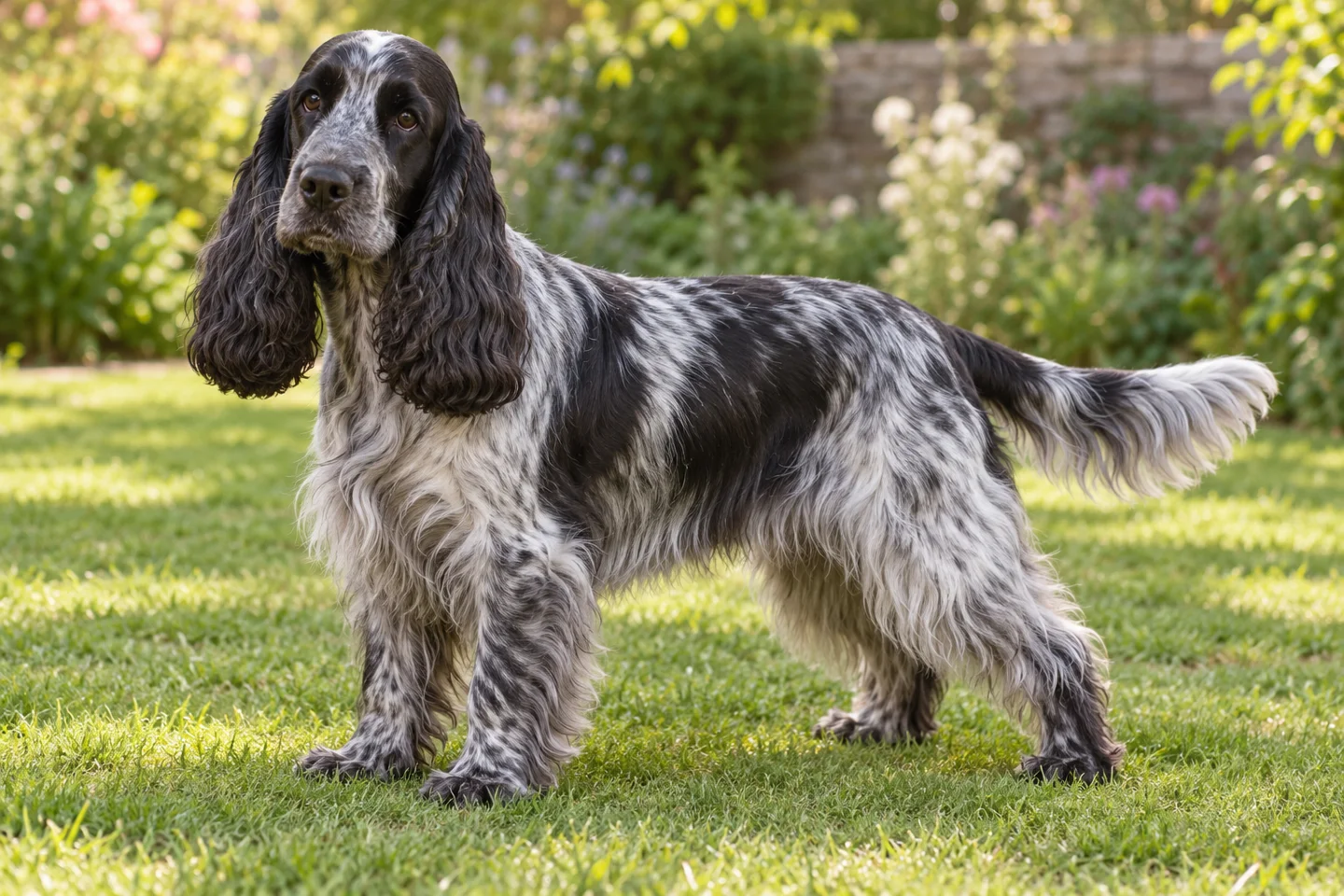
- Blue roan with a long natural feathered tail
General information for owners. These articles have not been reviewed by a veterinarian. Medical decisions need your dog's history and an examination.
An English Cocker needs time beyond the walk
An English Cocker Spaniel can be an engaging companion for someone who enjoys outdoor activity and patient daily care. Before choosing one, consider the whole routine: teaching recall, working through feathering, checking ears, arranging company, and helping the dog settle after excitement. A compact body does not eliminate those jobs. Meet adults and ask what happens on an ordinary weekday, including when people leave and when wet weather makes coat care more demanding. The suitable dog is the one whose real needs fit the home you can sustain.
Tell a breeder or rescue about your working hours, children, other pets, and access to secure exercise. Ask what has been observed about the individual and its close relatives. Do not assume that every cheerful puppy will become an easy adult without teaching. A source should discuss medical records, everyday behavior, support after placement, and return arrangements clearly. For a rehomed adult, learn which routines are established and which are unfamiliar. That information allows a practical transition rather than expecting immediate adjustment to a household the dog has never experienced.
English and American Cockers are separate breeds
The English Cocker Spaniel and American Cocker Spaniel are distinct breeds. In some countries, everyday use of the word Cocker may refer to the local familiar breed, so confirm the full identity when discussing health records or size. The FCI identifies Great Britain as the English breed's origin and classifies it as a flushing dog. Historically associated with sporting work, the breed still needs outlets for investigating scent and cooperating with people. It does not need to hunt to benefit from appropriate searches, walks, and retrieval teaching.
Ask about the specific family's activities rather than treating show and working labels as complete temperament descriptions. Selection can influence appearance and behavior, but those labels do not specify how an individual handles separation, strangers, or another animal taking its bed. Observe adult dogs where possible and ask what owners deliberately taught. A field skill and a comfortable household routine are separate accomplishments. Both require suitable experience, and neither follows automatically from an attractive pedigree or a video showing a dog succeeding at one selected task.
Adult size, blue roan, and a natural tail
The FCI gives male height as approximately 39–41 centimeters and female height as 38–39 centimeters, with approximate weight of 13–14.5 kilograms. Use these as reference measurements rather than a feeding target. A veterinarian can assess the actual dog's structure and condition, including whether weight change is appropriate. Measure harnesses and vehicle restraints on the dog itself. Long feathering can make the body look different from its underlying shape, so hands-on assessment matters alongside the number displayed on a scale.
The illustrations in this guide show a blue-roan English Cocker with long hanging ears and a natural feathered tail. Blue roan is a coat pattern, not a separate breed or a health certificate. The standard describes a silky coat rather than one that is excessively profuse or curly. These images are AI-generated illustrations and cannot document real coat texture, ancestry, or soundness. If a seller emphasizes an unusual color over family records and comfortable construction, return the conversation to the information needed for a responsible placement.
Affection, attention, and learning an indoor routine
Teach the dog how to participate when people are busy. Place a comfortable mat near ordinary activity, reward resting there briefly, and build duration after basic needs are met. Provide clear opportunities for outdoor access, company, and appropriate play. If people respond to every approach with food or a thrown toy, they can accidentally teach constant requests. Decide which behavior earns attention and practice it when the dog is calm enough to understand, instead of waiting until an evening has become chaotic.
Introduce short separations gradually, including moments when you remain nearby. Watch whether the dog can rest or becomes persistently distressed. A second pet and a longer walk do not automatically solve separation difficulty. Arrange suitable care while obtaining individual guidance if leaving produces sustained vocalization, pacing, or escape attempts. Ask about the source's existing routine and keep the initial transition manageable. An affectionate dog can learn independence, but it needs a plan matched to its present comfort and the length of absences your life actually requires.
Children and boundaries around treasured objects
English Cockers may be appealing to children because of their size and expressive appearance. Adults still need to manage contact carefully. Establish places for undisturbed sleep and meals, and teach children to ask before approaching. If the dog takes a toy, a child should call an adult rather than chase or reach into its mouth. Choose supervised activities with room for the animal to leave, such as rewarding a simple cue from a comfortable distance. A dog should not be made responsible for tolerating rough affection.
Ask about prior interaction with children of relevant ages and circumstances. Familiarity with quiet older children says little about a toddler pulling ear hair or visiting children running past food. Watch for stillness, withdrawal, lip tension, or repeated attempts to escape, and separate early. During gatherings, use gates or a separate comfortable room if supervision will be divided. Do not let a small child walk the dog alone where traffic or animals could create a sudden pull. Kind companionship requires clear adult responsibility for both participants' safety.
Aggression deserves assessment without sensational labels
A Cocker that growls, snaps, lunges, or bites needs an account of what actually happened. Avoid diagnosing a dramatic syndrome from breed or coat color. Record handling, location, resources, distance, and any apparent pain, then consult a veterinarian and qualified behavior professional. A sudden change can require medical assessment. Prevent the difficult situation while help is arranged. General claims that the breed is always friendly are no more useful than claims that a color predicts danger. Neither evaluates the individual incident.
Teach exchanges using safe objects and suitable rewards, and let the dog eat without interference. Repeatedly taking bowls, pinning the dog, or punishing warnings can increase conflict rather than teach a useful response. Store tempting items and separate animals around valued resources when needed. If a professional recommends muzzle conditioning, introduce it in comfortable steps and continue respecting handling limits. Explain any incident history honestly to sitters and veterinary staff. Accurate information gives them a chance to prevent repetition and avoids putting the dog in a familiar unsafe situation.

Training recall and retrieval without a chase
Start recall where the dog can succeed and cannot disappear into cover. Reward returning close enough for calm handling, then sometimes allow exploration to resume. Build toward more interesting environments gradually. Use secure equipment while the response is uncertain, learning long-line handling before adding obstacles. Calling repeatedly beside birds is not an effective substitute for the earlier steps. A dog can understand coming in the kitchen and still need substantial teaching before it can turn away from a rewarding scent outdoors.
For retrieval, teach picking up and releasing suitable items through cooperative games. Avoid turning every collected object into a contest. A Cocker running away with a sock may have learned that people chase, so change access and teach a worthwhile exchange. Include waiting at doors, loose-lead walking, and settling after play. AVSAB recommends reward-based methods and rejects aversive techniques. Choose an instructor who can explain how the dog will learn each response without fear or painful correction, and use the household's actual difficulties as training goals.
Socialization means confidence in manageable settings
Provide varied but controlled experiences of people, surfaces, sounds, and travel. A young dog can watch a busy place from the edge before moving closer. Allow it to decline contact and avoid surrounding it with people reaching toward the head. Follow veterinary advice about local disease risk while arranging safe learning opportunities. The useful question after an outing is whether the dog could observe and recover, not whether it met the largest possible number of strangers or remained present through escalating distress.
Practice calm passing as well as greeting. Reward moving with you while another dog remains across a wide path, and use distance before your Cocker becomes fixed or overwhelmed. Choose social partners that respect pauses and changes of direction. An animal that enjoys one familiar companion may not enjoy a crowded enclosure of unfamiliar dogs. Owners can provide satisfying social experience through selected walks and compatible contacts. There is no requirement to accept every invitation to play or to make each encounter include physical touching.

Exercise with space for the nose and recovery
Offer outdoor movement, searching, and cooperative activity suited to age and condition. A fixed number of minutes cannot account for a growing puppy, a fit adult, and an older dog with changed mobility. Ask the veterinarian about strenuous plans and any limitations. Simple searches in safe places can let the Cocker use its nose without uncontrolled wildlife pursuit. Choose manageable difficulty, reward success, and end before frustration or fatigue erases the dog's ability to participate comfortably. More speed is not always the most useful next step.
Plan for terrain and weather, carrying water and avoiding excessive heat. Check the coat and feet after wet or brush-filled routes. Repeated ball throwing can become the whole routine if owners do not deliberately provide alternatives and breaks. Practice a calm finish and quiet rest afterward. If exercise tolerance changes, investigate instead of assuming the dog needs firmer encouragement. Interest in a toy does not establish freedom from pain. A routine should preserve comfortable movement, responsiveness, and recovery across the week rather than compensate for inactivity with occasional exhausting outings.
Grooming feathering before it becomes a difficult job
The coat needs attention beyond a quick brush over the back. Work gently through feathered areas, separating hair so you can see tangles close to the skin. Ask a knowledgeable groomer to demonstrate the tools and maintenance suitable for your dog's coat and lifestyle. Discuss a practical companion trim when appropriate without treating a show outline as the only acceptable arrangement. Budget time between appointments, because a groomer's visit cannot prevent all discomfort if wet, dirty hair and developing mats are ignored afterward.
Pay attention where a harness lies and where movement rubs hair together. Introduce standing, paw presentation, and brief combing in small rewarded steps. Tight mats or sore skin call for professional help rather than hurried scissors on a moving dog. Dry the animal comfortably after bathing and choose products intended for canine use. If the dog suddenly objects to a familiar area, check for pain or irritation. Preserving cooperation during routine care makes it easier to find a new problem than repeatedly restraining the animal until the task is finished.
Ear health needs inspection and an actual diagnosis
Long hanging ears deserve regular comfortable inspection, especially when outdoor activity leaves hair wet or full of material. Look for a change in smell, discharge, redness, repeated scratching, or head shaking. Those observations should prompt veterinary advice. Ear disease can have different causes, and the treatment used for another animal or an earlier episode may be inappropriate now. Avoid introducing objects deeply into the canal or adding products simply because a social-media routine recommends them for every spaniel.
Ask the clinic to demonstrate any cleaning method prescribed for this dog. Build tolerance for lifting the ear and brief touch before trying a longer procedure. If the animal is painful, let the veterinary team plan care rather than tightening restraint at home. Keep a note of recurrence and possible circumstances, such as recent swimming, without deciding the cause yourself. A diagnosis can guide the next steps and investigation. Hair management around the ear should also be individualized; do not assume every English Cocker needs the same intervention regardless of comfort and findings.
Health screening, inherited conditions, and clear records
The AKC's current national-club list for English Cockers names patella evaluation, hip evaluation, and a PRA-prcd DNA test. The English Cocker Spaniel Club of Canada discusses additional inherited conditions, including familial nephropathy and adult-onset neuropathy, and explains further eye and other assessment options. Request the actual reports and ask what they establish. A DNA result for one retinal variant does not exclude all eye disease. Distinguish a program's minimum list, additional family-specific information, and the clinical needs of an individual dog.
Familial nephropathy concerns inherited kidney disease; adult-onset neuropathy involves progressive neurological weakness. Neither should be diagnosed from a vague symptom description. Review relevant parental findings with the source and your veterinarian, including how affected relatives and later diagnoses are reported. Completed tests do not mean every result was normal, nor do they guarantee future freedom from illness. Persistent changes in drinking, coordination, vision, movement, or appetite deserve assessment. Preserve uncertainty in a rescue's missing history and build the veterinary plan around current evidence instead of assuming undocumented clearances.
Nutrition, mouth care, and a changing adult routine
Feed a suitable complete diet in measured amounts and review body condition, accounting for rewards from everyone involved in training. Adjust portions with veterinary guidance when activity changes or recovery limits exercise. A dog willing to eat again has not necessarily demonstrated a need for another meal. Keep feeding spaces free from competition and make instructions clear to other caregivers. If appetite, stool, thirst, or weight changes persistently, seek advice instead of trying a succession of richer foods and losing track of the original pattern.
Introduce appropriate tooth brushing gradually and arrange dental assessment when the mouth appears painful or eating changes. Chews cannot substitute for identifying a damaged tooth or inflamed gums. Keep emergency contacts accessible and seek urgent veterinary advice for collapse, severe distress, or repeated unsuccessful retching. As the dog ages, adapt routes and access without assuming every change is inevitable. An older English Cocker may still enjoy investigation and gentle teaching while needing shorter activities and a more comfortable care arrangement. Review the individual, rather than measuring it against its younger performance.
English Cocker mixes and household animal decisions
A cross with a Poodle, often called a Cockapoo, can vary in size, coat texture, grooming requirements, and temperament. The name does not guarantee a non-shedding coat or suitability for an allergic household. Other English Cocker crosses are equally individual. Review known parental medical information and avoid assuming that crossing automatically removes inherited disease. If ancestry is guessed, use an appropriately cautious label. The animal's actual care needs, observed behavior, and veterinary findings should guide decisions more directly than expectations attached to a fashionable cross name.
Introduce resident dogs with space and separate resources. Cats need protected routes and resting places, and small pets need secure enclosures that prevent a chase. Ask what the Cocker has actually done around each species. Interest in scent and moving animals can remain present in a friendly household companion. Do not arrange an uncontrolled meeting as a test. If safe separation cannot be maintained while compatibility is assessed, resolve that limitation before adding the dog. Affection toward people does not establish safety with another species.
Costs, suitability, and dogsDating introductions
Include grooming, veterinary prevention, training, transport, competent sitting, and emergency treatment or insurance in the budget. A person providing holiday care needs to understand coat maintenance, recall limits, and any resource or medical restrictions. Try a short handover before a long absence. This breed can fit a household that enjoys regular engagement and practical care, but a desire for an attractive small dog is insufficient preparation. Check whether everyone agrees on the routine and who will carry it through busy periods.
On dogsDating, describe the individual Cocker's preferred pace and interaction style, including whether it collects toys or becomes excited by chasing. Keep exact home coordinates private and agree on a public route with room to separate. Begin with relaxed walking rather than shared retrieves. Let each dog disengage, and stop contact if one repeatedly pressures the other. A comfortable first outing can lead to another similar meeting. It should not automatically lead to loose play, shared food, or a home visit before owners have assessed those different situations carefully.
Sources and editorial notes
Sources checked October 21, 2026. Breed measurements describe reference ranges, not a diagnosis or an individual dog's ideal weight. Images are AI-generated breed illustrations and do not document a particular dog or health condition.
- AVSAB: Humane Dog Training Position Statement
- VCA Animal Hospitals: Food aggression in puppies
- VCA Animal Hospitals: Aggression toward unfamiliar dogs, diagnosis
- VCA Animal Hospitals: Grooming and coat care for your dog
- VCA Animal Hospitals: Ear infections in dogs
- VCA Animal Hospitals: Feeding guidelines for dogs
- VCA Animal Hospitals: Common emergencies in dogs
- VCA Animal Hospitals: Heat stroke in dogs
- Orthopedic Foundation for Animals: CHIC health screening programs
- American Kennel Club: Sporting group health testing requirements
- Fédération Cynologique Internationale: English Cocker Spaniel standard 5, October 2026 edition
- English Cocker Spaniel Club of Canada: Health and Genetics Testing
- English Cocker Spaniel Club of Canada: Grooming and Care
- VCA Animal Hospitals: Dental Disease in Dogs
Keep getting to know dogs.
Read another guide or return to your dogsDating community.
Explore breed guidesBack to dogsDating