Field Spaniel
A Field Spaniel is a distinct breed, so begin by clarifying the name before comparing dogs.
How these guides are researched and reviewed

- Origin
- Great Britain
- Identity
- Sporting / Flushing Spaniel
- Care priorities
- Silky coat maintenance, measured outdoor work, screening
- Adult standard size
- FCI reference: about 46 cm; 18–25 kg
General information for owners. These articles have not been reviewed by a veterinarian. Medical decisions need your dog's history and an examination.
Field Spaniel is a breed, not a working-line label
A Field Spaniel is a distinct breed, so begin by clarifying the name before comparing dogs. An English Cocker or Springer from working families is not automatically a Field Spaniel. The FCI identifies this British breed as a flushing and retrieving spaniel. A prospective owner should ask about the actual family, daily routine, coat, and placement needs rather than letting the word field substitute for a description of the individual animal.
The practical decision includes outdoor opportunity, company, handling, and the time available for maintenance. Ask to meet an adult during a normal day. Observing a return from a walk and a period of rest may reveal more than a brief show pose. A puppy needs teaching across development, while an adult can bring clearer habits and unknown experiences from a previous setting. Consider what you can maintain through ordinary workdays, wet weather, and temporary illness. Choose a source that discusses limitations and support openly instead of selling the breed as an uncomplicated answer to a general wish for a spaniel.
British development and the cost of selecting for appearance
The FCI's account describes late-nineteenth-century development involving earlier spaniel backgrounds and periods when the breed nearly disappeared. It links one difficult period to fashionable selection that harmed the breed's practical type. That history is relevant as a reminder to assess function and welfare today, without assuming it supplies a medical explanation for every modern dog. Recent family observations and records remain central to placement.
Ask how a source evaluates structure, temperament, and health together. An unusual color or substantial coat should not displace questions about movement and comfort. Verify the recorded identity when paperwork exists, and retain uncertainty when a rescue label is visual. A dog can be cared for appropriately without a complete pedigree, but an owner should not invent one from low-set ears and a dark coat. Keep the discussion grounded in what has been observed and documented rather than promotional claims about rarity or a romantic reconstruction of remote ancestry.
Silky coat over a practical sporting body
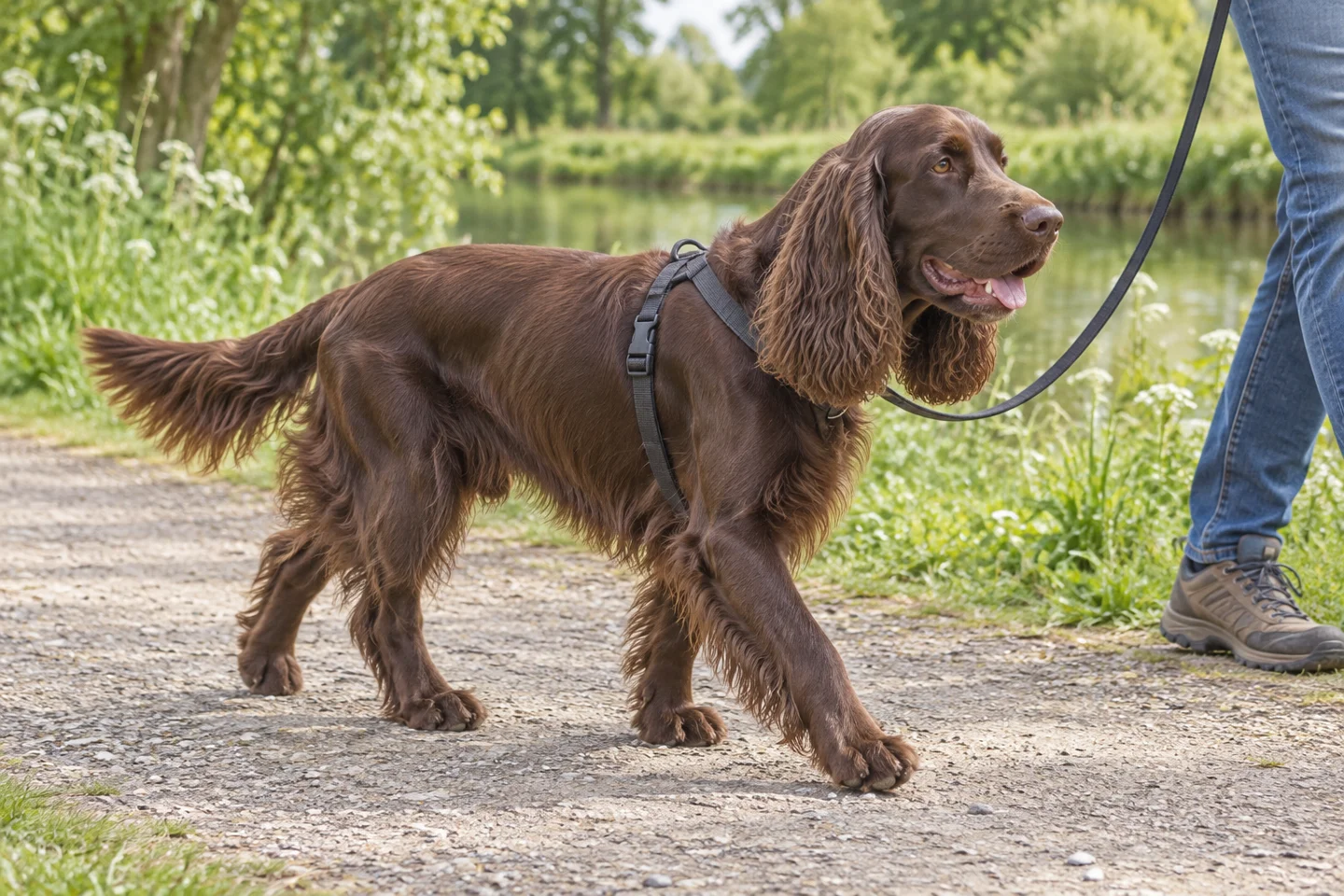
The Field Spaniel has a substantial sporting outline, moderately long legs, a long muzzle, and low-set feathered ears. Its silky coat and feathering need regular attention without being exaggerated into a heavy decorative covering. The illustrations show solid liver with a long natural tail. Other standard colors exist, and a chosen illustration cannot represent all of them. These are generated breed images, not photographs documenting a registered animal's condition or suitability.
Watch an adult move at a natural pace and rise after resting. Ask about repeated stiffness, a change in willingness to load into the vehicle, or unusual sensitivity during a check. Have the veterinary team demonstrate body-condition assessment beneath the hair. Fit equipment around the individual body and verify that feathering does not collect beneath a rubbing strap. Check the harness when the dog reverses as well as when it moves forward. A quiet fitting before an outing helps reveal an insecure clip or uncomfortable adjustment before the animal becomes distracted.
FCI lists an approximate adult shoulder height of 46 cm and weight of 18–25 kg for males and females. The reference conveys a substantial sporting spaniel rather than a miniature companion. Individual condition and proportions still matter more than reaching a number. Check the dog's actual travel dimensions and your ability to provide assistance if it cannot climb into the car, particularly when comparing it with another spaniel you already know.
Plan a country outing without assuming prior knowledge
A flushing background can make cover and bird scent absorbing, but the pedigree does not teach a dog every skill needed outdoors. Ask what the individual has actually experienced. A working claim should include details about training rather than an assumption from ancestry. If field work is intended, choose qualified humane instruction that includes the handler's decisions, conditioning, environmental risks, and responsibilities to other animals. Do not introduce difficult noise or uncontrolled quarry contact as an informal experiment.
Companion households can offer structured searches and suitable retrieving in a controlled area. Start with safe objects and a task the dog can complete, then gradually add complexity. Keep other animals away where rewards might create conflict. Teach returning toward a person separately before demanding it beside the most interesting vegetation. A useful activity has a clear finish and fits the week you can sustain. It should not become a requirement for an increasingly elaborate program just to make an ordinary quiet day possible.
Training for the necessary parts of daily care
An owner's most useful lessons may be standing while a harness is adjusted, resting a chin briefly, or moving onto a mat. Teach those actions when nothing urgent is happening. Reward the first manageable step and end before fatigue or frustration dominates. A dog that understands where to stand can cooperate more comfortably than one repeatedly pushed into position. Include a release so a brief care exercise does not always predict being held for a long session.
AVSAB recommends reward-based methods. If the Field Spaniel hesitates, examine physical comfort, setting, reward, and clarity before treating the response as deliberate opposition. An instructor can help adjust the task without resorting to fear or pain. Practice with another trusted person so a clinic visit or holiday does not introduce a new handler at the same time as everything else changes. Consistency means people make the situation understandable; it does not require them to repeat an unsuccessful command until the dog eventually stops moving.
Exercise in the week you actually have
Provide daily movement, investigation, and learning appropriate to this dog's condition. A sporting identity does not define a universal quota. Ask about recent activity and build distance or terrain gradually before long excursions. Notice recovery later and after sleep, not only enthusiasm during the outing. Growing puppies need sensible exploration and rest, with veterinary advice about repetitive impact or planned sport. An animal recovering from inactivity also needs a new starting point rather than an immediate return to a past workload.
Choose routes with alternatives when weather changes. In heat, use cooler times, drinking water, shade, and a straightforward exit. Stop for difficulty instead of completing a target simply because it has been planned. Severe distress, weakness, or collapse needs urgent assistance. After vegetation or rough ground, inspect feet, ears, and coat. Embedded material, painful swelling, or persistent lameness deserves assessment. A working description should encourage preparation, not become a reason to dismiss discomfort or expect the dog to recover without help.

Grooming a liver coat beneath the surface
A dark glossy top layer can look neat while hair underneath has tangled. Learn to separate the coat gently and inspect friction areas, including behind the ears, beneath equipment, and along the underside. Ask an experienced Field owner or groomer to demonstrate tools and maintenance on an adult. The plan should be achievable with your space, hands, and available time. Brushing that repeatedly hurts can create a handling problem as well as leave the original coat issue unresolved.
Seek professional assistance for tight mats or irritated skin, and avoid scissors near concealed skin. If a practical coat change is needed, discuss welfare and maintenance rather than preserving an appearance at any cost. Introduce short sessions with pauses and allow the dog to change position. A puppy's easy coat does not establish the time required later. Arrange backup grooming before travel or illness makes your own care unavailable. Someone who enjoys stroking the dog may need instruction before they can safely inspect and maintain the whole coat.
Ears, teeth, and the post-walk inspection
Make a return-home check an understandable routine. Have towels and a stable surface ready so the dog is not held in a busy doorway while people search for equipment. Look for loose debris around the feet and furnishings, removing it gently. A new objection to one area needs investigation. If something is embedded or painful, ask for help rather than repeatedly probing. Teach brief foot presentation before attempting all nail care at once.
Pendulous feathered ears need observation for odor, tenderness, discharge, or repeated shaking. Similar appearances do not establish identical causes, so do not automatically reuse old medicine. Ask whether cleaning is appropriate and request a demonstration. Dental care also requires suitable products and gradual learning. Tell professionals about handling concerns when arranging appointments. Necessary treatment may require a different immediate plan from long-term cooperative training; delaying a painful condition until the dog performs perfectly at home is not a useful compromise.
Children and a spaniel’s quiet boundaries
A calm-looking spaniel may be approached repeatedly because its coat and ears invite touch. Teach children to invite contact and let the dog decline. Keep faces apart, prevent pulling or hugging, and supervise closely enough to interrupt pressure promptly. A resting space should lie outside the route of games and remain inaccessible to children seeking another interaction. Gates are helpful when adults cannot watch or when visiting friends make the setting less predictable.
Meals, chews, and objects beside the dog are for an adult to manage. A child should ask for help rather than reaching into a bowl or taking a toy. Watch withdrawal or unusual stillness and stop contact before stronger warnings become necessary. An individual's affectionate history does not guarantee comfort with every visitor or while unwell. Review the arrangement when a child becomes more mobile, the dog develops pain, or household routines change. The aim is a relationship in which neither participant has to manage a difficult moment alone.
Aggression and the difference between reputation and an incident
If the dog growls during brushing or over an object, describe the actual sequence rather than concluding that a gentle breed cannot have a problem. Stop the immediate interaction, create space, and prevent someone else from repeating it. New sensitivity warrants clinical assessment, including the possibility of discomfort in a particular area. Record what the dog could do to leave, who approached, and what preceded the warning. Those facts help a professional plan safer care.
Avoid confrontational resource tests. VCA's guidance supports teaching exchanges and protecting meals from interference rather than repeatedly removing valued items. Recurrent threats or a bite requires qualified behavior help alongside veterinary care and a clear interim management arrangement. Do not conceal an incident from a sitter or groomer. Punishment can suppress an apparent warning without resolving its cause. Equipment such as a positively introduced muzzle may form part of professional advice, but it cannot make painful contact or a forced social encounter comfortable for the animal.
Other dogs, cats, and birds
Look at actual social experience before adding a pet. A Field Spaniel that walks comfortably with familiar dogs may still need help sharing a room, person, or resting place. Give independent resources during introductions and observe whether each dog can rest without pursuit. Repeatedly blocking a route or following a withdrawing companion can matter without barking or fighting. Provide breaks rather than expecting the quieter animal to settle the question by escalating a warning.
Cats require protected routes and introductions that prevent chasing. Captive birds, poultry, rabbits, and other small animals need secure separation during chores as well as when cages or doors are closed. Sporting work cannot establish safety around every vulnerable pet. Ask which experiences have been observed and keep missing information visible. If fixation or pursuit occurs, stop access and seek guidance. A placement should fit what your household can reliably manage when routine changes, not only a system that works while one person watches every movement continuously.
Health screening and a Field-specific conversation
The AKC lists hip evaluation, ophthalmologist evaluation, and autoimmune thyroiditis assessment among national-club recommendations for the Field Spaniel. Ask for actual identifiable reports and the relevant dates and findings. A routine puppy check differs from adult screening, and an eye examination answers questions a selected DNA variant result cannot. Have the veterinary team explain what the paperwork supports and what uncertainty remains before accepting a broad claim that all relevant health concerns have been excluded.
The AKC also encourages attention to broader family medical history. Ask which significant conditions have occurred and how the source followed older offspring. Do not turn an anecdote into a population frequency or copy another spaniel's screening list without explaining why it applies. A plan may include additional assessment because of family information or clinical findings. For adoption without records, acknowledge the gaps and begin with present examination. Screening informs care; it does not remove the need to investigate a new symptom in an apparently athletic dog.
Health observations, nutrition, and ordinary prevention
Notice persistent changes in appetite, drinking, willingness to move, skin, or tolerance of handling and discuss them clinically. Many causes are possible, and a breed article cannot diagnose from a short description. A dated note of timing and circumstances helps the veterinarian. A brief video of natural movement may contribute information if obtaining it does not provoke discomfort or delay treatment. Keep urgent contacts and safe transport arrangements available for a dog that cannot walk normally.
Choose a complete food for life stage and medical needs, measuring portions while establishing comfortable condition. Account for rewards used throughout the day and feed apart from competing pets. Review the amount when activity changes instead of feeding for the most demanding day indefinitely. Ask about supplements and obtain qualified advice for home-prepared nutrition. Preventive care should reflect actual exposure, including vaccination, parasites, mouth care, and travel. Collapse, serious respiratory difficulty, trauma, or rapidly worsening illness needs prompt assistance rather than waiting for the next scheduled check.
Mixes and the costs of continuing care
A Field Spaniel mix can have a different coat, adult size, activity style, or social preference from either familiar parental image. Ask how ancestry was established and evaluate the actual animal. For planned crosses, relevant health questions concern both parents. A crossbreed label does not guarantee reduced medical risk or low maintenance. A responsible source explains uncertainties, support, and return arrangements, allowing time to decide rather than using rarity or an attractive name to create pressure.
Budget for preventive care, diagnostics, training, grooming help, transport, and a backup person able to manage the dog. Introduce comfortable absences gradually and observe whether the animal settles. Persistent pacing, calling, or escape efforts needs support. A friend should rehearse the real routine before a holiday, including equipment and coat care. As the dog grows older, adapt surfaces and access while preserving comfortable exploration. New reluctance or irritability should prompt assessment rather than an automatic conclusion that aging or independence explains everything.
Before committing to a particular litter, ask who can demonstrate adult coat care locally or provide reliable instruction if you are far from other owners. A less familiar breed may require you to explain the intended routine to a groomer rather than assuming that any spaniel appointment will be identical. Share the source’s advice, discuss the dog’s current condition, and agree what is practical. Keep the welfare goal clear: clean comfortable skin, manageable hair, and procedures the dog can tolerate. Review the arrangement after the first visit and before a longer booking or holiday makes adjustments harder.
dogsDating for a thoughtful first meeting
Describe the individual on dogsDating with useful observations about distance, unfamiliar dogs, and relevant incidents. Keep exact home coordinates private and arrange an initial public walk with room to change direction. Separate handlers can prevent crowding and allow each dog to explore without immediately making contact. Leave food, chews, and shared toys out. A first meeting does not need play or a close photograph to provide worthwhile information about how the animals cope together.
Watch whether both can disengage and interrupt persistent pursuit or blocking. Finish when conditions become too difficult, including unexpected crowds or weather. A later home visit or shared vehicle introduces resources and boundaries absent from the walk and needs its own plan. Social compatibility also does not establish reproductive or medical suitability. Accurate descriptions, adaptable distance, and the option to stop help owners learn about the dogs while respecting the comfort of both animals and the people responsible for them.
Sources and editorial notes
Sources checked October 21, 2026. Breed measurements describe reference ranges, not a diagnosis or an individual dog's ideal weight. Images are AI-generated breed illustrations and do not document a particular dog or health condition.
- VCA Animal Hospitals: Grooming and coat care for your dog
- VCA Animal Hospitals: Ear infections in dogs
- VCA Animal Hospitals: Common emergencies in dogs
- American Kennel Club: Field Spaniel health and care
- VCA Animal Hospitals: Food aggression in puppies
- VCA Animal Hospitals: Heat stroke in dogs
- VCA Animal Hospitals: Aggression toward unfamiliar dogs, diagnosis
- AAHA: Feeding plans for healthy, appropriate weight cats and dogs
- Orthopedic Foundation for Animals: CHIC health screening programs
- American Kennel Club: sporting group recommended health tests
- Federation Cynologique Internationale: Field Spaniel breed standard
- AVSAB: Humane Dog Training Position Statement
Keep getting to know dogs.
Read another guide or return to your dogsDating community.
Explore breed guidesBack to dogsDating