Estonian Hound
Choose an Estonian Hound with a realistic plan for its nose, voice, and outdoor interests.
How these guides are researched and reviewed
- Origin
- Estonia
- Identity
- Hound / Scenthound
- Care priorities
- Scent routes, vocalization, secure boundaries
- Adult standard size
- FCI height: males 45–52 cm; females 42–49 cm
General information for owners. These articles have not been reviewed by a veterinarian. Medical decisions need your dog's history and an examination.
An Estonian Hound is a scent-led companion
Choose an Estonian Hound with a realistic plan for its nose, voice, and outdoor interests. The FCI describes a medium-sized scenthound developed for hunting hare, fox, and lynx. A dog entering a companion home still needs appropriate opportunities to investigate and learn. Its compact appearance does not answer how it will respond to a trail or settle during a quiet afternoon. Before meeting one, consider your routes, boundaries, neighbors, and the person who will help when your regular walking plan changes.
Ask to observe an adult during an ordinary outing and afterward. What happens when something interesting crosses the route? Can the dog recover from excitement and rest while people do something else? A current carer should distinguish repeated observations from assumptions about the breed. A working adult may be unfamiliar with indoor routines, while a puppy has much to learn about the world. The right placement conversation includes those needs rather than promising that a friendly hound will automatically adapt to every household arrangement.
Estonia, registration, and a separate hound identity
The FCI records the Estonian Hound's national standard as established in 1954 and describes development involving several European hound backgrounds. That history explains a recognized Estonian identity without providing a complete family tree for an individual dog. Ask for the registry entry and recent pedigree where available. A rescue with similar markings may have uncertain ancestry. It is possible to discuss a likely type honestly while avoiding a more precise claim than the evidence supports.
The breed is separate from the Finnish Hound and other familiar tricolor hounds. The similarity of short coats and markings should not make their records interchangeable. A listing should identify the dog clearly enough that you know which standard or health discussion is being referenced. When no documentary identity exists, current condition and observed behavior remain useful. Assess the actual animal's proportions, interests, and response to care. An owner does not need to invent ancestry to provide appropriate veterinary treatment, learning, or a comfortable home.
Proportions and the limits of a tricolor picture
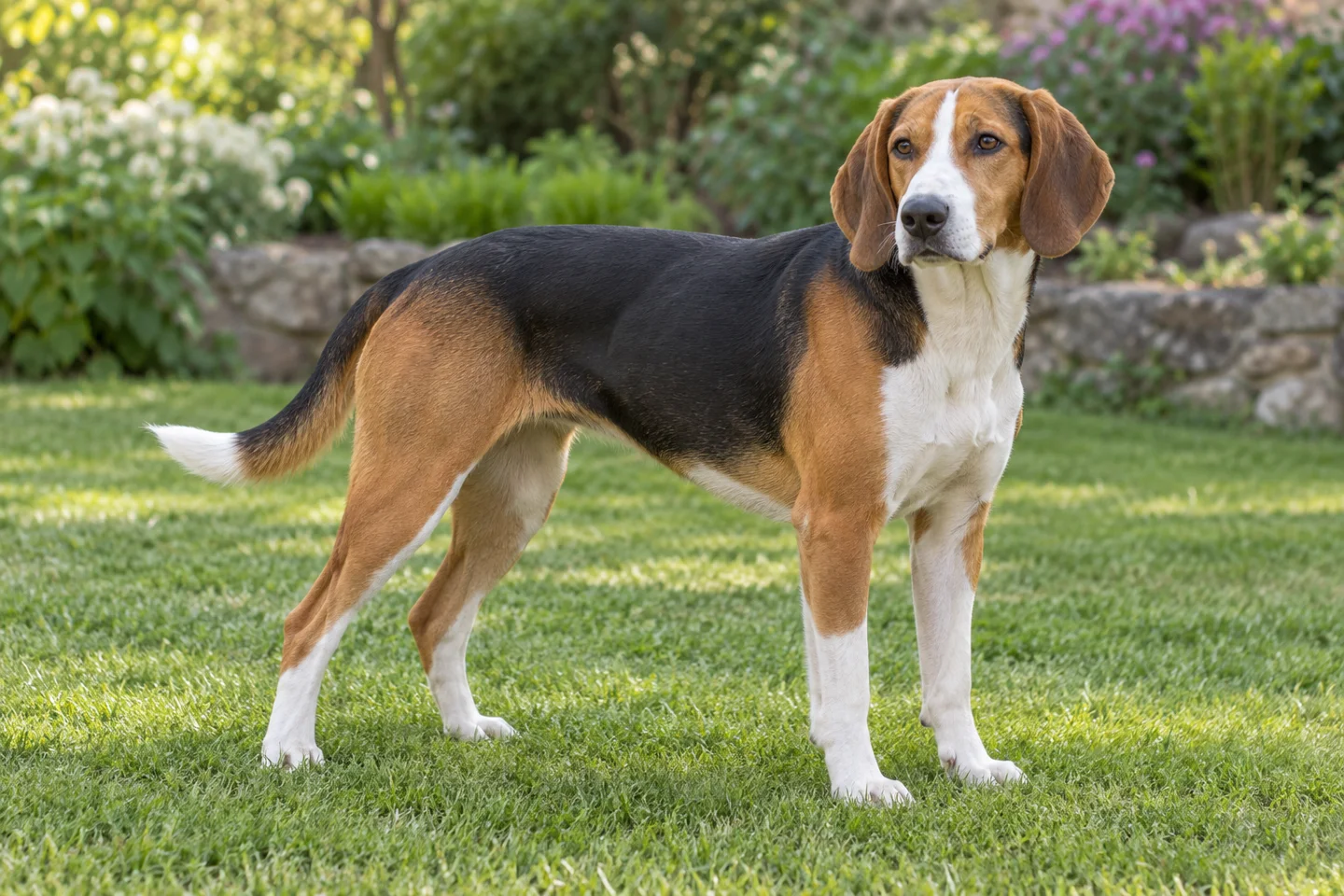
The Estonian Hound has a strong, dry-built body that is longer than tall, with moderate legs, a short coat, and natural pendant ears. The chosen illustrations show a tricolor example with clear white markings, brown eyes, and a natural tapering tail. These are generated illustrations rather than photographs of registered animals. Color cannot verify a pedigree, and a composed stance cannot establish soundness, hearing, temperament, or a particular animal's suitability for adoption.
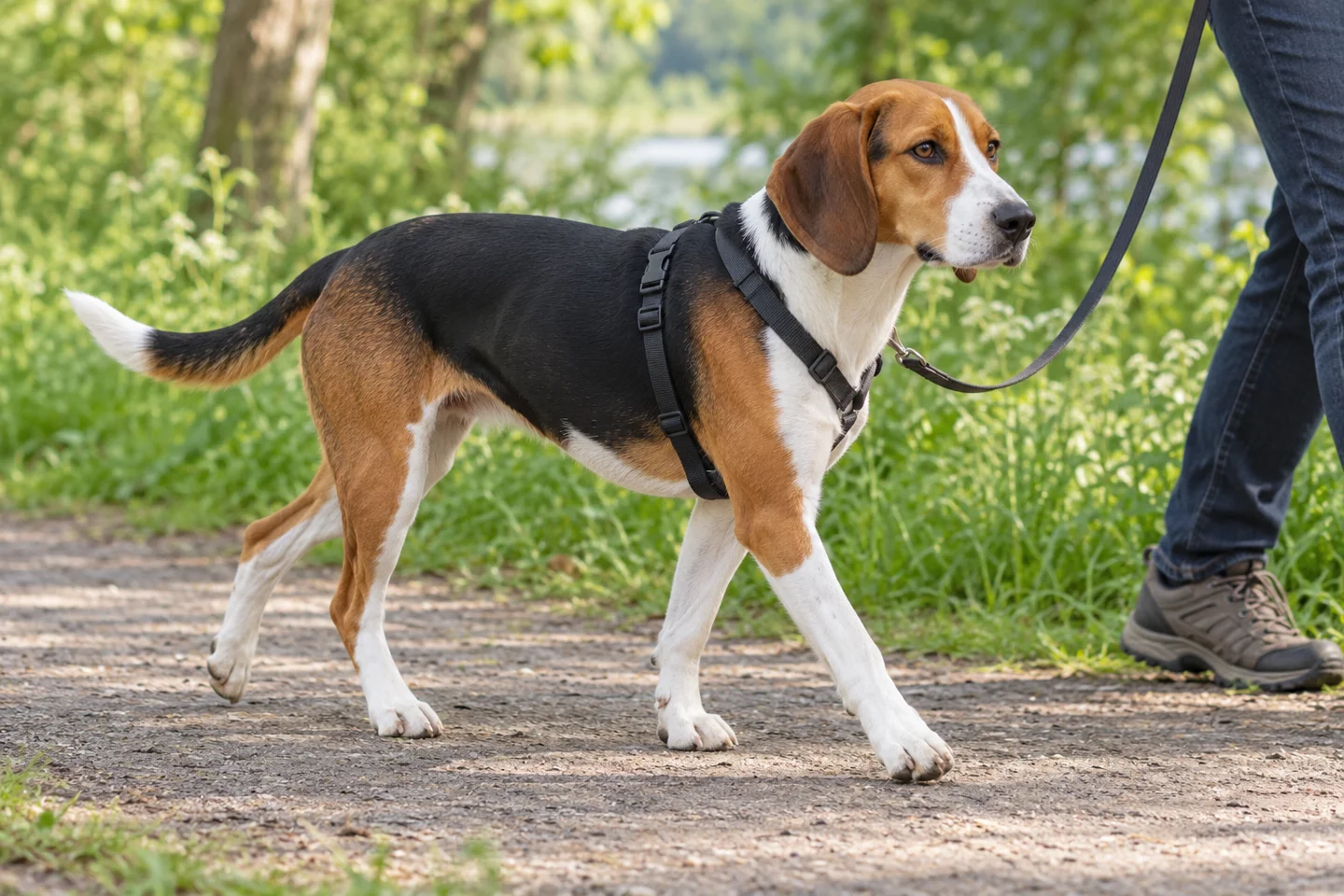
In person, watch natural movement on a sensible surface. A turn, a pause, and rising after rest can show questions worth taking to a veterinarian. Do not diagnose a recurring skipped step or limp from the breed description. Ask about its history and obtain assessment. Equipment must fit the individual; check whether a harness permits shoulder movement and remains secure during a backward motion. Identification and fastening deserve a quiet trial before you reach an unfamiliar route where scent and traffic compete for attention.
The adult FCI height range is 45–52 cm for males and 42–49 cm for females. These standard figures describe an intended range; they cannot confirm ancestry in a dog of unknown parentage. Use actual measurements when fitting travel space and walking equipment. Moderate height also says little about the strength of an absorbing trail, so handling preparation needs to consider interests as well as dimensions.
Follow the walk as the hound experiences it
A person may plan a circuit while the dog experiences a succession of scent locations. Allow time for investigation where appropriate and teach movement away before the dog becomes fully absorbed. Reward an offered glance or a turn toward the handler, then permit another suitable sniff. This lets useful human contact exist within the outing instead of predicting that every interesting place is about to be removed. A workable route can be more valuable than a larger distance.
When a trail becomes too compelling, create an easier situation rather than shouting through a series of failed cues. Change direction or move into a less absorbing area before trying the skill again. Keep adequate physical control near roads, livestock, and wildlife. A long line needs handling that prevents entanglement and an abrupt stop at speed. Ask an instructor to help choose equipment and technique if necessary. The aim is exploration that remains safe for the hound, the person holding the lead, and other users of the space.
Voice and residential expectations
The standard includes a resonant voice in the breed's hunting role. In a home, identify what this individual vocalizes about instead of assuming every sound has one cause. Calling on a scent, reacting at a window, and distress during an absence can require different changes. Ask the previous carer for duration and circumstances. A general claim that hounds are vocal does not help a neighbor understand what is happening or give an owner a useful plan.
Record a short example when safe and discuss the sequence with a qualified professional if noise becomes persistent. Reducing repeated window surveillance may help a dog reacting to passersby, while another situation may need an absence plan or clinical review. Avoid shouting as a default response, since it can add arousal without teaching a clear alternative. Consider shared walls and entrances before placement. A household should be able to meet a dog's needs without relying on a guarantee that voice will disappear once it receives more exercise.
Training everyday reliability before a demanding trail
Teach loading into the vehicle, waiting for a lead, moving onto a mat, and accepting a short body check during easy moments. These skills matter when the hound returns tired or a different person provides care. Reward-based methods are recommended by AVSAB and allow the owner to explain useful actions without relying on painful or frightening corrections. Break procedures into steps the dog can understand, and give a recognizable release or pause.
Formal scent activities may provide engagement when conducted with suitable guidance and safeguards. Companion searching can begin with a safe object in a controlled area rather than live quarry. Separate dogs if food or objects might create conflict. Start with something achievable and finish before frustration dominates. A hunting background does not mean an animal has mastered every task or that a novice owner can skip instruction. Ask what has actually been taught and continue from that point, adjusting the activity to the life you can maintain consistently.

Exercise through changes in season and fitness
Build the dog's activity from its current condition. A hound transferred from another home may be less fit than its age or eagerness suggests. Increase distance and terrain in stages, then watch recovery after rest. A puppy needs suitable exploration and sleep rather than adult distances assigned through a breed label. Discuss repetitive running, jumping, or planned sport with the veterinary team. Keep a manageable routine for days when weather or work changes the original plan.
The outdoor history of a breed does not protect an individual from heat or injury. Offer water, choose appropriate timing, and use routes with shade and an early way back. If the dog struggles, shorten the outing instead of measuring success by the map. Severe distress, weakness, or collapse requires urgent veterinary help. Cold wet conditions also call for attention to comfort afterward. Look at feet and skin after vegetation, and obtain care for a wound, embedded material, or painful swelling instead of expecting the dog to walk it off.
Gates, livestock, and small animals
Treat a secure boundary as part of daily care. Inspect a garden or rented field, including gates shared with other people and spaces beneath fencing. Recheck after maintenance or storm damage. A familiar recall exercise is not proof of control when quarry scent appears near a road or livestock. Keep the dog attached where the consequences of pursuit would be serious and respect access rules. A tracker may help recovery after escape, but it cannot prevent what happens immediately beyond the gate.
For resident cats, arrange protected routes and introductions that prevent chasing. Birds, rodents, and other small animals need reliable physical separation, including during cleaning and feeding. Ask what the source has actually observed and avoid informal tests at closer distance. A dog may behave differently with one familiar resting animal and an unfamiliar one moving quickly outside. If fixation or pursuit occurs, stop access and seek guidance. Decide whether the household can sustain the necessary arrangement when another carer takes over, rather than relying on perfect attention from one person indefinitely.
Children and a quiet place after the walk
Give the hound a route from an outing to water, drying, and rest without passing through a child's energetic game. Have equipment ready so the dog is not held in a busy doorway while people search for a towel. An adult should manage these transitions. Set the bed apart from regular play and explain that a dog sleeping there is left alone. Use barriers when adults cannot provide close supervision, especially during visits that add unfamiliar movement and noise.
Teach a child to invite contact and allow the dog to remain away. Avoid pulling ears, hugging around the neck, or putting a face beside the muzzle. Meals, chews, and objects near the dog are for an adult to manage. Watch for attempts to leave and do not repeatedly call the animal back into contact. A familiar family relationship can be affectionate while still requiring supervision. Review the arrangement when the child becomes more mobile, the dog develops discomfort, or visitors behave differently from the household routine.
Aggression and what happened immediately beforehand
An incident needs a factual account. Where was the hound resting, what approached, was a valued item present, and could it move away? Those details help more than describing the dog as normally friendly or naturally stubborn. Stop the immediate conflict and prevent another person from recreating it. A sudden reaction during handling warrants veterinary assessment, even if the animal continues to be keen on walks. Pain can affect a particular procedure before activity changes dramatically.
For resource concerns, arrange protected meals and teach rewarded exchanges at an easy level. VCA advises against creating competition through confrontational removal. Repeated growling, snapping, or a bite requires qualified behavioral support and clinical involvement where appropriate. Use barriers and distance while obtaining a plan and inform carers clearly. Punishment can make a warning less visible without resolving fear or discomfort. An owner should not use a social meeting to test whether an unresolved risk has disappeared. People and animals need protection while treatment and learning proceed.
Grooming a short coat and pendant ears
A short coat still deserves inspection. Brush loose hair, check skin beneath straps, and look around toes after rough ground. Introduce a towel and brief foot touch before an actual muddy return makes a full session necessary. Use appropriate products and avoid forceful pulling through trapped debris. If something is embedded or the skin is painful, seek help rather than attempting an invasive removal at home. Comfortable routine care should support observation without becoming a repeated struggle.
Ears with odor, discharge, head shaking, or soreness need veterinary advice. A dropped ear does not automatically require a fixed medication or deep-cleaning routine. Ask what suits the individual and avoid putting tools into the canal. Teeth and nails also require maintenance and gradual teaching. A new resistance to a previously manageable procedure is worth investigating. Tell professionals about handling difficulties when arranging an appointment so immediate care can be planned. The long-term goal is participation, while painful problems still need timely treatment before training is perfect.
Health evidence for a less familiar breed
Do not mistake a detailed conformation standard for a population medical survey. For the Estonian Hound, ask the source which screening program it uses and why those assessments were chosen. Request actual reports and significant family diagnoses rather than a list copied from a different tricolor hound. A test's availability does not automatically establish that it answers the relevant question in this breed or family. Your veterinarian can help interpret the purpose and limits of each result.
A routine examination, imaging, specialist assessment, and selected DNA panel supply different information. Keep identities and dates with the records, and distinguish missing findings from normal ones. For an adopted adult, begin with current condition and observed symptoms even when parental information is unavailable. Persistent appetite, drinking, mobility, or behavioral changes deserve assessment rather than a breed-based explanation. Emergency access should be planned for collapse, serious respiratory distress, major trauma, or rapidly worsening illness. Screening can inform care without replacing investigation when the dog in front of you becomes unwell.
Nutrition, rest, and learning to be alone
Provide a complete diet appropriate to life stage and diagnosed needs. Measure portions while establishing what maintains suitable condition and include rewards used during training or searching. Feed separately from other animals so intake remains visible and meals do not become competitive. Discuss supplements and home-prepared nutrition with someone qualified to evaluate the entire diet. Persistent digestive signs deserve a plan with the veterinarian rather than repeated product changes that make the pattern harder to interpret.
Provide quiet sleep after activity and observe whether the hound actually rests or keeps anticipating another event. Introduce short absences gradually, using a recording when necessary to see what follows departure. Sustained calling, pacing, or escape attempts needs attention before longer periods are expected. Another dog cannot be relied upon to treat distress. Prepare help for working hours that exceed current coping ability. A routine that includes company, activity, and comfortable independent rest is more useful than trying to solve every settling difficulty with an increasingly long walk.
Mixes, ownership costs, and dogsDating
An Estonian Hound mix may have uncertain ancestry and a different coat, body, voice, or social preference. Markings alone cannot verify the label. Ask what is known and evaluate the actual dog. Planned crosses need relevant health questions about both parents. Budget for prevention, diagnostics, instruction, safe outdoor equipment, transport, and competent relief care. Let a carer rehearse a walk and door routine while you can help, especially if they have previously met the hound only during a calm indoor visit.
Describe the individual honestly on dogsDating, including social distance preferences and relevant incidents. Keep exact home coordinates private and choose a public route with room for separate handlers. Begin with independent exploration rather than forced close contact, leaving shared toys and food out. Finish if either dog cannot disengage comfortably. A calm walk can be enough. Shared living space or a vehicle introduces different resources and boundaries and deserves another assessment. Social compatibility is also separate from reproductive and medical decisions, which cannot be established by one successful meeting or a photograph.
A handover across different routines
If the hound arrives from a different language or working routine, ask the current carer to demonstrate cues and write them down as used. The sound familiar to the dog matters more initially than the word you would prefer. Teach a new cue through a clear reward-based process instead of assuming the animal understands a translation. Ask for an explanation of signals used during loading, feeding, and a return from outdoor activity. A short demonstration video can help a new owner reproduce the arrangement accurately without guessing at timing.
Keep original veterinary documents together with any reliable translation and clarify unfamiliar terminology with the receiving clinic. Do not change an uncertain result into a convenient English label without knowing what the examination actually covered. Ask about the dog's recent diet, equipment, sleeping arrangement, and time spent indoors. Preserve useful familiar elements while introducing the new home gradually. A quiet adjustment period allows you to see what the dog knows and where teaching is needed. It also gives household members time to practice boundaries before adding visitors, long outings, or new animals. Review the transition with the source when questions arise rather than expecting a recognized breed name to fill every information gap.
Sources and editorial notes
Sources checked October 21, 2026. Breed measurements describe reference ranges, not a diagnosis or an individual dog's ideal weight. Images are AI-generated breed illustrations and do not document a particular dog or health condition.
- VCA Animal Hospitals: Grooming and coat care for your dog
- VCA Animal Hospitals: Ear infections in dogs
- VCA Animal Hospitals: Common emergencies in dogs
- VCA Animal Hospitals: Food aggression in puppies
- VCA Animal Hospitals: Heat stroke in dogs
- VCA Animal Hospitals: Aggression toward unfamiliar dogs, diagnosis
- AAHA: Feeding plans for healthy, appropriate weight cats and dogs
- Orthopedic Foundation for Animals: CHIC health screening programs
- Federation Cynologique Internationale: Estonian Hound breed standard
- AVSAB: Humane Dog Training Position Statement
Keep getting to know dogs.
Read another guide or return to your dogsDating community.
Explore breed guidesBack to dogsDating