Istrian Short-haired Hound
A Croatian white-and-orange scenthound whose companion care centers on secure scent exploration, suitable routines, skin and ear checks, and honest health records.
How these guides are researched and reviewed
- Origin
- Croatia
- Adult standard size
- Males 49–53 cm; females 47–51 cm; stated ±3 cm tolerance
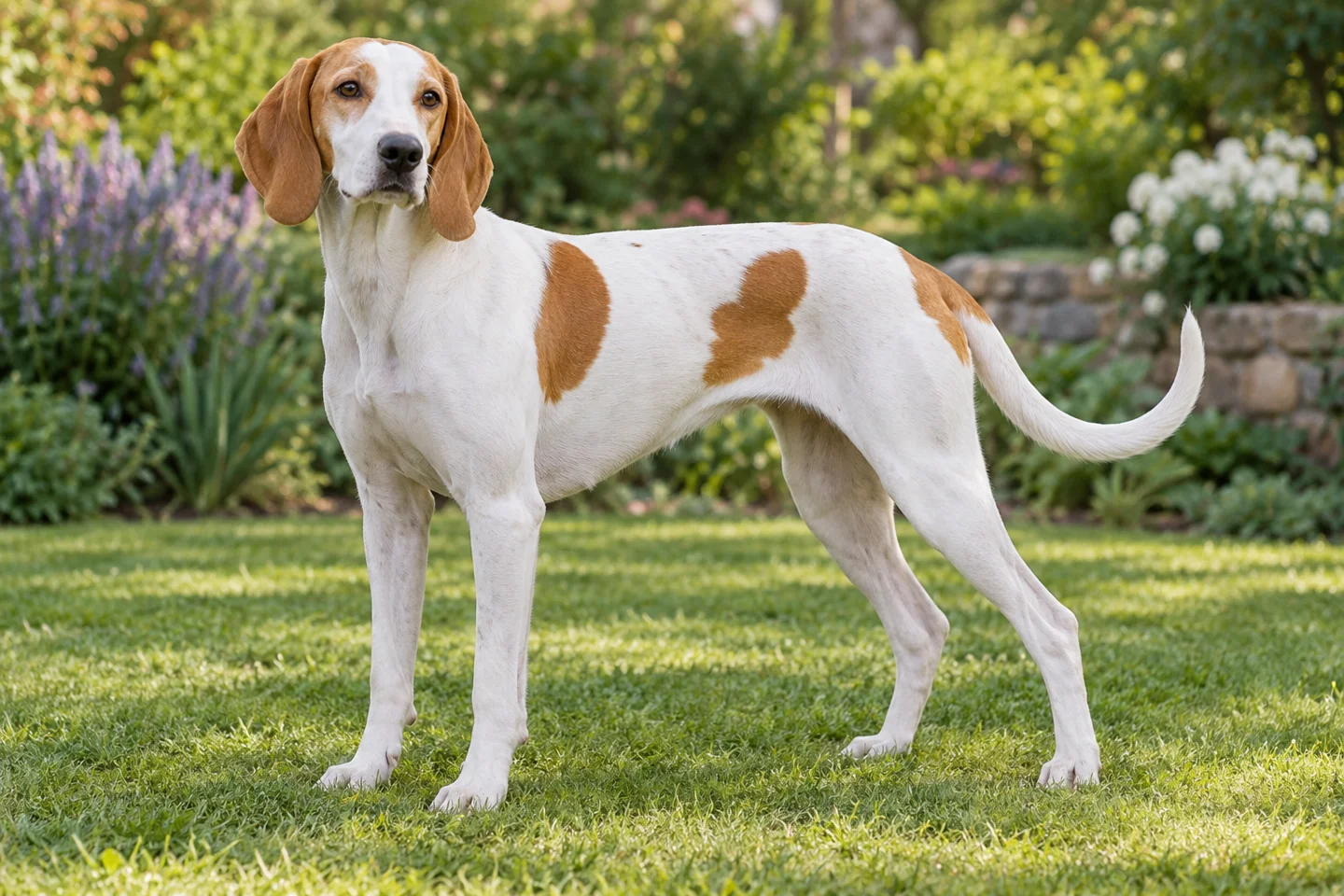
- Illustrated coat
- Snow-white short coat with orange patches
General information for owners. These articles have not been reviewed by a veterinarian. Medical decisions need your dog's history and an examination.
A separate Istrian scenthound
The Istrian Short-haired Hound is a Croatian hunting breed, known in its standard as Istarski Kratkodlaki Gonič. It is distinct from the Istrian Coarse-haired Hound. A smooth white coat and orange patches can resemble other hounds, so ask how identity is documented instead of making a pedigree decision from a photograph. For a companion home, the useful next questions concern what the individual does indoors, how it follows scent, and what support will be available after placement.
The FCI describes a hound for demanding hunting terrain and records a standard first published in 1955. Its historical account connects the breed to East Adriatic hounds and earlier depictions and descriptions. That background explains why outdoor interests deserve discussion, but it does not establish that a modern pet has learned recall or life beside road traffic. Ask a source how adults live between activities and how puppies encounter household routines. A working result can describe one achievement while leaving substantial questions about the proposed companion environment unanswered.
Measurements, markings, and a light outline
The FCI height ranges are 49–53 cm for males and 47–51 cm for females, with a stated three-centimeter tolerance under the standard's conditions. The dog is rectangular, with a longish head, hanging ears, and a short close coat. Snow-white is the base with orange markings. The illustrations use that general pattern and a full natural tail. The short-haired and coarse-haired standards have different measurements, so they should not be merged into one unsupported range for any dog called Istrian.
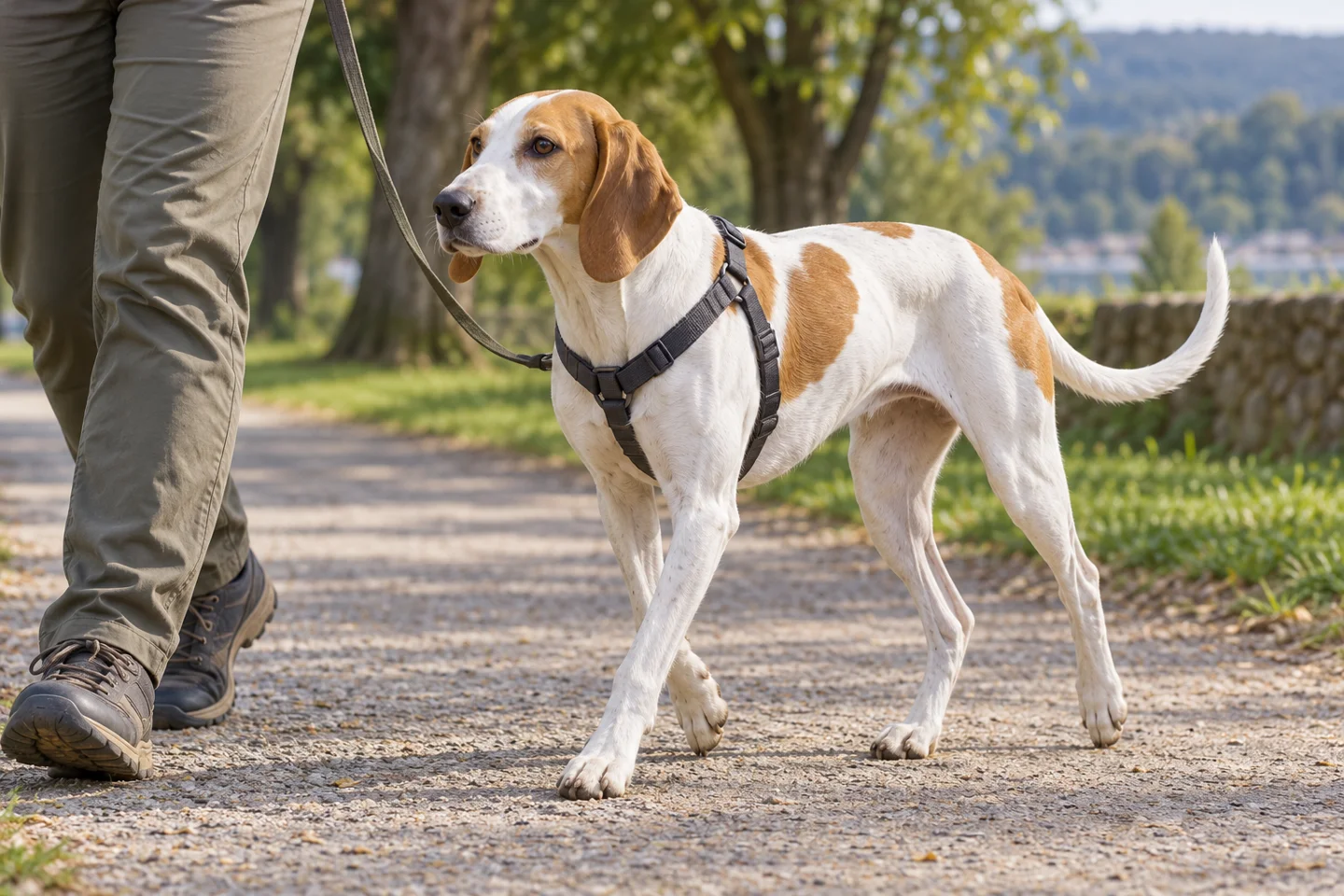
Plan equipment around actual proportions rather than a catalog size. Check that straps stay clear of the elbows and cannot be escaped during a sudden backward movement. Measure the space used for travel, rest, and turning. A conformation height does not provide an exact ideal weight or food portion for every individual. Ask the veterinary team to assess condition and growth. An AI illustration cannot evaluate pedigree, gait, or clinical health, and a lean working outline should not become a reason to overlook either excessive weight loss or uncomfortable movement in a real animal.
Grooming and skin color without a diagnosis from appearance
A close white coat makes some dirt, skin pigment, or small changes easier to notice than under long furnishings. The standard recognizes that pigment can show through the coat, but a standard cannot explain every new mark on your dog. Keep a simple record of changes and seek veterinary advice for persistent redness, hair loss, tenderness, or a lesion. Avoid deciding that every visible spot is normal pigment or that every discoloration is disease because of an online image comparison.
Use gentle brushing to remove loose hair and look beneath equipment after walks. Check the feet and underside for trapped material without digging into tissue. Ask a groomer or veterinary nurse to show an appropriate tool and comfortable handling if routine inspection is difficult. Bathing should suit actual needs and use suitable products. More frequent or stronger washing is not a diagnosis for persistent odor or irritation. A simple coat reduces some maintenance tasks, but it does not remove the need for skin observation, nail care, mouth care, and clinical assessment when something changes.
Build the household routine from known experience
Ask the previous carer which parts of indoor life the dog understands. Can it rest while people move around, cope with a short absence, and travel comfortably? Does it know steps, polished floors, and a busy entrance? These details matter when moving from a field-oriented environment to a companion household. A claim that a hound is obedient can describe a very specific activity. Request examples from the settings your dog will actually use instead of assuming every skill transfers automatically.
Keep the first days predictable, with a quiet resting place and straightforward access to toileting. Introduce visitors who will respect distance and avoid reaching into the bed. Reward short comfortable pauses while normal household activity continues. If the dog cannot settle or shows distress when alone, obtain advice and review the schedule rather than adding exercise indefinitely. Make notes of timing and recovery so a professional can see the pattern. A suitable home provides room for learning without repeatedly placing the animal in situations it cannot manage and then blaming it for the result.
Training a useful check-in on a scent walk
Begin where attention is available. Reward looking toward the handler, following a short turn, and coming closer. Move outdoor practice forward in small stages before expecting the dog to leave an exciting scent. If the hound becomes absorbed, increase distance or change location instead of repeating the cue more forcefully. AVSAB recommends reward-based training and advises against aversive methods. A good instructor can help arrange conditions in which the dog succeeds and explain how to progress from that starting point.
Teach practical skills around gates and equipment separately from difficult wildlife encounters. A suitable long lead can allow controlled investigation in an appropriate area, but its handling needs care to prevent tangles and abrupt stops. Ask for a demonstration before using unfamiliar equipment. Record which cues work in which environments, especially for another walker. A reliable kitchen response does not establish readiness for unfenced ground. Until learning is secure, use boundaries and control that protect the dog and other animals even when a cue is missed.
Exercise, surfaces, and recovery
Choose movement according to age, health, fitness, and the individual's response afterward. The breed's ability to work outdoors does not mean every puppy or older pet should follow a fit adult's schedule. Discuss structured running or a major workload increase with your veterinarian. A day can combine exploratory walking, quiet searching, and short lessons. Suitable enclosed activity may add freer movement when the boundary and environment have been checked. Do not use a prior dog's success as proof that every gate, surface, or obstacle is suitable for this one.
Notice stiffness, an altered stride, repeated attention to a foot, or unexpected fatigue after an outing. Persistent changes deserve assessment. Plan for warm weather through timing, water, footing, and reduced effort before distress appears. Stop and seek veterinary guidance for concerning signs after heat or exertion. A short coat and active appearance do not provide immunity to injury or illness. Have a shorter alternative for interrupted days and a way to reach transport if the animal cannot complete the planned distance. A useful routine should remain comfortable and achievable across ordinary weeks.

Voice and absence are different questions
The FCI describes a strong voice, so ask how a particular dog uses it at home and outdoors. Calling during scent activity, announcing something at a window, and vocalizing during an absence can involve different circumstances. A single instruction to stop barking does not identify the problem. Speak to people who live with the adults and ask what happens during the hours your household will be away. A quiet meeting in a novel place is only a small sample of the information needed.
Reduce repeated difficult triggers where practical, such as resting beside a busy boundary or watching constant pavement activity. Reward calm alternatives while the situation is manageable. If the dog becomes distressed when left, seek professional help and review company and gradual independence learning. Do not assume a longer walk will solve every absence problem. Keep a dated account of what precedes vocal behavior and how recovery occurs. That helps advice address the individual's experience and gives a sitter a clearer plan than a vague warning that all hounds are noisy.
Socialization that follows the response
Work with your veterinary team to arrange appropriate early exposure and local health precautions. A puppy can observe people, traffic, surfaces, and calm animals without being forced into contact. Let approach and retreat remain possible. Keep experiences brief enough for rest, and end before the animal is overwhelmed. If fear repeatedly prevents ordinary participation, obtain help instead of increasing intensity. An animal remaining still while held by a stranger has not necessarily learned comfort, even if the encounter produces a pleasant photograph.
For an adopted adult, ask what environments it has used and prepare the transition gradually. Start with predictable routes and visitors who can follow space and handling instructions. Add unfamiliar settings according to the response, not simply because a certain number of days has passed. Preserve gaps in history rather than treating age as proof that a skill must already exist. A quiet home and access to retreat make new learning easier to organize. Social experiences are useful when they support everyday coping and recovery, rather than meeting a fixed quota of greetings.
Aggression needs a factual account
A breed standard's desired gentleness cannot guarantee an individual dog's safety. If the hound freezes, growls, snaps, or lunges, create space and prevent another incident while obtaining advice. Record the approach, relevant objects, distance, and opportunity to leave. Do not minimize a warning because previous encounters were friendly, and do not ask another person to repeat the situation as a test. The immediate responsibility is a safer arrangement, especially where a child, visitor, or resident animal could encounter the same trigger.
New or escalating behavior, particularly during touch or movement, needs veterinary assessment. A qualified behavior professional can help connect medical findings, learning, and environmental pressure with practical management. Leave meals undisturbed and teach voluntary exchanges for safe items. Avoid punishment of warnings and forceful contests over possessions. If conditioned basket-muzzle use is recommended, check fit and ventilation and introduce it gradually. It remains one precaution within a broader plan. Tell carers and clinical staff about actual incidents so the next necessary task can be prepared rather than improvised around incomplete information.
Children and protected rest
Give the hound a resting area children cannot enter and supervise contact closely. Children should not pull ears, hug, climb on the dog, wake it, or interfere with meals and valued chewing. Leaving should be allowed to end the interaction. When an adult needs to focus elsewhere, use secure comfortable separation. A young child cannot reliably manage every subtle warning while excited about a companion. The physical arrangement should support the household rules before those rules are tested during a busy moment.
Ask for details behind a family-friendly description. Which ages has the dog met, in what setting, and were any warnings observed? A pleasant response to a familiar older child does not establish readiness for toddlers or a group running through the garden. Calm shared tasks with adult control can be more manageable than rough play. For example, an adult can hold the lead while a child helps plan a quiet route. Stop before excitement produces chasing or competition. The dog's comfort and the child's safety should both be visible in the plan.
Other dogs and smaller household animals
Plan canine meetings in space where separate handlers can move apart. Begin with parallel walking and watch whether both animals can disengage. A hound's field background does not mean every unfamiliar dog will be welcome beside a bowl or in a small room. At home, provide separate feeding and resting options while you learn what needs management. Preserve a resident animal's ordinary support and quiet areas. If play occurs, pause and notice whether both dogs choose to return rather than accepting one-sided pursuit as mutual enjoyment.
A household with a cat, caged bird, or rabbit needs a separate placement discussion. Ask the source for events it has observed, including responses when an animal moved quickly. Plan secure compartments and a route by which an existing cat can reach protected resting places. Watching calmly through a barrier cannot establish what the hound will do with unrestricted access, and releasing it to discover the answer risks the smaller animal. Some households will need lasting separation or a different new dog. Work out who closes which door and how those boundaries survive ordinary departures and divided attention before arranging the first encounter.
Ears, feet, and clinical handling
Hanging ears deserve comfortable observation for discharge, redness, unusual smell, scratching, or head shaking. Ask the veterinary team to investigate recurring problems and demonstrate any recommended cleaning. Do not probe deeply into the canal or use medicine left from another episode. Record changes and recent activities without choosing the diagnosis yourself. A dog that suddenly dislikes a familiar inspection may be painful, so increasing restraint is not an adequate answer to the new difficulty.
Inspect feet after rough or wet routes and report persistent lameness, swelling, an embedded object, or a painful wound. Introduce foot and mouth handling in small rewarded steps when the animal is well. A veterinary nurse or groomer can demonstrate suitable care and equipment. Share known handling needs before a clinical visit so the team can plan. Home practice can improve access to care, while necessary treatment may require a different approach. Keep instructions available for another carer, including which signs call for advice and which products or procedures were prescribed for this particular dog.
Health documents behind a breeding approval
For a Croatian-bred Istrian Short-haired Hound, ask the source to distinguish pedigree registration, breeding approval, working assessments, and veterinary records. They serve different purposes. The breeding rules published by Kinološko Društvo Istra describe a framework in which breed organizations may add requirements and specific assessments can apply to particular groups. Obtain the operative rules for the litter from the responsible organization; a historic copy on a club website should not be presented as a current medical clearance or a universal test list for this breed.
Take a concrete question to the source: if a parent or sibling later develops a diagnosed condition, how will owners of related dogs hear about it? Ask for examples of the information retained, including age at diagnosis and the clinician's conclusion. A statement that a family continues hunting successfully gives less detail than a record of an actual assessment. Keep performance and health findings alongside each other without allowing one to stand in for the other.
For an adult, the most useful first appointment may concern an existing problem rather than pedigree. Bring the previous clinic's notes about an old injury, ear treatment, or recurring skin change, and explain what has altered since placement. Let the veterinarian decide whether further investigation is needed. This establishes continuity for a short-coated hound whose new owner may notice a visible mark immediately but know little about its history. It also avoids inventing a breed diagnosis from appearance or from another Istrian dog's medical experience.
Food, costs, and uncertain mixes
Choose complete food suited to life stage and review measured portions against body condition and activity with the veterinary team. Include rewards and extras in the daily record and give carers clear instructions. Unexpected weight change or persistent digestive trouble needs investigation rather than a series of improvised food switches. Obtain local quotations for prevention, training, food, equipment, and suitable care during absences. Read insurance conditions and plan for urgent costs. Review a breeder or rescue's support and return arrangements before the animal comes home.
A smooth white-and-orange cross is not automatically a purebred Istrian hound. Ask what ancestry is documented and what was estimated. Known parents warrant relevant health questions for both, while crossing cannot guarantee a convenient temperament or freedom from inherited concerns. For an adult, current behavior, size, coat needs, and handling are useful placement evidence. A puppy leaves more uncertainty about mature traits. A confident marketing description should carry less weight than an honest account of daily care and a household plan that can meet the individual's observed needs.
dogsDating meetings with room for investigation
On dogsDating, write the information that would change another handler's choice of walk. If your hound needs to avoid a path beside poultry or would struggle at a crowded entrance, say so before the meeting. Propose an approximate area rather than publishing a location pin for your home. Keep exact coordinates private, and arrange a public meeting place away from your address. Agree who will hold each lead and where either person can turn back. A route with an easy shorter option is useful when the dogs have never met.
At the meeting, allow each dog to investigate its own space while the adults walk in the same direction. There is no need to begin with nose contact or to bring a toy as an introduction. If one animal cannot stop watching the other, is trying to leave, or becomes tense, change the distance and be prepared to finish. Afterwards, compare concrete observations: the first open stretch was comfortable, the gate was too narrow, or the return route added pressure. Use that account to decide whether another outing makes sense. A familiar walking partner can be valuable even when the dogs consistently prefer several meters between them and never choose to play.
Sources and editorial notes
Sources checked October 21, 2026. Breed measurements describe reference ranges, not a diagnosis or an individual dog's ideal weight. Images are AI-generated breed illustrations and do not document a particular dog or health condition.
- AVSAB: Humane Dog Training Position Statement
- VCA Animal Hospitals: Food aggression in puppies
- Orthopedic Foundation for Animals: CHIC health screening programs
- VCA Animal Hospitals: Aggression toward unfamiliar dogs, diagnosis
- VCA Animal Hospitals: Grooming and coat care for your dog
- VCA Animal Hospitals: Ear infections in dogs (otitis externa)
- AAHA: Feeding plans for healthy, appropriate weight cats and dogs
- VCA Animal Hospitals: Heat stroke in dogs
- AVSAB: Puppy Socialization Position Statement
- VCA Animal Hospitals: Dog behavior problems, aggression toward children
- Fédération Cynologique Internationale: Istrian Short-haired Hound official breed standard
- Kinološko Društvo Istra: Published Croatian breeding and registration rules
Keep getting to know dogs.
Read another guide or return to your dogsDating community.
Explore breed guidesBack to dogsDating