Lancashire Heeler
A low, sturdy cattle-working companion whose energy, eye screening, and behavior around movement deserve close attention.
How these guides are researched and reviewed
- Origin
- England
- Ideal adult height
- Males 30 cm; females 25 cm
- Coat
- Black and tan or liver brown and tan
- Identity
- A small herding breed with terrier instincts
General information for owners. These articles have not been reviewed by a veterinarian. Medical decisions need your dog's history and an examination.
Small height and a substantial working background
The Lancashire Heeler is a small herding dog that combines a sturdy low body with considerable interest in the world around it. A household choosing one should think beyond whether the dog fits on a sofa or in a car. Consider how it will respond to movement, what learning opportunities you enjoy providing, and how you will protect quiet rest in a busy home. Meet adults and ask owners about their daily routines, including the moments when activity needs to stop. A compact body does not tell you how much teaching or supervision a particular dog requires.
The breed can appeal to people who want to work closely with a dog through useful games and ordinary tasks. That partnership takes preparation. Secure doors, a practical walking setup, and agreement about household boundaries matter from the first day. Ask the breeder or rescue to describe this dog's experience with visitors, traffic, handling, and time alone. An honest account of difficulty is valuable information for a good placement. It allows you to arrange help before an avoidable problem appears rather than expecting a happy breed description to carry the household through every situation.
Lancashire history includes uncertainty as well as farm work
The FCI standard places the breed in England and describes cattle work alongside rabbiting and ratting instincts. It also treats the precise origin cautiously. The suggested meeting of Welsh cattle-driving dogs and Manchester Terriers around Ormskirk is presented as a possible explanation, not a documented pedigree for every modern line. Keep that uncertainty when discussing the breed's history. A plausible account should not acquire a precise founding date or a complete ancestral recipe merely through repetition. The important practical point is that the modern standard describes both herding and terrier interests.
Those interests help an owner formulate questions rather than supply a complete behavior prediction. Ask how adults react when a bicycle passes, when a ball game begins, or when another animal moves quickly. Find out whether they can disengage with a trained cue and whether they relax readily afterward. Historical usefulness around livestock does not make a puppy ready to work animals without skilled instruction. A pet household can provide suitable learning and investigation without keeping cattle or allowing pursuit of wildlife. The activity should fit the individual dog and protect the people and animals sharing its environment.
The low sturdy outline and natural tail
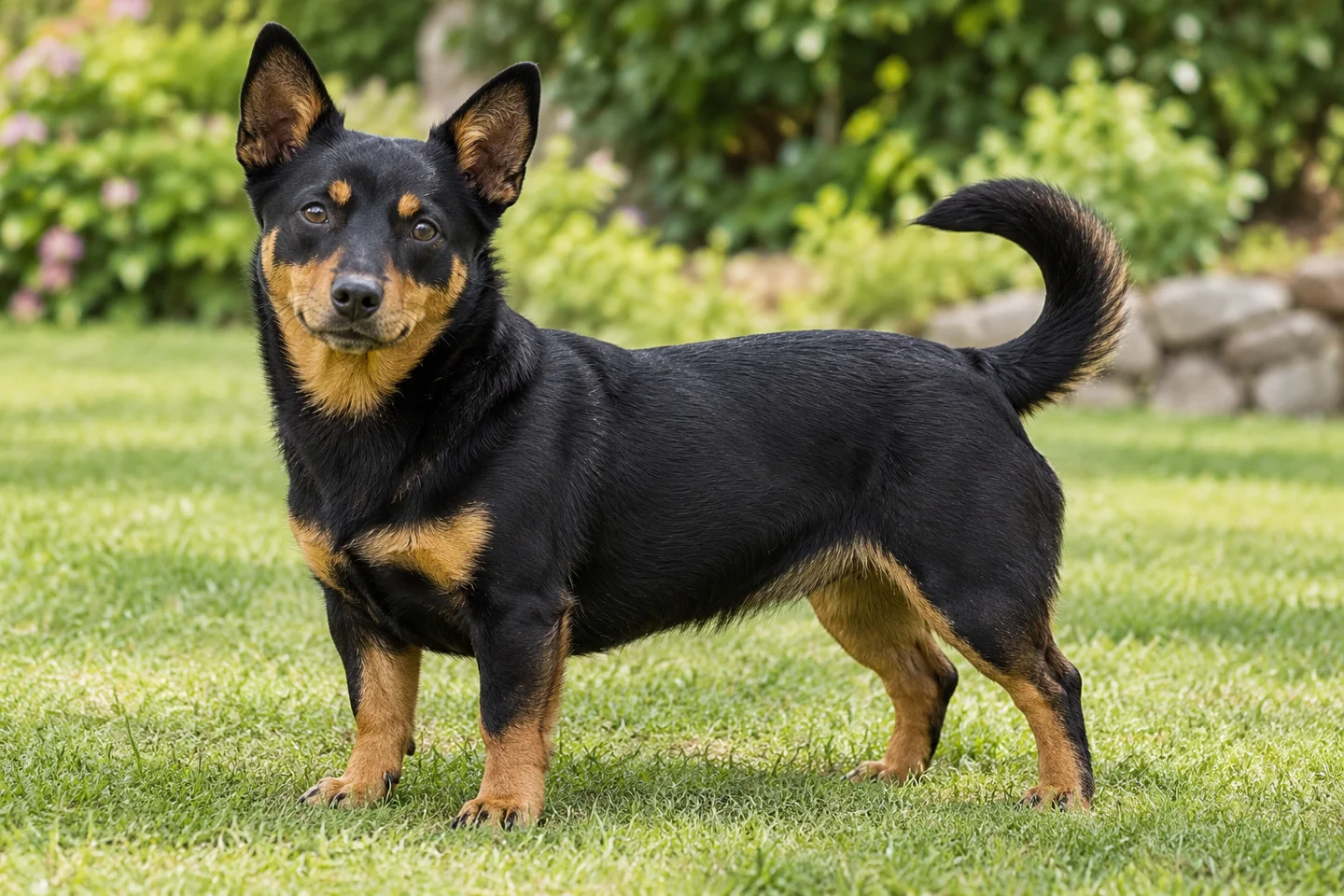
The FCI ideal shoulder height is 30 cm for males and 25 cm for females. The body is a little longer than the shoulder height, with strong short legs and a firm back. Alert ears lift or stand erect. The full natural tail may curve over the back when the dog is attentive, without forming a complete ring. Black and tan and liver brown and tan are the permitted coat colors. The images here use black and tan with clearly defined facial and lower-leg markings, retaining natural ears and tail.
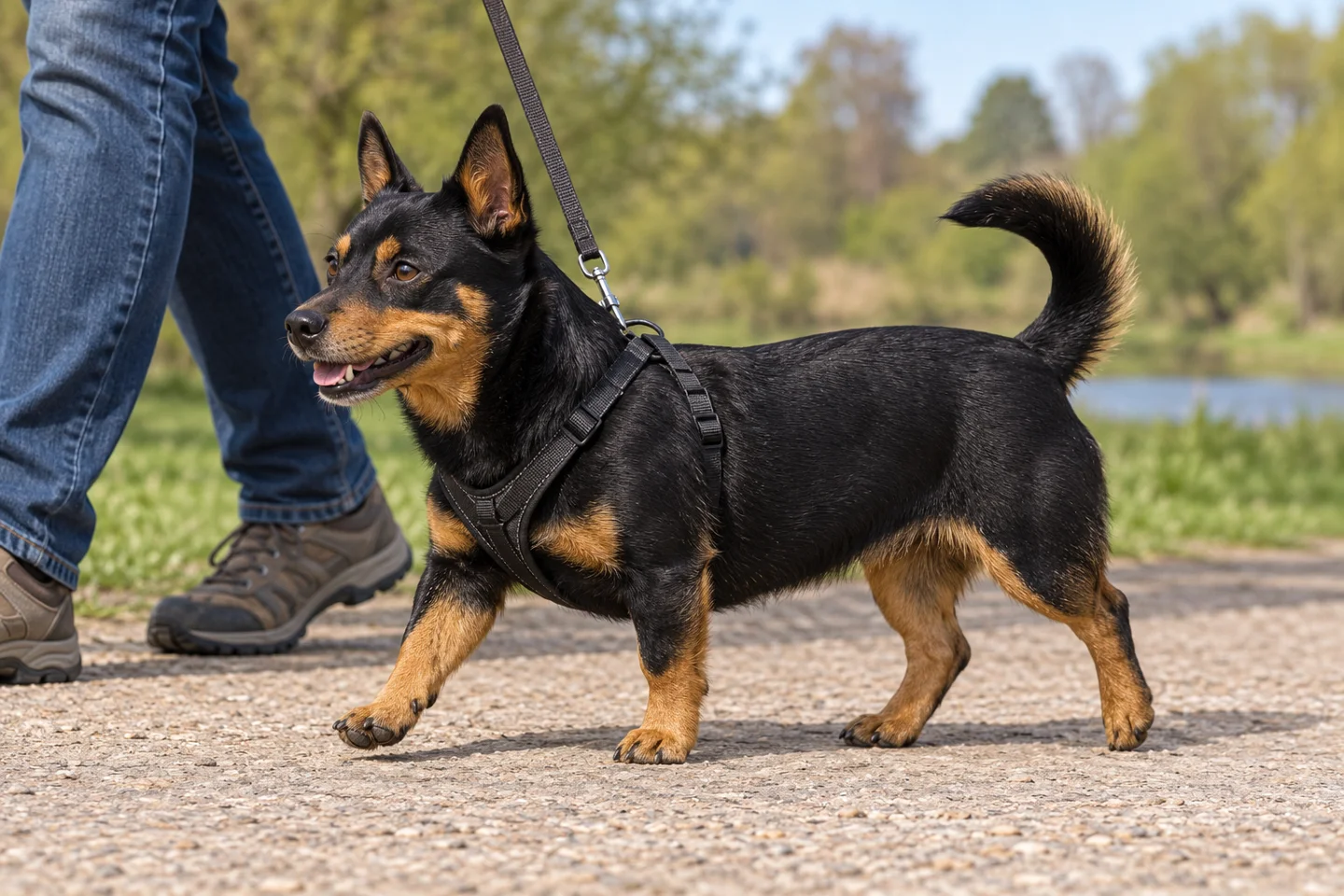
A low body requires equipment and handling suited to the actual frame. Check a harness while the dog walks rather than judging fit from a stationary photograph. Avoid a design that presses against the forelegs or slips over the head when the dog backs away. Puppies need frequent checks as their proportions change. When lifting is necessary, support the body securely and ask a professional to demonstrate if you are unsure. Small size can encourage people to scoop a dog up without warning, so teach comfortable handling and give visitors clear instructions instead of assuming every brief lift will be welcome.
Training alternatives to chasing feet and moving objects
Plan for movement before it becomes the most exciting event in the room. Teach the Heeler to go to a mat, turn toward the handler, and follow a simple recall in quiet circumstances. Then introduce an easy version of a household movement, such as one person taking a slow step. Reward the alternative behavior while keeping the exercise short. If children running through the hall already trigger pursuit, prevent that setup while the adults obtain guidance. Repeated shouting after the dog is chasing supplies much less information than a clear practiced response before the chase starts.
Use rewards the individual values and make the task achievable. A dog that succeeds beside a still bicycle has not necessarily learned to cope with a fast bicycle close by. Change distance and speed gradually, and use secure walking equipment during practice. Teach an interruption that leads to an appropriate activity rather than only removing access. A qualified reward-based trainer can help you identify where the dog begins losing the ability to respond. Keep family instructions consistent so the animal is not rewarded for chasing on one day and confronted for the same behavior the next. Good teaching should make everyday movement easier for everyone to manage.
Exercise, learning, and rest all need a place
A Heeler's activity plan should give it useful engagement without making constant excitement the household norm. Combine appropriate walks with short training, supervised investigation, and comfortable downtime. A search for a safe familiar object can be a quieter option than repeatedly throwing a toy until the dog cannot settle. End a game predictably and provide a transition to rest. Notice what the individual does after an outing. If it remains frantic or struggles to recover, review the activity rather than simply making the next session longer.
Age, health, surfaces, and weather affect what physical work is suitable. Ask your veterinarian before starting demanding sport or changing exercise substantially after illness. A low dog still needs attention to hot ground and access to shade and water. Plan routes where you can turn back easily and where you will not be forced into close encounters at narrow gates. Report persistent lameness or an unusual change in stamina with a clear timeline. Do not explain discomfort away as reluctance to cooperate. The goal is a routine that leaves the dog moving comfortably and able to participate normally at home, including on the day after a more active outing.
Temperament is visible in ordinary transitions
The standard describes an affectionate, courageous, energetic dog. Ask how those qualities appear when the household changes activity. Can the dog rest while people eat, leave the garden when asked, or remain comfortable while a visitor sits down? The answers reveal more than a label such as confident or clever. A puppy's responses will still develop, while an adult may show different behavior in a new environment. Request examples from several settings and ask what support helped during changes. A source should be able to describe both comfortable routines and situations still being managed.
Teach time alone through small steps within the dog's current coping ability. Set up a familiar resting area and begin with brief manageable separations after its needs have been met. Check whether the dog sleeps or relaxes rather than measuring success only by silence. If it becomes distressed, arrange support and seek suitable advice. Do not build a work schedule on the assumption that a small dog can manage unlimited absences. Include the availability and cost of care in the ownership decision. Training progresses more fairly when the household can prevent repeated overwhelming experiences while the dog learns.

Aggression and bite prevention around pressure
A herding history does not excuse biting people or make threatening behavior harmless. Examine the immediate circumstances: pursuit during fast movement, pressure around a chew, fear of an approaching dog, and pain during lifting require different responses. Prevent another incident while professional advice is arranged. Seek a veterinary examination for sudden changes or suspected discomfort. Give the clinician an accurate account of contact and any injury. Avoid repeating the event as a demonstration or punishing the dog for a warning that should have prompted more space.
Protect meals and resting areas from interference, and use planned reward-based exchanges for appropriate objects. Keep unfamiliar dog encounters at a manageable distance instead of removing the lead to test whether behavior improves. A behavior professional can help establish restrictions the family can maintain. Anyone providing care needs that plan and a candid incident history before taking over. If muzzle use is recommended, teach it gradually and retain other safeguards; the device cannot resolve an unsuitable situation by itself. Size affects how people perceive a risk, but the welfare of a small dog and the safety of those around it still require careful, consistent management.
Children and resident animals need separate decisions
Give children simple rules that an adult can enforce. Leave the dog alone while it eats or sleeps, ask before approaching, and get help if it takes an object. Do not let children practise being livestock for the Heeler to chase. Arrange calmer interactions and provide a protected resting place when a game becomes busy. Adults should manage the lead and any lifting. Supervision needs active attention, so use comfortable separation during gatherings when that attention is unavailable. A pleasant meeting with one older child does not answer how the dog will cope with several younger visitors.
Assess relationships with other dogs separately from interest in cats or small pets. Ask what has actually been observed, including the conditions and duration of contact. A dog's working background makes pursuit a relevant question without proving what this individual will do. Maintain secure separation wherever safety is uncertain, especially for rabbits, rodents, or birds. Do not use a loose animal as a test. With a new dog companion, allow space during introductions and organize separate food, chews, and rest. If the home cannot maintain those arrangements, seek a more suitable placement rather than relying on the animals to resolve a difficult relationship without help.
Health screening distinguishes DNA, eyes, and knees
Lancashire Heelers United identifies DNA screening for Collie eye anomaly and primary lens luxation, with clinical patellar evaluation among the US club's CHIC requirements. The British Lancashire Heeler Club also directs breeders to eye examination and the two DNA tests. Ask which programme governs the parents and request the actual results. A genetic result for a named variant is different from a specialist examination of the eyes, while knee assessment answers another question again. These records should not be compressed into a single claim that a dog has had every possible test.
A CHIC number means the specified tests were completed and the results made available; it does not mean every result was normal. Read the findings and have their implications explained for the proposed mating. Keep current eye information alongside DNA results, since the questions overlap only partly. If an individual develops an eye problem, do not let reassuring parental paperwork delay clinical assessment. Bring prior ophthalmology records and describe the onset of changes in appearance, comfort, or vision. The source should also explain how later owner diagnoses reach the relevant health programme, so information about families improves as the dogs age rather than ending when the puppies leave.
Food and ownership costs for the life you actually have
Measure complete food appropriate to life stage and include rewards in the daily amount. A small dog can receive a substantial share of its intake through training without anyone noticing how many pieces were offered. Discuss condition with the veterinary team and adjust deliberately as activity changes. Separate feeding if other animals create competition, and keep a record of significant appetite or digestive changes. Avoid using supplements or repeated diet switches as a substitute for investigating a persistent problem. A clear account of food and medication is useful when somebody else takes responsibility for care.
Find out what local support costs before deciding a placement is affordable. Include veterinary visits, appropriate secure equipment, fencing repairs, boarding or sitting, and the time needed for training. Ask a potential carer how they would manage a delivery, a fast-moving dog encounter, or a current behavior restriction. Establish emergency funding or suitable insurance and read the terms. Written support and return arrangements from a breeder or rescue should be understandable before collection. An appealing small dog still needs a plan that functions during work travel, family illness, and changes in the dog's abilities, rather than depending on one person always being available.
Mixes and the difference between appearance and ancestry
Black-and-tan coloring, upright ears, and a low body do not establish that a dog is a Lancashire Heeler or a particular cross. Ask what is documented about parentage and keep uncertain labels tentative. Where parents are known, obtain relevant information about both rather than looking only at the breed named first in an advertisement. A mix is not automatically protected from inherited conditions, and a small frame does not guarantee a quiet lifestyle. Assess the individual animal's health, movement, responses to handling, and observed social experience alongside family records.
The same caution applies to promises about adult coat and temperament. A puppy can develop characteristics that were not obvious at collection. Choose a source willing to discuss variation and offer realistic support. An adult placement may provide a clearer account of daily behavior, but a move can still change what the dog finds difficult. Set up a predictable first period with room to rest and learn. Avoid making immediate public appearances the measure of success. The useful information is what helps this dog eat, sleep, move, and respond comfortably in its new routine, regardless of how closely its appearance matches a breed photograph.
dogsDating introductions with a plan for movement
On dogsDating, describe whether this Heeler enjoys a steady walk, needs distance from fast play, or currently avoids direct greetings. Share an approximate location while keeping exact coordinates and the home address private. Agree on a public meeting point with clear sightlines and enough width for two handlers to turn away. Do not begin beside a busy playground if running children are already difficult for the dog. Each adult should manage their own animal and understand any restrictions before the meeting starts, so nobody has to discover an important limit during the first close approach.
Start with walking in the same direction and allow space for quiet investigation. Watch both dogs as the pace changes, since one individual's quick movement may be the part the other finds difficult. Avoid shared toys and food placed between them. Increase distance or finish if either repeatedly tries to escape, stiffens, or cannot disengage comfortably. Record what worked and choose the next step from that evidence. A compatible walking companion does not need to become a playmate. The meeting succeeds when the dogs remain manageable and the owners can make decisions that respect their needs throughout the outing.
Sources and editorial notes
Sources checked October 22, 2026. Breed measurements describe reference ranges, not a diagnosis or an individual dog's ideal weight. Images are AI-generated breed illustrations and do not document a particular dog or health condition.
- AVSAB: Humane Dog Training Position Statement
- VCA Animal Hospitals: Food aggression in puppies
- Orthopedic Foundation for Animals: CHIC health screening programs
- VCA Animal Hospitals: Aggression toward unfamiliar dogs, diagnosis
- VCA Animal Hospitals: Grooming and coat care for your dog
- VCA Animal Hospitals: Ear infections in dogs (otitis externa)
- AAHA: Feeding plans for healthy, appropriate weight cats and dogs
- VCA Animal Hospitals: Heat stroke in dogs
- AVSAB: Puppy Socialization Position Statement
- VCA Animal Hospitals: Dog behavior problems, aggression toward children
- Official breed standard: Lancashire Heeler
- Lancashire Heelers United: Health screening and CHIC interpretation
- Lancashire Heeler Club: Eye screening and DNA health guidance
Keep getting to know dogs.
Read another guide or return to your dogsDating community.
Explore breed guidesBack to dogsDating