Polish Lowland Sheepdog
The shaggy PON combines a sturdy working frame with a coat-care commitment and a need for owners who enjoy teaching daily routines.
How these guides are researched and reviewed
- Origin
- Poland
- Adult height
- Males 45–50 cm; females 42–47 cm
- Original name
- Polski Owczarek Nizinny, shortened to PON
- Coat
- Long coarse outer hair over soft dense undercoat
General information for owners. These articles have not been reviewed by a veterinarian. Medical decisions need your dog's history and an examination.
The PON’s coat is only the visible part of the commitment
The Polish Lowland Sheepdog is commonly called PON, using the initials of Polski Owczarek Nizinny. It is a sturdy medium-sized herding breed underneath the shaggy coat. Anyone choosing one should think about care, learning, and daily household transitions before deciding how appealing the outline looks. Meet mature dogs and ask what happens when visitors stop offering attention or a game finishes. A neat public appearance may reflect regular preparation that a prospective owner needs to understand, including work that is less visible than the dog standing for a photograph.
Describe the life you can offer in practical terms. Who will maintain the coat, teach useful behaviors, arrange suitable activity, and provide care during absences? Ask a source why a particular puppy or adult fits that routine and what remains difficult. A dog may learn quickly while still needing help with unfamiliar people or movement. A puppy's adult responses are still developing, and a rehomed dog may need time to adapt. The goal is an informed placement that remains workable during ordinary busy weeks, with support already identified instead of relying on an appealing breed description to fill a gap in care.
A Polish sheepdog identity, separate from the Tatra guardian
The PON is distinct from the Polish Tatra Sheepdog, the much larger white mountain guardian. Similar English names should not lead to shared size information or assumptions that their daily work is interchangeable. The PON's standard describes sheepdog and watch functions in a compact muscular body. The AKC records acceptance of its first standard by the Polish club and FCI in 1959. A modern standard date helps explain organized breed identity; it does not establish an exact founding date for every working dog in the earlier regional population.
When discussing history, keep documented events separate from distant ancestry stories. A source's account of the current family and its selection is more useful to placement than an unverified recipe of ancient dogs. Ask how adults respond to movement, notice unfamiliar events, and recover after activity. Working background supplies questions to investigate, not an identical script for every pet. A household can offer appropriate learning and activity without owning sheep, while anyone intending livestock work needs skilled instruction that protects the animals involved. Neither the name sheepdog nor a shaggy appearance makes an unprepared puppy ready for a job without supervision.
Size, tail variation, and sight through a long fringe
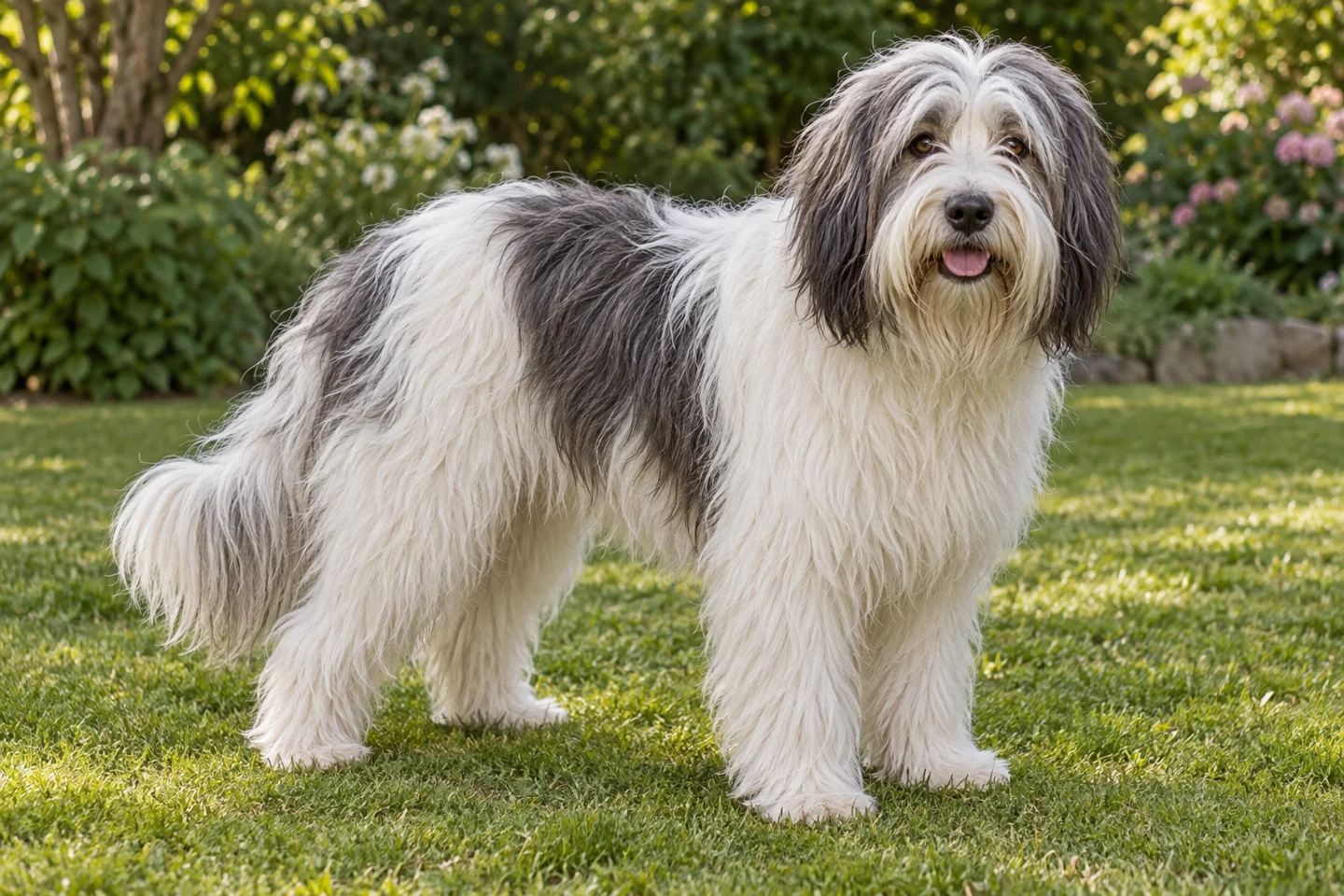
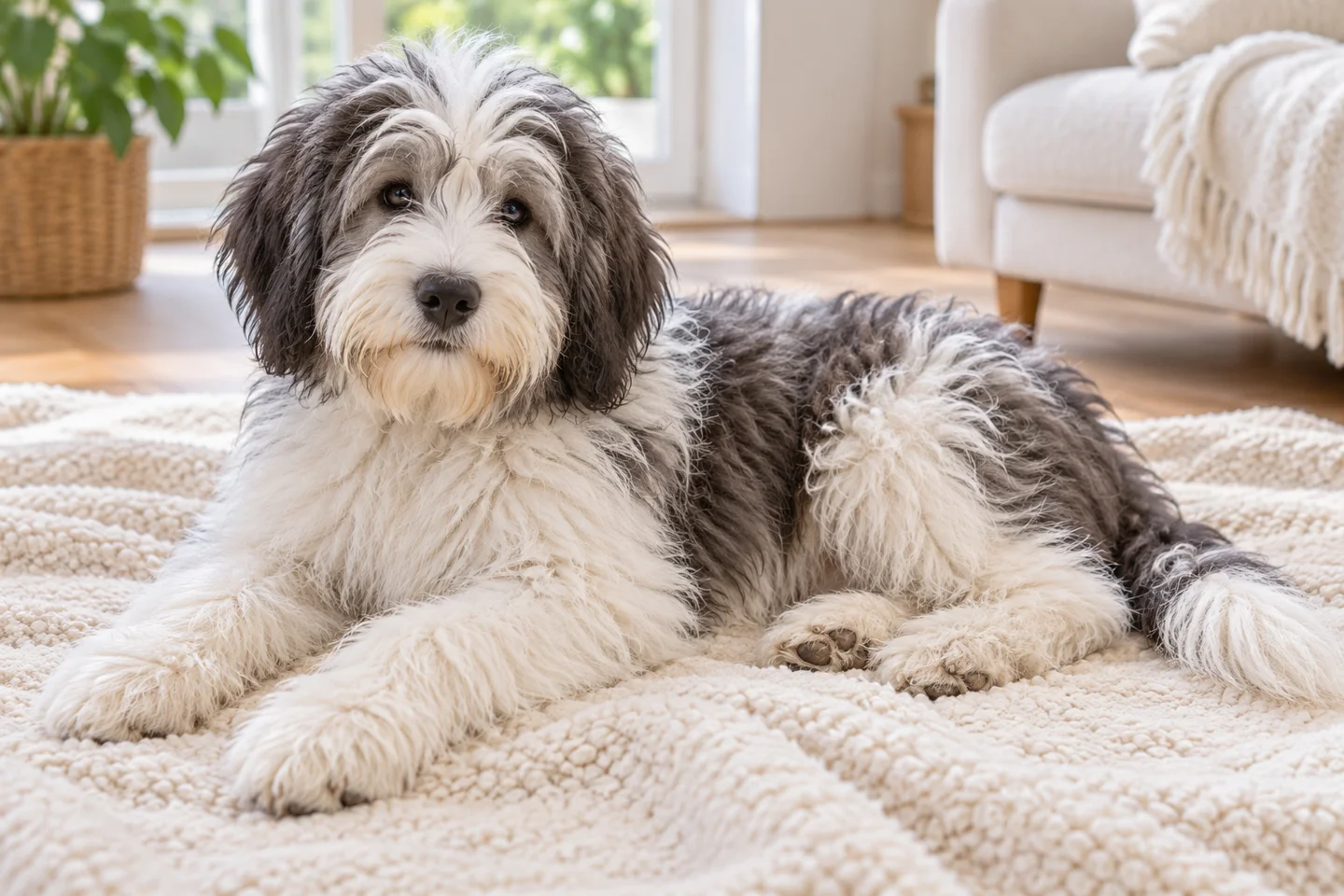
The FCI height range is 45–50 cm for males and 42–47 cm for females. The body is strong and rectangular rather than delicate, with natural hanging ears, hazel eyes, a beard, and long dense hair. All colors and patches are accepted. The standard describes tail variation, including natural longer tails; the illustrations choose a full natural hairy tail with a white-and-grey coat. They do not present docking as necessary to breed identity or confuse a naturally short-tailed animal with one whose tail was altered.
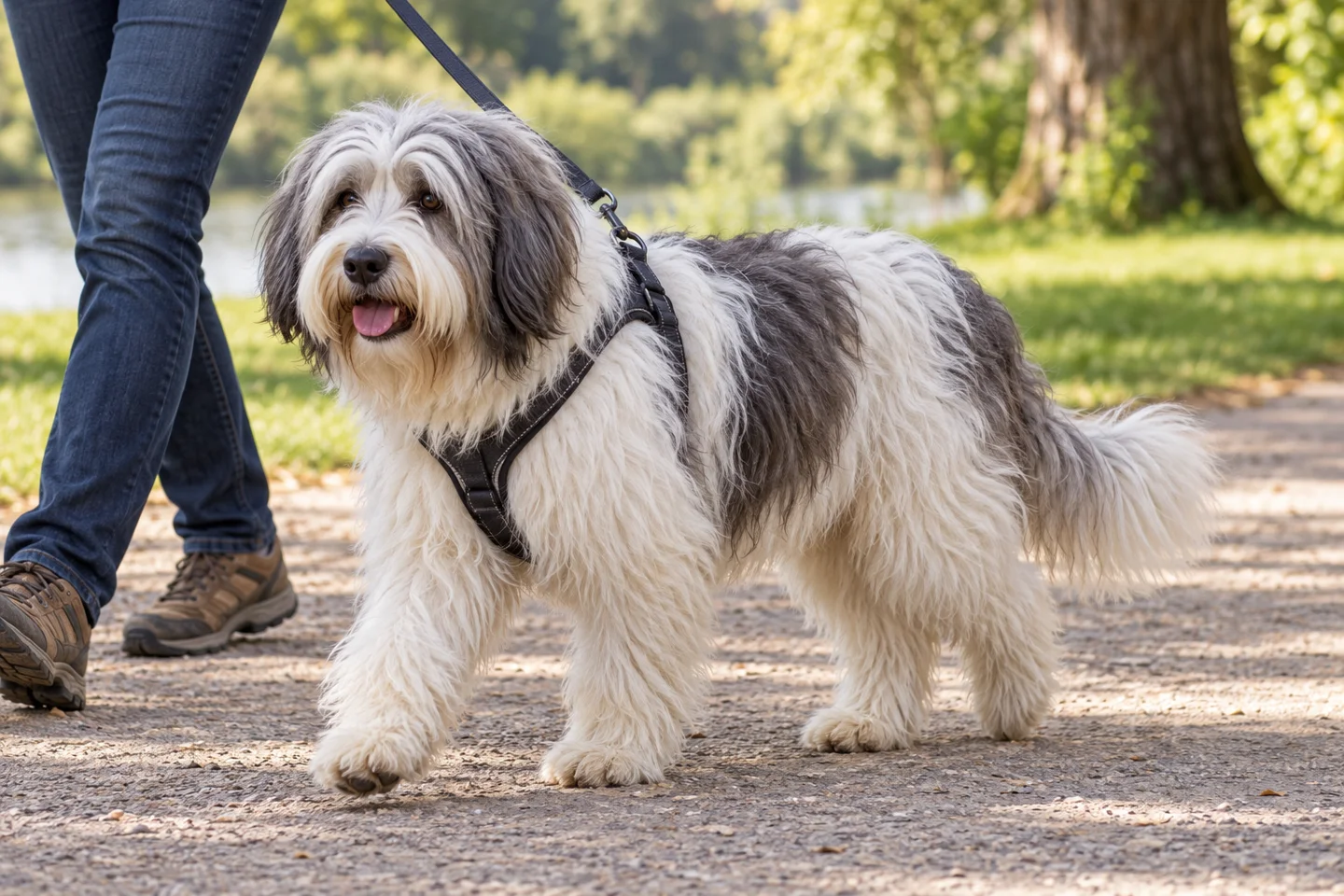
Long facial hair must not become an excuse to ignore sight or discomfort. Discuss practical maintenance with an experienced groomer so the dog can see, eat, move, and toilet normally. A full coat also makes body-condition assessment less obvious. Ask the veterinarian to judge the frame and use gentle handling to notice changes beneath the hair. Check equipment during walking rather than relying on a static fit over thick furnishings. Puppies need repeated checks as they grow. An adult's trim or condition change can also require adjustment, and transport should allow the dog to lie naturally rather than being chosen only for the smallest space the coat appears to fit.
Grooming needs a weekly plan the household can maintain
A PON kept in long coat needs substantial routine care. The AKC describes thorough brushing and notes that a shorter pet clip still requires maintenance. Ask a groomer to demonstrate how to work down toward the skin, especially where movement and equipment cause friction. Surface tidiness can hide a dense tangle below. Check the beard, feet, and hygiene areas as well as the back. Do not wait for tight mats and then make the dog endure a prolonged painful session merely to retain a desired presentation. Comfort should guide the recovery plan if maintenance has fallen behind.
Prepare the dog for care through small rewarded steps: standing on a stable surface, accepting a moment of brush contact, and pausing while a paw is inspected. Build duration only while the individual remains comfortable. Tell the groomer about skin concerns and handling limits before the appointment. Redness, odor, discharge, repeated scratching, or sudden sensitivity needs veterinary advice. Avoid tools pushed into the ear canal or leftover prescriptions for a new problem. Keep product and treatment details if irritation recurs. Care works better when another person can understand the routine and any limits, rather than beginning from a vague description that the dog dislikes grooming.
Training for a home full of movement and competing interests
Teach an easy response to the handler, recall, and moving onto a resting place before the household becomes exciting. Reward clear small steps and use barriers to protect unfinished learning. A dog that understands a cue in the kitchen still needs preparation around visitors, a passing bicycle, or a children's game. Add one part of the difficulty at a time. If the PON cannot respond, reduce the challenge rather than repeating louder commands after the situation is already too much. A reward-based instructor can help identify an achievable starting point.
Make household rules consistent. A behavior encouraged during play should not suddenly become an unexplained confrontation when someone else enters the room. Teach appropriate exchanges for suitable objects and prevent access to dangerous items. Give games a predictable ending and reward quiet transitions as deliberately as active skills. Cleverness is not a substitute for instruction. The owner should be able to explain what response is needed, how the dog will learn it, and what management remains necessary in a new context. The useful result is daily cooperation, not a collection of impressive behaviors that cannot be used when ordinary life becomes busy.
Exercise should include investigation and the ability to rest
Choose activity around the individual's age, health, and current condition. Walks, learning, and appropriate supervised games can provide variety without every day becoming a race toward exhaustion. A fenced space is useful only when its boundaries are checked and the dog remains supervised. It does not supply the whole relationship. Teach the end of an activity so the animal can recover comfortably while people do something else. A schedule that depends on continuous high excitement may become difficult to maintain when work, weather, or medical needs change.
Ask the veterinary team about readiness for demanding sport and about return after illness or injury. A puppy should not be pushed to match a mature trained dog. Consider warm surfaces, shade, water, and the journey as part of the outing. Keep a route that can be shortened and notice recovery later at home. Repeated stiffness, lameness, or unusual fatigue needs assessment rather than a judgment about motivation. The thick coat cannot tell you whether the body underneath is coping comfortably. Record what changed and when, so the clinician has a useful timeline instead of only a general claim that an active breed should want to keep going.
Watchfulness and comfortable time apart
Ask what starts the individual's barking or boundary attention. A visitor, repeated movement outside, and distress during absence require different responses. Describe neighbors and the dog's proposed daytime space honestly to the source. A useful plan reduces repeated exposure to a trigger while teaching a manageable alternative. A comfortable resting place away from continual visual disturbance may be important. Do not encourage suspicion to create a more authentic-looking watchdog. An owner needs a routine that makes ordinary arrivals predictable rather than relying on loud reactions as evidence that the animal is doing its job.
Teach manageable periods apart after the dog's needs have been met. Check genuine settling rather than treating silence as the only measure. A recording can help describe a difficulty to a professional. If the animal is distressed, arrange support while obtaining guidance instead of extending the absence as an endurance lesson. Another pet should not be assumed to solve the issue automatically. A social working breed still needs an individual coping plan, and a realistic budget should include help when the household's schedule exceeds what the dog currently manages. The routine becomes fairer when repeated overwhelming experiences can be prevented during learning.
Socialization without requiring every stranger to touch
During puppy vaccinations, discuss appropriate early exposure with the veterinary team. Introduce ordinary people, surfaces, vehicles, and sounds in small amounts with room to observe and leave. A calm look at a busy scene from the edge can be useful without a greeting. A newly adopted adult also needs experience assessed rather than presumed. Ask previous carers which settings have been observed directly and which remain unknown. The first days in a new home need not become a test of every environment the owner hopes the dog will eventually enjoy.
Watch recovery after surprise and the ability to settle afterward. Repeated avoidance, freezing, or threatening behavior means the setup needs reassessment and possibly qualified help. Being still under restraint does not necessarily mean comfort. Prepare medical handling separately, rewarding small relaxed steps and telling the clinic where difficulty begins. If pain or urgent illness is already present, seek care rather than waiting to finish training. Predictable cooperation is a useful long-term goal, while the professional team can choose an appropriate approach to the immediate patient. Good preparation gives them accurate information rather than an assumption that a well-trained dog should tolerate every procedure unchanged.
Aggression and guarding need their own account
An individual PON can threaten or bite despite affectionate behavior in other settings. Record who approached, the available space, any resource or handling involved, contact, and injury. Prevent repetition while arranging veterinary and behavior advice. Sudden changes around touch, movement, or rest deserve assessment for discomfort. Do not reproduce the event for a demonstration or punish the warning as if the absence of noise resolves the underlying problem. The goal is a safer environment and a clearer understanding of what the animal was finding difficult.
Protect meals and sleeping spaces and teach exchanges with appropriate objects in planned practice. Children should ask an adult to recover something rather than reaching into the mouth. Keep unfamiliar canine encounters at a manageable distance instead of forcing greetings to test sociability. A qualified professional can help establish restrictions the household can maintain. Give carers a factual incident history before they agree to take responsibility. If muzzle conditioning is advised, learn fit and comfortable gradual teaching while retaining barriers and supervision. A device can support prevention, but it cannot make repeated crowding, rough handling, or resource competition a suitable social exercise.
Children and resident pets need predictable boundaries
Teach children to invite contact, stop when the PON leaves, and avoid disturbing meals or sleep. A capable adult should manage the lead and care tasks. Do not organize running games around the idea that chasing is entertaining sheepdog work. Choose calmer shared activities and provide a protected resting place during busy visits. Active supervision requires attention, so use comfortable separation when attention must be divided. Ask the source what ages and situations have actually been observed. A pleasant brief encounter is one observation, not a guarantee about every future family gathering.
Other dogs, cats, and smaller pets require separate consideration. A familiar companion does not establish compatibility with every visitor, and a successful outdoor walk does not settle indoor food or rest. Begin introductions with room for handlers to withdraw and organize individual necessities at home. Maintain physical protection for vulnerable animals when behavior is uncertain. Never release one to test pursuit. The household's layout and habits must support the required management during ordinary distractions and absences. If they cannot, another placement may better protect all the animals than relying on them to resolve a difficulty the people cannot reliably prevent.
Health evidence for hips and eyes
Current AKC parent-club recommendations for the Polish Lowland Sheepdog include hip evaluation and specialist eye examination. Ask for identified reports from both parents and have the source explain their findings and dates. A genetic panel cannot replace radiographic hip assessment or a clinical examination of the eyes. Likewise, a CHIC number recognizes completion and publication of the applicable protocol rather than guaranteeing every result is normal. Read the records instead of stopping at a badge or a statement that the parents were checked.
The American club provides health and research resources, making it sensible to ask how later diagnoses from owners reach the family account. Include older nonbreeding relatives where information exists, not only young successful adults. Missing records should remain visible as unknown information. For an adult placement, collect the animal's own injuries, medication, restrictions, and follow-up plans. A new change in gait or vision needs investigation of that patient despite reassuring parental paperwork. If the dog hesitates in dim conditions or suddenly resists movement, describe the observation and timeline to the veterinarian rather than deciding the cause from a breed label or a generic online disease list.
Nutrition, mixes, and costs that remain after the first haircut
Use complete nutrition appropriate to life stage and current condition. Measure intake, include rewards, and review portions with the veterinary team as activity changes. Coat volume can make condition difficult to judge by sight alone. A dog described as a PON mix also needs this individual assessment. Ask what is documented about parentage, consider relevant information about both known parents, and retain uncertainty where a label rests on appearance. Crossing does not promise freedom from inherited illness, a predictable halfway temperament, or an easier coat. Puppy hair may develop into a different care commitment than the source first anticipated.
Obtain local prices for grooming, veterinary care, equipment, transport, training help, and suitable care during absences. Confirm that a sitter understands handling and coat needs before assuming an available place is appropriate. Clarify support and return provisions with the source in writing and arrange emergency funding or suitable insurance. The household plan must function when the usual person is ill or the dog requires more clinical attention. A short pet clip can simplify presentation but cannot remove every maintenance task. Ownership becomes more sustainable when the time and services needed for this actual animal are identified before collection rather than discovered through a crisis.
dogsDating meetings can favor quiet parallel company
Describe the PON's pace, response to movement, and current greeting limits on dogsDating. Share an approximate area while keeping exact coordinates and the home address private. Choose a public open starting point with room to remain apart, avoiding narrow gates that force contact immediately. Each capable adult should manage their own dog and agree that either can finish early. A practical profile should prepare the conditions for a suitable outing, rather than promise compatibility because two animals have shaggy coats or belong to herding breeds.
Begin with parallel walking and allow quiet investigation without shared toys or food placed between unfamiliar dogs. Watch both animals when pace or distance changes. Repeated withdrawal, stiffness, or excitement that prevents comfortable disengagement calls for greater separation or departure. Compare the route, duration, and pace afterward instead of deciding success requires close play or nose contact. A calm familiar walking partner can be valuable. Later meetings should follow evidence of comfort from these individuals, preserving the owners' ability to change the plan while it remains a manageable experience for the dogs as well as the people.
Sources and editorial notes
Sources checked October 22, 2026. Breed measurements describe reference ranges, not a diagnosis or an individual dog's ideal weight. Images are AI-generated breed illustrations and do not document a particular dog or health condition.
- AVSAB: Humane Dog Training Position Statement
- VCA Animal Hospitals: Food aggression in puppies
- Orthopedic Foundation for Animals: CHIC health screening programs
- VCA Animal Hospitals: Aggression toward unfamiliar dogs, diagnosis
- VCA Animal Hospitals: Grooming and coat care for your dog
- VCA Animal Hospitals: Ear infections in dogs (otitis externa)
- AAHA: Feeding plans for healthy, appropriate weight cats and dogs
- VCA Animal Hospitals: Heat stroke in dogs
- AVSAB: Puppy Socialization Position Statement
- VCA Animal Hospitals: Dog behavior problems, aggression toward children
- Official breed standard: Polish Lowland Sheepdog
- American Kennel Club: Polish Lowland Sheepdog hip and eye recommendations
- American Polish Lowland Sheepdog Club: Health information and research resources
- American Kennel Club: Polish Lowland Sheepdog care and identity
Keep getting to know dogs.
Read another guide or return to your dogsDating community.
Explore breed guidesBack to dogsDating