Papillon
An erect-eared Continental Toy Spaniel with guidance on safe handling, useful training, silky coat care, and knee, heart and eye screening.
How these guides are researched and reviewed
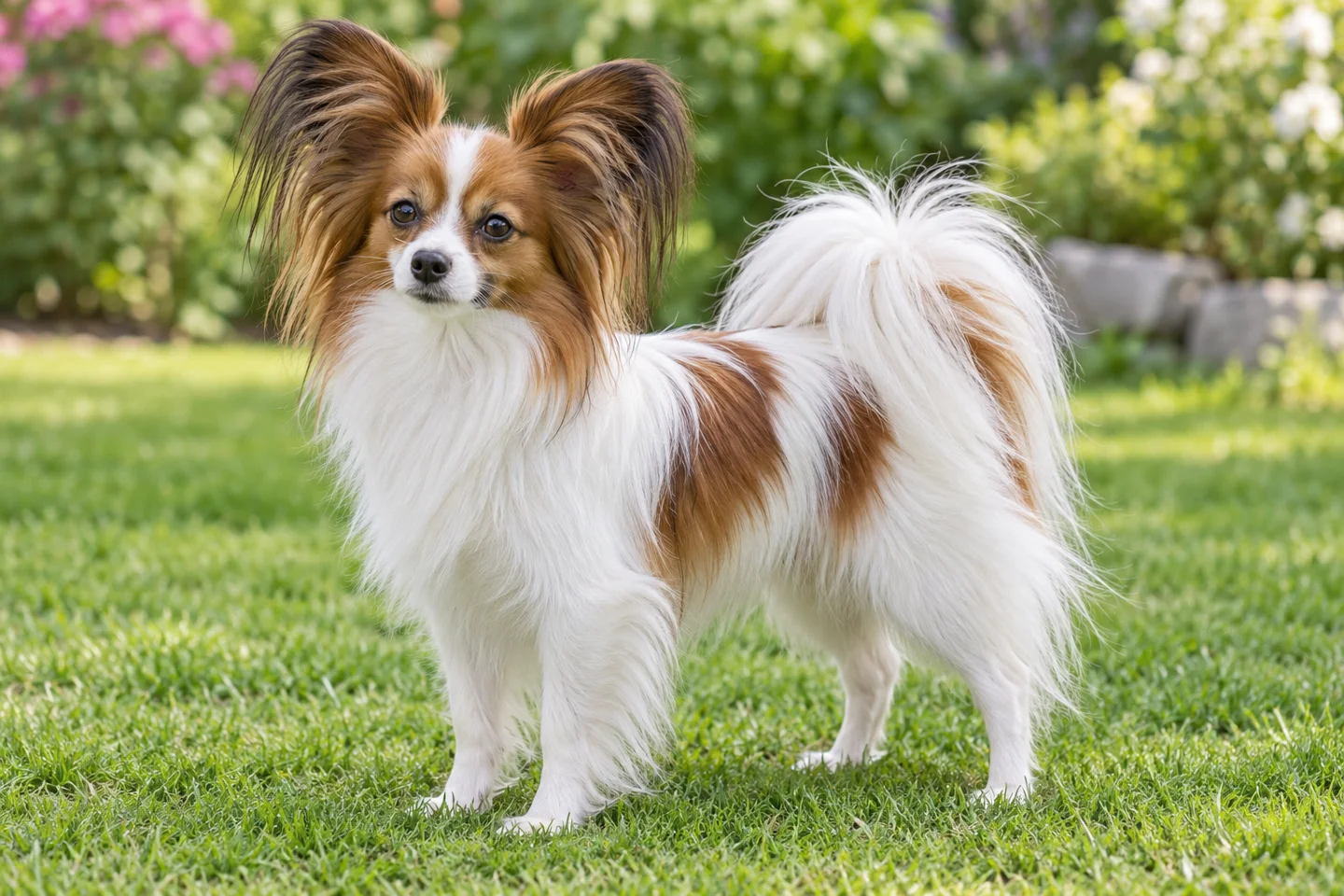
- Origin
- France and Belgium under the FCI standard
- Adult standard height
- About 28 cm
- Adult weight categories
- Minimum 1.5 kg; under 2.5 kg category, then males 2.5–4.5 kg and females 2.5–5 kg
- Illustrated variety
- Erect-eared Papillon
General information for owners. These articles have not been reviewed by a veterinarian. Medical decisions need your dog's history and an examination.
A toy spaniel with a working mind
The Papillon is a small Continental Toy Spaniel whose naturally upright, fringed ears create the familiar butterfly outline. A white background with colored markings, a fine muzzle, and a plumed tail complete the recognizable appearance. It is a dog with ordinary needs for exploration, learning, sleep, and choice. Its ability to fit on a lap should not become a reason to carry it through every experience or overlook discomfort because it is easy to restrain. Give it opportunities to approach, investigate, and walk away under its own control. A stable step or a well-placed gate can make those choices safer without requiring a person to lift it whenever the surroundings change.
Think about life at the dog's level. A busy pavement contains feet, wheeled bags, and dogs much taller than it. At home, a sofa may be a considerable jump and an opening exterior door an escape route. Owners who teach practical skills while managing those physical risks give the dog more freedom safely. Meet adults and ask about barking, handling, settling, and time alone. Small size can make transport easier, but it does not establish that every household routine will be easy.
Papillon, Phalène, and the breed name
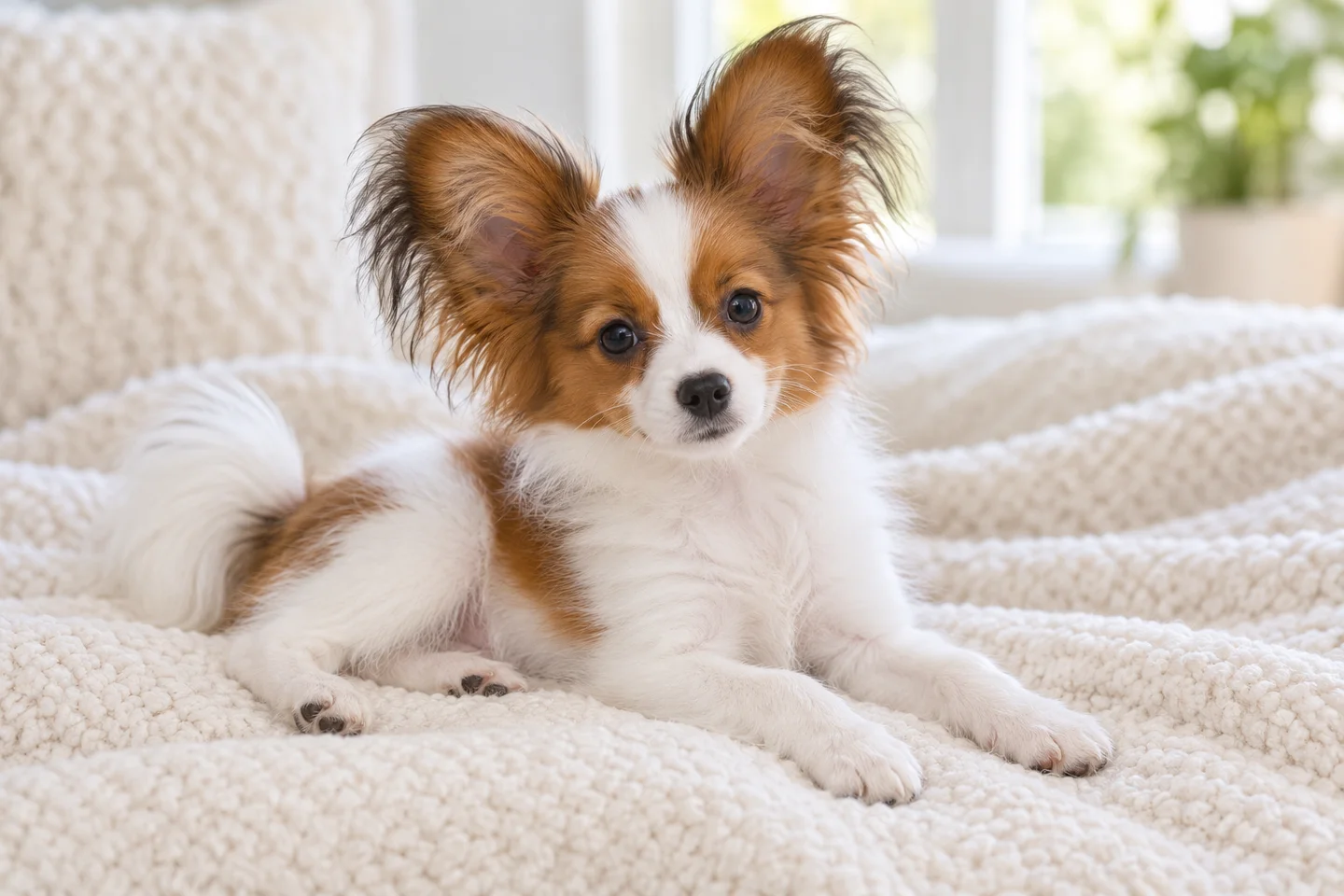
The FCI places the Papillon and the drop-eared Phalène within the Continental Toy Spaniel. Ear carriage distinguishes these named varieties. The illustrations here show the erect-eared Papillon, with natural ears and developing fringes in the puppy. A young dog's ear furnishings are not expected to look like a mature adult's, and a photograph is insufficient evidence of ancestry or future coat quality.
The breed's spaniel identity helps prevent confusion with a tiny Spitz or a Chihuahua selected chiefly for long hair. Look at the whole dog, including proportions and documented parentage. Ask a breeder to explain how its registry records varieties and what information it provides if a puppy's development differs from the early expectation. The history and naming of a breed can be interesting, but they should not distract from whether the animal moves comfortably, recovers from everyday surprises, and has appropriate veterinary and parental health records.
Adult measurements are references, not a target for tiny puppies
The FCI standard gives an approximate height of 28 cm at the withers. Its weight categories include dogs and bitches under 2.5 kg, then males from 2.5 to 4.5 kg and females from 2.5 to 5 kg, with a minimum weight of 1.5 kg. These categories describe conformation references rather than a reason to restrict nutrition or seek the smallest possible puppy.
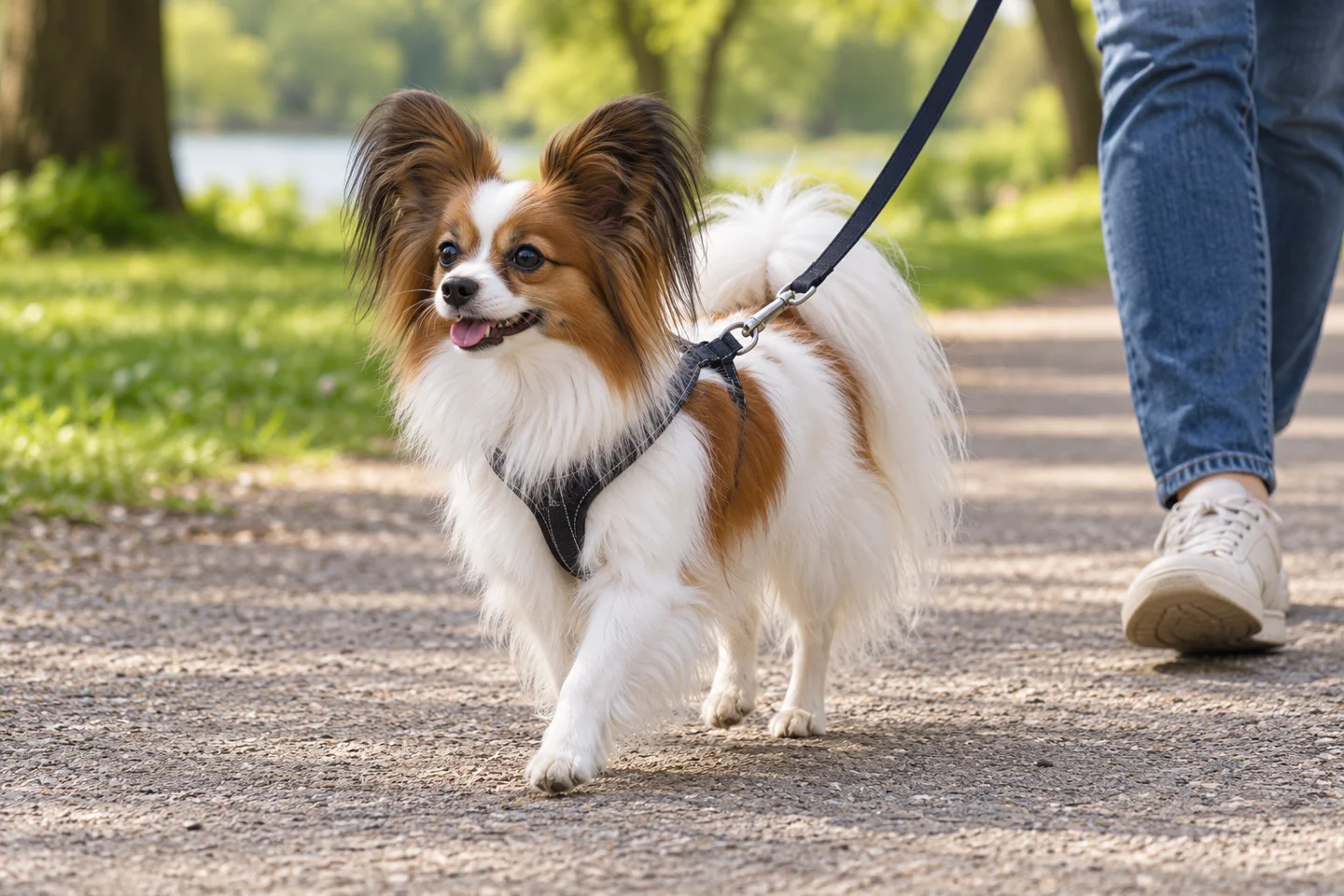
Ask for the parents' measurements and the puppy's growth record, but recognize that no photograph guarantees an exact adult weight. Have a veterinarian assess body condition through the coat and show you how to check ribs gently. Choose a harness that fits the chest without pressing against the throat, and recheck it as the puppy grows. A properly fitted travel carrier needs enough room for comfortable positioning and appropriate ventilation. Never leave it in a warm vehicle because its compact size makes the arrangement appear convenient.
Temperament in a home full of activity
A Papillon can be quick to notice changes and keen to participate. Give that attention useful places to go, such as searching for part of a meal, learning a short routine, or resting beside someone who is working. Constantly entertaining the dog can create a household that never becomes quiet. Reward calm periods and provide a protected bed where sleep is not interrupted by repeated invitations to play.
Observe the individual rather than assuming that brightness means limitless resilience. A dog may learn a trick quickly while struggling with a noisy visitor or an unexpected absence. Introduce departures gradually and use a camera or a trusted observer when assessing what happens while you are away. Repeated pacing, vocalizing, or refusal to settle needs a different plan from a brief look at the door. If distress persists, discuss it with a veterinarian and a qualified professional rather than interpreting it as a small dog being dramatic.
Training useful skills beyond the trick repertoire
Teach a Papillon to come toward an offered hand, step onto a mat, wait at a door, and move away from feet. These skills matter as much as a polished trick. Reward them when the environment is quiet, then repeat in gradually busier places. Use rewards small enough to deliver comfortably and count them within the day's food intake. The dog should be able to swallow without being rushed into the next repetition.
A small body is easy to move by hand, but lifting the dog whenever it hesitates can bypass learning and reduce its control over contact. Invite it into a carrier and teach a predictable lifting cue when lifting is necessary. Support the body securely and stop if the dog appears painful. Avoid lead jerks, shouting, and physical punishment. If an exercise repeatedly fails, change the distance, surface, or distraction rather than assuming the dog is deliberately refusing a task it understands.
Socialization from a safe viewing point
A puppy can learn about the world while staying outside the busiest part of it. Observe traffic from a sheltered bench, let a calm adult sit sideways nearby, and choose controlled meetings with suitable dogs. The aim is comfortable learning, not collecting a fixed number of greetings. Coordinate appropriate exposure with veterinary guidance about infectious disease risks, using clean locations and safe handling rather than keeping the puppy isolated from all ordinary life.
Teach people to wait before reaching down. For a tiny dog, a stranger leaning over can be a large physical event. Let it approach voluntarily and keep a retreat available. Pair new sounds and objects with something pleasant at a level the puppy can manage. If it stops eating, stiffens, or tries to hide, make the next experience easier. An adult rescue may need the same gradual approach, with expectations based on its previous experiences and current response instead of its age alone.
Exercise without making small mean sedentary
Offer daily movement that includes sniffing and exploration. A Papillon can enjoy learning on walks, searching for hidden food, and suitable dog sports when age and health allow. Introduce balance and body-awareness tasks at low difficulty and on stable surfaces. A puppy should not repeatedly jump from furniture or perform physically demanding repetitions simply because it is enthusiastic about rewards.
Use a secure long line or enclosed area when practicing recall, and inspect fences for gaps a small dog could use. Protect the dog from uncontrolled approaches by larger animals and avoid crowded spaces where escape routes are limited. Adjust distance to weather, terrain, fitness, and recovery. Carry water in warm conditions and provide shelter from cold or wet weather when needed. If the dog tires unexpectedly, changes gait, or repeatedly asks to be carried on a previously comfortable route, arrange a health assessment rather than increasing exercise to build toughness.
Children need instructions that protect a fine-boned dog
Children should sit for calm contact and let the Papillon approach, with an adult close enough to help. Prevent lifting by children who cannot support the body securely or resist carrying the dog away after it wants to leave. A fall can have serious consequences, and fear of being grabbed can change the dog's response to approaching hands. Use barriers when a child is running or an adult cannot supervise actively.
Keep the dog's bed, food, and chews outside children's access. Explain that leaving is an acceptable choice, and end contact when the dog turns away, becomes still, or repeatedly licks its lips. A child can help place a food search or reward a familiar cue under guidance without taking over restraint. Never require the dog to prove tolerance by enduring hugs or costumes. Familiarity with one gentle child does not predict its comfort with a whole group of visitors moving around the floor.
Aggression deserves attention even when the dog is easy to lift
A Papillon that growls, snaps, or guards an object needs a practical response rather than laughter or a label such as feisty. Move people away, prevent another reach toward the dog, and record what happened beforehand. Was it sleeping, cornered, painful, or holding food? The sequence helps identify what to change and gives a professional something more useful than a general description of bad attitude.
Do not punish a warning or pick the dog up to force an interaction it is trying to avoid. Pain should be considered when handling tolerance changes, particularly around the mouth, knees, or back. Arrange veterinary assessment and behavior support when needed. Teach exchanges with appropriate objects while the dog is comfortable, and manage valuable items so children cannot approach. If a bite has occurred, obtain suitable medical advice and prevent repetition while a professional helps build a plan. Small teeth can still injure a person.
Living with larger dogs, cats, and other pets
Choose initial dog partners for compatible behavior and safe movement rather than breed size alone. A calm larger dog may be suitable, while a smaller dog that repeatedly chases and pins can still create an unsafe encounter. Start with separate handlers and distance, then allow brief voluntary approaches. Interrupt escalating pursuit and give the Papillon a space it can reach without being followed.
In a shared home, provide separate feeding areas and several resting places. Protect access to water and avoid putting the small dog's only bed where another animal can block it. Introduce cats through barriers and preserve elevated routes for the cat. Do not leave a Papillon with loose rodents or birds merely because the dog is itself small. Observe behavior over time and maintain reliable separation whenever the response is uncertain. An early peaceful meeting is useful, but it does not justify leaving animals together before you understand their ordinary interactions.
Grooming silky furnishings without painful restraint
The FCI describes fine, flat-lying hair with silky reflections and a slight wave, rather than a curly or woolly coat. Ear fringes, feathering, and a plumed tail create the furnished outline. Work gently through tangles before they tighten, especially behind the ears and where equipment rubs. Hold a small section near the skin while combing so the tool does not pull directly at a knot. Ask a groomer to demonstrate if you cannot reach through comfortably. Repeated painful brushing can make the dog avoid all contact with the grooming area.
Keep the coat clean and dry as needed, without assuming frequent harsh washing will improve its condition. Maintain nails and introduce tooth brushing early. Inspect the ears for irritation rather than pulling fringes aside abruptly. Persistent odor, discharge, or soreness needs veterinary advice. The puppy's coat and fringe will develop with maturity, so avoid comparing it with a fully furnished show adult. An AI illustration can show selected breed features, but it cannot establish how a particular dog's coat or skin should look clinically.
Health records for knees, heart, and eyes
Papillon health questions include both clinical examinations and a documented inherited neurological condition. The current AKC list recommends patella, cardiac, and ophthalmologist assessment. Separately, researchers have identified a PLA2G6 variant associated with infantile neuroaxonal dystrophy in Papillons. Their published survey recommends screening breeding dogs to avoid affected puppies, while explicitly noting bias in the sampled populations. Those results should not be converted into a current worldwide prevalence or a prediction for a dog selected from an unrelated group.
Ask a breeder whether the relevant NAD result is known, alongside the clinical examinations, and have the laboratory interpretation explained. A young puppy developing tremor, difficulty rising, or abnormal coordination needs prompt veterinary assessment; the symptoms cannot establish that particular disease from appearance alone. Keep the onset and progression of signs in a record, including whether eating or vision has changed. Avoid making a promise that a favorable DNA report rules out every neurological problem. The useful distinction is between a result for a named inherited variant and the clinician's assessment of the animal's actual signs.
Movement, mouth care, and changes worth investigating
Notice how the Papillon walks on different surfaces, rises from rest, and approaches a low step. Repeated skipping, reluctance to jump, or an abrupt change in willingness to move deserves assessment. A video can help the veterinarian understand an intermittent sign, but it cannot replace examination. Reduce risky jumps while waiting for advice and do not give human pain medicines without veterinary direction.
Small mouths still require ordinary dental care. Train comfortable lip lifting and brushing in brief stages, and ask the veterinarian to review the teeth rather than relying on chewing alone. Appetite changes can have several causes, including oral discomfort, so avoid assuming that a dog which rejects hard food is simply fussy. Marked weakness, breathing difficulty, collapse, or significant injury warrants urgent contact. Keep an emergency transport plan that protects the dog from further movement, and ensure another household adult knows where veterinary details and current medication records are stored.
Food portions and a small dog's daily budget
Use a balanced diet appropriate to life stage and measure portions accurately. A small extra handful can represent a meaningful share of a Papillon's intake. Training rewards, chews, and food offered by visitors need to be counted as well. Ask the veterinary team to assess body condition and explain how the amount should change with growth, neutering, age, or altered activity rather than following a breed-specific cup figure indefinitely.
Keep rubbish, chocolate, medicines, and other hazards physically out of reach. A dog that can climb furniture may reach more than its height suggests. If ingestion is suspected, contact a veterinarian promptly and provide the product and approximate amount if known. Avoid waiting for signs while searching for a home remedy. For planned dietary changes, transition as advised and investigate persistent digestive problems. Homemade food should be formulated appropriately, and supplements should have a clear purpose rather than being added because an online owner recommends them for every Papillon.
Mixes, expenses, and realistic suitability
Papillon mixes can vary in ear carriage, coat care, size, and comfort with unfamiliar people. A crossbreed name does not promise a particular adult outline or remove the need for relevant parental screening. Ask what information is available about both parents and meet the individual when possible. For a rescue dog, observed behavior and a veterinary examination are more useful for immediate care than trying to identify ancestry from the shape of the ears alone.
Budget for preventive care, dental assessment, suitable walking and transport equipment, grooming, and emergency treatment. Find a carer who understands safe handling and can maintain the dog's routines. A Papillon may fit a smaller home when exercise and companionship are provided, but thin walls and frequent absences still deserve discussion. Owners who enjoy teaching and can protect a small dog without controlling every choice may find the arrangement workable. A household that expects a decorative animal to accept constant carrying should reconsider that expectation.
dogsDating meetings at a comfortable physical scale
Describe the Papillon's preferred companions on dogsDating in concrete terms, including whether it enjoys calm parallel walks or needs protection from rough play. Keep exact home coordinates and your address private. Use an approximate location to select a public place with enough room to move away from an approaching dog. Avoid making the first meeting a crowded dog park where the small dog's choice to disengage may be difficult to protect.
Start with separate handlers and a comfortable distance. Let each dog look and move without requiring direct contact, and end an approach if either stiffens or tries to leave. Keep toys and shared treats out of the interaction. Do not hold the Papillon aloft while another dog jumps underneath it; create distance and leave calmly when needed. Afterward, discuss what you observed rather than calling the pair compatible from a single greeting. A short walk that ends peacefully can be a better basis for another meeting than prolonged excitement.
Sources and editorial notes
Sources checked October 22, 2026. Breed measurements describe reference ranges, not a diagnosis or an individual dog's ideal weight. Images are AI-generated breed illustrations and do not document a particular dog or health condition.
- AVSAB: Humane Dog Training Position Statement
- VCA Animal Hospitals: Food aggression in puppies
- VCA Animal Hospitals: Common emergencies in dogs
- Orthopedic Foundation for Animals: CHIC health screening programs
- VCA Animal Hospitals: Aggression toward unfamiliar dogs, diagnosis
- VCA Animal Hospitals: Grooming and coat care for your dog
- VCA Animal Hospitals: Ear infections in dogs (otitis externa)
- AAHA: Feeding plans for healthy, appropriate weight cats and dogs
- VCA Animal Hospitals: Heat stroke in dogs
- AVSAB: Puppy Socialization Position Statement
- VCA Animal Hospitals: Dog behavior problems, aggression toward children
- FCI Continental Toy Spaniel standard 77: Papillon and Phalene varieties, coat and adult measurements
- American Kennel Club: Toy Group health testing requirements for Papillon
- Published primary research: Initial survey of PLA2G6 missense variant causing neuroaxonal dystrophy in Papillon dogs in North America and Europe
Keep getting to know dogs.
Read another guide or return to your dogsDating community.
Explore breed guidesBack to dogsDating