Shetland Sheepdog
A small long-coated sheepdog, with guidance on movement, coat care, DMS risk interpretation and placing MDR1 results in an individualized medication plan.
How these guides are researched and reviewed
- Origin
- Great Britain, Shetland
- FCI ideal adult height
- Males 37 cm; females 35.5 cm
- Standard height qualification
- More than ± 2.5 cm from ideal highly undesirable
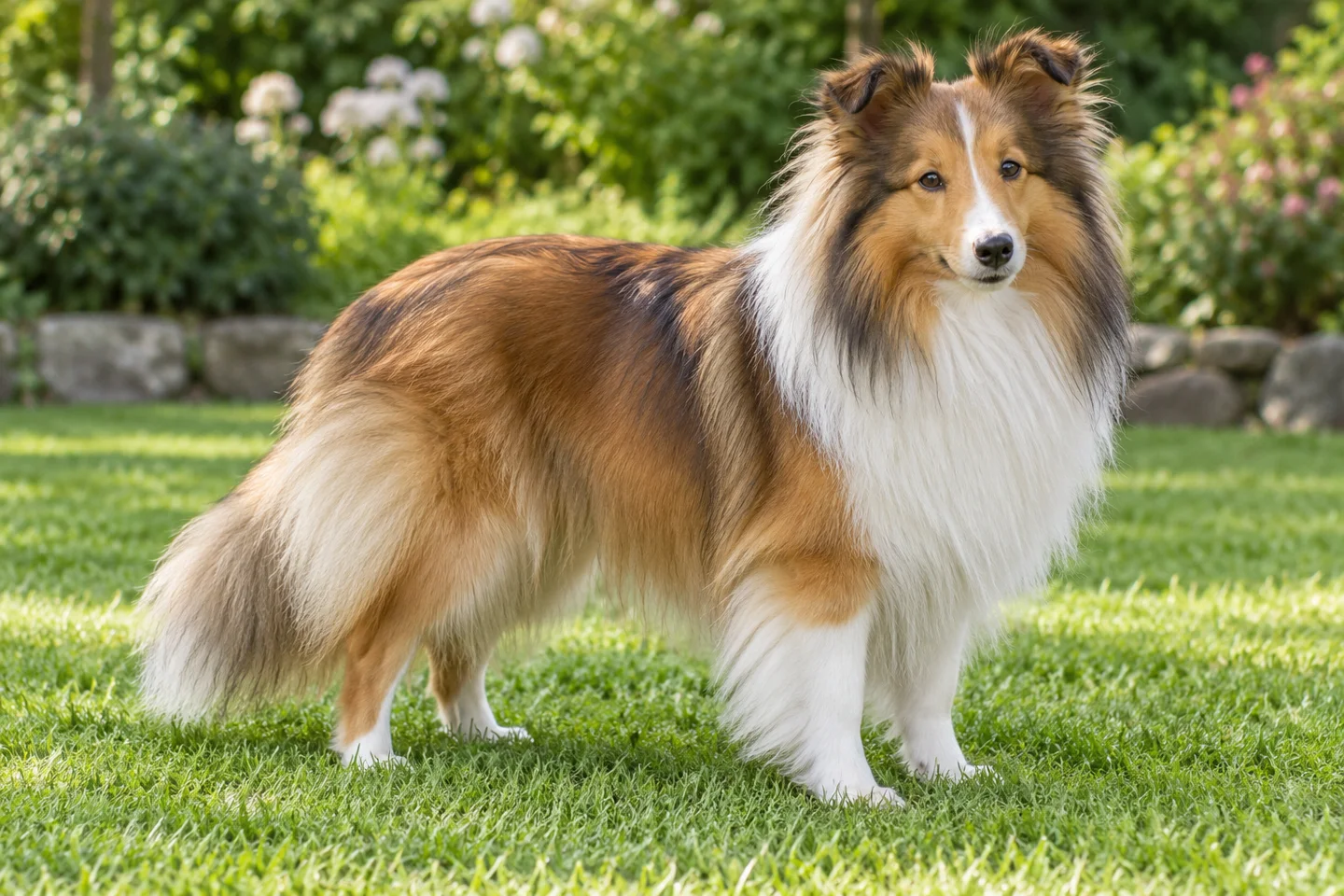
- Illustrated coat
- Sable and white, natural tipped ears and full tail
General information for owners. These articles have not been reviewed by a veterinarian. Medical decisions need your dog's history and an examination.
A Sheltie is a separate breed with its own needs
The Shetland Sheepdog, usually called the Sheltie, is a small long-coated sheepdog with a refined wedge-shaped head, tipped natural ears, and a full feathered tail. It is a distinct breed rather than a Rough Collie deliberately kept small. The similar outline can obscure differences in measurements, registration, and individual behavior. Check complete identities when examining documents and researching care.
The illustrations select sable and white, with a developing puppy coat rather than an adult mane on a young animal. They cannot establish pedigree, health, or a safety assessment. Owners should plan teaching, regular exploration, coat care, and opportunities for calm recovery. Meet adults where possible and ask what happens during ordinary household activity. A dog that learns quickly may still need time around strangers, noise, handling, and absences. Bright attention does not mean unlimited resilience, and a smaller body does not remove the need to manage movement and rest thoughtfully.
A sheepdog background without making children the task
The FCI identifies the Sheltie as a companion and sheepdog from Great Britain. Its alert response to movement belongs in the ownership discussion, but a household should not offer running children or passing bicycles as a job. Provide appropriate searches, learning, and controlled activities while preventing rehearsal of chasing or barking at everything that moves.
Ask breeders how adults disengage and rest rather than only how many skills they can perform. A dog may enjoy structured activity while finding busy domestic transitions difficult. A puppy needs teaching about doors, visitors, travel, and quiet periods as well as games. For an adult rescue, use the actual history available and observe current responses in manageable situations. Breed purpose explains possible motivations without determining every reaction. A stable routine should let the dog participate in family life while also giving it a protected place to sleep and a clear alternative when movement becomes too exciting.
Adult height and the difference between an ideal and growth
The October 2026 FCI standard gives ideal heights at the withers of 37 cm for males and 35.5 cm for females. More than 2.5 cm above or below those ideals is described as highly undesirable. It does not prescribe one adult weight range. These are conformation references, not a reason to restrict a puppy's food or choose extreme smallness as an ownership advantage.
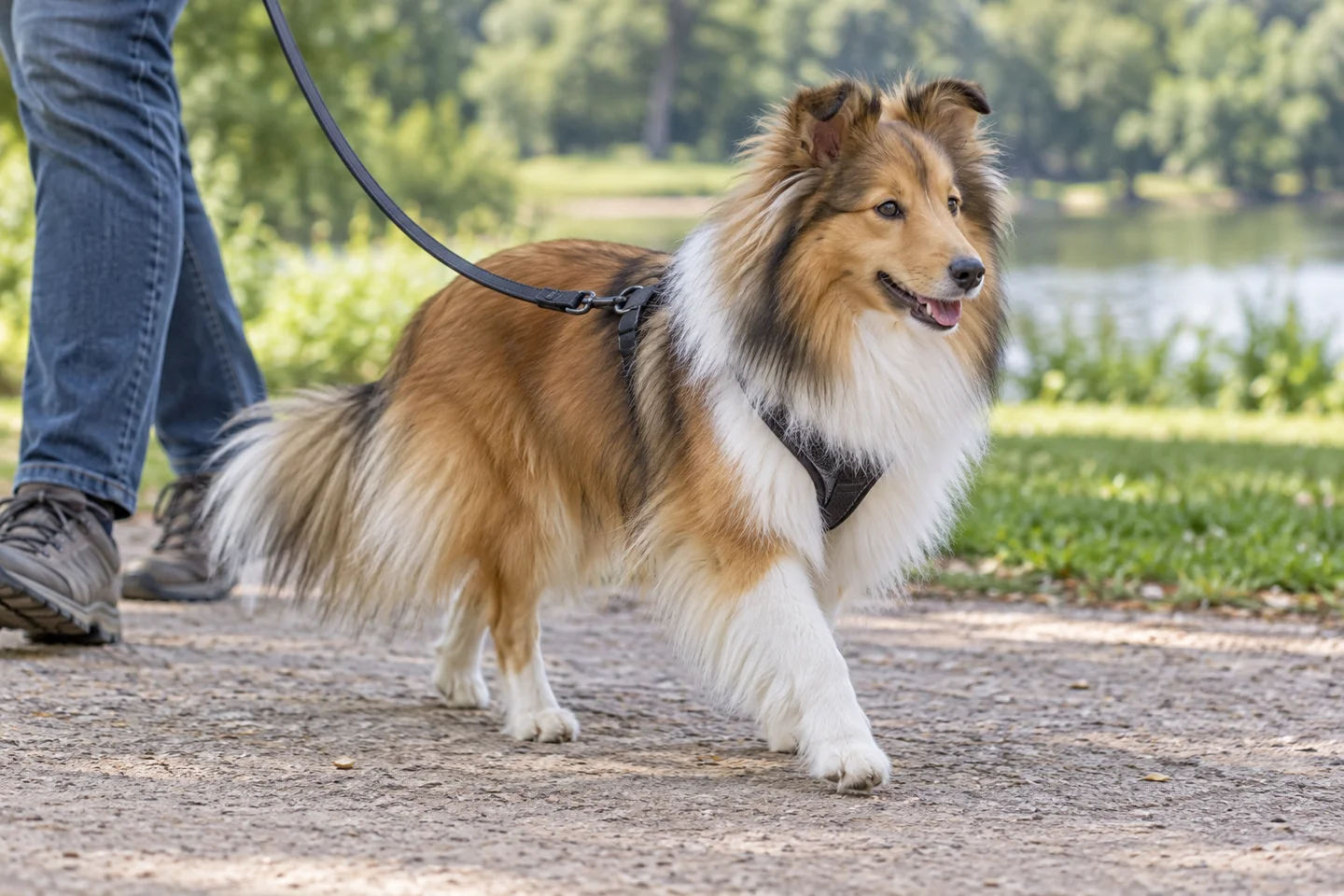
Ask the veterinary team to assess condition through the coat, including ribs, waist, and muscle. A full mane can disguise gradual weight gain, while a lean photograph alone cannot establish healthy development. Choose a harness that allows shoulder movement and remains secure when the dog steps backward. Recheck fit during growth and after coat maintenance. Measure vehicle and sleeping spaces for the grown animal and teach calm entry while it is well. If a movement changes, consider comfort and footing rather than deciding that a responsive dog must be refusing deliberately.
Coat colors and ear carriage without cosmetic force
The FCI describes a long straight outer coat over a soft close undercoat. Sable, tricolor, blue merle, and specified black combinations appear in the standard, with their own details about markings. The illustrated sable-and-white choice is one example. A striking color should not outweigh health records, functional movement, and the puppy's observed behavior.
The natural ears are semi-erect with tips falling forward when alert. Puppy ears and furnishings develop over time, and a young dog should not be expected to match a groomed adult immediately. Do not manipulate anatomy or apply a cosmetic treatment merely because an illustration shows a particular carriage. Ask a knowledgeable breeder or veterinarian about development and comfort. A picture cannot show skin under the coat or the result of an eye assessment. Keep conformation descriptions, cosmetic presentation, and clinical findings distinct rather than treating every difference from a posed image as a medical problem.
Training precise skills without making every moment a test
Teach attention, coming away from an opening, returning at short range, and settling while ordinary tasks continue. Reward promptly and make the exercise achievable before adding distraction. A dog that learns patterns quickly can also learn that a doorbell predicts frantic barking or that a moving toy always produces another game. Teach the alternative early and keep the routine consistent.
Use short sessions and pause before repetition becomes frustration. Practice exchanges with safe objects rather than reaching into the mouth for a found item. Avoid shouting, lead jerks, or physical punishment; these may increase worry while leaving the desired action unclear. If the dog cannot respond, review distance, understanding, fatigue, and discomfort. A qualified reward-based professional can help when sound or movement repeatedly overwhelms attention. The goal is useful cooperation in real settings, not a long trick list that leaves the animal unable to settle when the household becomes quiet.
Exercise with a planned return to rest
Offer walking, sniffing, searches, and suitable controlled play, adjusted to age, fitness, and health. Sports can be enjoyable when introduced with suitable instruction, footing, conditioning, and recovery. A growing puppy should not perform demanding jumps or hard turns simply because it follows rewards eagerly. Enthusiasm describes motivation, not a clinical assessment of safe repetitions.
Check enclosed spaces before free movement and maintain appropriate equipment while recall develops near traffic or wildlife. Carry water and choose cooler periods in warmth; a dense coat does not prevent heat illness. Observe comfort after the outing, including rising from rest and movement the following morning. Revise the plan if stiffness, limping, or unusual fatigue appears. Include quiet recovery instead of restarting a game whenever the dog watches expectantly. A shorter calm search may meet useful needs without keeping excitement elevated throughout the day, especially when the household also needs a dog able to sleep.

Children and an adult plan for running games
Adults should supervise closely and separate the Sheltie during rough play, meals, chews, and rest. Running can increase excitement, and a child's attempt to stop the dog physically can make the situation harder. Teach children to invite calm contact, pause touching, and let the animal leave. Prevent neck hugging, climbing, ear pulling, and pursuit into a protected bed.
Adults handle found objects and resource exchanges. A child should not remove food or reach into the mouth to prove trust. Safer participation includes a supervised search or rewarding a familiar cue. Notice stillness, turning away, repeated retreat, and a tightening body before warnings escalate. A dog comfortable with one household child has not demonstrated safety with every visiting group. Explain the same rules to guests and use barriers whenever the supervising adult must focus elsewhere. Physical separation is a useful arrangement when cooking, another child's needs, or a call prevents active observation.
Aggression and the need to distinguish worry from pain
When a Sheltie threatens, snaps, or bites, record the actual sequence: who approached, what was touched, where the dog was, what it possessed, and whether it could retreat. A response during painful grooming needs a different immediate plan from one guarding a chew against another dog. Avoid reducing every incident to a sensitive personality or deciding that a smaller sheepdog cannot cause meaningful injury.
Create space and prevent a repeat while help is arranged. Sudden changes warrant veterinary assessment, and recurring defensive behavior needs qualified reward-based support. Do not punish a warning or recreate the trigger to prove whether it was serious. Use barriers, separate resources, and suitable walking distance while learning develops. If a basket muzzle adds protection, introduce it gradually and fit it comfortably. It cannot turn an overwhelming encounter into an appropriate one. After a bite, obtain suitable medical advice and prioritize reliable prevention before another introduction.
Health screening includes the current PRA-BBS2 requirement
The American Shetland Sheepdog Association's current recommended-tests page lists hip evaluation, a clinical eye examination, and PRA-BBS2 DNA testing as required elements of its CHIC plan, plus at least two electives. This is an important update beyond the older 2017 statement. Ask which individual reports are available and confirm the current list before a mating, rather than treating an older checklist or a CHIC number as proof that every relevant result was normal. The test report should identify the BBS2-associated variant instead of merely saying that some form of PRA was included.
The reports answer different questions. A clinical eye examination, a radiograph, and a genetic-risk result should remain identifiable evidence. Ask how findings affected a mating and how later family diagnoses are communicated. For an adopted dog with incomplete history, its own examination guides current care while missing evidence remains uncertainty. Avoid copying a Collie's entire protocol merely because the silhouette resembles one. Discuss significant changes with the veterinarian even when screening was favorable, since the available tests cannot exclude every acquired condition or future source of discomfort.
Dermatomyositis testing describes risk rather than certainty
UC Davis describes dermatomyositis as an immune-mediated disorder involving skin and muscle in Collies and Shetland Sheepdogs. Its test combines several associated genetic findings into risk categories. It should not be reduced to the simple normal, carrier, and affected rules used for every single-variant recessive condition. Ask for the complete result and an explanation of what the risk category means for the individual and a proposed mating.
A dog developing localized hair loss, crusting, discomfort, or muscle-related difficulty needs veterinary assessment rather than a diagnosis from appearance or a risk report alone. Other problems can resemble parts of the presentation. Record where signs began, how they changed, and what products or medicines have been used. Avoid applying strong skin treatments or altering essential preventive care on the assumption that an online trigger list establishes the cause. The clinical team should interpret the animal's findings and explain monitoring and treatment. A low-risk result is useful information without becoming a guarantee against every skin or muscle disorder.
MDR1 results belong in the medication record
Washington State University's pharmacogenetics program explains that MDR1, also called ABCB1, can alter handling of particular medicines and create serious adverse reactions. A Sheltie's appearance cannot reveal its status. Ask whether a result is available and place the exact report in the veterinary record rather than relying on a vague warning that all herding dogs must avoid all drugs.
Tell every treating practice and carer about known findings before a procedure or new medicine. Drug, dose, and individual genotype matter, so owners should not choose a dose adjustment or discontinue necessary prevention through a breed-group message. The veterinarian can consult appropriate guidance. Keep over-the-counter products, other animals' medication, and household medicines secured. When changing clinics, transfer the original laboratory report rather than a handwritten summary of its category. Ask the receiving team to acknowledge the information before a planned procedure, and keep a copy available during travel. If a product has already been prescribed, clarify questions with that clinician instead of changing the schedule yourself. This preserves continuity while allowing the medical plan to reflect the dog's present condition and the specific treatment being considered. If an adverse exposure is suspected, contact a veterinarian promptly and provide the product, amount, timing, and result if known. A favorable test does not protect against every toxicity, and an altered result does not mean the dog cannot receive safe individualized medical care.
Food, mixes, and a budget for ordinary inconvenient days
Use balanced food appropriate to life stage and measure portions against condition and activity. Count training rewards and review unexpected weight change, persistent digestive problems, appetite differences, or altered drinking with the veterinarian. A long coat should not hide gradual change. Homemade diets need suitable formulation, and supplements should have a clear purpose rather than follow an unverified claim about all sheepdogs.
A Sheltie mix can differ in size, coat, pursuit, and social responses from either parent. A crossbreed label cannot promise easier grooming or eliminate drug-sensitivity questions. Ask about relevant parental assessment for a planned litter and use behavior and examination findings for a rescue. Budget locally for preventive and emergency care, grooming, training, equipment, transport, and competent cover. Rehearse a handover and provide medical records. A household enjoying patient teaching and managing movement thoughtfully may fit; one expecting constant entertainment or automatic calm around every noise should reconsider those assumptions.
dogsDating walks that leave room for recovery
Describe the Sheltie's actual preferences on dogsDating, including comfort with direct greetings, preferred walking partners, and situations that call for more distance. Keep exact home coordinates and your address private. Select a public meeting point from an approximate area, with broad paths and separate exits. Avoid a first encounter inside the home or beside a crowded entrance where movement away is difficult.
Begin with separate handlers walking in the same direction at a comfortable separation. Leave shared food and toys out of the introduction and keep contact optional. Watch stiffness, repeated avoidance, fixation, and recovery after excitement. Increase distance or end the outing when needed. A short calm walk offers useful evidence without requiring play. Discuss both animals' responses afterward before arranging another meeting, and let either person decline without pressure to prove that two bright or active dogs should enjoy the same social situation.
Sources and editorial notes
Sources checked October 22, 2026. Breed measurements describe reference ranges, not a diagnosis or an individual dog's ideal weight. Images are AI-generated breed illustrations and do not document a particular dog or health condition.
- AVSAB: Humane Dog Training Position Statement
- VCA Animal Hospitals: Food aggression in puppies
- VCA Animal Hospitals: Common emergencies in dogs
- Orthopedic Foundation for Animals: CHIC health screening programs
- VCA Animal Hospitals: Aggression toward unfamiliar dogs, diagnosis
- VCA Animal Hospitals: Grooming and coat care for your dog
- VCA Animal Hospitals: Ear infections in dogs (otitis externa)
- AAHA: Feeding plans for healthy, appropriate weight cats and dogs
- VCA Animal Hospitals: Heat stroke in dogs
- AVSAB: Puppy Socialization Position Statement
- VCA Animal Hospitals: Dog behavior problems, aggression toward children
- FCI Shetland Sheepdog standard 88, October 2026: coat, natural ears, proportions and ideal heights
- American Shetland Sheepdog Association: recommended tests updated August 2026, including required PRA-BBS2 testing
- UC Davis Veterinary Genetics Laboratory: susceptibility to dermatomyositis, multi-locus risk interpretation
- Washington State University Program in Individualized Medicine: MDR1 drug sensitivity and individualized clinical interpretation
Keep getting to know dogs.
Read another guide or return to your dogsDating community.
Explore breed guidesBack to dogsDating