Tibetan Spaniel
A small Tibetan companion with a silky coat, a watchful outlook, and a misleading spaniel name that does not place it among gundogs.
How these guides are researched and reviewed

- Origin
- Tibet (China)
- Adult standard size
- About 25.4 cm; ideal 4.1–6.8 kg
- Illustrated coat
- Golden sable silky coat
General information for owners. These articles have not been reviewed by a veterinarian. Medical decisions need your dog's history and an examination.
The spaniel name does not describe a gundog
The Tibetan Spaniel is a small companion breed from Tibet, placed by the FCI among companion and toy dogs. Its name should not lead an owner to expect a miniature flushing gundog. The Tibetan Spaniel Club of America calls spaniel a misnomer in its historical account. For practical purposes, start with the present companion and its individual needs rather than importing assumptions from a Cocker or Springer Spaniel.
The breed has a long association with Tibetan domestic and monastic life in club histories. Such accounts help explain an interest in watching activity, but they cannot certify the behavior of every puppy. Avoid turning historical descriptions into a guarantee that a dog will be an effortless watchdog or a naturally safe companion for children. The actual family, social experience, clinical history, and household arrangements all affect the animal an owner will live with.
Meet adult dogs where possible and ask about ordinary days. How does the dog respond to visitors, travel, time alone, grooming, and nearby animals? A source who can explain what is difficult provides information a glossy photograph cannot. The nickname Tibbie may be affectionate, but it should not reduce a complete dog's needs to a promise of convenient lap companionship. Small size makes some arrangements easier while leaving training and care essential.
Adult scale and a face with a real muzzle
The current FCI standard gives a height around 25.4 centimeters at the withers and an ideal weight of 4.1 to 6.8 kilograms. The body is slightly longer than tall and should remain balanced. These adult figures do not justify selecting the smallest possible puppy or feeding toward an arbitrary weight. Ask the veterinarian to assess growth and condition as the dog develops. A fluffy outline can conceal changes that matter.
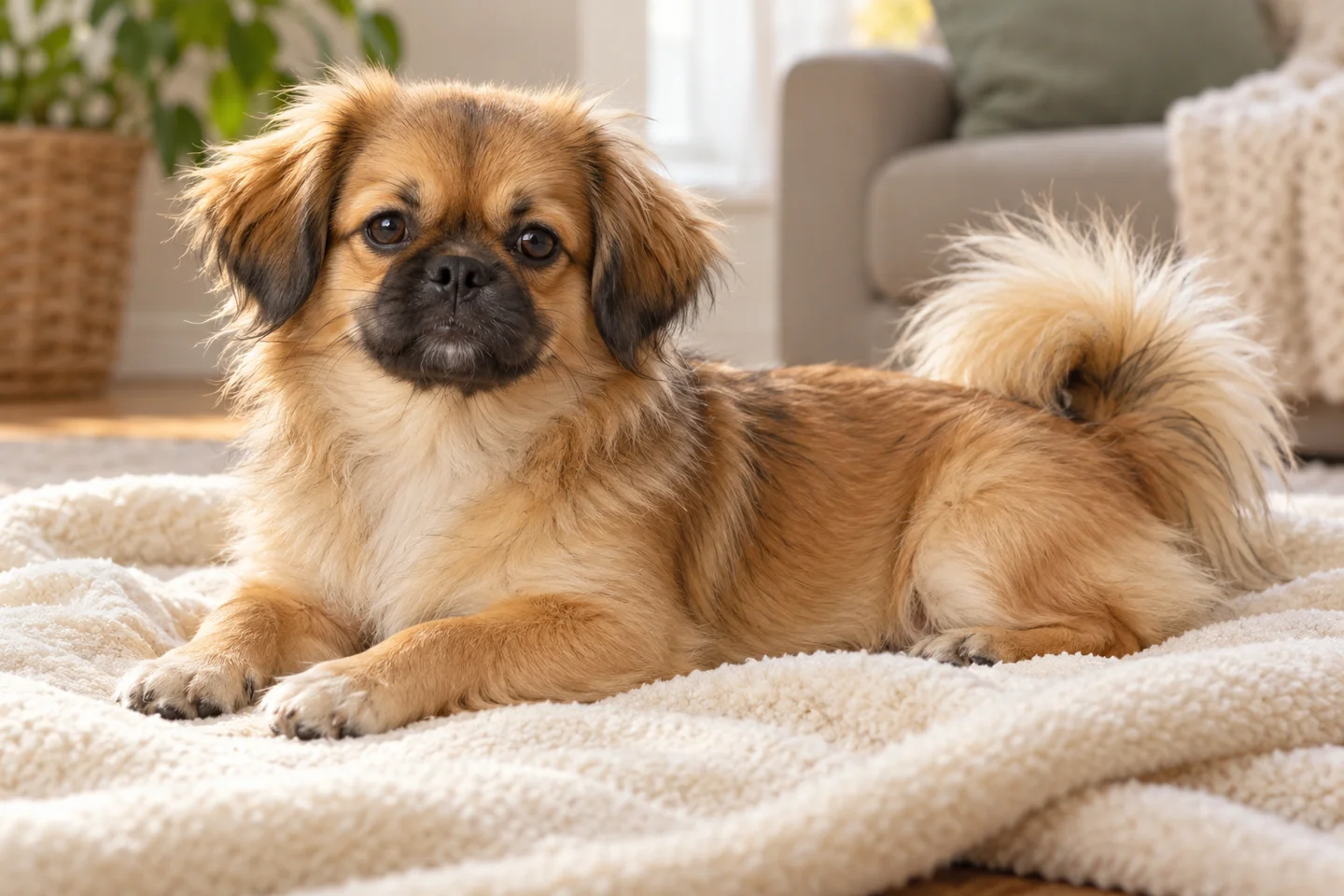
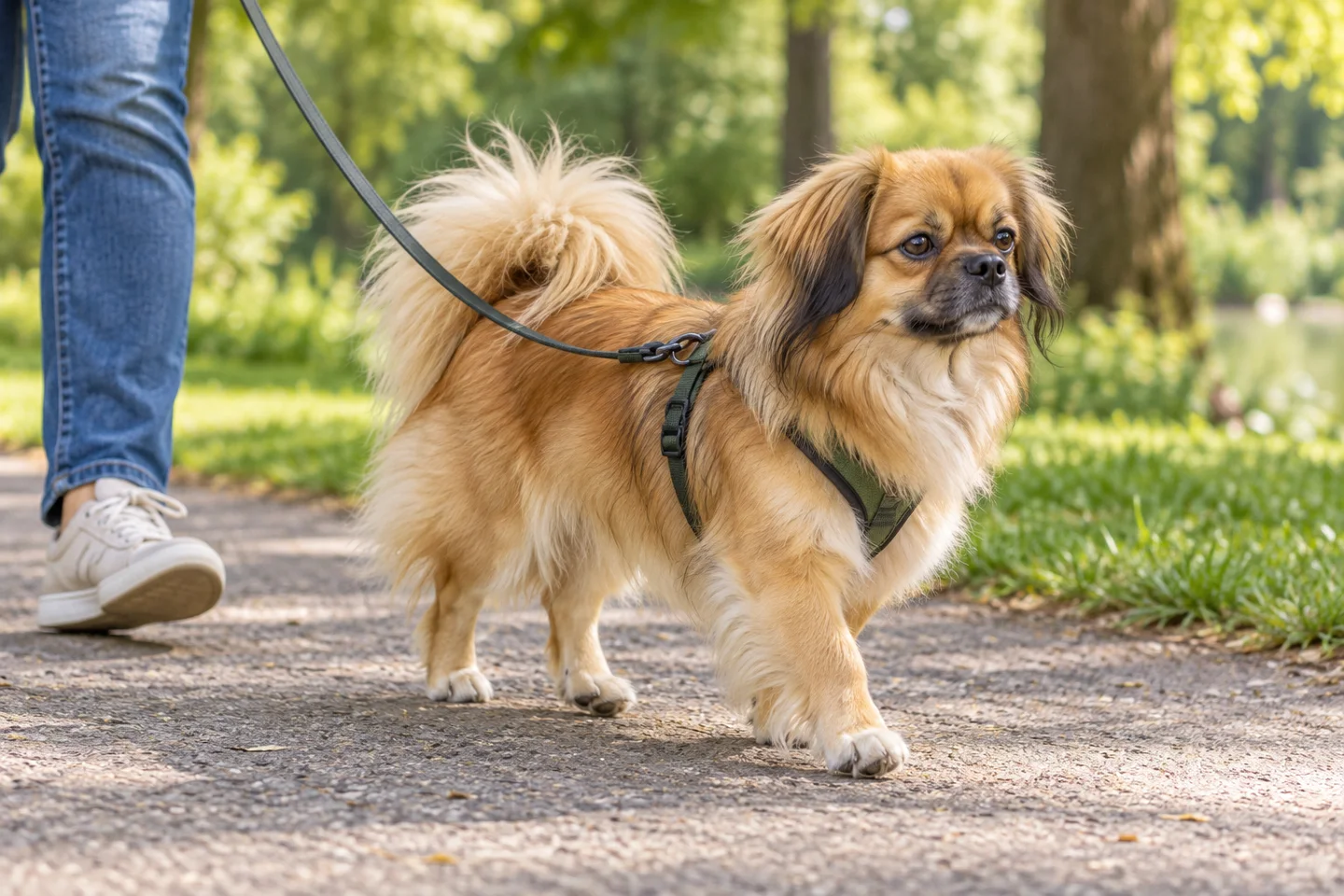
The muzzle is moderately short and blunt with cushioning, while the chin has depth. It should not be drawn as a completely flat Pekingese face. Natural ears hang and carry feathering. The coat is silky and relatively flat on the body, with a mane and a full feathered tail carried over the back. The selected illustrations show golden sable coloring with darker ear fringes and a complete tail.
A puppy naturally has a developing coat rather than an exaggerated adult mane. Our images are labeled AI-generated illustrations and do not establish pedigree or health. Examine the actual dog's breathing, movement, and comfort with the veterinary team when needed. No attractive expression can substitute for that assessment. Equipment should also be fitted directly, allowing movement without rubbing or slipping over the head when the dog backs away.
A comfortable lookout without constant duty
A Tibetan Spaniel may enjoy observing activity from a familiar place. Choose that place with safety in mind. A raised surface beside an open window or an unstable chair can create avoidable risk. If the preferred viewpoint repeatedly produces barking at passersby, change access and offer another comfortable location. The owner should ask what the dog sees and practices rather than assume watchfulness must be expressed all day.
Teach a mat or bed as a place where good things happen during ordinary household activity. Reward calm use while the room is quiet before expecting it during dinner or a visit. Let the dog move away when it wants privacy. Repeatedly returning it to a lap can prevent the independent settling the owner later expects during a work call or meal.
Observe short absences and build on what the dog can manage. Persistent pacing, vocalization, or escape attempts deserve a change in arrangements and appropriate advice. Another animal is not a guaranteed solution. A household should plan daily cover and backup care before an unavoidable long absence, including someone who understands safe handling and the dog's current tolerance for separation.
Inspect the route to a favorite seat as the dog ages. A previously easy jump may become uncomfortable, and a dog that avoids it may still enjoy the same view from a safer position. Discuss changes in mobility with the veterinarian instead of simply lifting the dog onto the old perch every time. A stable alternative can preserve access while the reason for the change is investigated. The household should also check whether other animals block the route or disturb rest there.
Training that leaves room for a choice
Teach practical actions through short, clear sessions: coming to the owner, stepping onto a mat, following a turn, and waiting while a harness is fitted. Reward the response promptly with suitably small food or another useful reward. A small dog's daily intake can change significantly through casual extras, so coordinate between family members. The task should remain easy enough that the dog can discover what earns the reward.
Toileting practice requires opportunities and observation. Help a puppy succeed after sleep, food, and play, and reward the desired location. Clean mistakes without frightening the dog. If an adult changes an established pattern, ask about medical causes rather than deciding that the breed has become unreliable. Consistency and clinical attention answer different parts of the problem.
Handling is a separate lesson from being affectionate. A dog may enjoy sitting beside someone while disliking restraint for a foot check. Introduce the task in small parts and reward participation. A reward-based trainer should explain how the exercise changes if the dog avoids contact. Simply holding a small dog more firmly may complete one attempt while making every later attempt harder and leaving discomfort unexplored.
Exercise and ordinary exploration
A Tibetan Spaniel needs chances to walk and investigate outside the home. Indoor play offers something different and should not be the only experience available. Choose manageable routes, let the dog sniff safe areas, and adjust effort to age, health, and weather. A puppy learning about a new surface may need a shorter session than an adult on a familiar route. There is no single minute count that accounts for all those differences.
Simple searches and gentle games can add variety. Use part of the measured ration if appropriate and inspect the location for debris or chemicals. Avoid relying on repeated leaps from furniture or frantic chasing to provide all activity. Teach a recognizable finish and make a comfortable resting place available. Constant restarting can blur the difference between an active period and a quiet household evening.
Watch comfort in heat and during exertion. A small dog with a relatively short muzzle still needs direct assessment of breathing and recovery. Avoid hot paving and exposed conditions, provide water, and shorten the plan when appropriate. New noisy breathing, marked fatigue, or reluctance to continue deserves veterinary advice. Do not treat an appealing facial shape or a dog's willingness to follow as evidence that every condition is comfortable.
Socialization at ground level
People and other animals can appear especially large from a small dog's position. Arrange encounters with distance and a way to retreat. A visitor can sit and wait instead of leaning over the dog or lifting it immediately. Reward voluntary investigation. Carrying can solve a specific safety problem, but holding the dog toward an approaching face does not necessarily make the experience reassuring.
For a puppy, coordinate infection precautions with the veterinarian while introducing travel, traffic, surfaces, and ordinary household sounds. Look for curiosity and recovery. If the puppy repeatedly freezes or tries to leave, reduce the challenge. A crowded event that ends in exhaustion is not automatically useful learning. Short experiences can be complete sessions rather than failed attempts to do more.
Choose early dog encounters carefully. A calm partner may be more useful than a large exuberant puppy that repeatedly knocks the Tibbie aside. Watch whether both animals can leave and whether the other handler interrupts pursuit. Socialization should not depend on the small dog tolerating every unwanted approach. Learning that another dog can pass without contact is a useful part of adult companionship.
Aggression and unwanted handling
Growling during lifting, stiffening over a bed, or snapping during grooming deserves attention even in a small companion. Stop recreating the conflict and consider pain, fear, and previous experience. A dog that suddenly objects to being picked up may need a veterinary assessment as well as a different teaching plan. Size should not make a warning amusing or encourage people to provoke it for a video.
Give resources a sensible setting. Feed where children and other pets cannot interrupt, prevent access to likely stolen objects, and teach exchanges in easy circumstances. If guarding already creates risk, obtain qualified help. Taking every chew to demonstrate ownership can make a person's approach predict loss. The plan should improve cooperation and reduce conflict rather than depend on repeated physical removal.
Tell carers and professionals about incidents accurately. Describe what contact occurred and the surrounding events. A groomer needs that information before the dog reaches the table, and a sitter needs the current management before taking over. Where additional equipment belongs in an individual plan, introduce it gradually and retain the other precautions. It cannot make forced contact comfortable simply by limiting the dog's ability to bite.
Children, a small body, and larger companions
Children should learn safe interaction at a low stable level under adult supervision. Sitting on the floor can reduce the distance of a fall, but it does not make grabbing, restraint, or face hugging appropriate. A child can place a reward onto a mat or help prepare a search without lifting the dog. The adult remains responsible for deciding when contact begins and ends.
Protect sleep and meals. A retreat should remain private even during a group visit, and the dog should not be followed beneath furniture. Explain concrete risks such as moving chairs or doors closing near a small animal. When the supervising adult becomes occupied, use the planned separation. Familiarity with a household child cannot establish comfort with every visiting child or every noisy game.
Larger dogs need control of speed and space during introductions. Friendly intent does not prevent a body bump from overwhelming a small companion. Cats also need individual assessment and escape routes, especially around a puppy. Provide separate resources and observe daily patterns rather than treating one calm greeting as a complete compatibility test. The aim is a home where each animal can eat, rest, and move without repeated pressure.
Grooming the silky body coat and furnishings
Brush gently through the coat rather than only smoothing its surface. Check feathering behind the ears, around the tail, and where equipment contacts the body. Small tangles are easier to address before they tighten against skin. A groomer can demonstrate appropriate tools and a practical schedule. The goal is comfort and inspection, not creating an exaggerated mane or a sculpted outline the dog's natural coat does not have.
After washing, rinse carefully and check that deeper areas dry. Keep bedding clean and inspect damp or irritated regions. Persistent odor, itching, or a sore patch needs veterinary advice. Do not select a stronger product simply because the previous one failed to remove a symptom whose cause is unknown. Give the clinic a timeline and the names of products already used.
Introduce nails, teeth, and external ear observation separately with short rewards. Do not push implements into the ear canal. Pain, discharge, or repeated head shaking warrants assessment. Facial discharge or squinting also needs attention rather than cosmetic treatment alone. A dog whose tolerance changes may be uncomfortable, so consider that possibility before increasing restraint to complete an ordinary care task.
Health: eyes, patellas, and optional tests
The Tibetan Spaniel Club of America's published statement identifies specialist eye examination and patella evaluation within its CHIC recommendations. It separately lists PRA3 DNA testing as optional and strongly recommends a baseline bile-acid screen while noting that the latter is not definitive. Ask which current program applies to the litter and obtain the actual parental results. Do not merge the categories into one inaccurate claim about compulsory testing everywhere.
A genetic test for one form of retinal disease cannot replace a clinical eye examination or rule out every cause of visual difficulty. If a dog hesitates in changed lighting, bumps into unfamiliar obstacles, or develops an abnormal-looking eye, note the circumstances and contact the clinic. Those observations are useful without requiring the owner to diagnose PRA. Avoid setting up hazards to test vision while an assessment is pending.
The bile-acid recommendation also needs careful interpretation. A screening result is not a diagnosis by itself, and the club explicitly cautions against treating it as definitive. Ask the veterinarian what a particular finding means and whether follow-up is appropriate. Do not select medication or diet changes from another owner's report. The purpose of testing is to inform care for this patient, with its history and examination.
Ask how later confirmed diagnoses in relatives are shared after placement. For an adult with incomplete records, transfer whatever original notes exist and resolve outstanding follow-up. A routine check, a CHIC number, and a laboratory result are different pieces of information. Read their actual scope rather than replacing uncertainty with a general promise that small companions are easy to keep healthy.
Feeding, mixes, and the household budget
Use a complete food appropriate to life stage and measure portions. Include treats, chews, and extra food supplied by other people. A small amount offered repeatedly can become a substantial addition for a dog of this size. Ask the clinic to demonstrate condition assessment beneath the coat and review intake when activity changes. Persistent appetite loss or weight change deserves investigation instead of an automatic switch to richer food.
A Tibetan Spaniel mix may have a different muzzle, size, coat, and response to unfamiliar people. Ask which ancestry is documented. A golden coat and feathered ears cannot identify both parents from appearance. Crossbreeding does not promise better health or a predictable temperament. For an adult, direct observations from a foster home can guide care even when ancestry remains uncertain. A puppy still needs expectations that can adapt during growth.
Obtain local estimates for preventive care, dentistry, grooming support, training, transport, and boarding. Read insurance conditions and arrange a backup carer who understands handling preferences. A small food bill does not make every other service inexpensive. Ask the source how advice continues after placement and what happens if a serious difficulty develops. Practical support can matter more than a reassuring sales description.
A dogsDating outing with no pressure to perform
Use dogsDating to describe the Tibbie's actual pace and style. Explain whether it prefers walking beside a companion to close physical play. Ask the other owner how their dog responds when a smaller dog withdraws. A claim that the partner loves everyone is less useful than a description of whether it stops following and returns to its handler when asked.
Meet in a quiet public place with safe footing and room to walk independently. Begin with a gap, allow exploration, and watch recovery after the dogs notice each other. Avoid placing the Tibetan Spaniel directly into a crowd of unfamiliar animals. If one dog keeps pursuing or the other repeatedly seeks escape, change the setup or leave. The first meeting can end after a calm short walk without any closer greeting.
Keep exact user coordinates private. Approximate discovery and an agreed public landmark can arrange the outing without disclosing a residence. Afterward, note the distance, pace, and moments of comfort. Those observations can guide another meeting or the choice of a different partner. The owners' digital match should support careful discussion while the dogs retain the space needed to show their actual preferences.
Sources and editorial notes
Sources checked October 22, 2026. Breed measurements describe reference ranges, not a diagnosis or an individual dog's ideal weight. Images are AI-generated breed illustrations and do not document a particular dog or health condition.
- AVSAB: Humane Dog Training Position Statement
- VCA Animal Hospitals: Food aggression in puppies
- Orthopedic Foundation for Animals: CHIC health screening programs
- VCA Animal Hospitals: Aggression toward unfamiliar dogs, diagnosis
- VCA Animal Hospitals: Grooming and coat care for your dog
- VCA Animal Hospitals: Ear infections in dogs (otitis externa)
- AAHA: Feeding plans for healthy, appropriate weight cats and dogs
- VCA Animal Hospitals: Heat stroke in dogs
- AVSAB: Puppy Socialization Position Statement
- VCA Animal Hospitals: Dog behavior problems, aggression toward children
- American Kennel Club: nonsporting health testing requirements
- Tibetan Spaniel Club of America: Health statement
- Tibetan Spaniel Club of America: About the breed
- Tibetan Spaniel: official breed standard
Keep getting to know dogs.
Read another guide or return to your dogsDating community.
Explore breed guidesBack to dogsDating