Tibetan Terrier
A sturdy, square Tibetan companion with broad feet and a long double coat, whose terrier name does not describe conventional earth-working ancestry.
How these guides are researched and reviewed
- Origin
- Tibet (China)
- Adult standard size
- Males 36–41 cm; females slightly smaller
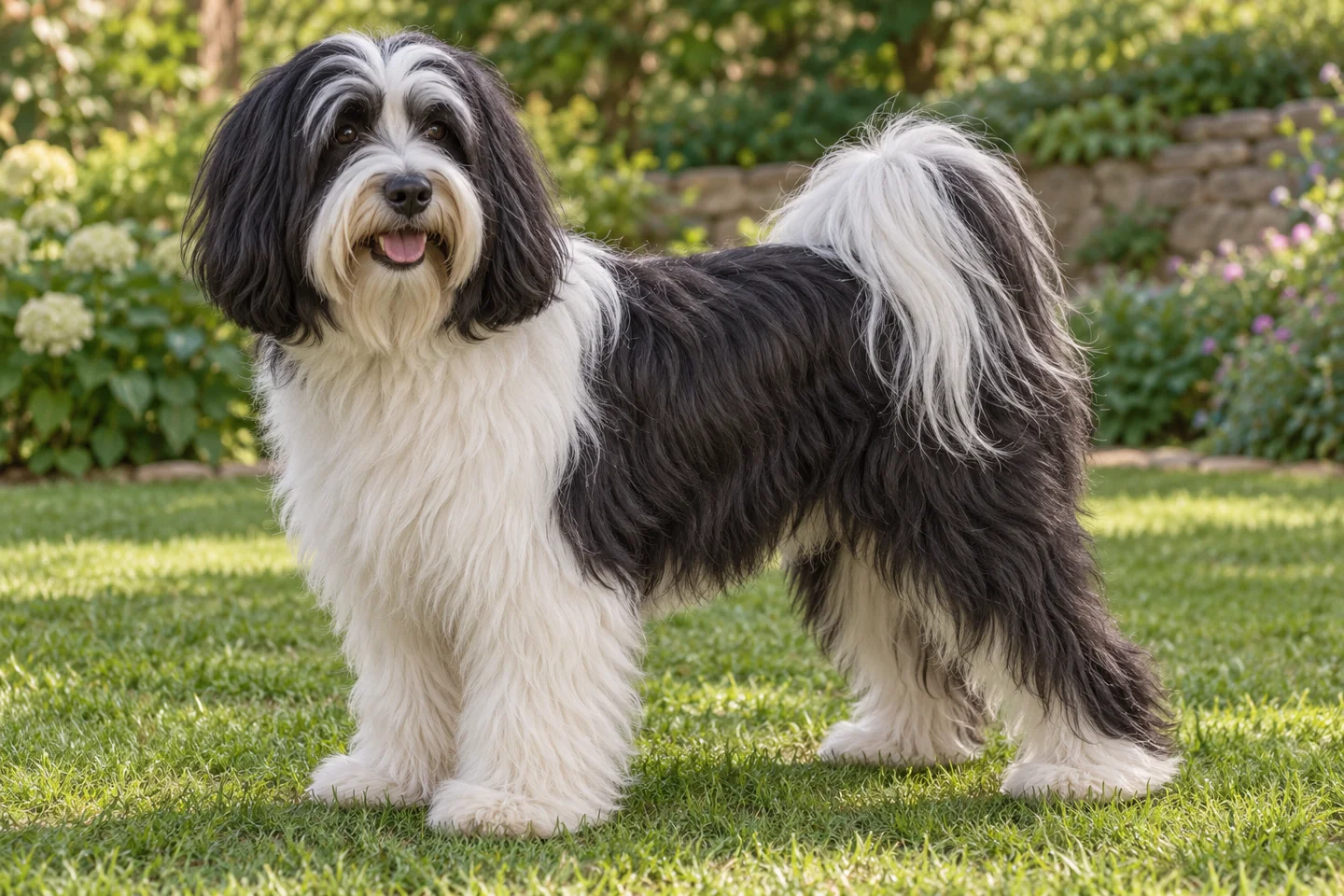
- Illustrated coat
- Black and white long coat
General information for owners. These articles have not been reviewed by a veterinarian. Medical decisions need your dog's history and an examination.
A Tibetan companion carrying a misleading name
The Tibetan Terrier belongs to the FCI companion group among Tibetan breeds. Its terrier name should not place it automatically alongside dogs developed to enter earth after quarry. The current FCI history describes herding and guarding roles in its background. A prospective owner should begin with the actual breed and individual rather than importing assumptions from a similarly sized wire-coated working terrier.
The breed is sturdy and generally square, with a long coat and distinctive broad feet. Those features can be appealing in a photograph while concealing a substantial daily care commitment. Meet adults and ask what brushing, drying, training, and ordinary walks involve. The owner needs a routine that works when the dog is muddy, the weather is poor, or the usual groomer is unavailable. Admiration of the coat is only the beginning of that decision.
Historical accounts often attach spiritual stories to Tibetan dogs. Such stories should remain clearly attributed accounts rather than promises about a puppy's temperament or health. A dog cannot be selected safely because its ancestors were regarded as lucky. Ask about the real parents, clinical records, and present surroundings. A source who explains uncertainty and practical difficulties provides more useful placement information than one who relies on an attractive origin story.
Adult size, large feet, and the illustrated coat
The FCI standard gives males a shoulder height of 36 to 41 centimeters and says females are slightly smaller. It does not provide a separate exact female range in that wording. Do not invent one from a generic chart. Weight should be interpreted against frame and condition. A puppy should develop on a complete appropriate diet rather than be fed toward an adult appearance selected from a photograph.
The body should be strong and balanced. The broad, rounded feet and hair between the toes are distinctive, while natural V-shaped ears hang and the full furnished tail curls over the back. The head has a definite muzzle rather than an extremely flat toy-dog face. Dark eyes should remain visible enough for ordinary comfort and inspection. Hair covering a problem should not delay attention to it.
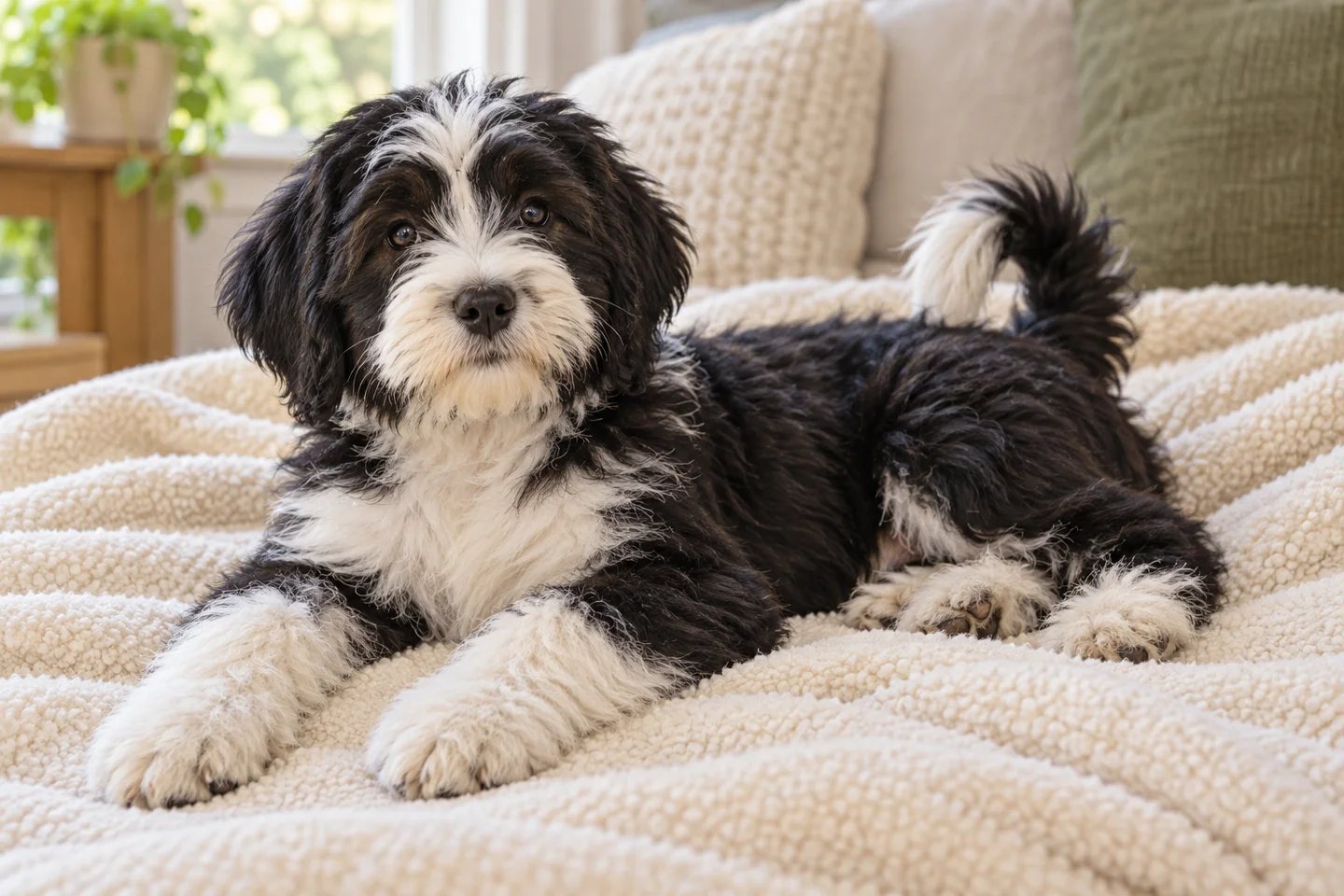
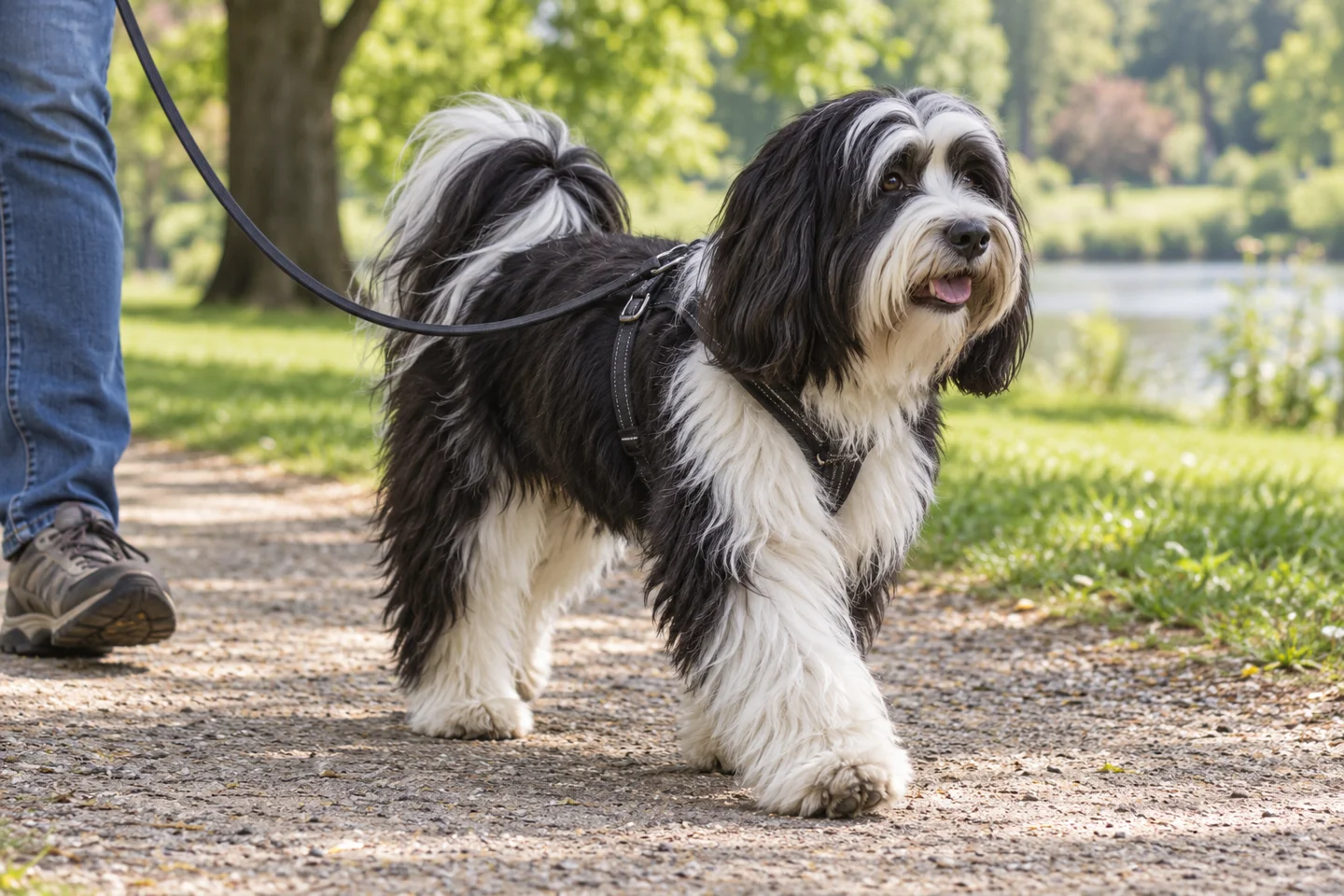
The double coat has a fine undercoat and a long outer layer that may be straight or wavy. Our illustrations select black-and-white parti-color and a complete tail. A puppy naturally carries a shorter developing coat. The images are labeled AI-generated illustrations; they cannot demonstrate gait soundness, eyesight, or ancestry. Examine the actual dog and fit equipment by hand beneath the coat instead of using a fluffy outline as a measurement.
Grooming is a maintenance decision
Ask a groomer to demonstrate working in sections down to the skin. A brush passed over the surface may leave knots underneath, particularly behind ears, under legs, and around a harness. Support the hair and avoid scraping. The schedule should respond to the individual coat and activity, not a promise that every Tibetan Terrier can be maintained with the same few minutes each week.
Decide what coat length the household can keep comfortable. A practical grooming choice should account for skin health, tolerance, and available time. Discuss the process before matting becomes severe, since removing tight tangles can require a different plan from routine maintenance. A dog should not be left uncomfortable because an owner hopes to preserve a photograph-ready length. The relevant goal is a coat that can be checked and cared for reliably.
Introduce grooming as a skill. Standing briefly on a non-slip surface, accepting a touch, and allowing one small section to be combed can be rewarded separately. End while the dog remains manageable and build gradually. If care is already difficult, tell the professional before booking a long session. Sudden resistance in a particular region may reflect pain or skin disease, so investigate rather than simply restraining more firmly.
Drying, feet, teeth, and ears
After washing, rinse thoroughly and check the deeper coat as it dries. Damp material against the skin can be missed when the surface feels dry. Bedding and towels also need to be clean and dry. Persistent odor, itch, or inflamed skin calls for veterinary assessment rather than increasingly strong products. Record when the change began and what was applied, so the clinic has a useful timeline.
Inspect the broad feet after walks. Hair can collect debris between the toes and obscure a damaged nail or irritated area. Remove ordinary surface material gently and seek help for an embedded object or pain. Keep nails manageable and introduce each step of trimming with rewards. A dog that walks frequently can still need nail care; activity does not automatically supply the correct wear.
Toothbrushing with a canine product and external ear observation belong alongside coat work. Do not insert implements into the ear canal. Repeated shaking, discharge, or discomfort needs advice, and facial squinting should receive attention rather than cosmetic cleaning alone. A tidy outer coat cannot establish that the mouth, eyes, or joints are healthy. Grooming is an opportunity to notice change, not a substitute for clinical care.
Training a practical companion
Teach actions that make a coated medium dog easy to live with: following a turn, stepping onto a mat, coming back in a secure place, and waiting while equipment is fitted. Reward clear small responses in quiet surroundings before adding distraction. A dog that succeeds beside the sofa may need a simpler version outdoors. Progress should follow what it can actually do rather than the assumption that a familiar word transfers automatically everywhere.
Prevent access to tempting unsafe objects while release and exchange skills develop. Practice with low-value safe items, reward letting go, and sometimes return the object when appropriate. A found object should not be the first time the household teaches cooperation. If guarding is already present, obtain qualified support rather than testing the dog with increasingly valuable items. The task is to reduce conflict and improve the predictability of approaching hands.
Choose reward-based help and ask how the trainer adapts when the dog becomes frightened or overexcited. They should explain what earns reinforcement and how the setup prevents unwanted rehearsal. Physical intimidation can make care and handling harder. If a dog suddenly resists a previously familiar action, consider pain or a changed environment before deciding that it needs a firmer lesson.
Exercise and comfortable recovery
Provide walks with time to investigate and other suitable tasks, adjusting effort to health, age, and condition. A young puppy, a fit adult, and an older dog with stiffness need different plans. Build conditioning gradually rather than replacing several quiet days with one strenuous outing. Watch recovery after rest, including gait and willingness to rise. Enthusiasm when a lead appears cannot prove the body is comfortable.
Simple searches can add variety without continual high-speed play. Use part of a measured ration where appropriate and inspect the area for debris or chemicals. An organized activity may also suit the individual, with an instructor who explains preparation and safe progression. The owner should be free to choose a gentler task when the dog or conditions require it instead of treating activity as a fixed breed obligation.
Warm weather needs shade, water, and sensible timing. A long coat does not protect against every heat problem. Check breathing and recovery directly, and avoid exposed hot surfaces. After wet or rough-ground outings, allow time for the coat and foot inspection the activity creates. The practical exercise plan includes recovery and cleanup, not only the enjoyable portion while the dog is moving.
Aggression and the need to examine context
A friendly breed summary cannot certify the individual dog's safety. Stiffening over a chew, snapping during brushing, or lunging at a visitor calls for attention to the circumstances. Prevent repetition while veterinary and qualified behavioral advice is arranged. A thick coat may conceal a painful area that makes grooming difficult, so do not assume the behavior is only a training problem.
Keep meals and valuable resources away from passing children and pets. Stop taking items merely to demonstrate authority. Teach easier exchanges and use management meanwhile if conflict already occurs. The dog needs to learn a workable response while people avoid creating the same risky situation repeatedly. A good plan explains who uses which barrier and what happens when a visitor arrives unexpectedly.
Disclose bite incidents accurately to carers and professionals, including contact and injury. A calm walk cannot erase a different response during restraint. Some plans may include a positively introduced basket muzzle, but equipment does not remove distress or justify forced contact. Space and careful handling remain necessary. The arrangement should be practical for the actual household, including anyone who provides temporary cover.
Children and the right to leave
Children should leave sleeping, eating, and retreat areas undisturbed. Long hair can invite grabbing, so explain that pulling the coat hurts and that contact requires adult guidance. No riding, neck hugging, or following beneath furniture should occur. A dog moving away has already made a choice the adult should protect. The child does not need to wait for a growl before stopping.
Choose activities with a predictable role for everyone, such as an adult-led search or a familiar cue. Fast games can become difficult when a young dog becomes excited by running and noise. Visiting groups may require separation even when ordinary family contact is comfortable. When supervision ends, use a suitable safe area rather than relying on the dog's reputation to manage the situation alone.
Older children can help maintain a care record or prepare supplies away from the dog. Grooming and lead handling require judgment and should be supervised according to ability. Adults remain responsible for safety decisions and should not ask a child to correct threatening behavior or retrieve a guarded item. The relationship develops through manageable experience, not through assigning authority the child cannot safely exercise.
Other dogs, cats, and daily pressure points
Assess other dogs individually and begin with room to move away. Outdoor play is only part of the picture. At home, watch beds, food preparation, doorways, and access to people. One dog can create pressure by blocking or following without an immediate fight. Separate resources initially and provide alternative resting places so neither animal has to negotiate every movement closely.
Cats need escape routes and a gradual introduction. A calm encounter with one familiar cat cannot establish safety with a running unfamiliar animal outdoors. Securely protect smaller pets. Avoid using exposure without control as a test of temperament. The owner can gather information while preventing a chase, rather than waiting to learn from an event that has already frightened or injured another animal.
Outside, retain appropriate control around stock and wildlife and follow local rules. A misleading terrier name does not answer the individual pursuit question either way. Observe actual responses and manage accordingly. The household should be able to provide exploration without depending on unrestricted roaming among unfamiliar animals. That decision belongs in the planning before placement, not after the first escape.
Health screening with several distinct purposes
The Tibetan Terrier Club of America's updated statement recommends hip, patella, BAER hearing, and specialist eye assessments for breeding parents. It also identifies DNA testing for NCL, PLL, rcd4-PRA, and PRA3, with the stated clear-by-parentage provisions. Obtain the actual findings and confirm the current program. A report for one of those questions cannot replace all the others, and a hearing response in the room is not equivalent to BAER certification.
The club specifies an eye examination within the year before breeding in its statement. That makes the date relevant when reviewing paperwork. A genetic result does not replace a current clinical eye examination or rule out every cause of visual difficulty. Ask a source to explain what was tested and why the proposed combination is appropriate. A general claim that the parents are genetically clear leaves too much unspecified.
The statement also distinguishes additional tests breeders may choose from the main recommendations. More names on a panel do not automatically establish better interpretation. Ask which are relevant to the family and how later diagnoses are shared. A CHIC number records completion and disclosure under a program; it should not be translated into a guarantee that every result was normal. Read the findings rather than relying on the badge.
For the pet, investigate new symptoms regardless of parental records. Changes in vision, gait, balance, or comfort deserve a clinical assessment. Record intermittent events safely and bring timing and circumstances to the veterinarian. Do not diagnose a named inherited disorder from a resemblance to a description online. The breeding program informs risk, while the current animal still needs care based on what is happening now.
Feeding, mixes, and a coat-care budget
Measure a complete life-stage diet and include rewards, chews, and food provided by other household members. Ask the clinic to demonstrate a condition check beneath the long coat. Weight changes can be difficult to judge visually. Review intake when activity or medication changes and investigate persistent appetite, thirst, or weight differences. Supplements should have an individual reason instead of being added to improve a vague impression of coat quality.
A Tibetan Terrier mix may develop a different coat texture, size, and care requirement. Ask which ancestry is documented and what the actual parents' records show. A shaggy black-and-white appearance cannot prove both parents. Crossbreeding cannot guarantee reduced maintenance or freedom from disease. For an adopted adult, assess the present coat and observed behavior directly, while keeping uncertainty about lineage explicit.
Price grooming support and the time needed for home maintenance alongside veterinary care, dentistry, transport, training, and boarding. A backup carer should understand how to check tangles and dry the coat, not only how much food to provide. Obtain local estimates and read insurance terms. Ask the source what support follows placement. The recurring coat work and reliable people form a larger commitment than the initial fee alone suggests.
A dogsDating walk that stays readable
On dogsDating, describe the Tibetan Terrier's current preferences rather than relying on a charming photograph. Explain whether it enjoys a quiet walk, needs time before greeting, or becomes uncomfortable when another dog follows closely. Ask the partner's owner how their dog pauses and disengages. Similar coat or size does not establish compatible social behavior.
Choose a broad public route with space for separate movement. Start far enough apart that each dog can explore independently after noticing the other. Avoid an immediate close greeting at a gate or a crowded enclosure. The coat can obscure some posture, so watch movement, avoidance, and the ability to respond as well. If tension or repeated pursuit continues, make the setup easier or end calmly.
Keep exact user coordinates private. Approximate discovery and an agreed public landmark can arrange the outing without sharing a residence or private grooming location. Compare the moments when both dogs were comfortable before proposing another meeting. A short walk without close play can be a complete first experience, and either owner can decide that a different partner would better suit the animal.
Sources and editorial notes
Sources checked October 22, 2026. Breed measurements describe reference ranges, not a diagnosis or an individual dog's ideal weight. Images are AI-generated breed illustrations and do not document a particular dog or health condition.
- AVSAB: Humane Dog Training Position Statement
- VCA Animal Hospitals: Food aggression in puppies
- Orthopedic Foundation for Animals: CHIC health screening programs
- VCA Animal Hospitals: Aggression toward unfamiliar dogs, diagnosis
- VCA Animal Hospitals: Grooming and coat care for your dog
- VCA Animal Hospitals: Ear infections in dogs (otitis externa)
- AAHA: Feeding plans for healthy, appropriate weight cats and dogs
- VCA Animal Hospitals: Heat stroke in dogs
- AVSAB: Puppy Socialization Position Statement
- VCA Animal Hospitals: Dog behavior problems, aggression toward children
- American Kennel Club: nonsporting health testing requirements
- Tibetan Terrier Club of America: March 2023 health statement
- Tibetan Terrier: official breed standard
Keep getting to know dogs.
Read another guide or return to your dogsDating community.
Explore breed guidesBack to dogsDating