White Swiss Shepherd Dog
A separately recognized white shepherd, with long-coat illustrations, practical household learning and clear distinctions around Swiss screening, MDR1 sensitivity and DM risk information.
How these guides are researched and reviewed
- Origin
- Switzerland
- Male size reference
- 58–66 cm; approximately 30–40 kg
- Female size reference
- 53–61 cm; approximately 25–35 kg
- Illustrated coat
- Long white double coat; medium coat also recognized
General information for owners. These articles have not been reviewed by a veterinarian. Medical decisions need your dog's history and an examination.
A separately recognized white shepherd breed
The White Swiss Shepherd Dog, or Berger Blanc Suisse, has its own FCI identity and standard. A white German Shepherd is not automatically registered as this breed simply because its coat looks similar. Ask which registry documents the ancestry and use the name precisely. For a rescue with uncertain background, acknowledge that uncertainty and assess the animal's actual needs.
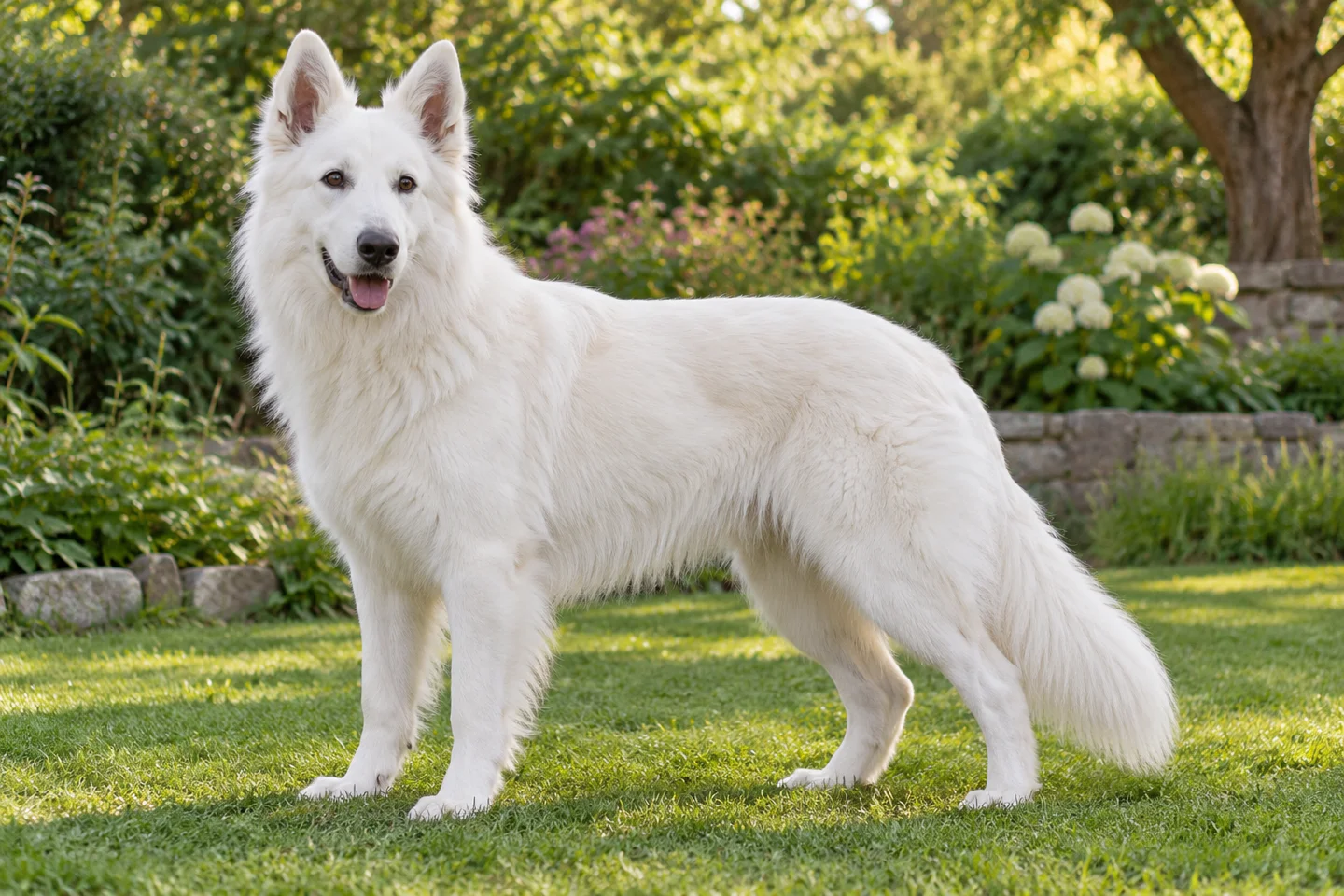
The illustrations choose the long-coated form, with natural erect ears, dark eyes and nose, and a full bushy tail. The back is functional rather than drawn with an exaggerated slope. Images cannot establish pedigree or emotional comfort. A prospective owner needs information about movement, necessary care, responses to strangers, and the ability to rest. An appealing white coat does not supply domestic skills. Puppies and adopted adults both need a learning plan suited to the household, with realistic expectations about travel, time apart, and controlled activity around people and animals.
Swiss recognition and the difference between ancestry and registration
The FCI history discusses white shepherd populations in North America and their establishment in Switzerland. Shared background with other shepherds is relevant history, while present registration and breeding systems remain separate questions. A seller should be able to explain the actual pedigree without relying on claims that color alone proves membership or superior temperament.
For a household, recent family experience is usually more useful than a remote ancestry argument. Ask how the adults react to an unfamiliar visitor, a medical examination, and a day when the usual outing changes. Find out whether the puppy will have experience of normal home sounds and handling. A working title may describe accomplishment without explaining every domestic situation. An adult rescue can bring useful skills while needing a gradual transition to new surroundings. Describe the environment honestly when discussing placement, including entrances, neighbors, children, other animals, and the help available during absences. Suitability depends on those practical circumstances as well as the individual dog's observed responses.
Adult size and planning for an athletic large dog
The FCI gives male heights of 58–66 cm and female heights of 53–61 cm. Approximate weights are 30–40 kg for males and 25–35 kg for females. Use those references alongside assessment of frame and condition rather than feeding a puppy toward the largest number. The coat can obscure changes, so ask the veterinary team to demonstrate checking ribs, waist, and muscle.
Plan transport and handling for adulthood. The dog needs suitable restraint and room to lie comfortably. Teach vehicle entry while it is well, with secure footing and manageable steps. A ramp introduced calmly can later help if mobility changes. Arrange traction on smooth floors near exits and care surfaces. If rising, turning, or loading becomes newly difficult, report the pattern rather than assuming the animal needs more exercise. A large athletic dog may continue enthusiastically despite discomfort. The clinician must assess the individual problem, while the household adjusts practical access to prevent avoidable strain.
Medium and long coats are recognized forms
The standard describes both medium-length and long double coats, with white coloring. The chosen long coat has a mane, fuller hair behind the legs, and a bushy tail without exaggerated length. Dark pigmentation is part of the illustrated appearance. White hair should not be treated as proof of albinism, nor as a guarantee that the dog cannot have hearing or skin problems.
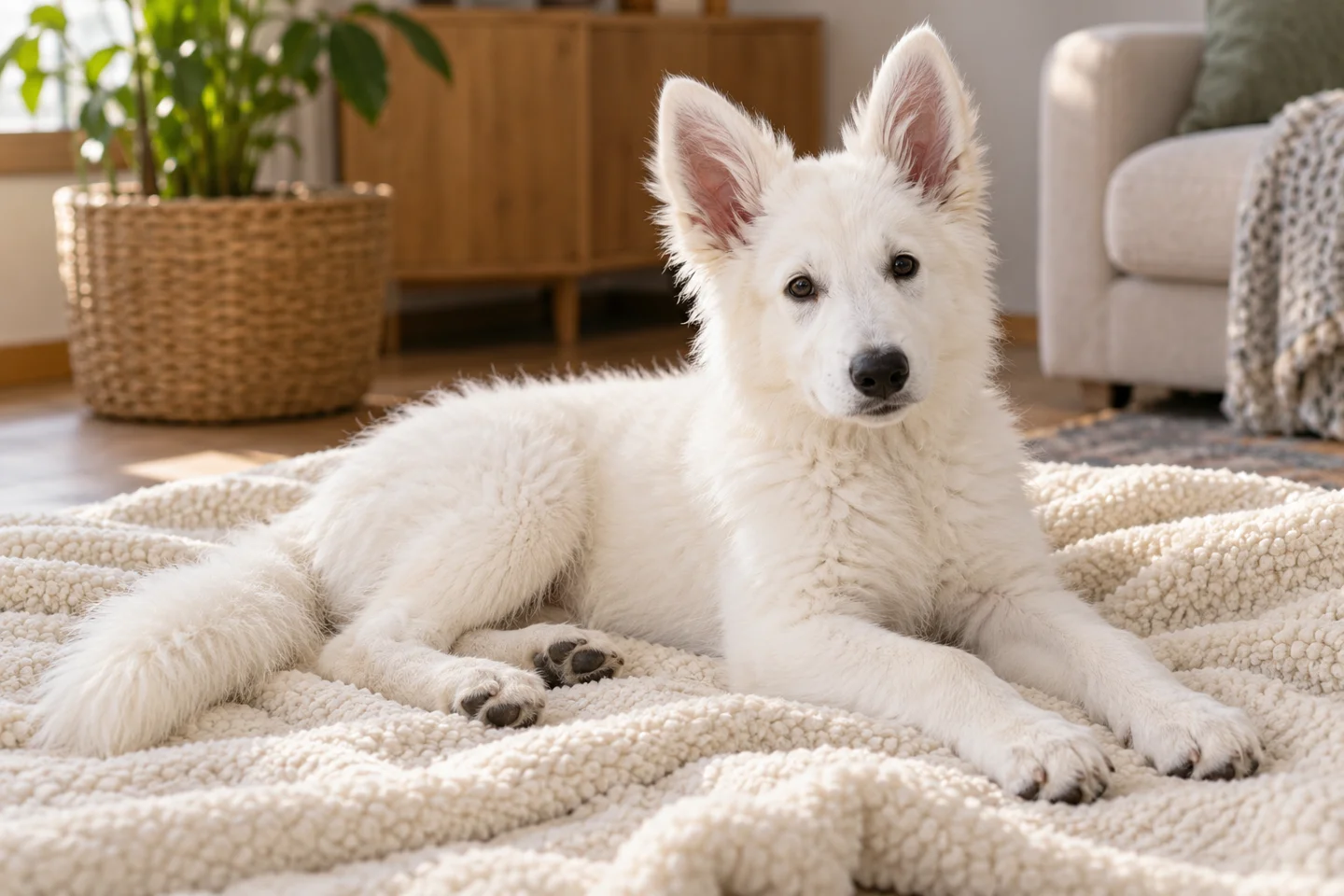
Puppy ears and coat develop, so an early image should not be expected to match the adult immediately. Ask about normal development in the family rather than manipulating anatomy to obtain a posed look. Appearance cannot show the skin beneath a dense coat or establish acceptance of brushing. Meet adults outside a prepared photograph and observe ordinary care. For an adopted animal, assess coat condition and comfort before planning cosmetic changes. Professional help may be needed if matting or painful skin has developed. The care arrangement should preserve sight, movement, and access to the body for examination.
Training attention around a moving environment
Teach an orientation toward the handler in quiet conditions, then add movement at a distance the dog can manage. A bicycle passing far away and one suddenly crossing close by are different levels of difficulty. Reinforce successful responses before demanding more. If the dog cannot disengage, increase the distance rather than repeating cues while the physical situation deteriorates.
Practice coming back, waiting at openings, and moving to a resting area. A reward can be food or renewed access to a suitable investigation. Found objects need a separate exchange lesson using harmless items before an actual hazard appears. Avoid forced mouth opening and confrontations intended to prove authority. If guarding or intense reactions already affect daily handling, obtain qualified reward-based assistance and change access while learning progresses. Intelligence does not mean a dog understands an untrained request in every environment. Useful cooperation is built through clear consequences, achievable steps, and physical safeguards around real hazards.
Exercise and the quality of recovery
Provide regular movement and purposeful tasks, adjusted to development and current health. Walking, searching, and suitable controlled activity can offer variety without keeping the animal in continual anticipation of another chase. A household should also teach rest. Persistent pacing after an outing may require a review of arousal, discomfort, and surroundings rather than automatically adding more distance.
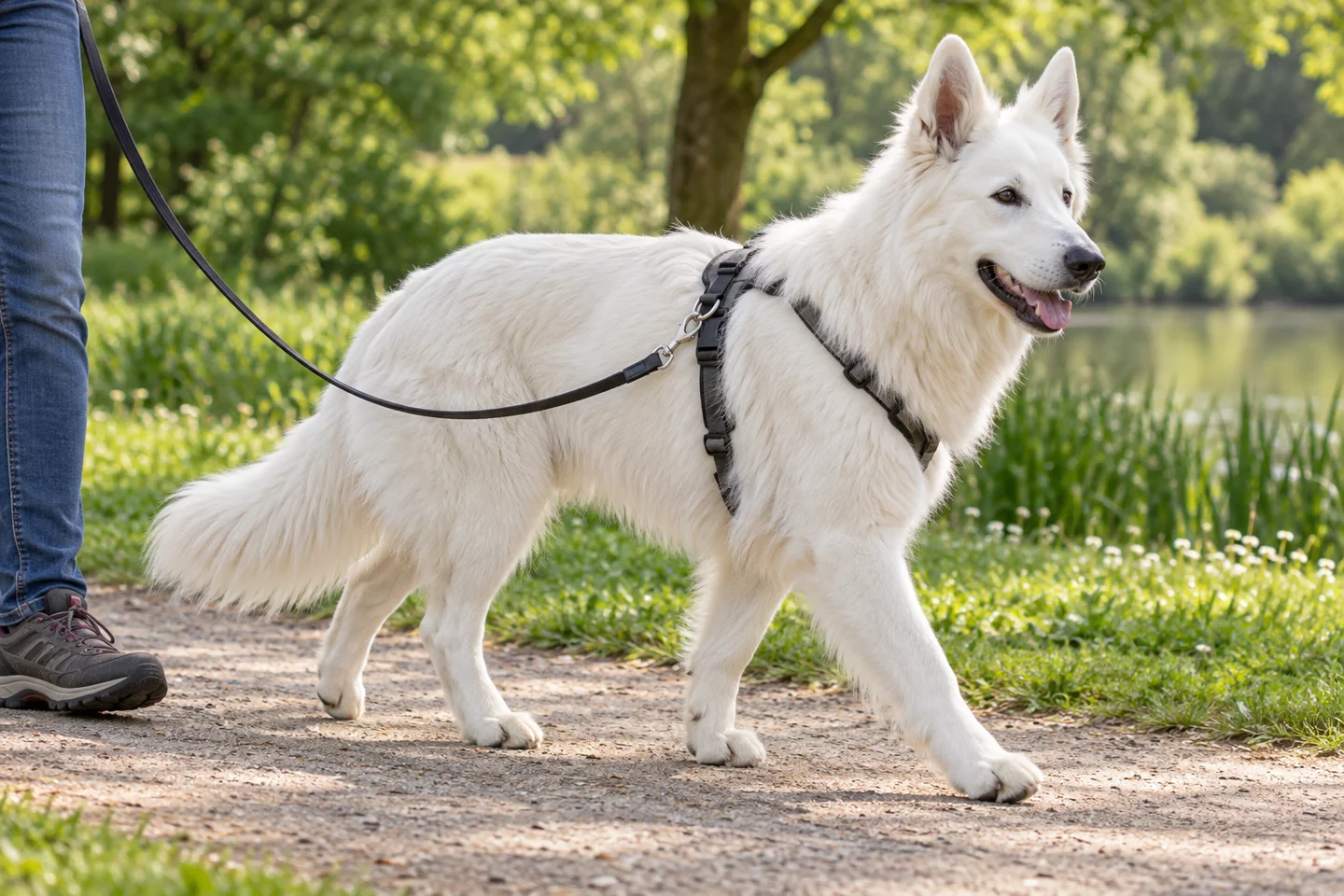
Build demanding activity gradually. Puppies should not follow an adult endurance target, while older dogs may need easier ground or shorter periods. Consider water, temperature, surfaces, and a way to leave the route early. Inspect secure exercise areas before release. A gap or loose latch matters regardless of what the facility calls itself. After activity, check pads and equipment contact points, then observe movement later. Repeated stiffness or unusual recovery deserves advice. A dense white coat does not make the dog immune to heat illness or establish that an eager animal can safely continue in unsuitable conditions.
A visitor routine before the door opens
Prepare a protected resting area that can be reached without crossing the arriving visitor's path. Practice moving there while the entrance is quiet and reward settling briefly. Every regular carer should know the arrangement. An internal barrier can make opening the outer door safe without relying on a person physically holding back an excited adult.
Visitors can wait while the dog observes from a comfortable distance. They should not be expected to approach or touch in order to prove friendliness. If a window or fence produces repeated reactions, change access while teaching an alternative response. Rehearsing the difficult behavior throughout the day makes a short lesson harder to use. Where reactions already threaten safety, seek professional help before another person becomes a test. A shepherd identity cannot supply a visitor policy by itself. The household needs a plan that works during deliveries, gatherings, and unexpected interruptions as well as calm practice.
Socialization includes travel, handling, and the option to leave
Introduce unfamiliar sights and sounds through manageable observation. A puppy can watch people from a distance and receive rewards without every stranger making contact. Preserve a retreat route and stop people crowding the animal. If it freezes, repeatedly withdraws, or remains unsettled afterward, make the next experience easier and ask for guidance.
Necessary care deserves separate practice. Brief paw contact, a look near an ear, equipment fitting, and standing on a nonslip surface should be taught before injury makes them urgent. Adult rescues need an assessment of actual experience too. Confidence in one setting does not establish familiarity with every new environment. Continue learning after a move or major household change. Observe how readily ordinary rest and activity return after outings. Mere physical presence through a long event is not enough to establish comfortable learning. A qualified instructor should be able to explain how the task is adjusted to the dog's current response.
Children and boundaries around a large companion
Plan for physical size as well as intention. A young shepherd crossing a narrow space quickly can knock over a child during an otherwise friendly moment. Keep running games away from the bed and manage hurried arrivals before excitement grows. Children should not be responsible for holding the adult near traffic or controlling access at an exterior door.
During calm contact, help a child invite an approach and pause after brief touch. Prevent climbing on the body, neck hugging, and following the dog into protected space. Meals, chews, and found objects belong under adult management. A child should ask for help rather than reach into the mouth. Visiting children need their own supervision even where household relationships are relaxed. If close adult attention is unavailable, use dependable separation. A general family-dog description cannot certify tolerance for every noisy visitor or sudden grasp. Suitability includes the adults' ability to maintain those arrangements consistently.
Aggression and making the actual event understandable
A response near a gate may involve different circumstances from one during grooming or over food. Record the sequence before a growl, snap, or bite, including contact, distance, resources, and the option to retreat. First create safety and prevent another exposure. Repeating the trigger for a video or a skeptical observer can produce another injury.
Arrange veterinary assessment for new sensitivity or abrupt changes, with qualified reward-based behavioral support for recurring defensive responses. Practical barriers and appropriate distances matter while teaching develops. Avoid punishment intended to remove a warning; the concern may persist even if the signal becomes quieter. When a basket muzzle is advised, introduce it comfortably and follow the agreed purpose. It cannot turn forced social contact into a suitable exercise. Following a bite, obtain care for the injured person and review how access occurred. Breed reputation or affection toward a familiar handler cannot replace a specific prevention plan.
Other dogs, cats, and different forms of movement
Assess canine meetings with separate handlers and room to turn away. Watch whether both animals can pause and disengage. One repeatedly blocking or pursuing an animal trying to leave is a reason to intervene. A relationship that works during an outdoor walk does not automatically establish comfort sharing a bed or food at home.
Prepare independent resource access and options for separation before adding a pet. Cats need protected routes to essentials and introductions that prevent chase rehearsals. Acceptance of one resident animal cannot predict the response to an unfamiliar running cat outside. Small pets require secure accommodation and a plan whenever an enclosure opens. Ask about known history and acknowledge missing information. If ordinary chores or absences would defeat necessary separation, reconsider placement rather than expect training to erase every pursuit response. A dog's cooperative relationship with people is useful, while compatibility with each animal remains a separate practical question.
Grooming a long white double coat
Work through loose undercoat gently and inspect areas behind ears, beneath equipment, and around the hindquarters and tail. Surface brushing alone may miss compacted hair close to skin. Ask a suitable groomer to demonstrate tools and a manageable routine. Do not repeatedly pull through a tight knot or cut where skin cannot be identified safely.
After bathing or wet activity, allow comfortable drying and check areas that remain damp or irritated. Maintain nails and teach tooth brushing in brief stages. Erect ears still need observation for discharge, odor, and pain. Their position does not exclude disease, and a new problem should not be treated with deep tools or leftover medication. If one area becomes newly difficult to touch, investigate discomfort before increasing restraint. Cosmetic whiteness should not take priority over healthy skin or make irritation harder to monitor. Cooperative care needs to provide access for examination while preserving the animal's comfort.
Health: Swiss screening includes more than a hip photograph
The Swiss breed club's health information describes orthopedic assessment of hips, elbows, and the lumbosacral transitional region, alongside hearing assessment and MDR1 information in its breeding context. These are Swiss club statements, not a universal international panel. Ask which current national and club rules apply to the particular litter and inspect identifiable reports.
A favorable hip result does not answer the question of hearing or medication sensitivity, and a DNA result cannot establish comfortable joints. Have the veterinary team explain the scope of each record. Family diagnoses appearing later in life also matter. For an adult rescue, preserve current medicines, symptoms, and previous investigations even where ancestry records are incomplete. A new movement problem needs its own clinical assessment rather than reassurance that the parents were screened. Keep the distinctions clear between a breeding requirement, a research sample, and investigation of a present problem. Each serves a different purpose in the animal's care.
MDR1 is clinically relevant even with one variant copy
UC Davis identifies the White Swiss Shepherd among breeds appropriate for MDR1 testing. The ABCB1 variant can alter responses to certain medicines. A dog with one copy may also show sensitivity, so the word carrier should not be used to dismiss its clinical relevance. Give the veterinary team the actual genotype report before prescribing or a procedure.
Avoid making a universal banned-drug list from another owner's account. The clinician must consider the drug, dose, route, and individual circumstances. Do not stop prescribed parasite prevention or substitute medication without advice. A clear result applies to this variant; it cannot promise the absence of every adverse drug response. Keep the report accessible when changing practices and tell a temporary carer where it is stored. If no test has been performed, say so rather than assuming the dog is unaffected because it appears well. The result informs clinical decisions when relevant exposure occurs, not a visible personality or appearance category.
DM risk tests are not a diagnosis of hindlimb weakness
Some national breeding systems use SOD1 testing for degenerative-myelopathy risk. UC Davis emphasizes incomplete penetrance and the need to interpret testing in the relevant breed context. A risk-associated genotype should not be equated with certainty that every individual will develop the disease, and a test is not a diagnosis for a dog currently struggling to walk.
If hindlimb coordination, strength, or continence changes, arrange veterinary assessment. Several orthopedic and neurological problems may need consideration, including potentially treatable causes. Record onset and progression safely without repeatedly challenging the dog on difficult ground. Ask what activity, support, and follow-up are appropriate while investigation proceeds. A prior DNA result belongs in the history but should not end the diagnostic conversation. Similarly, a negative result cannot exclude every cause of weakness. The useful distinction is between inherited-risk information used in a breeding decision and clinical investigation needed to explain the actual animal's present signs.
Feeding, mixes, and ownership costs
Measure meals and account for training food, then review condition and actual activity with the veterinary team. A long coat can conceal weight or muscle change. Choose complete food appropriate to life stage, and obtain advice for persistent thirst, digestive signs, appetite changes, or unexplained weight differences. Homemade feeding requires proper formulation, with supplements serving an identified need.
A White Swiss Shepherd mix may vary in adult size, coat, pursuit, and social behavior. Ask which backgrounds are documented and avoid promises of easier temperament or freedom from inherited disease. Relevant parental information remains useful for a planned litter. Obtain local costs for veterinary care, grooming support, secure equipment, training, transport, and trusted cover. A backup person needs to manage the adult at doors and around distractions. Practice the handover before illness or travel makes it urgent. A household's enthusiasm for the appearance or training potential is one part of suitability, alongside a sustainable ordinary routine.
dogsDating: choose the distance before making contact
A White Swiss Shepherd dogsDating profile should explain actual meeting experience and the kind of outing proposed. Mention comfortable pace, compatible partners, and situations needing more room. Keep exact home coordinates private and omit the household address. An approximate locality can identify a public starting place with space for separate preparation.
Agree on a route and a simple way to request a pause or finish. Begin with controlled movement apart and notice whether each dog can return to ordinary investigation after seeing the other. Greeting is optional. Repeated blocking, fixation, or attempts to escape contact mean the plan needs changing. Avoid shared food or toys during the first encounter. Afterwards, compare specific responses and decide whether another outing would suit both animals. Either person can decline. A calm parallel walk can remain the arrangement that works, without requiring close play or assuming shepherd ancestry predicts friendship.
Sources and editorial notes
Sources checked October 22, 2026. Breed measurements describe reference ranges, not a diagnosis or an individual dog's ideal weight. Images are AI-generated breed illustrations and do not document a particular dog or health condition.
- AVSAB: Humane Dog Training Position Statement
- VCA Animal Hospitals: Food aggression in puppies
- Orthopedic Foundation for Animals: CHIC health screening programs
- VCA Animal Hospitals: Aggression toward unfamiliar dogs, diagnosis
- VCA Animal Hospitals: Grooming and coat care for your dog
- VCA Animal Hospitals: Ear infections in dogs (otitis externa)
- AAHA: Feeding plans for healthy, appropriate weight cats and dogs
- VCA Animal Hospitals: Heat stroke in dogs
- AVSAB: Puppy Socialization Position Statement
- VCA Animal Hospitals: Dog behavior problems, aggression toward children
- FCI White Swiss Shepherd Dog standard 347: separate identity, history, coat forms and adult size
- Swiss White Shepherd breed club: orthopedic, hearing and MDR1 breeding-health context
- UC Davis Veterinary Genetics Laboratory: MDR1 ABCB1 drug sensitivity and one-copy clinical relevance
- UC Davis Veterinary Genetics Laboratory: degenerative myelopathy risk, incomplete penetrance and breed context
Keep getting to know dogs.
Read another guide or return to your dogsDating community.
Explore breed guidesBack to dogsDating