Yakutian Laika
A distinct northern working breed, with black-and-white blue-eyed illustrations and careful separation of hearing evidence, Norwegian screening context and appearance.
How these guides are researched and reviewed
- Origin
- Russia; Yakutia
- Male height
- 55–59 cm
- Female height
- 53–57 cm
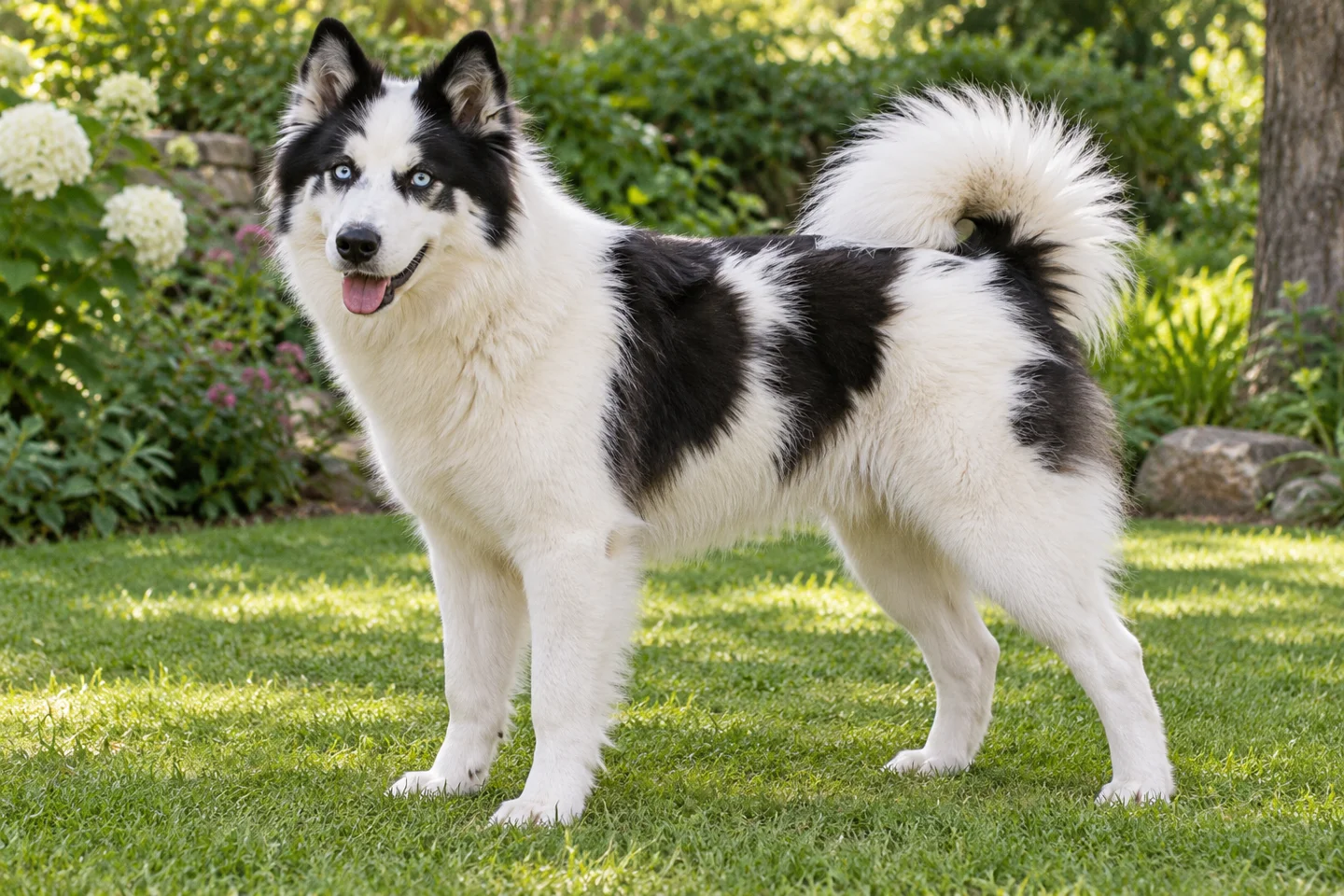
- Illustrated type
- Black and white, blue eyes, dense coat and full curled tail
General information for owners. These articles have not been reviewed by a veterinarian. Medical decisions need your dog's history and an examination.
The Yakutian Laika is a separate northern working breed
The Yakutian Laika is associated with northeastern Russia and has its own standard. It is separate from the West Siberian, East Siberian, and Russian-European Laikas, and from the Siberian Husky. Similar upright ears and a curled tail do not make their registration, appearance, or health information interchangeable. Ask which identity is documented for the actual dog.
The illustrations select black patches on white, natural upright ears, blue eyes, and a complete bushy curled tail. Brown eyes and other permitted arrangements exist; the selected image is one example. It cannot establish a real dog's ancestry, hearing, vision, or temperament. A prospective household needs direct information about movement, care, recovery, and social experience. An attractive northern coat does not supply domestic skills. Meet adults in ordinary circumstances where possible, and discuss what the puppy or adopted animal already knows and what must be taught in the new setting.
Yakutian working history and the modern care decision
The FCI describes a regional history involving transport and hunting alongside people. That context helps explain interest in purposeful movement and investigation, while it cannot promise that every individual enjoys the same sport or responds identically to unfamiliar animals. A companion can receive safe structured activity without access to wildlife or an attempt to recreate every historical task.
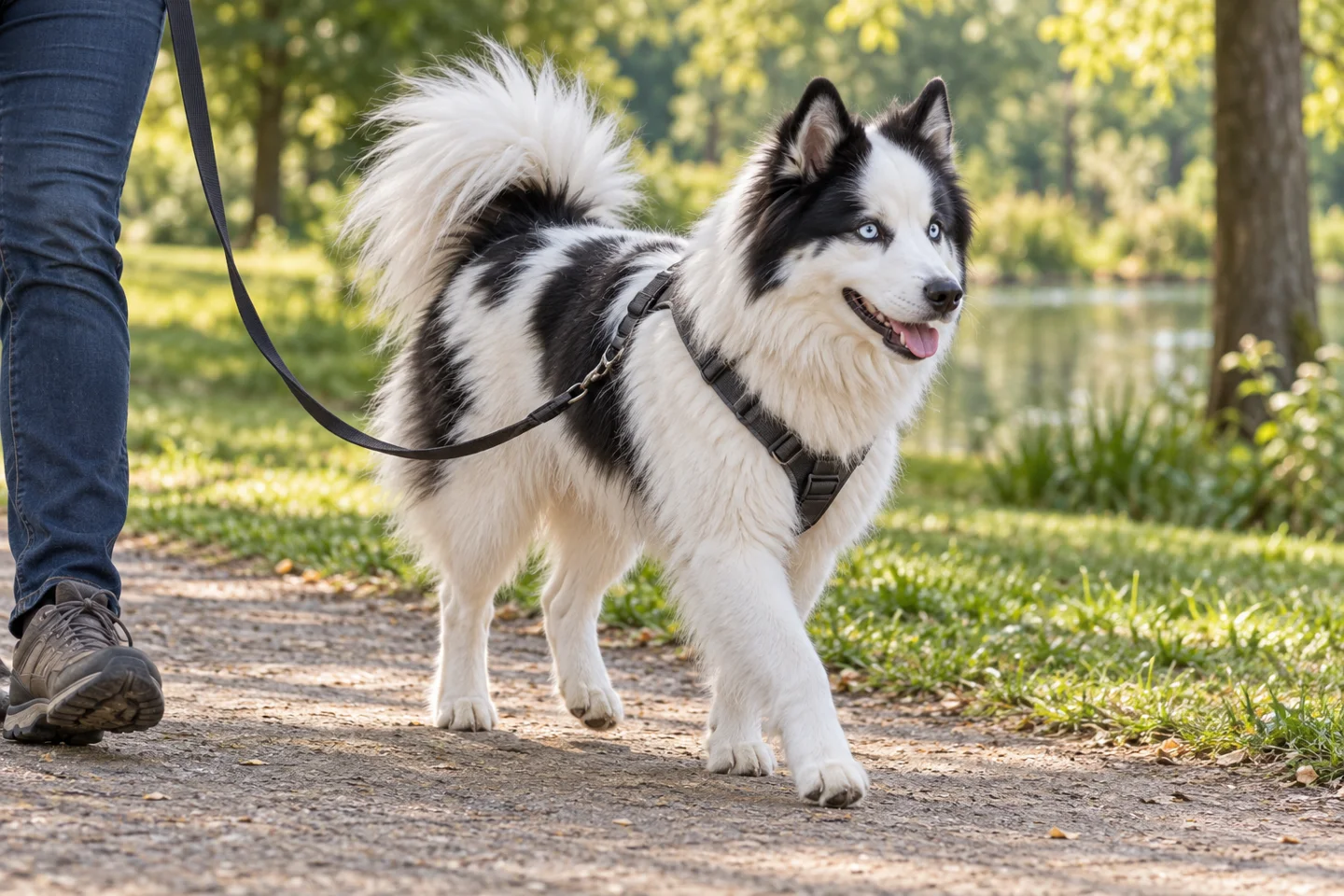
If pulling activity is planned, obtain experienced instruction on appropriate equipment, progression, conditions, and veterinary readiness. A puppy's pedigree is not permission for adult workloads. Ask a breeder what happens between outings: rest, necessary handling, visitors, and time with another carer all matter. An adult rescue may have extensive experience in one environment while needing new lessons elsewhere. Quiet confidence in fields does not establish familiarity with lifts or crowded entrances. Discuss the household's actual schedule and available help before placement. Suitability depends on a sustainable week and the individual animal, not simply enthusiasm for a northern working image.
Adult heights and a compact athletic frame
The FCI gives males a height range of 55–59 cm and females 53–57 cm. It does not prescribe a fixed adult weight interval in that document. Ask the veterinary team to assess the individual frame, muscle, growth, and condition rather than borrow a target from a Husky or another Laika. A dense coat can conceal gradual change.
Plan transport and care for the adult. The dog needs comfortable restraint and room to turn and lie down. Teach secure vehicle access with stable footing before injury makes assistance urgent. A familiar ramp or supported arrangement can simplify later care if mobility changes. Recheck equipment through growth and coat changes, including whether the animal can back free. Observe ordinary rising and turning as well as excitement outside. A dog still keen to move may have discomfort that appears more clearly after activity. Clinical advice should guide changes when a limp, stiffness, or altered recovery persists.
Patching, eye color, and what photographs cannot answer
The standard permits white and patching in bicolour or tricolour arrangements, with specified eye-color possibilities including blue and brown. The chosen black-and-white, blue-eyed example should not be confused with merle advertising or an unrelated breed's coat. Natural ears may be erect or half-pricked under the standard, while the selected adult is erect-eared.
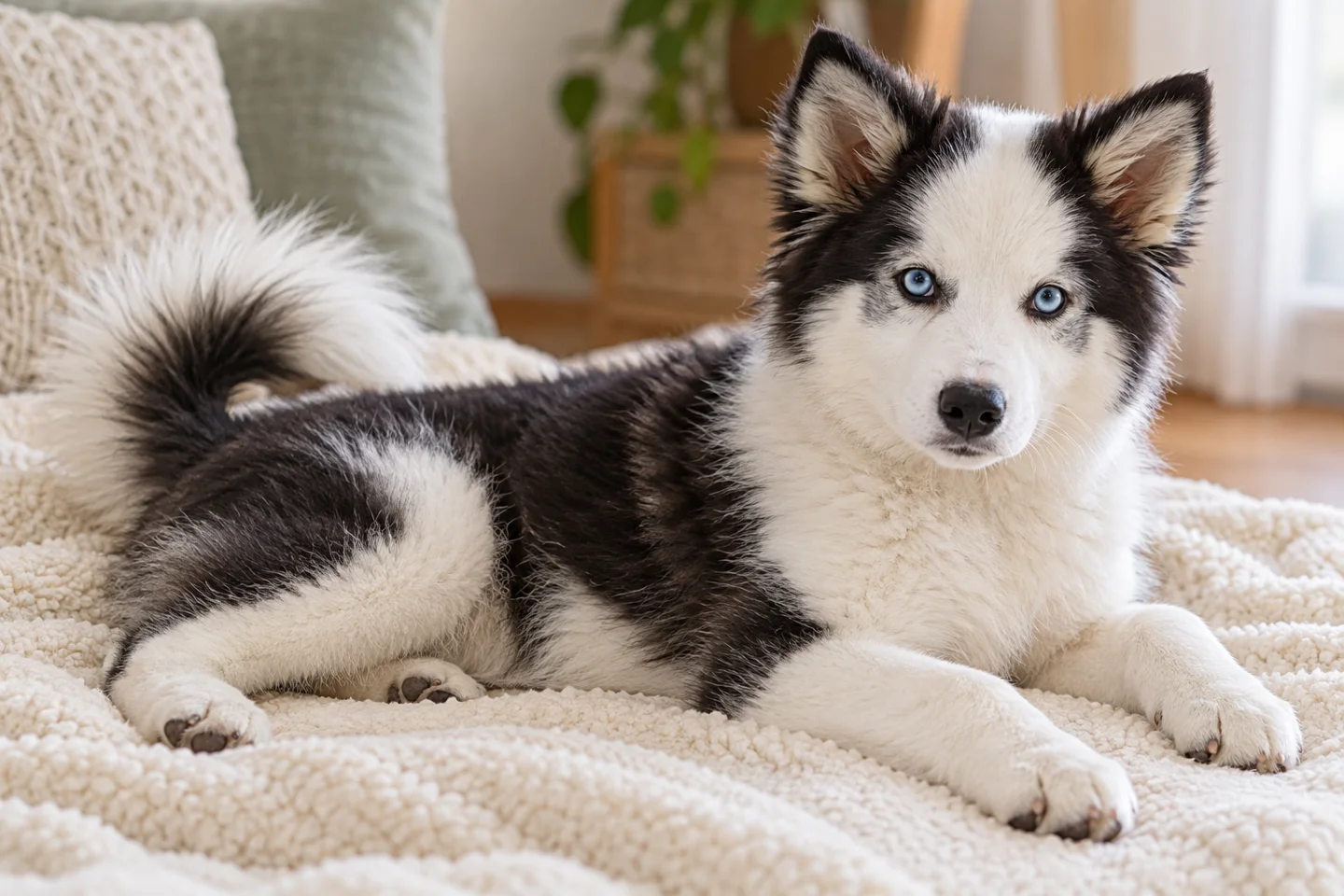
Eye color does not establish hearing status. A photograph of two blue eyes cannot diagnose deafness, and brown eyes cannot certify normal hearing. Ask for the relevant clinical assessment rather than make medical decisions from appearance. Puppy proportions, ear carriage, and coat develop with maturity. Avoid manipulating anatomy to reproduce an adult pose. For an adopted dog, keep uncertain ancestry uncertain and assess the actual needs. A distinctive patch can help individual identification, but it cannot replace registration records or a veterinary examination. Keep current photographs and microchip details without posting private documents or a visible household address publicly.
Training cooperation before adding distance and speed
Begin with attention and following the handler where distractions are manageable. Reinforce success promptly and sometimes allow a safe investigation afterward. Increase difficulty through small changes. A response learned indoors does not establish reliability beside running wildlife or another dog, regardless of affection toward the usual person.
Teach an exterior-door pause behind physical safeguards before an exciting departure. Every regular carer needs the same procedure. Practice returning with appropriate secure equipment and obtain instruction on line handling if needed; tangles around people or obstacles create injury risk. Teach exchanges with harmless objects rather than repeatedly chase and force the mouth open. Secure hazards while learning progresses. Qualified reward-based help can support pulling, fixation, or guarding that already interferes with daily care. A working reputation cannot replace clear teaching at the actual level required. Review understanding, fatigue, emotional state, and discomfort before treating a difficult response as a contest over authority.
Exercise that accounts for warmth and ordinary recovery
Provide regular movement and suitable tasks through the week, adjusted to development and health. Walking, searching, and appropriately supervised activity can offer purpose without continuous excitement. A puppy needs manageable experience and rest rather than an adult endurance schedule. Older animals may remain interested while needing easier terrain, shorter periods, or a different pace.
Northern ancestry does not make heat illness impossible. Consider weather, water, shade, surfaces, and an early exit before a route or task. An eager dog may still require the handler to stop. Inspect any enclosure for gaps, latches, and hazards before release. After demanding ground, check feet and equipment contact areas, then notice movement later. Repeated stiffness, altered breathing, or unusually slow recovery warrants advice. A sustainable household also has alternatives when conditions make the preferred activity unsuitable. More distance is not the answer to every restless afternoon, particularly where discomfort or an overstimulating environment may contribute.
Rest, voice, and a predictable absence routine
A resting area should be outside the busiest route and protected from continual interruption. Practice calm periods while people perform ordinary tasks nearby. If a window or fence keeps prompting reactions, change access while teaching disengagement. Shouting over vocalizing does not necessarily explain what the dog should do next. Notice the trigger and whether recovery is easy.
Introduce time apart gradually and observe sleep, eating, pacing, and vocalization. Persistent distress needs veterinary and qualified behavior advice. Damage alone cannot identify the cause, and adding another animal may create new concerns without treating the original problem. Arrange a trusted carer and practice the full routine before a long unavoidable absence. The person needs equipment, entrances, feeding instructions, and medical contacts. Discuss the actual weekly schedule before placement. A sociable working-breed description cannot provide practical cover when work, illness, or travel interrupts the usual handler's presence.
Socialization with manageable novelty and handling
A puppy can learn about unfamiliar people, surfaces, sounds, and vehicles through comfortable observation. Reward relaxed engagement and keep a route away. Greeting is optional. Ask strangers not to lean over, lift, or restrain the animal because they find the coat or eyes appealing. If it repeatedly freezes or withdraws, simplify the experience and seek guidance on progression.
Necessary care deserves separate lessons. Brief paw and ear contact, equipment fitting, and standing on a nonslip surface should develop before injury makes them urgent. An adult rescue needs a review of actual experience rather than assumptions based on age or robust build. Confidence in one place does not establish comfort in every busy setting. Continue learning after moves and major household changes. Watch recovery after a session, including ordinary sleep and activity. Prolonged vigilance can mean the demands were too high. Useful social learning involves coping, not simply remaining physically present until the handler decides the event is complete.
Children and a northern dog’s protected choices
Plan running games and hurried arrivals so that the dog and young children do not compete for the same narrow space. Physical momentum can cause injury without threatening intent. Adults manage leads near roads and exterior entrances. Children should not be responsible for controlling an adult after an abrupt distraction.
For quieter interaction, an adult can help a child call the dog nearer and then pause after a short stroke. An animal leaving should be allowed to reach its protected place without pursuit. The thick coat is not a handle, and children must not climb or lean across the body. Adults handle anything involving food, chews, or a retrieved object. A visiting group needs a fresh plan even if familiar children understand the household rules. Before games become boisterous, settle the dog comfortably behind a dependable barrier. Separation is also appropriate when adult attention must move elsewhere. A family-dog description cannot replace arrangements that protect choice and prevent rough contact on ordinary busy days.
Aggression and a practical account of the response
A warning at a doorway, during painful grooming, or near food can involve different concerns. First prevent another exposure and create space. Record the sequence, contact, resource, distance, and available escape. Do not recreate the situation to prove the warning was serious or obtain a clearer video.
New sensitivity and abrupt changes deserve veterinary assessment. Recurring threatening behavior needs qualified reward-based help and dependable physical safeguards while teaching progresses. Punishment can make a growl less observable without resolving the cause. When a basket muzzle is recommended, introduce it comfortably and use it within the agreed plan; it cannot make forced contact suitable. Following a bite, arrange medical care and review how access occurred before allowing another encounter. An individual dog's prior friendliness or breed description cannot predict the next response. Prevention has to address actual circumstances and how necessary care can be delivered without another painful or frightening confrontation.
Other animals and the difference between familiar and new
Assess prospective canine companions with separate handlers and room to turn away. Observe whether both animals can pause and disengage. Repeated one-sided pursuit of a dog trying to leave needs interruption, even if the pursuer seems playful. A comfortable outdoor relationship cannot establish immediate agreement over beds and food indoors.
Before adding an animal, sketch the household routes to beds, bowls, exits, and the cat's essentials. One dog's position should not control access to everything useful. Use secure separation while introducing cats and prevent the Laika from practicing pursuit. Cleaning an enclosure or carrying shopping can defeat an arrangement that worked during a staged first meeting, so test the ordinary chores too. Small pets need protected accommodation whenever they are housed or handled. A previous peaceful relationship is evidence about those animals in that setting; a new running animal may evoke a different response. If the home cannot preserve the necessary safeguards during absences, discuss another placement before adoption rather than wait for conflict to decide the matter.
Grooming through dense undercoat and outdoor debris
Brush gently through loose undercoat, checking behind ears, under equipment, and around hindquarters and tail. A surface pass can leave compacted hair close to skin. Ask a knowledgeable groomer to demonstrate suitable tools and a manageable routine. Do not repeatedly pull through a tight knot or cut where skin cannot be identified safely.
After wet activity, allow comfortable drying and inspect damp or irritated areas. Check pads and between toes after rough ground, maintain nails, and introduce tooth brushing through brief cooperation. Natural erect ears still need observation for odor, discharge, and pain. Avoid deep tools or leftover medication for a new problem. If handling becomes difficult around one area, stop and investigate discomfort before increasing restraint. The coat should permit access for examination and condition checks rather than hide a persistent change. A northern appearance does not make painful skin, rubbing, or neglected care normal or acceptable.
Health: Norwegian requirements and recommendations are distinct
NKK's Yakutian Laika information says known parental hip status has been required for registration since June 2022. It also recommends eye examination, gonioscopy, and BAER hearing assessment. Those are Norwegian statements, not an invented international panel. Confirm the current rules relevant to a particular litter and ask for actual identifiable reports.
Do not transfer the West Siberian Laika program simply because both names include Laika. Separate populations can have different requirements and evidence. A hip result, drainage-angle assessment, and hearing record answer different questions. Discuss interpretation with the veterinary team rather than accept a broad fully-tested claim. Family diagnoses appearing later remain relevant. For an adult rescue, current medicines, symptoms, and previous investigations supply useful information even where pedigree records are absent. A new clinical problem needs its own assessment; favorable parental screening cannot explain every limp, eye change, or altered response to sound in the individual dog.
BAER assesses ears separately, not the beauty of the eyes
BAER testing records an auditory response and can identify hearing in one or both ears. The University of Florida explains that its routine assessment establishes whether an animal hears rather than characterizing every amount of hearing. A dog responding to household noise may still need objective evaluation; casual observations cannot reliably substitute for an ear-specific report.
Ask to see results linked to the actual animal rather than an assurance that the litter seems alert. Eye color alone is not a diagnosis. If hearing impairment is found, discuss communication, safe waking, secure access, and training with the veterinary team and a suitable professional. Avoid startling the dog through unexpected touch, particularly during sleep. A hearing difference does not establish aggression or inability to learn, while it can change what practical arrangements are needed. Keep the record available to carers and future practices. The useful goal is accurate knowledge and an individual plan, not a judgment based on appearance or a dramatic online demonstration.
Eye screening and a new painful eye are different tasks
NKK recommends ophthalmic assessment including gonioscopy in its breed information. Gonioscopy concerns the drainage-angle anatomy and should not be treated as identical to every general eye examination. Ask which procedure was performed, when, and how the report was interpreted. A favorable screen is useful without becoming a promise that no future eye disease or injury can occur.
A red, cloudy, painful, or unusually closed eye needs prompt veterinary advice. Do not wait for the next planned screening appointment or use drops left over from another animal. Describe onset and any apparent vision or behavior change, without forcing the eye open. The clinician determines the cause and whether pressure assessment or referral is needed. Blue eyes do not diagnose disease, and brown eyes cannot exclude it. Keep appearance claims separate from medical evidence. Current clinical findings guide care for the problem present now, while family records and earlier screening provide background.
Food, mixes, and the cost of the ordinary week
Measure meals and include rewards and chews when reviewing condition and actual activity. Choose complete food appropriate to life stage and seek advice for persistent thirst, appetite, digestive, or weight changes. A dense coat is not a condition assessment. Homemade alternatives need proper formulation and supplements should serve an identified purpose rather than a generic northern-dog claim.
A Yakutian cross needs its own assessment of adult build, coat, social responses, and investigation. Ask whether the ancestry is recorded or estimated, then discuss relevant family health information without promising that a cross removes inherited risk. In rescue, observed behavior and examination findings provide a practical starting point where records are absent. Obtain prices from the actual local people who would supply care, transport, training, and coat support. Check that a replacement carer understands equipment and any hearing-related cues. Practice together before leaving that person responsible. An attractive northern appearance is only one reason someone may become interested; maintaining purposeful activity and a comfortable household routine through an inconvenient week determines whether the arrangement can last.
dogsDating and an outing both handlers can adjust
A Yakutian dogsDating profile can propose a specific route and pace, with the spacing that has helped around previous companions. Explain any established communication arrangements for hearing impairment. Keep exact home coordinates private, and leave the street address out of the profile. An approximate locality is sufficient for choosing a public landmark. Check that each party can arrive and organize equipment without an immediate encounter through a bottleneck. A first walk should give both handlers control over the opening distance.
Decide how to request a wider gap before starting. Look for the dogs returning to sniffing or ordinary movement after noticing one another, rather than measure success through proximity. If one blocks the other's route or keeps trying to withdraw, change direction or finish. Contact and play need not happen. A shared resource can complicate that initial assessment, so keep rewards under each handler's own control. Afterwards, discuss the places where either dog struggled and whether the same walk would be useful again. Neither person needs to continue an arrangement that does not suit their animal. Calm company at a distance can remain the practical outcome.
Sources and editorial notes
Sources checked October 22, 2026. Breed measurements describe reference ranges, not a diagnosis or an individual dog's ideal weight. Images are AI-generated breed illustrations and do not document a particular dog or health condition.
- AVSAB: Humane Dog Training Position Statement
- VCA Animal Hospitals: Food aggression in puppies
- VCA Animal Hospitals: Common emergencies in dogs
- Orthopedic Foundation for Animals: CHIC health screening programs
- VCA Animal Hospitals: Aggression toward unfamiliar dogs, diagnosis
- VCA Animal Hospitals: Grooming and coat care for your dog
- VCA Animal Hospitals: Ear infections in dogs (otitis externa)
- AAHA: Feeding plans for healthy, appropriate weight cats and dogs
- VCA Animal Hospitals: Heat stroke in dogs
- AVSAB: Puppy Socialization Position Statement
- VCA Animal Hospitals: Dog behavior problems, aggression toward children
- FCI Yakutian Laika standard 365: identity, size, permitted eyes and coat
- Norwegian Kennel Club: Yakutian Laika hip registration context, eye and BAER recommendations
- Louisiana State University veterinary deafness information: eye color is not a diagnosis of deafness
- University of Florida Small Animal Hospital: BAER hearing testing and its scope
Keep getting to know dogs.
Read another guide or return to your dogsDating community.
Explore breed guidesBack to dogsDating