Basenji
An independent African hunting dog whose care includes secure exploration, realistic expectations about voice, and clear Fanconi and eye screening records.
How these guides are researched and reviewed
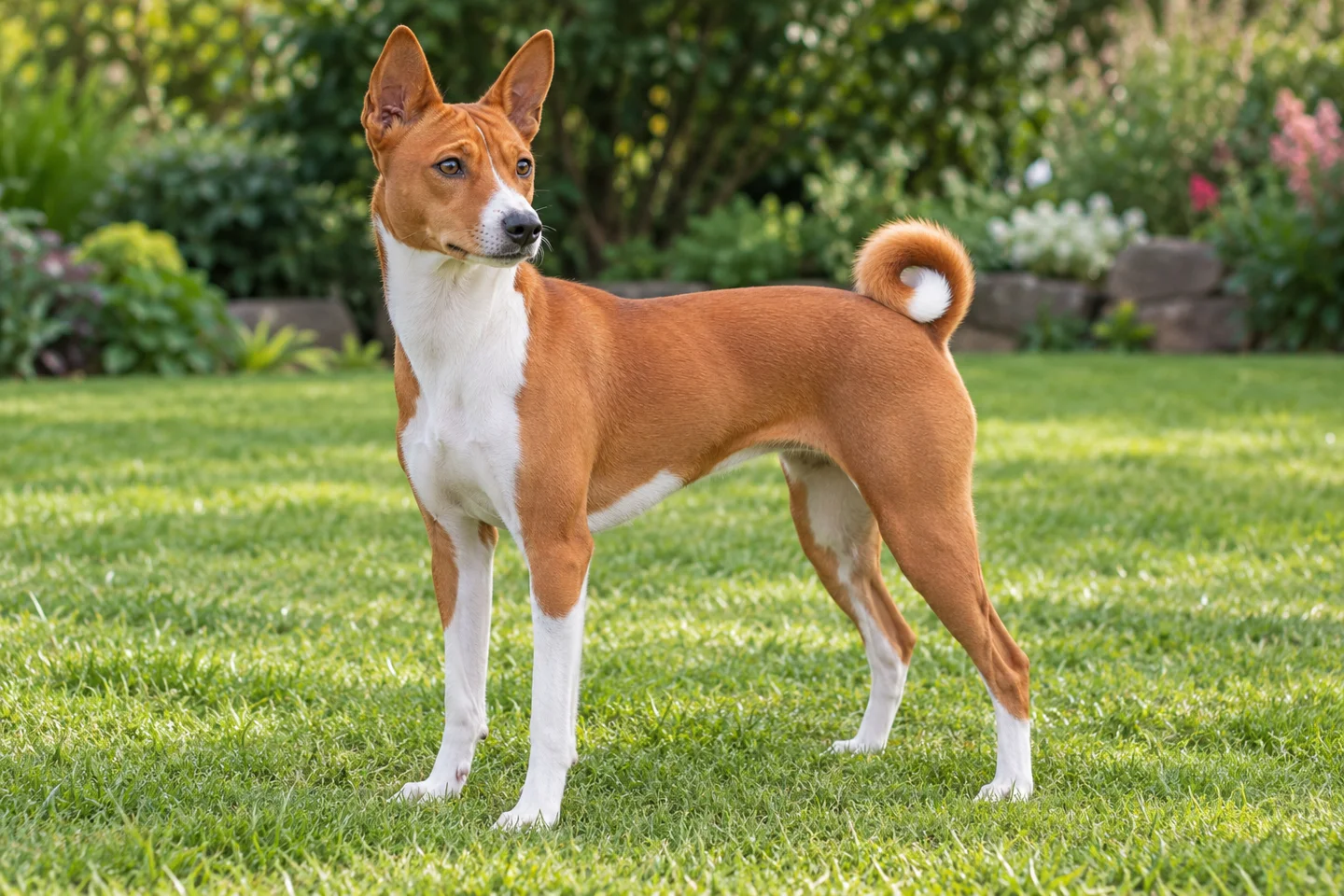
- Coat
- Short; several colors with white markings
- Outline
- Erect ears, wrinkled forehead, curled tail
- Care priorities
- Boundaries, company, and health reports
General information for owners. These articles have not been reviewed by a veterinarian. Medical decisions need your dog's history and an examination.
Life with a Basenji
A Basenji needs secure boundaries, interesting activity, and patient teaching that respects an independent, observant dog. The breed's small size and short coat can make everyday logistics look simple, but neither tells you how it will cope with isolation, moving animals, or access to an open door. Before adopting, decide how walks, rest, training, and company fit your ordinary week. A plan that depends on reliable off-lead behavior everywhere leaves too much to chance when a compelling sight or scent appears.
Meet adults and ask about household life rather than relying on a distinctive appearance. Find out what the dog does when people leave, when a visitor arrives, and when someone needs to inspect its feet. An adult foster assessment can provide useful information, while a puppy brings uncertainty even with known parents. A suitable owner can enjoy teaching and exploration without expecting constant obedience or immediate friendliness. The individual dog's behavior and health records deserve more weight than a broad description of the breed as clean, quiet, or catlike.
African origins and the meaning of barkless
The Basenji's documented modern breed history includes dogs brought from central Africa, with later imports contributing to breeding populations. Avoid turning ancient images of similar-looking dogs into proof of an uninterrupted pedigree for every present-day animal. The practical background is a small hunting dog with alert senses and independent decisions. That context can help explain care needs while leaving substantial variation in the temperament and experience of individual companions.
Barkless is a common description, but it does not mean silent. Basenjis can produce distinctive vocal sounds and may communicate distress or excitement noisily. Ask to hear the actual dog's responses in ordinary situations, especially if neighbors share walls. A nickname cannot establish that a dog will remain quiet during absences. Similarly, comparisons with cats describe an impression rather than a different set of welfare needs. A Basenji still requires daily human care, suitable teaching, veterinary attention, and safe opportunities to behave as a dog.
Outline, coat, and practical equipment
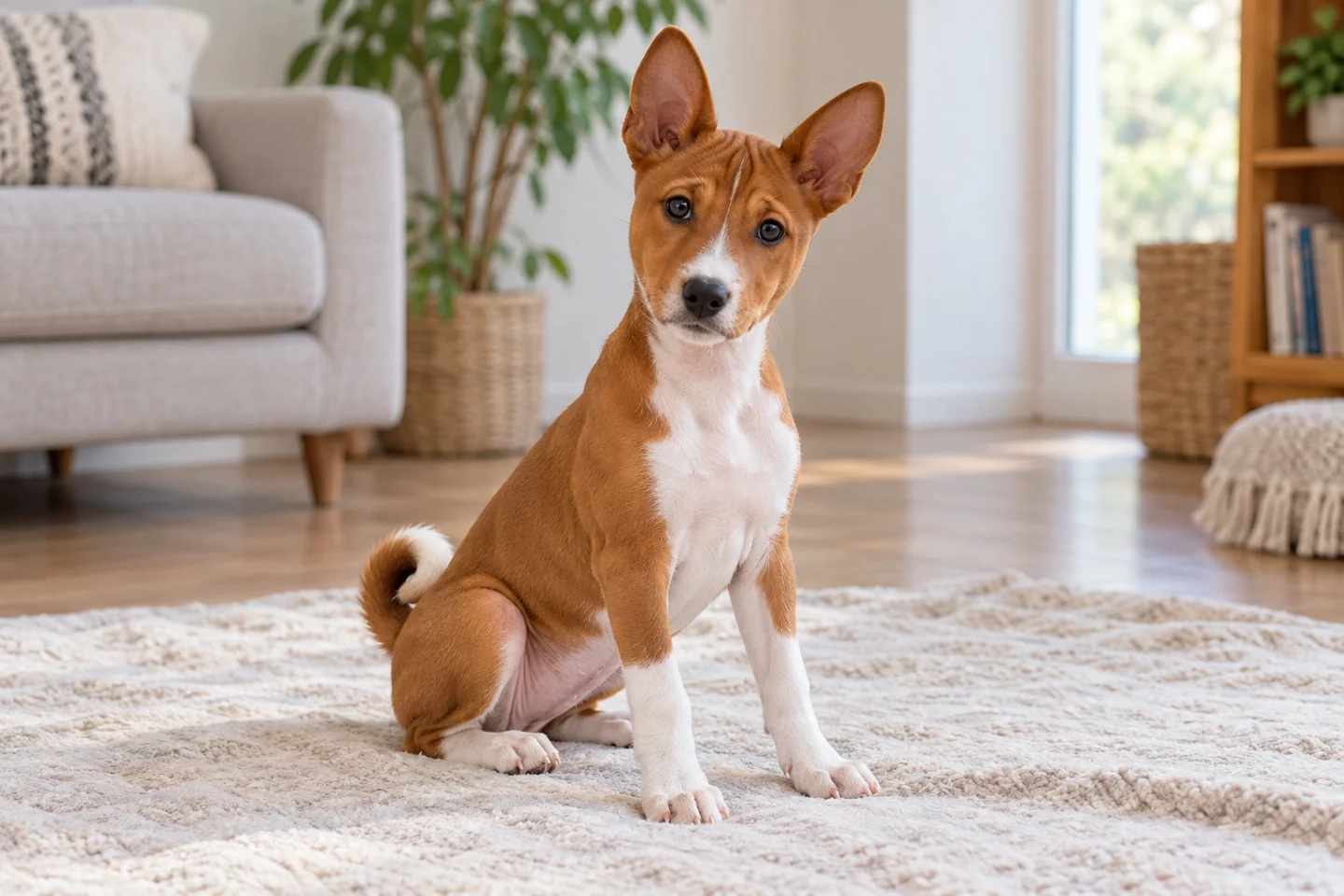
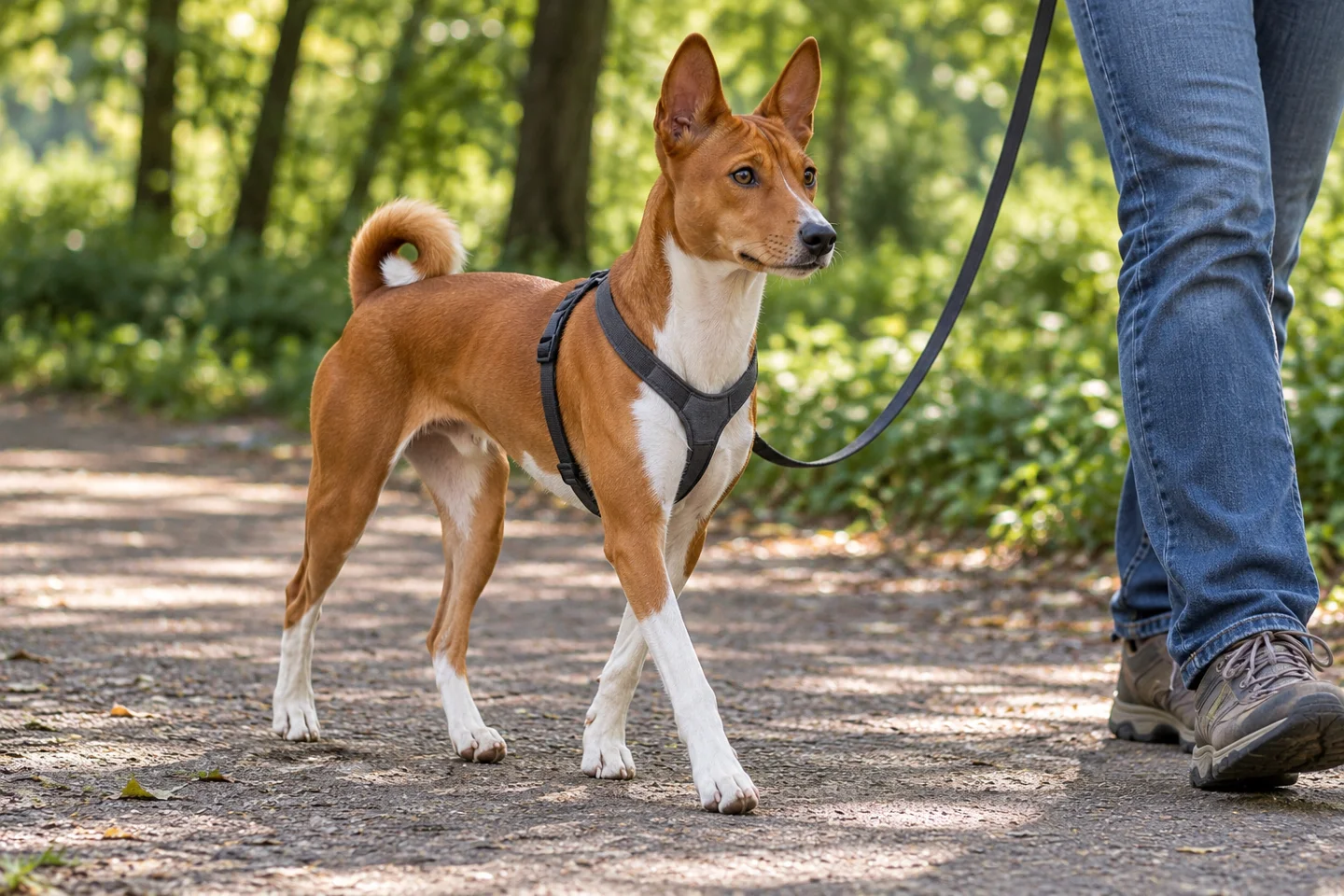
The breed's outline includes erect ears, a wrinkled forehead, a short coat, and a curled tail. Several colors occur, and the illustrations show red-and-white examples with natural ears and tails. They are generated illustrations rather than records of particular dogs or evidence of ideal health. Watch a real dog move, turn, and rise comfortably. Ask about persistent stiffness or reluctance to be touched instead of allowing a tidy, athletic appearance to substitute for assessment.
Fit equipment to the dog's actual neck, chest, and shoulders. Check whether a startled individual can reverse out of a loose harness or collar, and inspect fasteners before outings. Puppies need repeated adjustments during growth. Teach calm equipment fitting and waiting at doors in easy conditions. Identification and a registered microchip are useful backup measures, while a practiced access routine prevents the escape itself. Vehicle travel also needs a secure arrangement so opening a door does not create an immediate route into traffic.
Fences, climbing, and household access
Inspect the garden from the dog's side. Gaps beneath gates, loose panels, furniture near a fence, and an open side entrance can all undermine an otherwise secure boundary. Do not assume a small dog will remain within a low barrier or stay close because it has just arrived. Supervise the first use of an unfamiliar enclosure and check rented exercise fields before releasing the dog. A tracker adds information after an escape but cannot prevent danger to the dog or other animals.
Indoors, manage access to rubbish, medications, unsafe foods, and items the dog might chew or swallow. Provide appropriate outlets and teach exchanges rather than turning every discovery into a chase. A comfortable separate area can help during deliveries or busy household activity. Introduce confinement gradually so it predicts rest rather than sudden isolation. If the dog repeatedly attempts to escape or injures itself at a barrier, obtain qualified help and veterinary advice instead of strengthening confinement without investigating the reason for distress.
Children and respectful contact
Children need active adult supervision with a Basenji. Teach calm invitations and let the dog move away. Avoid hugging, climbing, pulling ears or tail, and leaning over its face. Keep children away from sleeping places, meals, and chews. A child should call an adult when something is beside the dog rather than attempting to move it or take an object from its mouth. Small size does not eliminate bite risk or make repeated unwanted handling acceptable.
Visiting children create different movement and noise from the usual family routine. Use a comfortable separate area before energetic games if supervision will be divided. Watch for freezing, turning away, hiding, or repeated efforts to leave. A dog should not need to escalate warnings to obtain space. Comfortable behavior with one familiar child does not establish tolerance of every gathering. Review the plan as children become mobile, the dog ages, or pain makes touch less comfortable than it was previously.
Other dogs, cats, and pursuit
Basenjis differ in their social preferences. Ask about specific experiences rather than assuming a playful dog will enjoy an unfamiliar group. Begin introductions with parallel walking in a suitable neutral place, allowing both dogs to disengage. At home, separate bowls, chews, and resting areas while assessing comfort. Watch for repeated blocking or pursuit, and do not wait for a fight before intervening when one dog cannot rest or leave freely.
Cats need gradual introductions and escape routes the dog cannot follow. A Basenji accustomed to one cat may still pursue an unfamiliar animal running outdoors. Rabbits, rodents, and other small pets require secure protection rather than a test of intentions. Stop access when stalking, fixation, or chasing appears and seek qualified advice. A gentle response to people gives little information about prey-related behavior. The household needs to maintain separation reliably before deciding that the individual dog can live safely with vulnerable animals.
Aggression and preserving useful warnings
Stiffness, freezing, hard staring, growling, snapping, or attempts to retreat mean the interaction needs to change. Create space and remove the immediate pressure. Fear, pain, resource concerns, and previous learning can all matter. Do not corner the dog or repeatedly reach for a valued object to prove that it must tolerate contact. Breed descriptions cannot determine safety in a particular situation, and an explanation involving independence should not become a reason to ignore recurring threats.
Arrange veterinary examination for sudden irritability or new handling sensitivity. Record the context of repeated problems and consult a veterinary behaviorist or qualified reward-based professional. Punishing warnings can leave the underlying concern unresolved while making risk less visible. Barriers and separate resources can prevent further conflict while a plan is developed. A positively introduced basket muzzle may add protection in appropriate circumstances, alongside treatment and management. It cannot make unwanted close contact comfortable or replace the opportunity to keep distance.
Training through rewards and clear choices
Teach attention to a name, a hand target, a short recall, and a turn away in quiet surroundings. Use rewards that matter to the individual, including food, a suitable game, or access to an interesting sniff. Add difficulty gradually. If the dog cannot respond near moving animals, increase distance and retain physical safeguards. A recall practiced at home does not justify testing it beside traffic or wildlife, where a single failure can cause serious harm.
Keep sessions brief and understandable. A delayed response may mean the task is unclear, the environment is too difficult, or the reward is less compelling than something nearby. Review those factors instead of assuming the dog is challenging authority. Practice standing for care, settling during household activity, and releasing objects through exchanges. Reward-based instruction can help an owner improve timing without repeated pulling or forced positions. Useful everyday cooperation is a reasonable goal even when the dog remains curious and independently interested in its surroundings.
Exercise, weather, and recovery
Provide daily movement suited to age, health, and conditioning. Walks with time to investigate, controlled searches, and securely enclosed opportunities for faster activity can create variety. Inspect the surface and boundary before free running. Build fitness gradually before long outings or demanding sports, and discuss repeated high-impact exercise for a youngster with the veterinarian. An eager dog may continue despite fatigue, making gait and recovery important information for the handler.
A short coat can make cold or wet conditions uncomfortable for some individuals. Adjust duration, provide dry rest, and fit any clothing so it does not rub or restrict movement. In heat, provide water and shade and reduce demanding activity. African origins do not prevent heat illness. Collapse or severe breathing difficulty needs urgent veterinary advice. Persistent limping, slower recovery, or reluctance to rise also warrants assessment, even when the dog remains interested in leaving the house and investigating its usual route.
Grooming and cooperative care
The short coat needs regular gentle brushing and skin checks. Look beneath equipment for rubbing and inspect feet after rough ground. A dog that grooms itself still needs help with nails, teeth, parasites, and medical assessment. Bathe when necessary with suitable products and dry comfortably. Avoid treating low coat maintenance as no maintenance. Skin changes, wounds, or repeated licking need investigation rather than an assumption that the dog will keep every area healthy through its own grooming.
Introduce tooth brushing, nail care, ear inspection, and standing for examination in small rewarded stages. Stop to assess new discomfort. Persistent ear odor, discharge, or painful touch needs veterinary advice rather than old medication or deep cleaning. Tell the clinic about handling concerns before arrival so staff can plan an appropriate visit. Cooperative care becomes especially useful when illness makes a familiar procedure uncomfortable, but necessary treatment should not wait until the dog has perfected a training exercise.
Health screening and Fanconi syndrome
The AKC lists hip, eye, and thyroid evaluations alongside DNA tests for Basenji PRA and Fanconi syndrome among national club recommendations. Request identifiable reports and read actual results, dates, and methods. The Basenji Club of America provides guidance distinguishing testing options and their interpretation. Ask whether a report uses a direct test or an older linked approach and have the laboratory or veterinarian explain it. A summary that the parents were checked is insufficient detail for a breeding decision.
Fanconi syndrome concerns abnormal kidney-tubule handling of substances that should normally be retained. Increased thirst, altered urination, weight loss, or unexplained illness needs veterinary investigation, with the dog's breed and test history shared. Those signs have multiple possible causes, and a guide cannot diagnose an individual. Do not use another dog's treatment plan or assume a normal-looking puppy needs no follow-up. Genetic information can guide decisions while current symptoms still require clinical assessment and an individualized care plan.
Eyes, thyroid, and the limits of a panel
An eye examination and a DNA test for a specific PRA variant answer different questions. A clear result cannot exclude every cause of visual change. Report painful eyes, sudden cloudiness, collisions, or hesitation in dim light promptly. Thyroid assessment also needs clinical interpretation rather than a conclusion drawn from coat or temperament alone. Bring records to the veterinarian and ask how current findings fit family history and any previous screening.
A CHIC number records completion and disclosure of specified testing, not a guarantee that every result was normal. Broad DNA panels cover selected variants and cannot rule out all inherited or acquired disease. For an adopted adult with missing history, acknowledge the gaps and make a preventive plan from current findings. Discuss vaccination, parasites, dental care, and local travel risks as well. A breed-specific health concern should sharpen questions without distracting from ordinary illness that can affect any dog.
Feeding and resource routines
Choose a complete diet appropriate to life stage and health. Measure portions and include training food in the daily allowance, then adjust using weight trends and body condition. Ask the veterinarian to demonstrate assessment of ribs, waist, and muscle. An athletic outline should not excuse unexplained weight loss, and an eager appetite does not automatically mean more food is needed. Review intake when activity changes through injury, weather, work schedules, or ageing.
Feed away from children and other animals and teach exchanges without repeatedly removing meals. Keep rubbish, medications, and unsafe foods inaccessible. Avoid supplements without a veterinary reason, especially when a complete diet already meets growth needs. Home-prepared meals require qualified nutritional guidance. Persistent digestive changes or altered thirst deserves assessment rather than repeated unplanned food switches. If medical treatment changes nutritional requirements, obtain a plan specific to the dog's condition and make sure backup carers understand it.
Basenji mixes and source selection
A Basenji mix can vary in appearance, voice, social preferences, and pursuit behavior. A curled tail and erect ears cannot confirm ancestry. Ask which information is documented and which was inferred from appearance. DNA ancestry results may add context while leaving behavior and many health questions unresolved. Mixed ancestry does not guarantee easier care or remove the need for secure access and health assessment. A short or low-shedding coat also cannot guarantee personal tolerance for someone with allergies.
For a puppy, ask about the parents, early handling, household exposure, and support after placement. For an adult, request observations about absences, visitors, cats, transport, and grooming. A candid source should discuss limitations as well as appealing traits. Read records and contracts carefully, and avoid choosing primarily because the breed is unusual. A useful assessment explains how the dog actually lives and where further learning or management is needed, giving the household a basis for an informed commitment.
Costs, later life, and dogsDating
Budget for secure equipment, suitable enclosed exercise, food, preventive care, training help, and emergency treatment. Arrange a trusted backup carer and practice a short visit before a necessary absence. Leave written instructions and veterinary contacts. As the dog ages, review footing, bedding, travel access, and recovery after walks. New handling sensitivity or reluctance to rise can indicate pain. Know where urgent care is available for collapse, major injury, severe breathing trouble, or rapidly worsening illness.
For dogsDating, describe individual experience and preferred distance while keeping exact home coordinates private. Choose a quiet public route for parallel walking with separate capable adult handlers. Leave toys and shared food out of the first meeting. Increase space or end if either dog stiffens, pursues persistently, or cannot recover. A calm walk can be useful without greeting or play. It does not establish that the dogs can share a house, vehicle, or high-value resource without further assessment.
Preparing another trusted handler
Arrange a trial walk with the backup carer while you remain available. Let that person practice fitting equipment, opening the correct gates, and rewarding a familiar response. Leave instructions about the routes that work and the situations where distance is needed. A dog comfortable with one owner may need gradual learning with another handler. Correct problems during the trial rather than discovering them during an urgent absence, and make sure the carer knows which clinic to contact if illness or injury occurs.
Sources and editorial notes
Sources checked October 21, 2026. Breed measurements describe reference ranges, not a diagnosis or an individual dog's ideal weight. Images are AI-generated breed illustrations and do not document a particular dog or health condition.
- VCA Animal Hospitals: Hypoallergenic dog breeds
- Orthopedic Foundation for Animals: CHIC program and interpretation of numbers
- Basenji Club of America: Health testing, Fanconi syndrome, and PRA guidance
- VCA Animal Hospitals: Ear infections in dogs
- VCA Animal Hospitals: General feeding guidelines for dogs
- VCA Animal Hospitals: Food aggression in puppies
- American Kennel Club: Relevant national breed-club health testing recommendations
- VCA Animal Hospitals: Heat stroke in dogs
- American Kennel Club: Basenji breed identity and care
- VCA Animal Hospitals: Aggression toward unfamiliar dogs, diagnosis
- AVSAB: Humane Dog Training Position Statement
Keep getting to know dogs.
Read another guide or return to your dogsDating community.
Explore breed guidesBack to dogsDating