Beagle
A scent-focused companion who needs secure outings, patient recall training, and a home prepared for food interest and a carrying voice.
How these guides are researched and reviewed

- US height varieties
- Up to 13 in; over 13 to 15 in
- Coat
- Short, dense coat
- Daily life
- Scent walks, training, and company
General information for owners. These articles have not been reviewed by a veterinarian. Medical decisions need your dog's history and an examination.
Life with a Beagle
A Beagle can turn an ordinary pavement into a detailed investigation. It may stop at a gate, follow a trail along a hedge, and return to a patch of grass you thought it had already finished. That interest in scent shapes daily life. A home that allows time for sniffing, teaches useful habits, and keeps exits secure will usually find the routine easier to manage.
The breed's compact size can mislead prospective owners. A Beagle still needs exercise, company, training, and supervision. Its voice can travel through an apartment wall, and a determined search for food can reach places you assumed were inaccessible. Consider those practical details alongside the floppy ears and sociable reputation.
Start with the individual dog. A rescue adult who has lived quietly in a foster home may need a different arrangement from a young hunting-line dog. Ask how the dog spends an uneventful afternoon, responds to being alone, and behaves around meals and other animals. Those answers help you decide whether your household can meet its needs.
Scent-hound history and modern habits
Beagles developed as small hunting hounds, with a history of following scent and working in packs. The American Kennel Club places them in the Hound Group. This background helps explain the interest many Beagles show in trails and canine company. It does not establish how a particular dog will behave around an unfamiliar animal.
You do not need to hunt to offer a Beagle useful activity. Try placing a familiar toy in easy hiding places or making a short trail with part of its normal food ration in a safe area. Let the dog work out the task without constant directions. Stop while it remains interested, and make the next search harder gradually.
A scent trail can be more compelling than a distant owner calling. Treat that as a training and management problem rather than an insult. Use secure equipment and suitable enclosed areas while building a recall. Avoid giving an untrained dog opportunities to disappear after wildlife, even when the area seems quiet and the dog has returned reliably elsewhere.
Size, varieties, and appearance
The American Beagle standard recognizes two height varieties: dogs not exceeding 13 inches at the shoulder, and dogs over 13 inches but not exceeding 15 inches. Other registries use different limits. These are size categories within the breed. Neither category promises a quieter dog, lower exercise needs, or easier house training.
The short coat comes in several hound colors, including tricolor, red and white, and lemon and white. The long ears and white-tipped tail are familiar features. Coat pattern, head shape, or an online photograph cannot confirm ancestry or tell you whether a dog is healthy. Ask for records when parentage matters.
A healthy weight depends on frame and body condition. Ask your veterinary team to demonstrate how to check the ribs and waist beneath the coat. Buy a bed, harness, and vehicle restraint that fit the actual dog. Recheck equipment during growth and after weight changes, especially if the dog can back out of a harness when following an interesting smell.
Company, barking, and time alone
Many Beagles enjoy being close to people and familiar dogs. Some also howl or bark when excited, frustrated, or distressed. The useful question is what happens before the noise. A dog announcing a passing animal needs a different plan from a dog who panics after the owner leaves.
Keep a brief record of timing and circumstances. Note whether the dog can eat, rest, and recover while alone. If it injures itself, repeatedly tries to escape, or remains distressed, seek veterinary and behavior advice. Leaving a frightened dog for longer does not teach a comfortable routine by itself.
Practice short, manageable absences while meeting ordinary care needs. Arrange help when a working day exceeds the dog's current ability to cope. A second dog is a separate commitment and cannot be promised to solve separation distress. Choose another companion only if you can care for both animals and their observed compatibility supports the decision.
Recall, leads, and keeping a nose safe
Check the whole route by which a Beagle could leave your property. A solid fence means little if the gate does not latch or a gap opens beneath it. Ask visitors and contractors to follow a clear entry routine. Keep identification details current, and use a secure restraint during vehicle arrivals and departures.
A long line can provide room to explore in a suitable place, but it needs careful handling. Attach it to appropriately fitted equipment, avoid tangling people or dogs, and do not use it near traffic. Allow distance gradually rather than letting the dog accelerate into the end of the line. Seek instruction if you are unsure how to manage it.
Build recall practice around success. Call from a short distance with few distractions, reward generously, and sometimes release the dog back to sniffing. If returning always ends the interesting part of a walk, you are teaching a predictable consequence. Avoid repeatedly calling in circumstances where you already know the dog cannot respond.
Children, other dogs, and smaller animals
A Beagle's family reputation does not make every interaction safe. Young children need an attentive adult who can prevent hugging, chasing, and interference with sleep or meals. Give the dog a resting area the child cannot enter. Separate them when supervision is unavailable, even if earlier meetings went well.
With other dogs, look for compatible behavior rather than assuming pack ancestry guarantees friendship. A dog may enjoy a familiar walking partner and dislike being cornered by a group. Feed separately and supervise access to valued objects when animals share a home. The ability to take a break matters as much as the willingness to begin playing.
Be careful around rabbits, rodents, poultry, and other small animals. A hunting background gives you a reason to take chasing seriously. Secure separation may be necessary. Introductions to cats need barriers, escape routes, and close observation. Do not use a smaller animal to test whether the dog will chase, and do not assume calm behavior through a barrier proves direct contact will be safe.

Aggression and resource guarding
Any Beagle can bite. Pain, fear, frustration, and conflict over an object can change the response of a dog who is affectionate in other situations. Watch for freezing, staring, growling, or attempts to move away. Create space before an encounter escalates instead of asking the dog to tolerate more pressure.
Food interest deserves sensible boundaries. Keep children away from bowls and chews, feed animals apart, and prevent access to dangerous rubbish. Avoid repeatedly removing a meal to test the dog. If it has already guarded an object, arrange individual advice rather than starting a confrontation over the next stolen sock.
Describe incidents precisely to your veterinarian or behavior professional. Include the setting, who approached, what the dog had, and whether contact caused injury. Sudden irritability or discomfort during handling also needs a medical assessment. Use gates and distance while obtaining help. A safety plan should reduce opportunities for another incident, without relying on a promise that a friendly breed would never bite.
Training that works around scent and food
Reward-based training suits practical tasks such as waiting at a door, coming when called, exchanging an object, and walking without pulling. The American Veterinary Society of Animal Behavior recommends reward-based methods. Choose a quiet starting place and keep the task small enough for the dog to understand what earns a reward.
Use food thoughtfully. Set aside training portions before the day begins, and account for rewards given by several people. Sniffing can also reward behavior. For example, a few steps beside you can lead to permission to investigate a safe verge. That makes the walk a series of achievable exchanges rather than continuous conflict over the lead.
Teach a clear finish to games and feeding activities. Pick up equipment, offer an appropriate rest opportunity, and allow the dog to settle. If progress stalls, examine the setup before deciding the dog is stubborn. The distraction may be too strong, the reward unhelpful, or the session too long. A short successful lesson gives you something useful to repeat tomorrow.
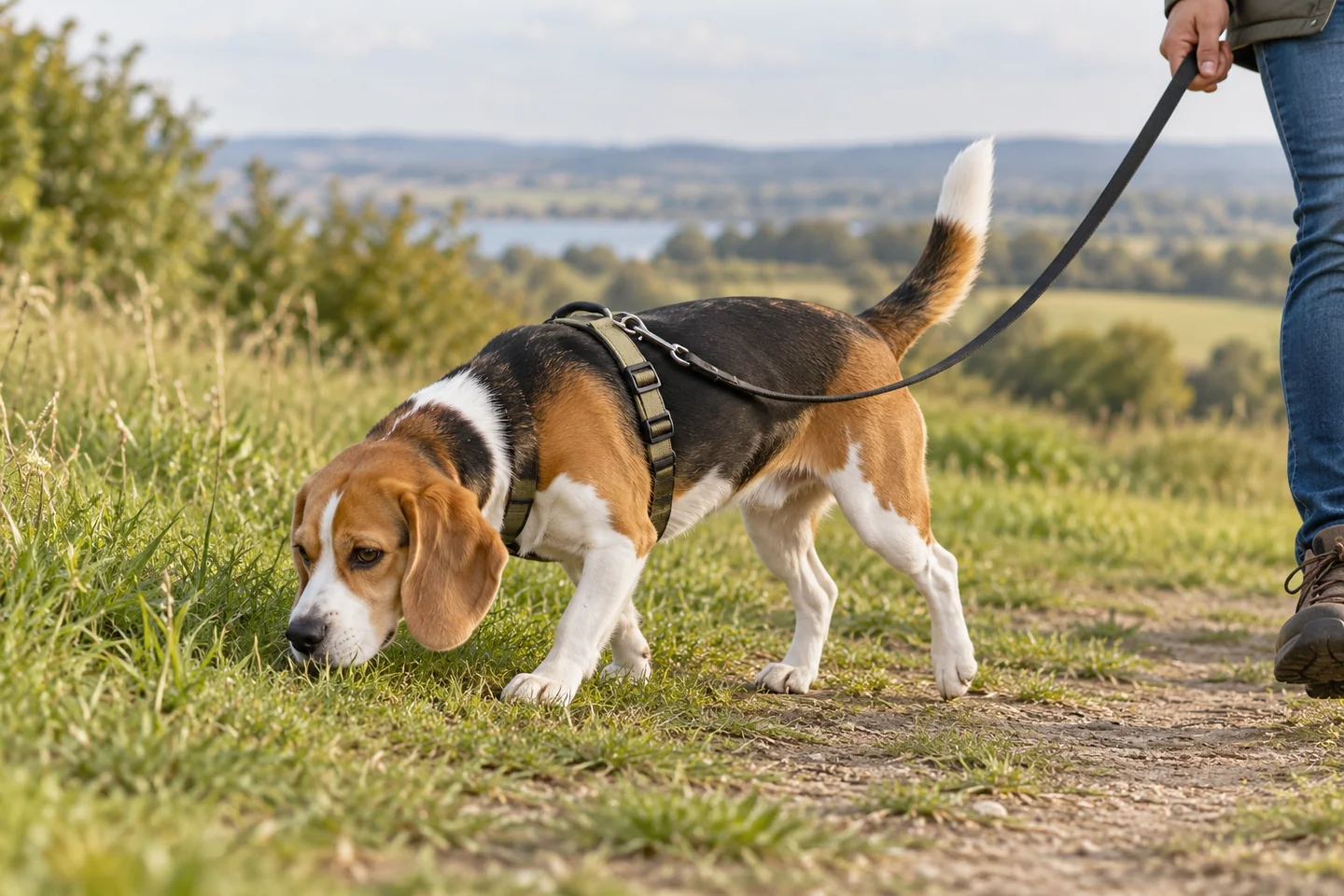
Exercise and scent enrichment
Offer regular walks with time to explore as well as opportunities for controlled play. The right amount depends on age, fitness, health, weather, and the demands of the activity. A slow scent walk and a fast run are different tasks, even when they take the same time. Avoid universal distance or minute formulas.
A simple home search can begin with a few pieces of normal food placed where the dog can find them easily. Use a safe surface and separate animals who compete over food. Increase difficulty through hiding places rather than making the dog frantic. Inspect enrichment equipment and remove anything the dog starts swallowing or breaking into hazardous pieces.
For growing puppies or dogs returning from illness, discuss activity with your veterinarian. Build new exercise gradually and watch recovery afterward. Restlessness can have several causes, including inadequate rest or distress, so more exertion is not always the answer. Leave room in the day for undisturbed sleep and calm time near the household.
Food management and healthy weight
Secure kitchen bins, picnic bags, children's lunchboxes, and medication. A Beagle may find food by scent before anyone notices that a bag is open. Use storage the dog cannot reach or manipulate. Make the arrangement easy for every household member to follow, including visitors who are unused to living with dogs.
Choose a complete diet for the dog's life stage and health needs. Measure portions consistently and include chews, training food, and table scraps when reviewing intake. Use weight trends and body condition with your veterinary team to adjust feeding. A pleading expression cannot tell you whether the day's nutritional needs have been met.
Avoid replacing veterinary assessment with repeated changes of food when appetite, weight, thirst, or stool changes. Bring a clear account of what the dog eats and may have scavenged. If you suspect poisoning or swallowing a dangerous object, contact a veterinarian promptly. Keep packaging where possible, but do not delay care to search for it or attempt to induce vomiting without instructions.
Grooming and comfortable handling
The short coat needs regular brushing and checks for skin changes, parasites, and sore areas. Long ears also deserve attention. Notice odor, discharge, head shaking, or pain rather than assuming an ear problem is a normal part of being a Beagle. Ask the clinic what care is appropriate for your dog.
Teach handling gradually. A brief ear look followed by a reward can be a better lesson than holding the dog still through a long inspection. Use the same approach for paws, nails, toothbrushing, and drying. If touching a particular area causes a new reaction, investigate discomfort before treating it as disobedience.
Discuss suitable bathing products and frequency with a groomer or veterinarian. Do not insert tools into the ear canal or keep applying products to a painful ear without a diagnosis. A dog who is comfortable being examined is easier to care for throughout its life, so allow time to build that cooperation before an urgent problem occurs.
Health screening before a puppy comes home
The National Beagle Club's health statement lists hip assessment, an eye examination, Musladin-Lueke syndrome testing, cardiac evaluation, and autoimmune thyroiditis evaluation among its CHIC requirements. It also lists optional recommended tests. Check the current statement and ask which results apply to the parents of the litter you are considering.
Request registered identities and results you can verify. A CHIC number records completion and publication of the scheme's requirements; it should not be read as a guarantee that every result is normal. Review the findings themselves. A general puppy examination and a DNA panel provide different information from orthopedic, eye, or cardiac evaluations.
Ask about health in the wider family and the support offered if a condition appears later. Screening cannot eliminate every illness or predict every puppy's future. For an adopted adult, gather available records and acknowledge any gaps. Your veterinarian can build a plan from the dog's current examination and known history rather than treating missing paperwork as evidence of good health.
Breed-specific conditions and changes worth reporting
Musladin-Lueke syndrome, usually shortened to MLS, is an inherited connective-tissue disorder described by the National Beagle Club. The club explains that DNA testing can inform breeding decisions. An owner's assessment of appearance cannot replace that information. Ask how the parents' results were interpreted for the proposed litter.
The club also identifies epilepsy, allergies, hypothyroidism, hip dysplasia, and back problems as concerns owners should know about. Those names are prompts for informed questions, not diagnoses for every symptom. A seizure, persistent itching, unusual weight change, or reluctance to move needs an individual assessment. Avoid starting supplements or altering prescribed medication on the basis of a breed list.
Beagles are among the breeds Cornell discusses in relation to intervertebral disc disease. New pain, weakness, or loss of coordination requires prompt veterinary contact, and inability to walk is urgent. Do not encourage a painful dog to run as a test. Ask the clinic how to handle and transport it while arranging an examination.
Beagle mixes and informal names
Puggle commonly describes a Beagle and Pug cross. Other crossbreed names vary between sellers and rescues. Ask what is documented about the parents. A label or a photograph cannot establish exact ancestry, especially for an adopted dog with an incomplete history.
A cross can inherit different combinations of coat, build, activity needs, and health risks. A Pug cross may still need assessment for short-muzzle breathing problems. A larger retriever cross may grow beyond the size a family expects from the Beagle name. Evaluate known parents and the actual dog rather than assuming a mixed puppy will average their features.
Request relevant health screening for both parents when they are known. Mixed ancestry does not guarantee freedom from inherited disease, low shedding, or compatibility with children. For an adult, focus on observed behavior, handling, medical findings, and the living arrangements it has managed successfully. Those details support a decision even when a precise breed percentage remains unavailable.
Housing, costs, and senior care
Before committing, check housing rules and consider the effect of vocal behavior on neighbors. A yard can offer useful space, but it does not replace walks or company. An apartment may work for an individual dog when care, access, and noise are managed. Think about the routine you can sustain on ordinary workdays.
Get local estimates for preventive care, food, training, sitting, and emergency treatment. Budget for secure equipment and changes to gates or fencing where needed. Ask insurers about terms before relying on a policy to cover future conditions. Avoid choosing a dog on purchase price alone when recurring care will continue for years.
As the dog ages, review footing, bedding, transport, and access to favorite resting places. New accidents, confusion, reduced activity, or irritability deserves assessment. Do not assume every change is unavoidable aging. Adapt games so the dog can still investigate and participate comfortably, with suitable rest and a care plan based on its current abilities.
Planning a dogsDating meeting
Tell another owner how your Beagle actually behaves. Include interest in food, tendency to follow scent, preferred play style, and any chasing or guarding history. Agree on a location with secure handling and enough space to move apart. Keep exact home coordinates private when arranging a first meeting.
A parallel walk can be a useful start. Allow sniffing without crowding, keep leads from tangling, and leave valuable food and toys out of the interaction if they create competition. Discuss recent illness and relevant veterinary precautions before meeting. Watch both dogs rather than assuming an earlier friendly greeting predicts the whole outing.
End the meeting if a dog repeatedly freezes, hides, pursues an unwilling companion, or tries to escape. A calm walk with occasional shared sniffing can be a successful result. Choose future company around the dog's responses and comfort. Friendship is easier to assess when both animals can leave an interaction and their owners are willing to respect that choice.
Sources and editorial notes
Sources checked October 21, 2026. Breed measurements describe reference ranges, not a diagnosis or an individual dog's ideal weight. Images are AI-generated breed illustrations and do not document a particular dog or health condition.
- American Kennel Club: Is the Beagle a good fit for you?
- Cornell University College of Veterinary Medicine: Chondrodystrophy and intervertebral disc disease
- VCA Animal Hospitals: Common emergencies in dogs
- VCA Animal Hospitals: General feeding guidelines for dogs
- VCA Animal Hospitals: Food aggression in puppies
- National Beagle Club of America: Health statement
- American Kennel Club: Beagle breed information
- VCA Animal Hospitals: Aggression toward unfamiliar dogs, diagnosis
- PetMD: Puggle health and care
- National Beagle Club of America: Screening tests
- AVSAB: Humane Dog Training Position Statement
Keep getting to know dogs.
Read another guide or return to your dogsDating community.
Explore breed guidesBack to dogsDating