Basset Fauve de Bretagne
A rough-coated fawn hound from Brittany whose care includes secure exploration, suitable conditioning, grooming, and identifiable screening records.
How these guides are researched and reviewed

- Origin
- Brittany, France
- Coat
- Harsh fawn coat
- Care priorities
- Scent, boundaries, movement, and screening
General information for owners. These articles have not been reviewed by a veterinarian. Medical decisions need your dog's history and an examination.
Choosing a Basset Fauve de Bretagne
A Basset Fauve de Bretagne needs an owner who enjoys an active little scent hound and can provide secure exploration, suitable company, and steady teaching. Its rough fawn coat and manageable size can make care seem simple before questions about noise, pursuit, and time alone have been answered. Consider your ordinary week, including where the dog will walk and rest. A garden is useful space, but access alone does not establish enough activity or a comfortable response to everything beyond the fence.
Ask about the individual dog's routine and recovery after excitement. Find out what happens when a visitor arrives, when another dog approaches, and when someone needs to inspect a foot. An adult living in a foster home can provide useful observations, while a puppy brings uncertainty even with known parents. Choose according to your household's time and resources rather than an expectation that a compact hound will be an effortless companion. Quiet days, travel, and later-life care belong in the decision from the start.
Brittany origins and breed identity
The name refers to a low fawn-colored hound from Brittany in France. Its established background involves scent work, including following game through countryside conditions. Avoid extending a broad regional history into a precise ancient pedigree for every modern dog. The practical connection to scent and activity is enough to inform an owner's questions about routes, boundaries, and voice. A working description can explain tendencies while leaving substantial variation in the experience and behavior of individual companions.
The Basset Fauve is distinct from the Griffon Fauve de Bretagne and from the smooth-coated Basset Hound or Basset Artésien Normand. These are separate breeds rather than grooming styles or color versions of one dog. Ask which registry issued a pedigree and what supports an identification when records are absent. A rough fawn coat does not confirm ancestry. A rescue's visual estimate can provide context when its uncertainty is visible, while observed needs remain the basis for care and household suitability.
Rough coat and a small functional hound
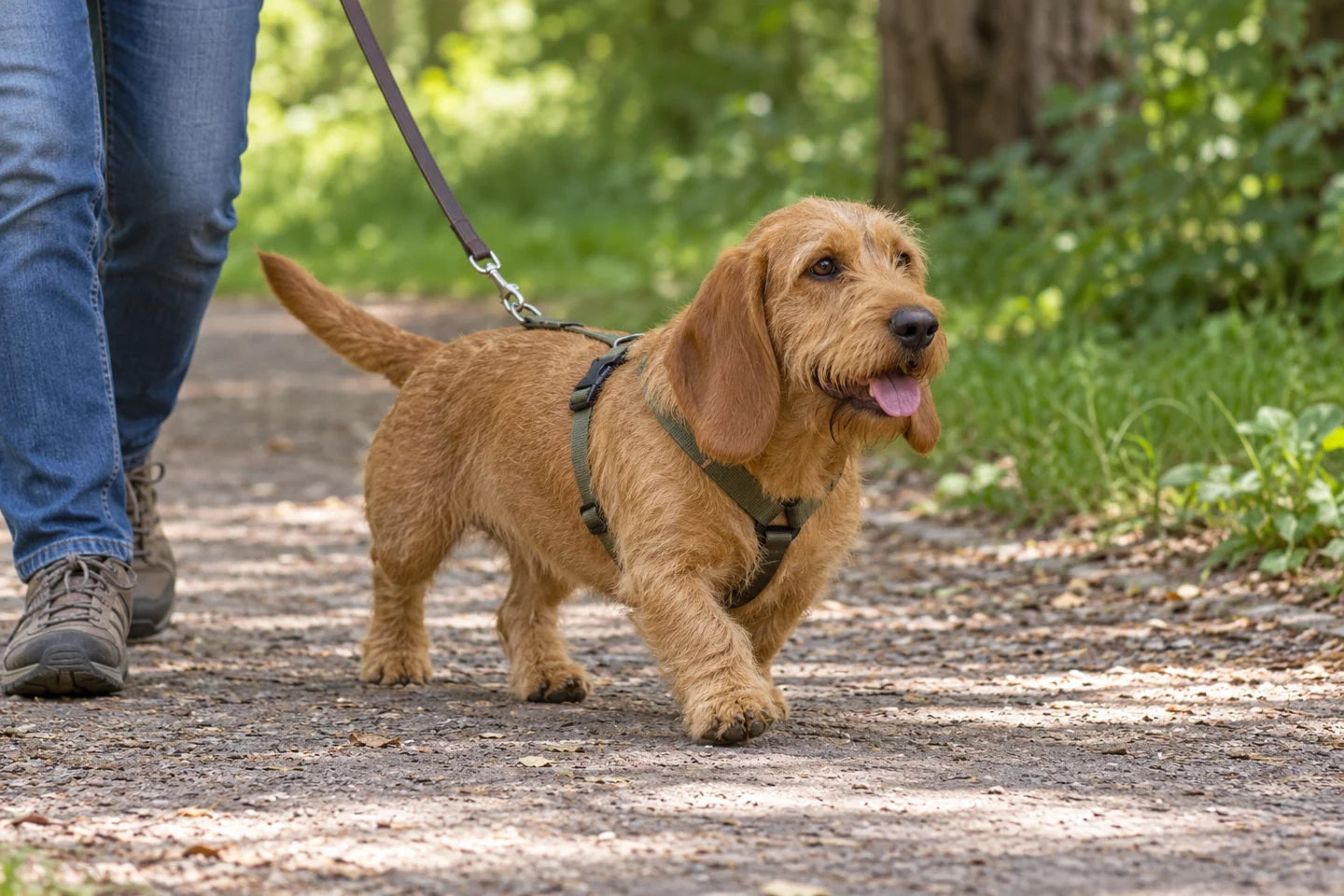
The breed has a low, sturdy outline with a harsh fawn coat, dropped ears, and a natural tail. The coat's practical texture differs from a soft decorative curl or a long silky coat. The illustrations are generated examples, not records of particular animals or evidence of ideal health. Look at the actual dog walking, turning, and rising comfortably. Ask about persistent stiffness or repeated limping rather than assuming any irregular movement is normal for a short-legged hound.
Fit equipment to the individual chest and shoulders, checking for rubbing beneath the rough coat. A puppy needs regular adjustments as it grows. Teach standing for a harness and waiting while doors open before an exciting outing makes those tasks difficult. Inspect stitching and clips and keep identification readable. Secure equipment supports safe exploration, but a predictable access routine reduces the number of moments that depend on an owner catching the dog after it has already noticed a trail outside.
A home arranged for comfortable movement
Examine floors, furniture access, and stairs. Slippery surfaces and repeated jumps can become difficult for a young, injured, or older dog. Provide grip and manage access according to the individual, without assuming that a low build requires permanent inactivity. Suitable daily movement matters. A dog following someone upstairs does not establish comfortable descent later when tired or excited, so observe both directions and ask for veterinary advice when movement changes.
Teach vehicle entry using an appropriate ramp or supported method before a medical problem makes it urgent. If lifting is necessary, ask a professional to demonstrate body support rather than pulling on the front end. Secure the dog during travel and practice waiting before doors open. Check access and fencing at holiday accommodation and boarding facilities. A general dog-friendly description does not tell you whether the physical layout or care routine fits a short-legged dog with individual mobility or handling needs.
Scent interest and safe walking
Practice a recall in enclosed surroundings and reward it well, retaining a lead where traffic, wildlife, or livestock create danger. A familiar response can be less reliable when the dog becomes deeply occupied by a trail. Avoid testing the limit with a risky release. A long line may provide room when managed carefully, with attention to sudden speed, terrain, and entanglement. Check that equipment remains secure if the dog reverses away from something unexpected.
Let appropriate sniffing be part of the walk. Teach a pause, a comfortable turn away, and attention to the handler in easy conditions before using them near distractions. Choose routes with enough room to move aside. If the dog cannot respond, simplify the setting instead of repeating louder commands. Identification and a microchip help after an escape while leaving the owner responsible for preventing it. Respect local access rules and prevent contact with stock rather than assuming a small hound cannot cause alarm or injury.
Gardens, gates, and digging
Inspect the boundary at ground level, including loose soil, gaps beneath gates, and weak panels. A small dog may reach places an owner overlooked while assessing a fence for a larger animal. Supervise first use of an unfamiliar enclosure and check rented fields before release. A tracker can add information after an escape but cannot prevent the dog reaching traffic or wildlife. Keep exterior doors managed during deliveries and agree a routine that every household member follows.
If digging is an interest, offer an appropriate place and protect unsafe areas physically. Store garden chemicals and tools securely. Teach exchanges for found objects rather than turning every discovery into a chase. A comfortable resting area can help during busy work or visitors, provided confinement is introduced gradually. Persistent escape attempts or distress at a barrier needs assessment. Strengthening the enclosure without investigating why the dog is struggling may leave a significant welfare problem unresolved.

Voice, company, and quiet periods
Ask when the actual dog vocalizes and how long recovery takes. Excitement, reacting at a fence, and distress during absences can require different responses. Neighbors sharing walls may find a hound's call difficult even when its owner enjoys the sound. Reduce repeated visual triggers and provide a quieter sleeping location. Practice a useful station or turn toward the handler during mild arrivals rather than trying to teach the entire routine while guests and deliveries are already waiting.
Build short comfortable absences gradually and observe what happens after departure. A recording can reveal pacing, persistent calling, or attempts to escape. Seek qualified help for distress instead of assuming another dog or more exercise will solve it. A newly adopted hound may also need teaching about appliances, indoor surfaces, and closed doors. Keep the arrival period predictable. Initial quietness can change as the dog settles, so allow time to understand its routine without treating the first few days as a complete assessment.
Children and a dog's right to leave
Children need active adult supervision with a Basset Fauve. Teach calm invitations and allow the dog to move away. Prevent hugging, climbing, ear pulling, and leaning over the face. Keep children out of sleeping areas and away from meals and chews. A child should call an adult when something is beside the dog rather than attempting to move it. A small body and sociable approach cannot establish tolerance for repeated unwanted handling or remove bite risk.
Use separation before energetic games if excitement or uncertainty makes supervision difficult. Visiting children need the same rules explained, and barriers help when adult attention is divided. Watch turning away, freezing, hiding, or repeated attempts to leave. A dog should not need to escalate warnings to obtain space. Review arrangements as children become mobile or the dog develops pain. Comfortable behavior with familiar family members does not promise tolerance of every crowded gathering, new game, or unfamiliar child.
Other dogs and small-animal safety
Begin unfamiliar dog meetings with parallel walking in a suitable neutral area and room to disengage. A hound that enjoys company may still prefer space around food, rest, or people. At home, separate bowls, chews, and sleeping areas while assessing comfort. Watch repeated blocking and pursuit, and interrupt when the other dog is trying to leave. Both animals should be able to pause. An enthusiastic pursuer's apparent enjoyment does not determine whether the interaction is comfortable for the recipient.
Cats need gradual introductions and escape routes the dog cannot follow. Familiarity with one household cat does not establish safety with a running stranger outdoors. Rabbits, rodents, and similar pets require secure protection rather than a test of intentions. Stop access if stalking, fixation, or chasing occurs and obtain advice. Sociability with people provides little information about prey-related responses. A mixed-animal household needs reliable separation while assessing the individual, and should acknowledge a mismatch when that separation cannot be maintained safely.
Aggression, fear, and resource concerns
Stiffness, freezing, growling, snapping, or efforts to retreat indicate that pressure should stop. Create space and review what preceded the response. Handling discomfort, fear, and resources can all matter. Avoid cornering the dog or repeatedly taking a valued object to establish control. A breed description about friendliness cannot decide the safety of a particular encounter. Practical barriers and separate resources can prevent another person or animal being placed in the same unresolved situation while help is arranged.
A sudden change in tolerance warrants veterinary examination. Pain may influence behavior before obvious loss of activity. Keep an incident record and consult a veterinary behaviorist or qualified reward-based professional for recurring problems. Punishing warnings can obscure risk while leaving the concern unresolved. A basket muzzle introduced gradually with rewards may add protection within an appropriate plan, alongside treatment and management. It cannot make unwanted handling comfortable or replace the dog's opportunity to maintain distance and leave contact.
Exercise, conditioning, and recovery
Provide daily movement appropriate to age, health, and fitness. A small low hound can need meaningful activity, while long distances and demanding terrain should be built gradually. Let sniffing and simple searches add interest rather than forcing the dog to match faster companions continuously. Puppies need appropriate movement and sleep, with repeated high-impact exercise discussed with their veterinarian. An eager dog may keep going despite fatigue, so observe gait and recovery instead of relying only on willingness to continue.
Persistent limping, reluctance to rise, or unusually slow recovery needs assessment. In heat, shorten outings and provide shade and drinking water. Collapse or severe breathing difficulty requires urgent advice. Inspect paws and skin after vegetation, removing loose debris carefully and seeking help for embedded material or painful swelling. A working reputation can guide preparation without becoming a reason to dismiss discomfort. Quiet days can include manageable walks and learning tasks without frantic indoor play that makes settled rest harder afterward.
Grooming a harsh outdoor coat
Brush and check the rough coat regularly, paying attention where equipment rests and where vegetation can collect. Ask a groomer familiar with the texture how to maintain a practical companion coat. Show preparation and ordinary comfort may involve different choices. Bathe when needed with suitable products and dry comfortably. A weather-resistant description does not establish that skin beneath the coat is healthy or that wet equipment can remain in place without checking for irritation.
Inspect ears for odor, discharge, redness, head shaking, or pain and seek veterinary advice when those signs appear. Avoid deep insertion of objects or reused medication. Teach tooth brushing, nail care, and foot checks through brief rewarded steps. Stop to investigate new sensitivity rather than increasing restraint to finish. Tell professionals about handling concerns before an appointment. Cooperative care can improve ordinary maintenance and medical assessment, while needed treatment should not wait until the dog has mastered every home training exercise.
Health screening and interpreting records
The AKC lists patellar, cardiac, and ophthalmologist evaluations among national club recommendations for the Basset Fauve. Request actual reports linked to identifiable parents and read dates, methods, and findings. A routine puppy visit answers different questions from formal screening. Ask how the breeder's program fits current club guidance and relevant family illness. A statement that the dogs work well or have never seemed unwell is insufficient detail for understanding what was assessed.
A CHIC number records completion and disclosure of specified testing, not a guarantee that every result was normal. DNA panels cover selected variants and cannot exclude all inherited or acquired conditions. New eye pain, movement changes, persistent skin problems, or altered behavior needs investigation regardless of prior screening. For an adopted adult with missing records, state the gaps and make a preventive plan from current findings. Avoid presenting unsupported prevalence figures or assuming that the absence of a long disease list proves the breed has no medical concerns.
Feeding and a suitable body condition
Use a complete diet suited to life stage and health, measure portions, and include training rewards in the daily allowance. Adjust using weight trends and body condition. Ask the veterinarian to demonstrate assessment of ribs, waist, and muscle rather than judging only through the rough coat. A sturdy dog should not accumulate excess body fat because a heavier outline appears familiar. Unexplained weight loss also deserves assessment, even when the dog remains keen to investigate and play.
Feed away from children and other animals and teach exchanges without repeatedly removing bowls. Secure rubbish, medications, and unsafe foods. Avoid supplements without a veterinary reason, especially alongside a complete growth diet. Home-prepared meals need qualified nutritional guidance. Review intake during injury, quiet seasons, and ageing. Persistent digestive changes, altered thirst, or appetite loss needs advice rather than repeated unplanned food switches. Make sure backup carers understand any prescribed diet and know which changes should be reported promptly.
Mixes, lifetime planning, and dogsDating
A Basset Fauve mix can vary in coat, outline, voice, and pursuit behavior. A rough fawn coat cannot confirm a particular cross. Ask what ancestry is documented and assess observed needs. Budget for suitable equipment, preventive care, grooming help, training, emergency treatment, and backup care. Practice a short stay with a trusted carer and leave written routines. In later years, review flooring, transport, bedding, and recovery so pain receives assessment rather than being labeled stubbornness or ordinary ageing without examination.
For dogsDating, describe individual experience and preferred distance while keeping exact home coordinates private. Choose a quiet public route for parallel walking with separate capable adult handlers and a suitable pace. Leave shared toys and food out of the first meeting. Increase space or end if either dog stiffens, becomes overwhelmed, or is persistently pursued. A calm walk can be useful without physical greeting. It does not establish readiness to share a home, vehicle, or valued resource without further assessment.
Sources and editorial notes
Sources checked October 21, 2026. Breed measurements describe reference ranges, not a diagnosis or an individual dog's ideal weight. Images are AI-generated breed illustrations and do not document a particular dog or health condition.
- VCA Animal Hospitals: Hypoallergenic dog breeds
- Orthopedic Foundation for Animals: CHIC program and interpretation of numbers
- VCA Animal Hospitals: Ear infections in dogs
- VCA Animal Hospitals: General feeding guidelines for dogs
- VCA Animal Hospitals: Food aggression in puppies
- American Kennel Club: Relevant national breed-club health testing recommendations
- VCA Animal Hospitals: Heat stroke in dogs
- American Kennel Club: Basset Fauve de Bretagne breed identity and care
- VCA Animal Hospitals: Aggression toward unfamiliar dogs, diagnosis
- AVSAB: Humane Dog Training Position Statement
Keep getting to know dogs.
Read another guide or return to your dogsDating community.
Explore breed guidesBack to dogsDating