Beagle-Harrier
A distinct French scent hound whose care includes secure exploration, realistic noise and company planning, suitable conditioning, and careful interpretation of health evidence.
How these guides are researched and reviewed

- Origin
- France
- Identity
- Distinct from Beagle and Harrier
- Care priorities
- Scent, voice, company, and secure boundaries
General information for owners. These articles have not been reviewed by a veterinarian. Medical decisions need your dog's history and an examination.
A Beagle-Harrier in a companion household
A Beagle-Harrier needs secure scent exploration, suitable activity, company, and an owner prepared to teach calm household routines. The name can suggest a convenient compromise between two familiar hounds, but it identifies a distinct breed rather than a guaranteed middle setting for behavior. Consider your walking routes, working hours, neighbors, and ability to manage gates. A dog that follows trails enthusiastically still needs rest, veterinary care, and human attention on days when a long countryside outing is impossible.
Ask about the individual dog's actual routine. A hound raised with other dogs or mainly in a kennel may need help learning indoor sounds, toilet habits, and short absences. An adult in foster care can provide useful observations about those transitions. A puppy brings uncertainty even with known family records. Choose according to the care your household can maintain over time rather than a promise that a sociable working background guarantees comfort with every person, animal, or public setting.
French breed identity and a misleading name
The FCI identifies the Beagle-Harrier as a French scent hound with its own standard. It is separate from the Beagle and Harrier, even though the name reflects a historical relationship between those types. A contemporary first-generation cross advertised under the same words is a different ancestry claim. Ask which registry issued the pedigree and how the source uses the name. Clear documentation prevents an owner comparing health records and expectations for dogs whose breeding contexts differ.
Avoid turning a broad development story into a precise family tree without evidence. Recent information about the parents' work, health, and household behavior is usually more useful for placement. A tricolor coat and dropped ears cannot establish breed identity in a rescue dog. Where identification relies on appearance, keep the uncertainty visible and assess the individual. A plausible label can add context while leaving the most important questions about care, compatibility, and future health unanswered.
Proportions, coat, and athletic condition
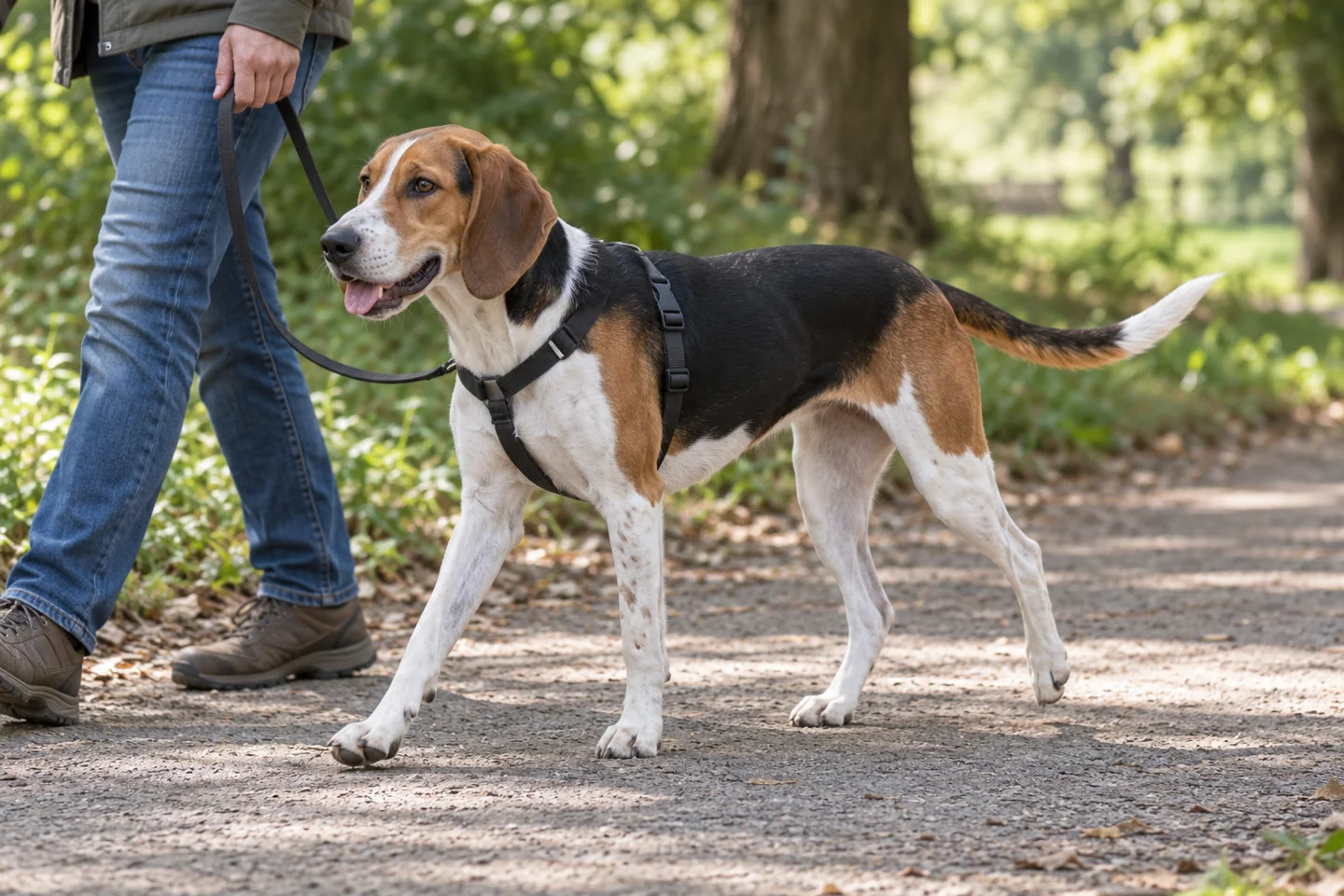
The breed has a medium, balanced hound outline, relatively long legs, dropped ears, and a short coat. Tricolor markings are familiar within the standard. The illustrations show generated examples rather than particular documented animals or medical reference images. A dog that looks like a larger Beagle may still have uncertain ancestry. Assess a real animal through movement and examination, including comfortable walking, turning, rising, and recovery after ordinary activity, instead of selecting primarily for a familiar facial pattern.
Ask about persistent stiffness, an uneven gait, or reluctance to be touched. An eager response to a trail cannot rule out discomfort elsewhere. Fit equipment to the actual chest and shoulders and check that it remains secure if the dog reverses away. A puppy needs repeated adjustment during growth. Teach standing for fitting and waiting at doors before a busy outing adds pressure. Reliable clips, readable identification, and a predictable access routine reduce the risk of a sudden move toward scent becoming an escape.
Scent-led walks and physical safeguards
Practice recall in enclosed surroundings and reward it well, retaining a lead where traffic, wildlife, or livestock create danger. A response at home does not establish reliability on a fresh trail. Avoid discovering the limit through a risky release. A long line may provide room when managed carefully, with attention to speed, footing, and entanglement. It should support exploration rather than stop a fast dog abruptly at full extension or allow it to reach animals beyond the handler's control.
Teach a comfortable turn away, a brief pause, and checking in with the handler in easy conditions. Let suitable sniffing form part of the outing instead of requiring continuous close marching. Choose routes with room to move aside. If the dog cannot respond, change distance or difficulty rather than repeating louder commands. Identification, a microchip, and a tracker can assist after an escape while leaving secure boundaries and attached equipment responsible for preventing the initial danger to the dog and others.
Gardens, gates, and responsible countryside access
Inspect ground-level gaps, loose panels, and gates before allowing free garden access. A rented exercise field also needs checking, including adjacent animals and whether latches work securely. Attach the lead before opening an exterior door and agree the same routine across the household. Do not assume a dog will remain nearby because it has just arrived or appears tired. A new environment can create opportunities to follow scent that the owner has not yet noticed.
Respect local path rules and prevent contact with stock or wildlife. A right of access does not mean the dog can pursue animals or leave the route. Choose another path when safe distance cannot be maintained. At home, secure rubbish, medications, unsafe foods, and objects the dog might swallow. Provide appropriate outlets and teach exchanges rather than turning every discovery into a chase. Persistent attempts to escape confinement need assessment of distress as well as inspection of the physical barrier.
Voice and adapting from pack life
Ask when this dog calls and what happens after familiar company leaves. A working voice may be useful in one context and difficult for neighbors sharing walls. Excitement, fence reactions, and separation-related distress can need different responses. Reduce repeated visual triggers and provide a quieter resting location. Practice a useful station during mild arrivals before trying the whole routine while guests or deliveries are waiting. Shouting over a hound does not identify the underlying need or explain an alternative behavior.
Build short comfortable absences gradually and observe what happens after departure. A recording can reveal pacing, sustained calling, or escape attempts that are less obvious at the moment of reunion. Seek qualified help for distress rather than assuming another dog or more exercise will solve it. A newly adopted adult may need gradual learning about indoor flooring, appliances, and closed doors. Keep early demands manageable, because initial quietness can reflect adjustment rather than a complete picture of settled household behavior.

Children and safe everyday contact
Children need active adult supervision with a Beagle-Harrier. Excited greetings and sudden movement can knock over a small child. Teach calm invitations and let the dog leave contact. Prevent hugging, climbing, pulling ears, and leaning over the face. Keep children away from sleeping places, meals, and chews. They should call an adult when something is beside the dog rather than trying to move it. A friendly approach does not establish tolerance of repeated unwanted touch.
Visiting children bring different noise and movement from the usual routine. Use separation before energetic games if adult attention will be divided, and provide a retreat children cannot enter. Watch freezing, turning away, hiding, or repeated efforts to leave. A dog should not need to escalate warnings to obtain space. Review arrangements when children become mobile or health changes. Comfortable behavior with one familiar child cannot guarantee tolerance of every crowded gathering, unfamiliar visitor, or sudden attempt to touch a tired animal.
Dogs, cats, and resources in a shared home
Pack experience can provide social history without guaranteeing compatibility with every unfamiliar dog. Begin introductions with parallel walking on suitable neutral ground and room to disengage. At home, separate bowls, chews, and rest areas while observing comfort. Monitor doorways and access to people, where repeated blocking can create tension. Both dogs should be able to pause and leave. An enthusiastic pursuer's apparent enjoyment does not decide whether the other dog welcomes the interaction or needs protection from it.
Cats need gradual introductions and dog-free escape routes. Familiarity with one household cat does not establish safety with an unfamiliar animal running outdoors. Rabbits and similar pets require secure protection rather than an informal test of intentions. Stop access if stalking, fixation, or chasing appears and obtain qualified advice. Sociability toward people provides little information about prey-related responses. A household needs reliable separation while assessing the individual, and should acknowledge when resident animals and the dog's needs cannot be accommodated safely together.
Aggression and meaningful warnings
Stiffness, freezing, growling, snapping, or attempts to retreat mean pressure should stop. Increase space and review what happened beforehand, including food, rest, handling, and access to an exit. Avoid cornering the dog or repeatedly removing a valued object to prove authority. A breed description about sociability cannot determine safety in a specific encounter. Practical barriers and separate resources can prevent another person or animal being placed in the same unresolved situation while the owner seeks an assessment.
New irritability or sensitivity during touch warrants veterinary examination. Pain and sensory changes can affect behavior before the dog stops enjoying walks. Record recurring incidents and consult a veterinary behaviorist or qualified reward-based professional. Punishing warnings can obscure risk while leaving fear or discomfort unresolved. A basket muzzle introduced gradually with rewards may add protection within an appropriate plan, alongside management and treatment. It cannot make unwanted contact comfortable or replace the dog's opportunity to maintain distance and leave.
Training a useful household routine
Reward attention to a name, a hand target, waiting at doors, and releasing objects through an exchange. Begin in quiet surroundings and add difficulty gradually. Food, appropriate games, and access to a suitable sniff can all be meaningful rewards. A delayed response may reflect unclear instruction, weak motivation, or an overwhelming setting rather than a desire to oppose the owner. Short sessions make it easier to notice progress and stop while both dog and handler remain patient.
Teach standing for equipment, brief foot inspection, and settling while people prepare food. Consistent cues and access rules across carers help the dog understand what works. Reward-based coaching can improve timing and equipment use without repeated lead jerks or forced positions. Skills learned at home need gradual practice elsewhere, and safeguards remain necessary near hazards. An elaborate trick in a quiet room is less useful than comfortable cooperation during travel, veterinary care, and an ordinary visitor arrival.
Exercise, conditioning, and an off switch
Provide daily movement matched to age, health, and fitness. Walks with time to investigate, simple searches, and controlled games can create variety without repeated maximum-speed effort. Build endurance before long hikes or demanding sports. Puppies need suitable activity and sleep, with repeated high-impact exercise discussed with their veterinarian. A garden supplements the plan but does not show whether the dog moves usefully or spends its time reacting at the fence and waiting for people.
Observe gait after activity and after rest. Persistent limping, reluctance to rise, or slow recovery needs assessment. In heat, shorten outings and provide shade and water; collapse or severe breathing difficulty requires urgent advice. Teach a predictable end to games and offer a comfortable resting area. More exercise may build fitness without resolving anxiety or constant anticipation. Quiet days should remain manageable through suitable walks and learning rather than frantic indoor activity intended to compensate for every missed countryside trip.
Grooming, ears, and body checks
Brush the short coat regularly and inspect skin beneath equipment. A tidy outer appearance can hide parasites, scratches, or irritation. Bathe when necessary with suitable products and dry comfortably. Dropped ears need observation for odor, discharge, redness, head shaking, or pain. Ask the veterinarian whether cleaning is appropriate and which method suits the individual. Avoid deep insertion of objects or reused medication, because similar signs do not establish that every ear problem has the same cause.
Teach tooth brushing, nail care, and gentle handling through brief rewarded steps. Stop to investigate a new objection to familiar touch rather than increasing restraint to finish. Tell professionals about handling concerns before an appointment so the visit can be planned. Check feet after rough vegetation and seek help for embedded material, painful swelling, or wounds. Cooperative care can improve maintenance and assessment, while necessary treatment should not wait for perfect home training or a complete examination by the owner.
Health evidence and records worth reading
The FCI standard describes breed identity and structure rather than a population-wide health survey. Reliable prevalence figures and a universal international screening checklist may be limited for this less common hound. Ask what the breeder actually evaluates, what significant illness occurred in relatives, and which identifiable reports are available. Avoid accepting a promise that the breed has no inherited problems or an unsupported list of percentages copied from a general website. A working reputation cannot establish an individual's future health.
Discuss relevant joint, eye, hearing, and family concerns with the veterinarian. A routine examination, formal imaging, specialist assessment, and DNA panel answer different questions. Selected genetic variants cannot exclude every inherited or acquired condition. Read identities, dates, methods, and findings. For an adopted adult with missing records, state the gaps and make a preventive plan from current examination. New symptoms need investigation regardless of prior screening, alongside ordinary care for vaccination, parasites, teeth, and risks associated with travel or countryside activity.
Food, mixes, and choosing a source
Use a complete diet appropriate to age and health, measure portions, and count training rewards within the allowance. Adjust using body condition and actual activity rather than the breed's job title. Feed separately from children and other animals and teach exchanges without confrontation. Avoid supplements without a veterinary reason and seek qualified guidance for home-prepared meals. Persistent changes in appetite, thirst, weight, or digestion need assessment rather than repeated unplanned food switches or an assumption that an energetic dog cannot be unwell.
A Beagle-Harrier mix can vary in size, coat, voice, and scent interest. Clarify whether a source describes a registered Beagle-Harrier, a recent Beagle and Harrier cross, or a visual guess. DNA ancestry information can add context without predicting every trait or excluding disease. Ask about visitors, absences, cats, travel, and handling, as well as family records and early experiences. A candid source explains limitations and support after placement rather than promising universal suitability from a combination of familiar breed names.
Costs, later years, and dogsDating
Budget for suitable equipment, food, preventive care, training support, emergency treatment, and backup care. Practice a short stay with a trusted carer and leave written routines and veterinary contacts. In later life, review footing, bedding, transport access, and recovery after activity. New reluctance to rise or sensitivity during handling can indicate pain. Know where urgent care is available for collapse, major injury, severe breathing trouble, or rapidly worsening illness and how the dog would travel securely if it could not walk.
For dogsDating, describe individual experience and preferred distance while keeping exact home coordinates private. Choose a quiet public route for parallel walking with separate capable adult handlers. Leave shared food and toys out of the first outing. Increase space or end if either dog stiffens, becomes overwhelmed, or is persistently pursued. A calm walk can be useful without physical greeting. It does not establish that the dogs can share a home, vehicle, or valued resource without a separate assessment and suitable management.
Sources and editorial notes
Sources checked October 21, 2026. Breed measurements describe reference ranges, not a diagnosis or an individual dog's ideal weight. Images are AI-generated breed illustrations and do not document a particular dog or health condition.
- VCA Animal Hospitals: Hypoallergenic dog breeds
- VCA Animal Hospitals: Ear infections in dogs
- VCA Animal Hospitals: Food aggression in puppies
- Orthopedic Foundation for Animals: Disease screening information
- VCA Animal Hospitals: Heat stroke in dogs
- Fédération Cynologique Internationale: Beagle-Harrier official breed standard
- VCA Animal Hospitals: Aggression toward unfamiliar dogs, diagnosis
- AVSAB: Humane Dog Training Position Statement
Keep getting to know dogs.
Read another guide or return to your dogsDating community.
Explore breed guidesBack to dogsDating