Cesky Fousek
A Czech versatile pointing dog whose outdoor interests need trained cooperation, realistic activity, and careful coat and field care.
How these guides are researched and reviewed
- Origin
- Czech Republic, formerly Czechoslovakia
- Appearance illustrated
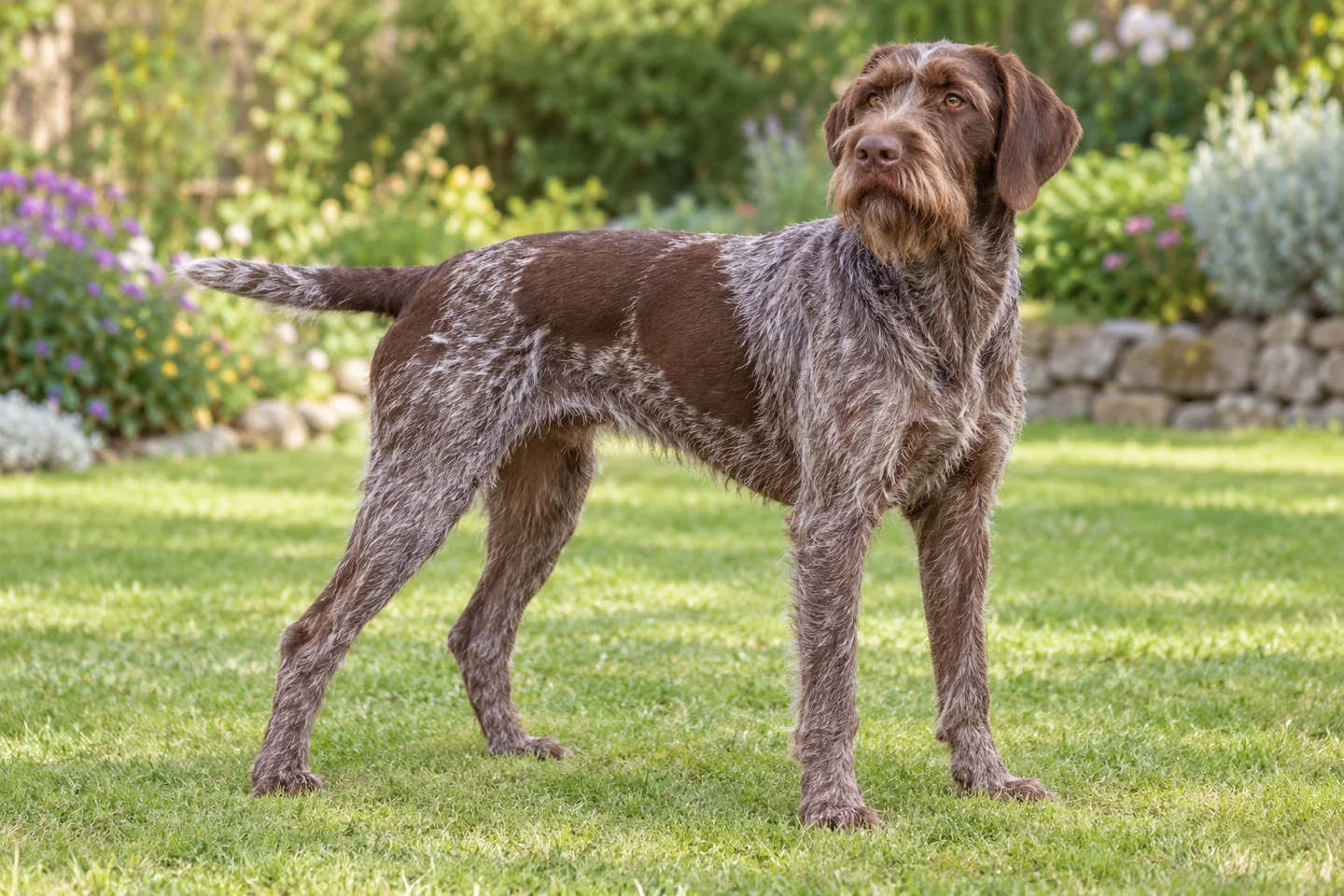
- Dark brown roan with brown patches, wiry beard and brows, natural hanging ears and full tail
- Adult size reference
- FCI males 60–66 cm and 28–34 kg; females 58–62 cm and 22–28 kg
General information for owners. These articles have not been reviewed by a veterinarian. Medical decisions need your dog's history and an examination.
An active pointing dog needs a realistic week
A Cesky Fousek suits a person who wants to work with a dog outdoors and can also teach it how to relax inside. Consider the wet weekday when there is no trip to the countryside. The dog still needs suitable movement, opportunities to investigate, and patient instruction. A long weekend outing cannot organize the rest of its week. Write down who will provide those activities and what happens if that person is unavailable.
This breed is also called the Bohemian Wire-Haired Pointing Griffon. It should not be confused with the much smaller Cesky Terrier. The beard can attract attention, but the more important choice is whether a pointing dog's interests fit the household. Ask to meet mature relatives or an adult with a known history. Watch how the dog moves between activity and rest, how it responds when an outing ends, and what its owner does around wildlife. Those ordinary observations give you a better starting point than a promise that an intelligent dog will be easy to keep occupied.
Czech identity and a recovered breeding population
The FCI identifies the origin as the former Czechoslovakia, now the Czech Republic, and places the breed among continental pointing dogs. Its historical account describes a severe decline associated with the First World War and subsequent regeneration using surviving representative dogs. The standard presents a versatile field, woodland, and water worker. Those roles explain the relevance of scent, retrieving, and close cooperation with a handler.
They do not mean every individual arrives knowing how to work safely or appropriately. Ask what the family has been bred and prepared to do, and how a breeder evaluates prospects for a companion home. A puppy raised around kennels, fields, and working equipment may need deliberate preparation for traffic, household appliances, and quiet time alone. Conversely, a household puppy still needs suitable outlets for investigation and movement. Be clear about your intentions before agreeing to a placement. If the source expects formal work or testing, discuss that commitment explicitly rather than assuming the dog can simply become a pet without changes to its routine.
Numeric adult references and the wirehaired outline
The FCI height ranges are 60 to 66 centimeters for males and 58 to 62 for females. Its weight ranges are 28 to 34 kilograms for males and 22 to 28 for females. These describe standard adults. A puppy's appropriate growth and an adult's healthy condition need individual assessment rather than feeding toward the upper end of a range.
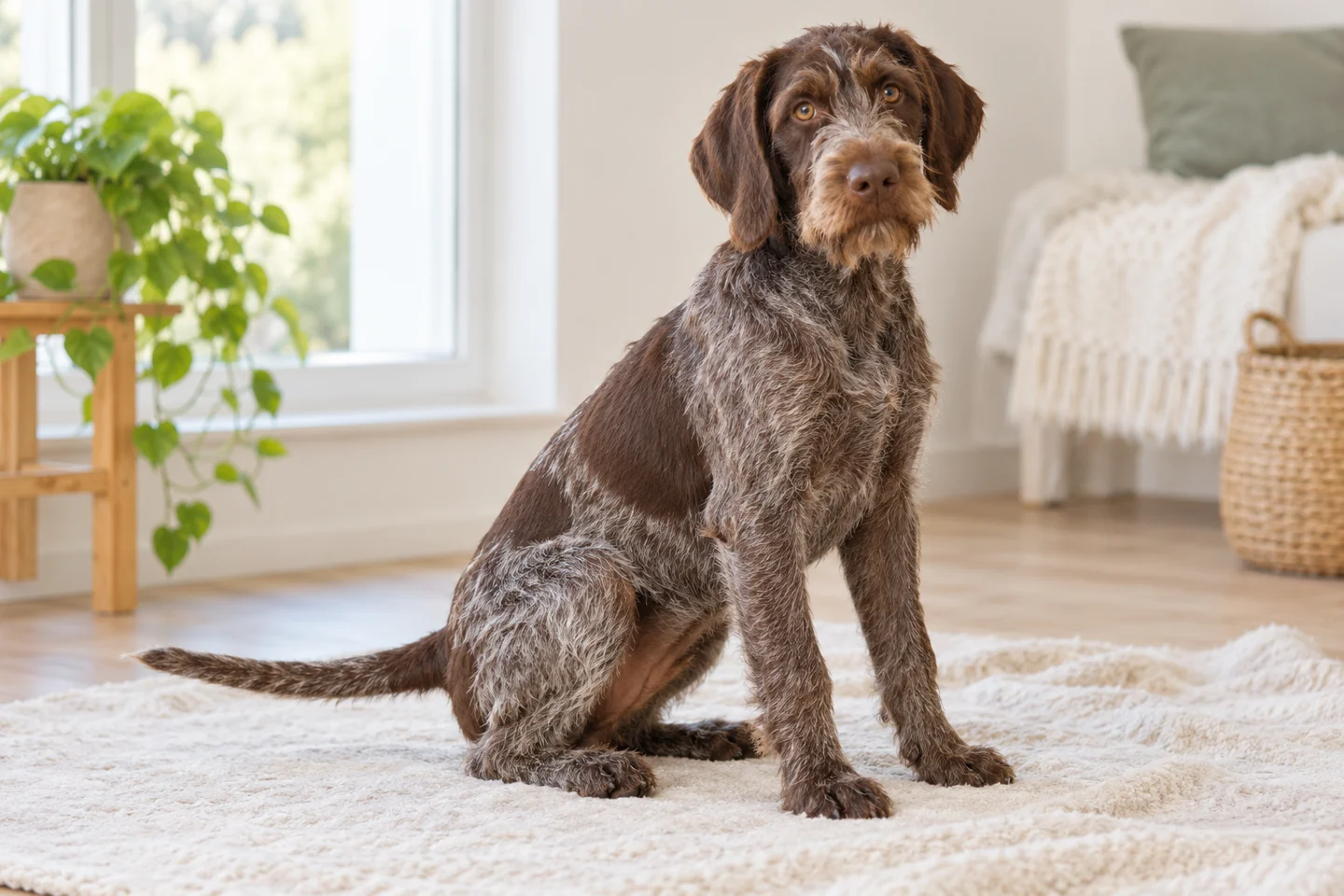
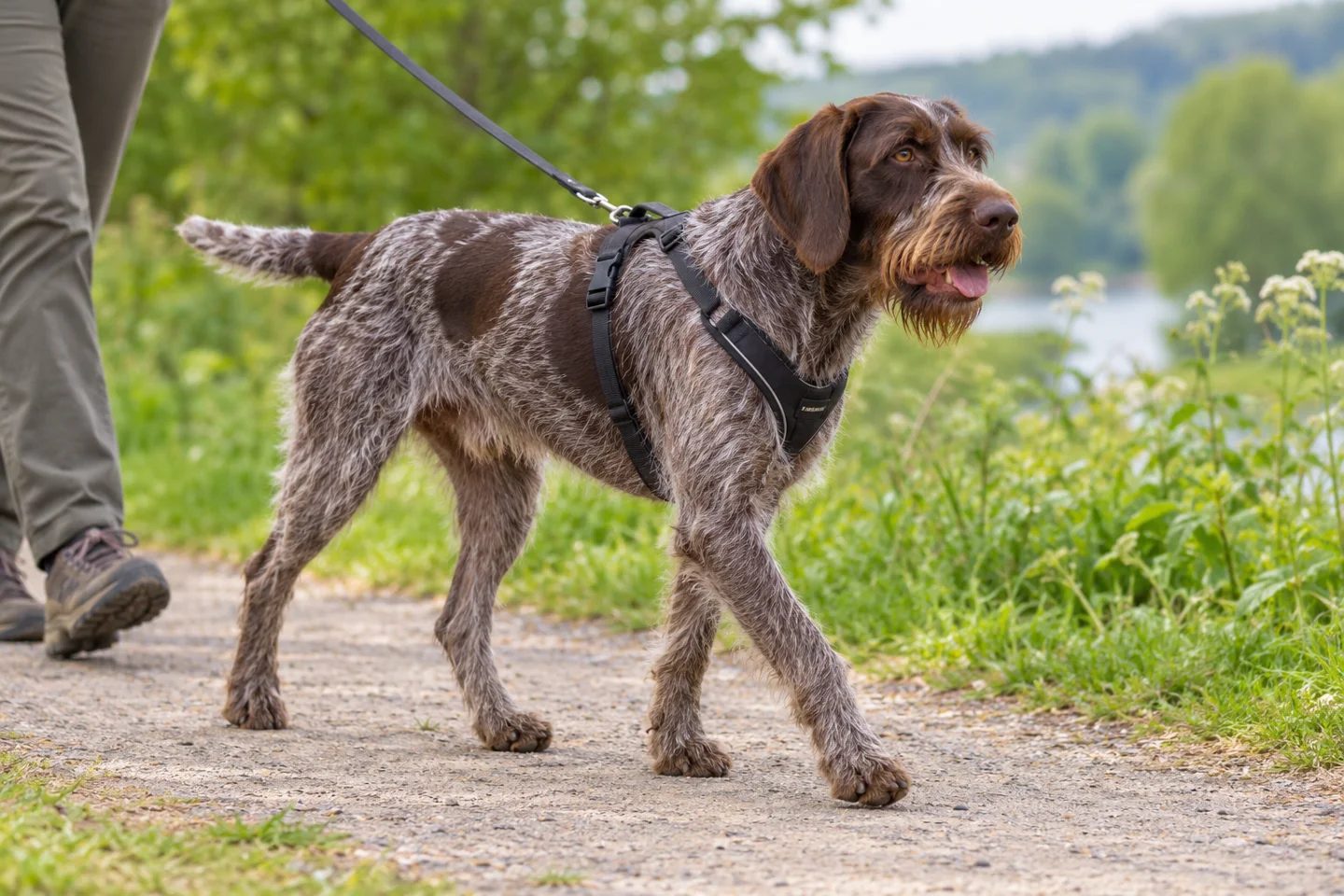
The images show dark roan with brown patches, a wiry coat, characteristic beard and raised eyebrow hair, natural hanging ears, and a full undocked tail. The standard also permits brown with specified ticking or solid brown. Color cannot establish quality or health. In person, observe the dog from several angles as it walks and turns. A heavily furnished face can make expression harder to read, so notice the whole body and ask the owner how it signals uncertainty. Choose walking equipment that sits securely without rubbing the armpits or compressing the coat. The illustrated appearance is one example within the breed, rather than a checklist for identifying an unknown dog by sight.
Training a return that survives interesting smells
Teach recall as a rewarded action before relying on it near wildlife. Begin in an enclosed quiet place, call once when success is likely, and reward the dog when it arrives. Occasionally release it back to a safe activity so returning does not always end the outing. Practice changing direction and checking in with the handler as separate skills. They can help you turn away before a distraction becomes overwhelming.
A long line may support practice in an appropriate open area, with careful handling and suitable equipment. It must not be left where it can catch on obstacles or entangle animals. Avoid releasing a dog in an unfenced area simply to find out whether its recall has improved. Progress depends on repeated evidence in comparable settings. A response in the garden says little about a sudden flush of birds. If the dog becomes absorbed in scent, increase distance from the source and make the task simpler. Reward based teaching provides a route back to cooperation without turning the handler's approach into something the dog wants to avoid.
Retrieving games need a beginning and an ending
A retrieve can become part of a useful routine when the dog understands how to take, carry, and release an appropriate object. Start in a space with few distractions and use an item that is safe for the individual's size and chewing habits. Reward a voluntary exchange. Keep the number of repetitions modest while the dog learns the sequence, and finish before fatigue or frustration changes the quality of the movement.
Do not chase a puppy that has picked up a shoe or force its jaws open during an ordinary training disagreement. Prevent access to unsuitable items and practice exchanges with safe ones. Seek veterinary help promptly if an object may have been swallowed or lodged in the mouth. Around other dogs, remove retrieve toys until you know how each responds to competition. Even compatible walking companions may argue over a valued object. An ending cue and a quiet activity afterwards help distinguish a short training game from an expectation of continuous throwing. The handler should decide when an activity is complete without needing to wrestle the object away.
Socialization for travel, waiting, and wet equipment
Prepare the puppy for the experiences that accompany outdoor life. These include entering a vehicle, standing while a lead is changed, hearing a distant trolley, and resting while someone removes muddy boots. Introduce one element at a time and keep the experience manageable. Your veterinarian can advise on infection precautions while a young dog learns about the wider environment.
A dog destined for rural outings also benefits from quiet exposure to ordinary town life. Observe a bicycle from a comfortable distance, walk near a stationary car before approaching traffic, and reward attention to the handler. People need not reach into the beard or lean over the dog to make the experience count. Include brief separations and comfortable rest in a suitable area at home. Gradual preparation is especially useful before the first overnight trip, boarding stay, or visit to a busy veterinary clinic. A single exhausting day full of novelty can leave you with little information about which element was difficult. Short, repeatable experiences make both progress and problems easier to recognize.
Exercise over land and near water
Choose activity that matches condition and experience. An adult accustomed to regular work may enjoy varied terrain and search exercises; a growing puppy needs a gentler progression with room to stop. Discuss sustained running, repetitive jumping, and demanding terrain with your veterinarian before building them into a routine. Observe how the dog gets up later in the day as well as how eagerly it started the outing.
Water requires its own assessment. Working history does not prove that an individual can swim confidently, manage a current, or find a safe exit. Inspect access and conditions first, keep control where necessary, and avoid sending a dog into an unknown waterway. Cold, debris, steep banks, and other users can change the decision. Ask a suitably qualified professional about preparation for any planned water activity. After wet outings, dry and inspect the dog, including feet and ears. In hot conditions, shorten activity and provide water and shade. Weakness, confusion, collapse, or breathing distress needs urgent veterinary advice. A sensible outing leaves a comfortable dog able to recover afterwards.
Wildlife, cats, and farm animals need protection
A pointing dog's interest in movement and scent requires active management. Keep leads and enclosures suitable for the place rather than assuming a calm household dog will ignore an unexpected rabbit. Choose routes that respect nesting birds, livestock, and other people's animals. Ask land managers about access and keep enough distance that the dog cannot pressure animals through a fence.
If cats share the home, prepare protected spaces and routes above or beyond the dog's reach. Introduce sight and scent gradually under supervision, and prevent pursuit from becoming a practiced activity. A cat remaining still during one meeting does not establish safety when it later runs across a room. Poultry and small mammals need secure physical separation. Do not use them to test how much hunting interest the dog has. An owner planning formal field work should learn from experienced instructors who use humane preparation and understand local requirements. Companion owners can provide searching games with safe hidden objects without involving live animals or assuming that every activity from the working tradition belongs in a domestic routine.
Children and other dogs need manageable interactions
Children can enjoy a Cesky Fousek's company when adults organize appropriate contact. Keep running games separate while a young dog is learning to keep its feet and mouth to itself. An enthusiastic greeting can knock a smaller child over without hostile intent. Adults should manage the lead, retrieve games, food, and resting spaces. Stop an interaction when either participant becomes tired or overexcited.
Meet unfamiliar dogs with enough room for parallel movement rather than immediate close contact. Ask how each behaves around toys and whether it can settle after becoming excited. Early walks may be easier without balls, food scattered between the dogs, or narrow gateways. At home, provide separate meals and places to rest, and supervise access to valued objects. A dog that enjoys one familiar companion may prefer distance from a bouncy youngster or several unfamiliar dogs. Respect those differences. Children should never be asked to intervene in a disagreement. Suitable adult management allows the household to enjoy shared activities without treating a friendly breed reputation as evidence about every encounter.
Aggression, guarding, and sudden changes
If a dog freezes over a retrieved item, growls when moved, or snaps during brushing, stop and describe the circumstances. Was it tired, wet, being restrained, or protecting an object? Prevent the same setup while you arrange appropriate advice. A hunting dog's willingness to carry something does not mean a person can safely take every item directly from its mouth.
Consult a veterinarian about behavior that appears suddenly or becomes more severe, especially when touch or movement is involved. Pain and medical problems need investigation alongside training history. A qualified behavior professional can help plan exchanges, handling practice, and changes to the environment. Avoid punishing growls or provoking another response to confirm the problem. Those choices can escalate conflict and make warning signs less useful. Keep an accurate account for anyone caring for the dog. State what happened and what management is in place, rather than labeling it stubborn or protective. Most households benefit from seeking help before an uncomfortable pattern has been repeated many times.
Grooming the wiry coat and beard
Ask someone familiar with the breed to demonstrate coat maintenance and explain which tools suit the individual. A wirehaired coat is not an excuse to leave tangles or ignore skin beneath it. Work through small sections while the dog stands on a stable nonslip surface. Pay attention to areas where equipment rubs, the underside after wet grass, and the beard after meals or drinking.
Inspect for debris after field walks without pulling hard at material caught near the skin. Painful mats, embedded objects, or irritated patches deserve professional attention. If coat loss develops, seek veterinary assessment rather than assuming seasonal change or making a diagnosis from a breed discussion online. Record when it started and whether the skin appears itchy or sore. That history helps the clinician choose the next steps. Do not treat this coat as interchangeable with every other wirehaired breed when arranging grooming. Explain the dog's identity and your practical goals, and ask how a proposed procedure affects routine care. Comfortable maintenance should remain possible between professional visits.
Ears, feet, and health planning after outdoor work
Check the dog after rough or wet outings while the experience remains calm. Look between toes, examine pads, and notice whether one foot is being lifted repeatedly. Do not dig into tissue for an object you cannot easily see or continue walking a dog that appears painful. A veterinary examination is appropriate for persistent lameness, swelling, or a wound that needs more than routine cleaning advice.
Hanging ears also need observation. An unusual smell, redness, discharge, repeated head shaking, or discomfort when touched calls for professional assessment. Ask which cleaning routine is suitable and avoid inserting swabs deeply into the canal. Teach foot and ear handling in brief sessions when the dog is comfortable, using rewards and release. Keep your clinic's details accessible on outings and arrange transport that works when the dog is unable to jump into the vehicle. Collapse, breathing difficulty, severe injury, suspected poisoning, or repeated unsuccessful retching requires urgent contact. Tell the clinic about recent activity and possible exposures so it can provide relevant instructions.
Health screening without inventing a universal panel
Request identifiable parental health results and discuss them with the breed organization and your veterinarian. Ask what each test measures, which family concerns are relevant, and whether further examinations are recommended. A generic list copied from a popular pointing breed does not establish the correct program for a Cesky Fousek. Screening information also needs to be interpreted alongside relatives' clinical histories and the way dogs have lived and worked.
For an adult, obtain previous veterinary records and ask about medication, recurring skin trouble, injuries, and reduced stamina. Take changes in behavior or willingness to exercise seriously even if appetite remains normal. Schedule preventive care according to local parasite and disease exposure. No responsible source can promise that testing eliminates every future illness. Ask how support would work if a significant problem appeared after placement, and make sure any agreement is clear in writing. Owners should leave a health discussion with specific records and next steps. A reassuring adjective about the breed's hardiness is not enough information for an individual decision.
Nutrition, body condition, and the off-season
Measure a complete life-stage diet and include rewards, chews, and extras when calculating intake. Requirements can change between a demanding working period and several quiet weeks. Do not keep increasing portions merely because the dog looks enthusiastic about its next activity. Ask the veterinary team to demonstrate body-condition assessment and review muscle as well as weight.
A coat can conceal changes, so combine visual checks with gentle hands-on assessment. Keep a short food record if weight starts to drift. During recovery from an injury, discuss how reduced activity should affect feeding while the dog heals. Persistent appetite loss, diarrhea, vomiting, or unexplained weight change needs medical advice. Avoid solving every digestive problem by repeatedly changing products without recording what happened. Tell the veterinarian which food, treats, supplements, and field snacks the dog receives. An outdoor companion can encounter unsuitable material on a walk, making that history particularly useful. Feed in a quiet area and provide reliable access to fresh water before and after ordinary daily activity.
Mixes, costs, and choosing a workable home
A Cesky Fousek mix may inherit a different coat, size, or pattern of activity from the examples here. Ask how its ancestry was established and whether either parent is available for assessment. Where ancestry is uncertain, observed behavior and medical records should guide planning. Mixing does not remove the need to investigate inherited concerns or guarantee a coat that needs less maintenance.
Budget for outdoor equipment, routine veterinary care, training, food, grooming help, and suitable backup care. Check local prices and discuss the individual with any prospective boarding provider. A household needs enough time to teach indoor settling as well as to arrange outings. A secure garden can help, but it does not provide instruction or replace shared activity. Responsible breeders and rescues should ask about work plans, other animals, transport, and the hours the dog would spend alone. Ask what support they offer if the placement becomes difficult. A good decision rests on an honest account of the weekly routine, including its limitations, and a source willing to discuss the particular dog candidly.
Sources and editorial notes
Sources checked October 21, 2026. Breed measurements describe reference ranges, not a diagnosis or an individual dog's ideal weight. Images are AI-generated breed illustrations and do not document a particular dog or health condition.
- AVSAB: Humane Dog Training Position Statement
- VCA Animal Hospitals: Food aggression in puppies
- VCA Animal Hospitals: Aggression toward unfamiliar dogs, diagnosis
- VCA Animal Hospitals: Heat stroke in dogs
- VCA Animal Hospitals: Common emergencies in dogs
- VCA Animal Hospitals: Grooming and coat care for your dog
- VCA Animal Hospitals: Ear infections in dogs
- VCA Animal Hospitals: Feeding guidelines for dogs
- Orthopedic Foundation for Animals: CHIC program and interpretation of numbers
- Fédération Cynologique Internationale: Cesky Fousek breed standard
Keep getting to know dogs.
Read another guide or return to your dogsDating community.
Explore breed guidesBack to dogsDating