Golden Retriever
An affectionate retrieving dog with an active daily routine, a coat that needs care, and individual needs beyond its friendly reputation.
How these guides are researched and reviewed
- Adult weight
- About 55–75 lb
- Coat
- Double coat with feathering
- Daily life
- Activity, training, and company
General information for owners. These articles have not been reviewed by a veterinarian. Medical decisions need your dog's history and an examination.
Living with a Golden Retriever
A Golden Retriever can be affectionate, sociable, and eager to share whatever you are doing. The same dog may also carry muddy toys into the kitchen, leave hair on the sofa, and need more daily attention than a busy household expects. Choosing one means making room for an active companion who needs training, exercise, grooming, and ordinary quiet time with people.
The breed's friendly reputation is useful background, but it cannot tell you whether a particular Golden will enjoy children, tolerate another dog, or feel comfortable in a crowded park. Genetics, early experiences, health, learning, and the situation in front of the dog all matter. A nervous rescue adult and a confident puppy from a carefully managed litter may need very different introductions.
This guide explains the decisions that affect daily life with a Golden Retriever. Use it to prepare questions for breeders, rescues, trainers, and your veterinarian. Individual medical decisions need the dog's history and an examination. No breed description can provide that information.
Where the breed came from
Golden Retrievers developed in Scotland as retrieving gundogs. Their work required cooperation with a handler, physical stamina, and the ability to carry game. Those origins help explain why many modern Goldens enjoy carrying objects, following people, and practicing retrieving games. The American Kennel Club places them in its Sporting Group.
Working ancestry does not mean every Golden needs hunting work. It does mean a family should offer appropriate outlets for the behaviors it likes. Carrying a soft toy can be useful when an excited dog wants to grab sleeves. Searching for a hidden dummy can provide a more thoughtful activity than chasing the same ball repeatedly.
You may hear people describe field-bred and show-bred Goldens. These are breeding emphases within the breed, not separate guarantees of temperament. Ask what the adult relatives actually do and how they behave at home. A breeder's account of ordinary mornings, visitors, recovery after excitement, and time alone can tell you more than a label on an advertisement.
Adult size, coat, and appearance
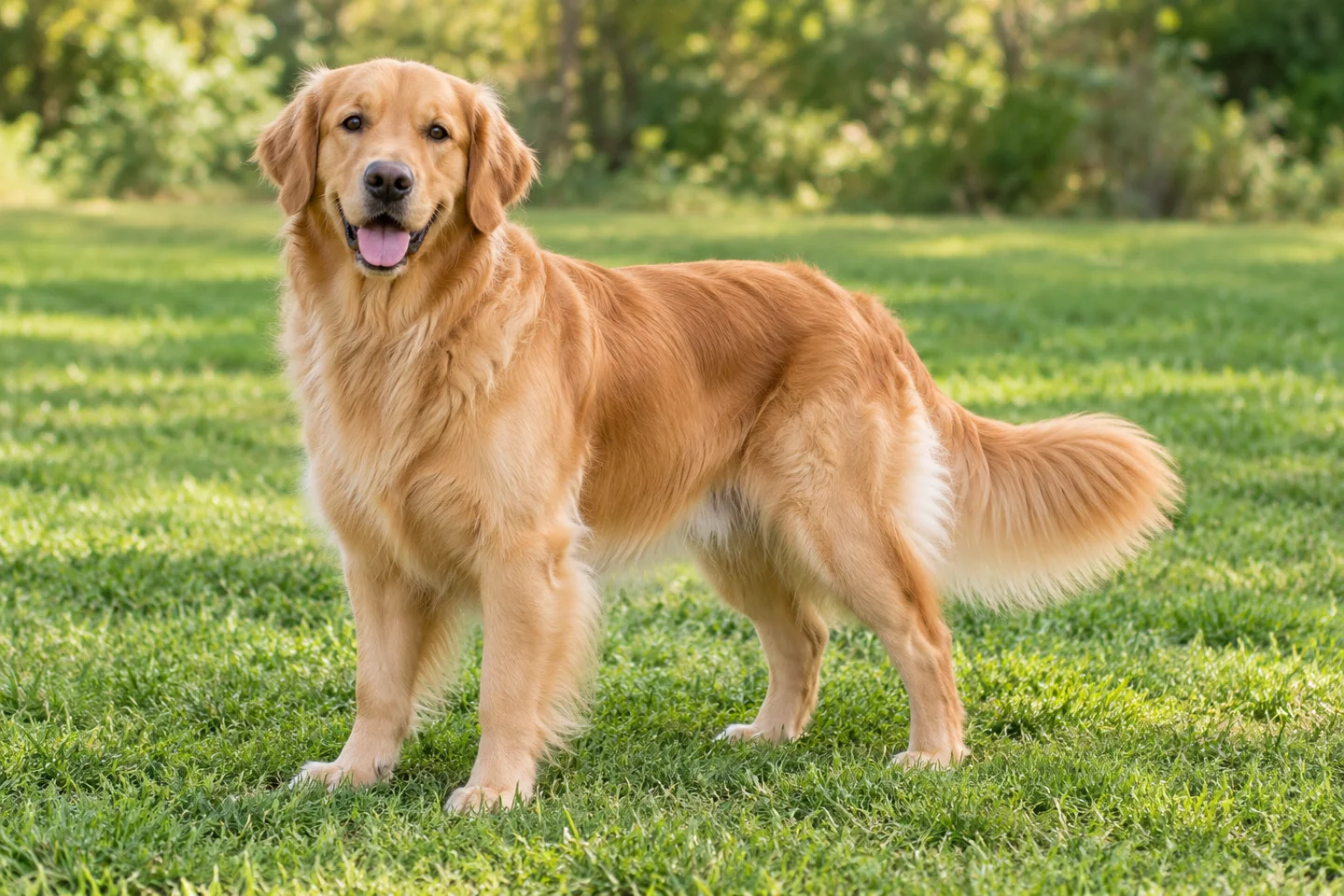
Golden Retrievers are substantial dogs. The AKC's breed weight chart gives an overall range of roughly 55 to 75 pounds. Sex, breeding, age, and individual development affect size. An appropriate weight depends on body condition, not a target number copied from the internet. Your veterinarian can assess whether your dog carries excess fat or needs nutritional support.
The coat has a weather-resistant outer layer and an undercoat, with longer feathering around parts of the body. Shades of gold vary. A lighter coat does not establish better health, a calmer personality, or greater suitability for children. Ask for evidence about the individual dog instead of treating a fashionable color description as a quality certificate.
Expect shedding and wet fur after outdoor activities. Think about the practical consequences before bringing a puppy home. You will need space for a comfortable adult bed, equipment strong enough for the grown dog, and a way to transport the dog safely. A vehicle restraint or appropriately fitted travel crate should suit the adult dog's size. Arrange help if stairs or lifting will become difficult during illness or old age.
Temperament and the daily household
Many Goldens seek contact with their families and learn readily when training is clear. Those tendencies can support an enjoyable partnership. They also create work. An affectionate adolescent may follow guests, jump when excited, steal a sock, or struggle when the household suddenly becomes unavailable for most of the day.
Teach the behaviors you want during calm moments. Reward four paws on the floor before visitors arrive. Practice resting on a mat while someone makes tea. Introduce short periods of separation gradually. A dog who can settle independently has more options than a dog who relies on constant entertainment.
Keep a record when behavior changes. Note what happened beforehand, who was present, whether food or toys were involved, and how quickly the dog recovered. Details help distinguish normal excitement from discomfort or a developing problem. A new reluctance to be touched, unusual irritability, or withdrawal deserves a veterinary conversation. Pain and illness can change how a normally sociable dog responds to people and other animals.
Aggression, guarding, and bite prevention
A Golden Retriever can bite. A friendly breed description does not make it safe to interrupt meals, hug a worried dog, or allow a child to climb on a resting animal. Prevention depends on supervision, suitable boundaries, and responding to the dog's behavior before an encounter escalates.
Resource guarding can involve food, chews, stolen objects, resting places, or access to a person. VCA describes warning behaviors such as freezing, staring, eating faster, and growling around valued items. Do not repeatedly take a bowl away to prove control. Keep children and other pets away from meals, prevent access to dangerous objects, and obtain professional advice if guarding appears.
A growl gives information about discomfort. Creating distance is safer than confronting the dog. If there is a bite history, repeated snapping, or difficulty keeping people safe, arrange a veterinary assessment and help from a suitably qualified behavior professional. Describe what happened accurately. Avoid testing whether the dog will react again.
Use physical separation when supervision is unavailable. A comfortable gated room can protect both a resting dog and an active child. If a professional recommends a basket muzzle, introduce it gradually through rewards. A muzzle can support a safety plan, but it does not make an uncomfortable interaction appropriate or replace attention to the cause of the behavior.
Children, cats, and other dogs
A Golden's enthusiasm can be difficult for a toddler even when the dog is trying to play. Knocking someone over, grabbing clothing, and competing for dropped food can frighten a child and raise everyone's arousal. Adults should arrange space, interrupt unsuitable play, and teach children how to invite interaction without cornering the dog.
Children should leave a sleeping or eating dog alone. Give the dog a retreat that children do not enter. Supervision means an adult is close enough and attentive enough to intervene. Being somewhere in the house is insufficient when a young child and a large dog are together.
Compatibility with cats and dogs varies. Introduce cats behind appropriate barriers, provide elevated escape routes, and prevent chasing from becoming a routine. Introduce dogs at a distance where both can stay relaxed. A Golden who enjoys one familiar companion may dislike rough group play. Respect that preference. Social success can be a comfortable parallel walk rather than wrestling with every dog in the neighborhood.

Training without frightening the dog
The American Veterinary Society of Animal Behavior recommends reward-based training. For a Golden, useful starting skills include responding to a name, coming when called, walking on a loose leash, leaving an item, exchanging an object, and resting in a chosen place. Practice in conditions where success is realistic before adding distractions.
Food rewards can be part of the daily ration. Toys, access to a sniffing area, and permission to greet a familiar person may also reinforce behavior. Choose rewards the dog actually values. Keep sessions short enough that the dog remains engaged, and finish before frustration takes over.
Avoid treating physical exhaustion as the main route to obedience. A dog may become fitter without learning how to wait at a door or relax around a visitor. Teach the specific skill, arrange the environment to prevent repeated mistakes, and reward progress. If the dog struggles, reduce the difficulty. Young puppies, anxious adults, and dogs recovering from illness need different expectations. Training should account for the animal in front of you.
Exercise, enrichment, and rest
Plan for daily physical activity and opportunities to use the dog's nose and brain. The appropriate amount depends on maturity, conditioning, health, weather, and the activity itself. A relaxed sniffing walk places different demands on the body from sprinting, jumping, or repeated abrupt turns during fetch.
For puppies, avoid turning internet exercise formulas into rigid rules. Ask your veterinarian about suitable activity while the dog grows. Offer varied, comfortable movement and stop when the puppy needs rest. Do not force a puppy to keep up with an adult runner or an older dog.
For adults, combine walks with activities such as searching for a toy, learning a practical skill, or carrying a suitable retrieving dummy. Use toys too large to swallow and inspect damaged equipment. Choose games that let you pause easily. A dog who becomes frantic around a ball may benefit from less repetitive chasing and more controlled searching.
Rest belongs in the schedule. If your Golden repeatedly becomes mouthy or unable to settle after busy outings, reduce the intensity and review sleep, handling, and expectations. More activity is not always the missing ingredient.
Swimming, heat, and outdoor safety
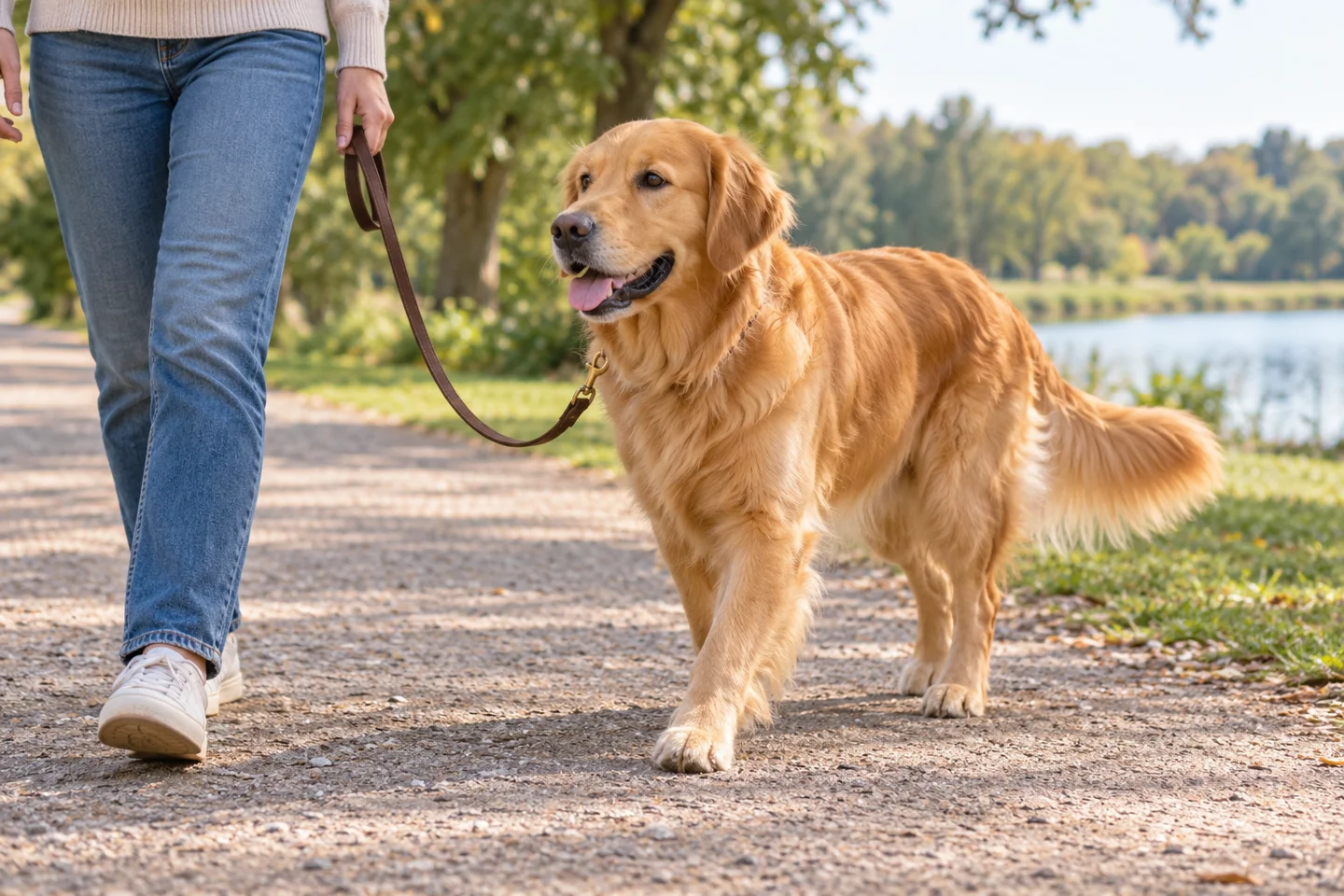
Many Goldens enjoy water, but swimming ability and judgment vary. VCA's water-sports guidance advises owners to supervise swimming and avoid assuming a dog already knows how. Introduce water gradually, check the exit route, and consider a correctly fitted canine flotation aid for boating or other suitable activities.
Avoid dangerous currents, inaccessible banks, contaminated water, and conditions beyond the dog's experience. Limit sessions before fatigue becomes obvious. A dog who keeps retrieving may continue beyond a sensible stopping point. Rinse and dry the coat as appropriate after swimming, and discuss recurring ear or skin problems with your veterinarian.
In warm weather, choose cooler hours, carry water, and offer shade and breaks. Never leave the dog in a hot vehicle. Weakness, confusion, collapse, or concerning breathing during heat exposure warrants urgent veterinary attention. Contact the clinic while arranging transport rather than waiting for the dog to improve at home. Keep emergency contact information accessible to anyone who walks or cares for the dog.
Grooming that protects comfort
Brush often enough to remove loose hair and prevent tangles, paying attention to feathering and friction areas. Check behind the ears, around the legs, and anywhere equipment rubs. After outdoor trips, look for debris, ticks, sore areas, and small mats before they become difficult to remove.
Build cooperation with handling. Show the brush, reward calm interest, and begin with a few comfortable strokes. The same gradual approach can help with nail care, toothbrushing, drying, and checking paws. Struggling through a long session may make the next session harder.
Persistent scratching, a bad ear odor, skin redness, or pain during brushing needs investigation. Those signs are not a reason to keep applying products without a diagnosis. Discuss bathing frequency and suitable products with your veterinarian or a competent groomer. Ask what a service includes and how the dog is handled. A tidy appearance should never require painful restraint or conceal untreated skin disease.
Feeding and keeping a healthy weight
Feed a complete diet appropriate to the dog's life stage and health needs. The feeding guide on a package is a starting point. Adjust portions with your veterinarian using body condition, activity, growth, and weight trends. Count training treats, chews, table food, and food used in enrichment toys as part of intake.
Use a measuring method consistently, and record changes when several people feed the dog. It is easy for an affectionate household to provide extra snacks without realizing how much the dog receives. Ask the clinic to demonstrate how to assess the ribs and waist rather than relying only on the scale.
Puppies need a growth plan. Older dogs may need different portions or investigation when appetite or weight changes. Avoid adding calcium, oils, supplements, or restrictive diets simply because a product is marketed for Goldens. Discuss a specific problem and the evidence for a proposed change. If a dog has repeated vomiting, diarrhea, reduced appetite, or difficulty swallowing, seek veterinary advice instead of repeatedly changing foods without a plan.
Health risks and questions for the veterinarian
The Golden Retriever Club of America recommends screening breeding dogs for hip, elbow, eye, and heart conditions. Ask for identifiable results that can be checked against the parents' registered identities. A statement that a puppy was examined, vaccinated, or genetically tested does not answer every question covered by those evaluations.
Screening reduces uncertainty; it does not guarantee lifelong health. Ask what was tested, when the examinations occurred, who performed them, and whether follow-up evaluations are appropriate. A disease panel and an orthopedic assessment answer different questions. Discuss the relevance of each result rather than treating a long list of tests as proof of quality.
Goldens can also develop problems for which those clearances provide no guarantee, including cancer and other medical conditions. The breed club explicitly notes limits to routine screening. Discuss the family history and the dog's own findings without assuming that every lump is cancer or that a normal-looking dog cannot be ill.
Keep records of mobility, appetite, thirst, energy, skin changes, and any new masses. Arrange examinations for persistent changes. Sudden collapse, severe breathing difficulty, a painful swollen abdomen, repeated unsuccessful retching, or suspected poisoning requires urgent contact with a veterinarian. Those signs should not be handled by waiting for an online breed discussion to identify the cause.
Golden Retriever mixes
A Goldendoodle generally describes a Golden Retriever and Poodle cross. Other informal names include Golden Labrador or Goldador for a Golden and Labrador cross, and Golden Shepherd for a Golden and German Shepherd cross. Names are inconsistent, so ask what is actually known about the parents. Appearance alone cannot establish ancestry.
A cross can inherit different combinations of coat, size, activity needs, behavior, and health risks. A Poodle cross does not guarantee a low-shedding coat or freedom from human allergies. VCA notes that no breed is universally hypoallergenic. A curly coat may require substantial grooming even when less loose hair appears around the home.
Evaluate the actual dog and the relevant health risks from both sides of the family. If both parents are known, ask for appropriate screening for each. A mixed background does not erase the need for sensible breeding decisions or veterinary care. If adopting an adult with uncertain ancestry, ask about observed behavior, handling tolerance, living history, and medical findings. Those details can guide a household decision without requiring a precise breed percentage.
Finding a puppy or adopting an adult
A responsible source should welcome questions about health, temperament, housing, social experiences, and what happens if the placement fails. Ask to see how puppies are raised and what individual differences the caregiver has observed. A puppy who approaches first is not automatically the best match for every household.
For an adult, discuss behavior around meals, visitors, unfamiliar dogs, children, grooming, transport, and separation. Ask which observations come from a foster home and which come from a brief shelter interaction. Different settings reveal different information. A rescue organization should describe uncertainty plainly instead of promising that a dog will fit every family.
Plan an adjustment period with predictable routines and manageable introductions. Avoid filling the first week with visitors and busy outings. Establish sleeping and toilet arrangements before arrival. Check the identification record, veterinary documents, and emergency contacts. Arrange a veterinary appointment and discuss any medication or ongoing treatment before changing it. If another animal already lives at home, prepare separation space before introducing them.
Costs, housing, and the long view
Consider the recurring costs of food, preventive care, grooming supplies, training, transport, and care when you travel. Include a plan for emergencies and longer illnesses. Prices vary by location and individual needs, so request local estimates rather than relying on a universal monthly figure.
A home with a yard still needs walks, interaction, and training. An apartment can work for some Goldens when the owner can meet those needs and manage access, noise, and the building's rules. Consider stairs, elevators, lease restrictions, and how you would move a sick adult dog. Check applicable rules before committing to a placement.
As the dog ages, review traction, bedding, car access, and comfortable exercise. New accidents, reluctance to climb stairs, or reduced interest in play should not automatically be dismissed as age. A veterinary examination may identify a problem that can be managed. Make care decisions around comfort and function rather than expecting a senior dog to maintain the schedule it followed as a young adult.
Choosing a playdate on dogsDating
Describe your Golden's current behavior accurately. Include the play styles it enjoys, any handling concerns, whether it guards valued objects, and whether a quiet walk is preferable to physical play. A profile photograph and a shared breed name cannot establish compatibility.
Begin in a suitable public place with space to create distance. Discuss recent health concerns and the precautions recommended by each dog's veterinarian. Start with a parallel walk when appropriate. Keep food, favorite toys, and crowded greetings out of the first encounter if they create tension. Watch both dogs throughout the meeting and allow either owner to end it.
Loose movement, voluntary breaks, and the ability to disengage are more useful than insisting the dogs immediately become friends. Stop if one dog repeatedly hides, freezes, attempts to escape, or cannot get a break from the other. Choose a different activity or another companion when necessary. A comfortable, uneventful walk is a worthwhile result for a dog who prefers calm company.
Sources and editorial notes
Sources checked October 21, 2026. Breed measurements describe reference ranges, not a diagnosis or an individual dog's ideal weight. Images are AI-generated breed illustrations and do not document a particular dog or health condition.
- AVSAB: Humane Dog Training Position Statement
- VCA Animal Hospitals: Food aggression in puppies
- VCA Animal Hospitals: Water sports for dogs
- VCA Animal Hospitals: Heat stroke in dogs
- VCA Animal Hospitals: Hypoallergenic dog breeds
- VCA Animal Hospitals: Aggression toward unfamiliar dogs, diagnosis
- VCA Animal Hospitals: Common emergencies in dogs
- American Kennel Club: Breed weight chart
- American Kennel Club: Golden Retriever
- Golden Retriever Club of America: Health screenings for the parents of a litter
- AAHA: Feeding plans for healthy, appropriate weight cats and dogs
Keep getting to know dogs.
Read another guide or return to your dogsDating community.
Explore breed guidesBack to dogsDating