Grand Bleu de Gascogne
A large, deep-voiced French scent hound whose companion life needs secure exploration, suitable company, long-ear care, and a realistic home routine.
How these guides are researched and reviewed
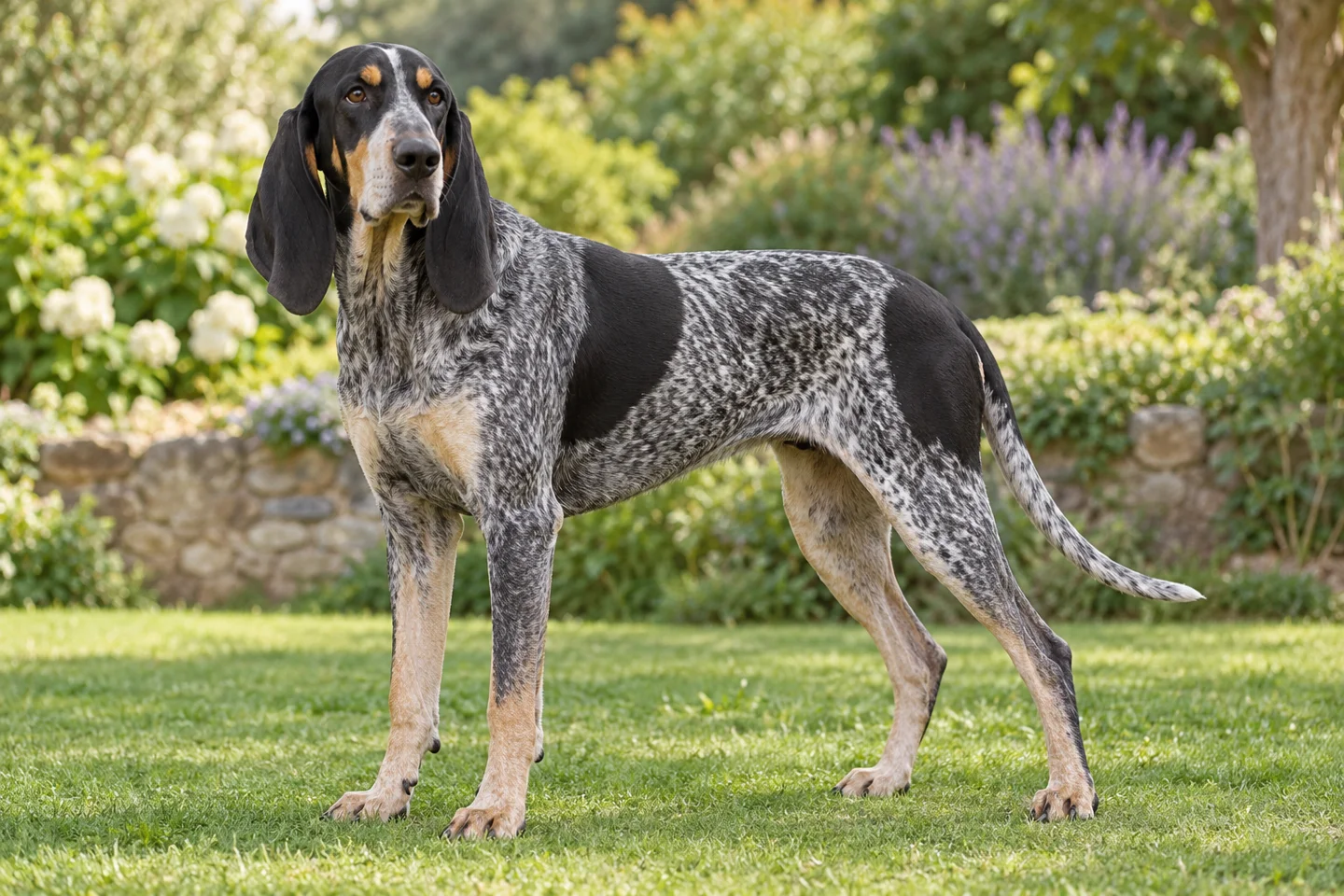
- Origin
- France; Gascony
- Adult height
- Males 65–72 cm; females 62–68 cm
- Coat
- Short black-and-white mottling with black patches and tan points
General information for owners. These articles have not been reviewed by a veterinarian. Medical decisions need your dog's history and an examination.
A large scent hound in a companion home
The Grand Bleu de Gascogne brings a substantial body, a searching nose, and a carrying voice into a household. Choose it because you can accommodate those features in daily life. Before meeting a litter or rescue, consider the places where you could walk a large hound securely, the time you can spend outdoors, and who will provide care when you are away. A garden can be useful, but its fence, gates, and relationship to roads need inspection. Access to open space becomes valuable only when the dog can use it safely.
Grand, Petit, Basset, and Griffon Bleu de Gascogne refer to distinct breeds. The Grand is the tall, short-coated one discussed here. Similar coloring does not make the others small or rough-haired versions that can be substituted without further thought. Confirm the name on the animal's records and ask how the source identifies it. The breed's history can help explain its intended work, while the individual dog's experiences determine much of what it has learned about domestic life. Both deserve attention before you decide whether the placement fits.
Gascony history and what it can tell an owner
The FCI places the breed in France and describes a history in Gascony involving large game and hare hunting. Its account includes the packs of Gaston Febus, Count of Foix. That historical account explains why scent work and a voice heard across distance feature in descriptions of the Grand Bleu. It does not show that every modern companion has performed those jobs. Ask what the actual parents or adopted dog do now, and how their everyday environment resembles or differs from yours.
A hound accustomed to group housing, working outings, and a rural setting may need deliberate preparation for domestic routines. Find out whether it has traveled alone, rested indoors, or encountered ordinary urban traffic. A puppy raised inside a home also needs teaching before you can expect it to relax beside a busy road. Avoid making a romantic account of hunting ancestry carry the entire placement decision. Current observations are more useful: how the dog recovers after activity, how it responds to handling, and what company it has been able to tolerate without distress.
Adult dimensions and the blue coat
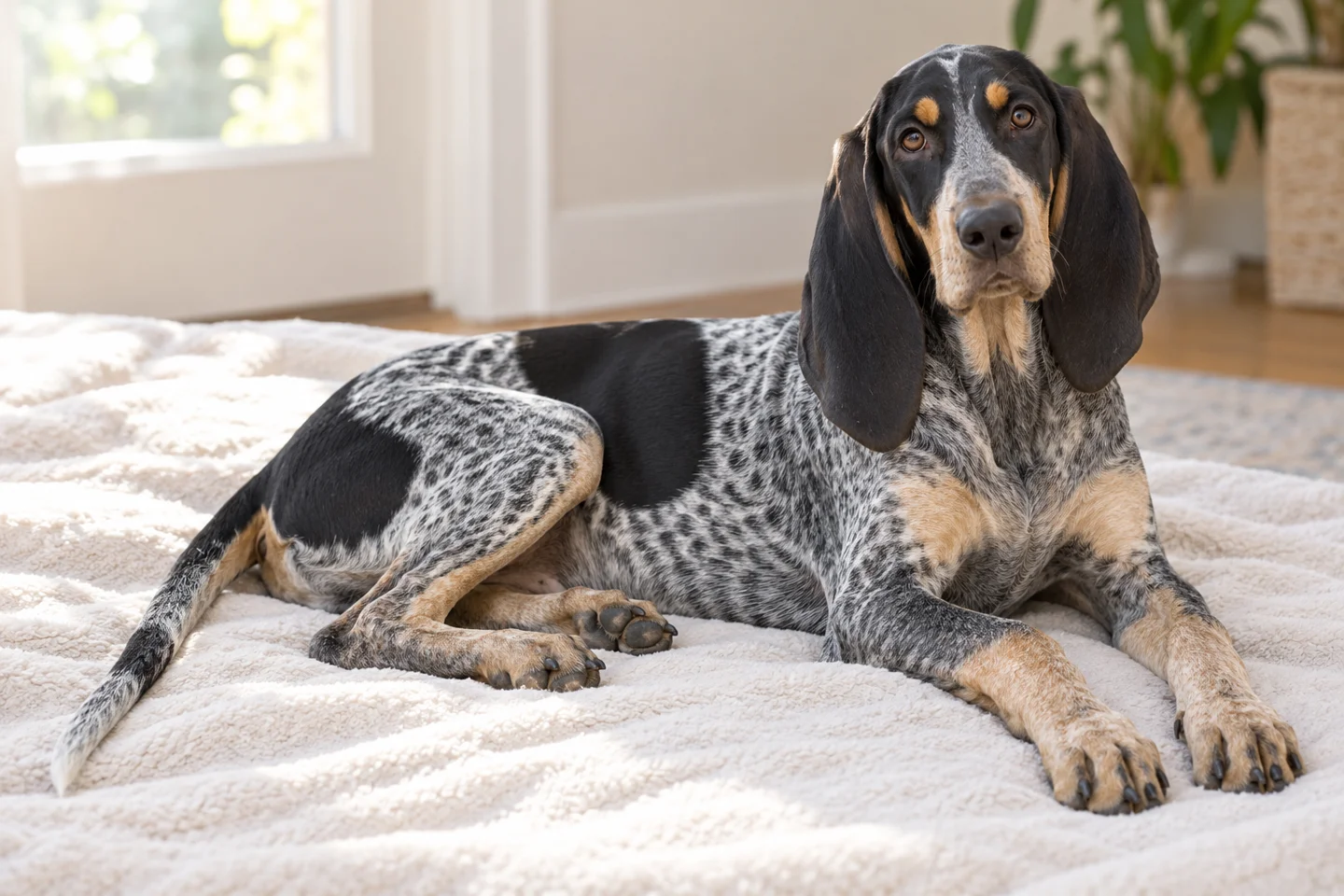
FCI height references are 65 to 72 centimeters for males and 62 to 68 centimeters for females. The blue effect comes from black-and-white mottling, with black patches and tan points. Long, fine, inward-folding ears and a substantial muzzle help distinguish the outline. These details describe type rather than an individual health assessment. A photograph cannot tell you whether an animal moves comfortably or whether a harness fits beneath the chest. The illustrations here are AI-generated visual examples, not proof of pedigree.
Measure the adult dog when choosing transport restraints, a sleeping area, and any equipment needed for outings. A puppy's current dimensions can make an arrangement seem easier than it will be later. Check whether an adult can turn in the vehicle and enter without an awkward leap. If assistance might be needed, ask your veterinary team how to provide it comfortably. Place the bed where the hound can stretch out without blocking access or being repeatedly stepped over. Practical space is more specific than a statement that the house is large.
Temperament includes the hours between walks
The standard describes a calm pack hound with a sonorous voice and strong scenting interest. Those intended qualities do not establish how a particular dog will handle solitude, frustration, or a visitor at your door. Ask the foster carer or breeder for examples from an ordinary day. Does the animal sleep while people move around? What happens when a familiar companion leaves? A useful answer includes context and duration, rather than a reassuring personality label that leaves the important details unexplained.
Introduce the household schedule gradually. Keep sleeping, meals, and outside access predictable while the dog learns the setting. Arrange a quiet place away from constant arrivals. If resting becomes difficult, examine the environment and consult a qualified professional rather than continually increasing excitement in the hope of tiring the dog. A record of when unsettled behavior begins can reveal a practical problem, such as an inaccessible resting area or a repeated disturbance. It also helps another carer follow the same routine without having to guess what has worked.
Voice and neighbors deserve an honest discussion
A deep hound voice can travel beyond the garden. Hear adults yourself when possible and ask when they vocalize. Hunting, anticipation, frustration, and being left alone are different settings, even if the sound is similar to a listener. Consider nearby bedrooms, shared walls, and the times you need to leave home. Do not accept an assurance that all barking will disappear after one lesson. Explain the actual property and routine to the source so that a foreseeable mismatch can be discussed before placement.
If noise begins in your home, investigate what precedes it. Is the dog watching another animal through the fence, waiting for a walk, or distressed when people leave? Prevent repeated rehearsal where possible and teach an alternative at an easier level. Keep punishment out of the plan. For persistent distress or a sudden behavioral change, involve the veterinary team and an appropriate behavior professional. Temporary care arrangements may be needed while you work on the problem. Your neighbors also benefit from a concrete account of the steps being taken and realistic expectations.
Training a return before the scent becomes overwhelming
Start return-cue practice where the hound can readily respond. Reward coming to you, then allow another safe activity so arrival does not always end exploration. Introduce distractions in manageable steps. A secure enclosed area or a suitable long lead can make practice possible while preventing an uncontrolled departure. Ask an instructor to demonstrate safe line handling around a dog of this size. Avoid wrapping a line around your hand or letting people stand in its path when the dog accelerates.
AVSAB recommends reward-based training. For a Grand Bleu, useful goals include stopping at an open gate, turning with a handler, and standing while equipment is checked. Teach each in a quiet setting before expecting performance at a woodland entrance. Write down a successful distance from distractions and begin there next time. If the hound cannot respond, reduce the difficulty instead of issuing the cue repeatedly. A task practiced indoors has not yet been taught under every outdoor condition. Keep safety equipment in place while learning catches up with the demands of the location.
Exercise through controlled scent exploration
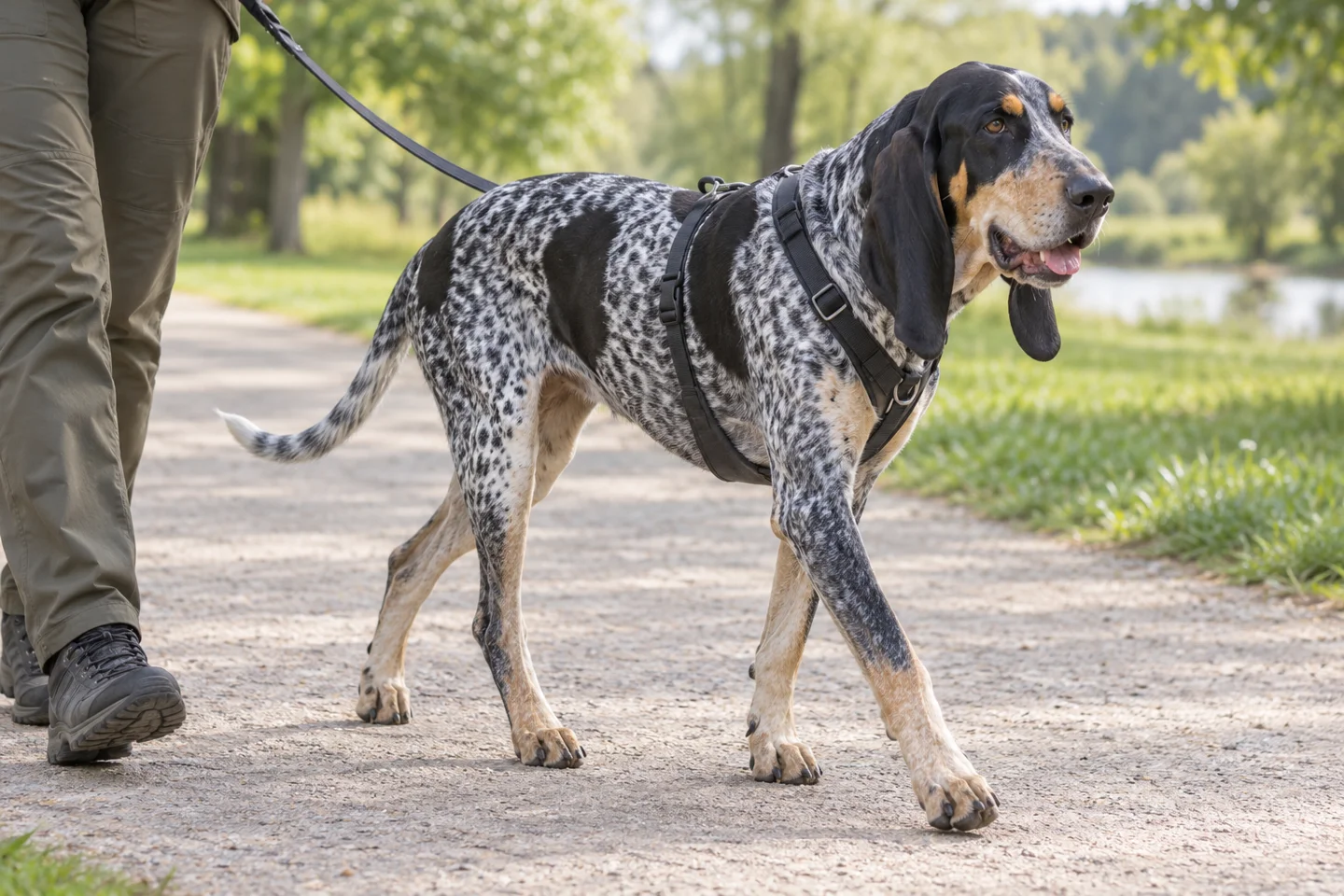
A scent walk can give the hound room to investigate without making freedom beside traffic the price of a worthwhile outing. Choose routes with visible exits and enough width for you to change direction. Let sniffing have a place in the schedule, while keeping control around livestock and wildlife. Ask about the individual's fitness and previous workload before planning a long walk. A newly adopted dog may arrive enthusiastic but lack the conditioning, experience, or health needed for your preferred distance.
Adjust activity for growth, illness, and aging with veterinary advice. Notice recovery later that day and the following morning rather than judging the outing solely by eagerness at the start. Heat changes the plan: shade, water, cooler times, and a shorter route may be necessary. If the dog appears distressed, stop and contact a veterinarian promptly. Keep the vehicle and destination part of the same assessment. A pleasant walk can still be followed by an unsafe wait in a hot space if the rest of the day has not been planned.
Social experience without forced contact
Discuss suitable puppy exposure with your veterinarian while vaccination is underway. The aim is comfortable experience, not reaching a quota of greetings. A hound watching a bicycle from across a quiet space can learn without being brought directly into its path. Provide opportunities to leave and recover. For an adult with unfamiliar history, begin with small observations and short outings. What it tolerates in one setting should guide the next step, rather than a deadline for attending a crowded event.
Long ears and an appealing expression attract hands. Explain to people when the dog needs space and manage access rather than expecting it to accept every approach. Teach comfortable brief handling with rewards at home. If it moves away, find a smaller step it can manage. Keep notes about noises, surfaces, and transport so that difficulties can be discussed precisely. Persistent fear, frantic escape attempts, or inability to recover deserves professional attention. Exposing the animal repeatedly at the same overwhelming intensity is unlikely to supply the useful learning you intended.
Aggression and bite prevention around a large hound
A calm breed description cannot certify that a dog will never bite. Guarding an object, stiffening during ear handling, and threatening an unfamiliar dog call for different questions. Record what happened immediately before the response and prevent a repeat while help is arranged. Do not provoke a warning to see whether it will happen again. A veterinary examination is particularly important when a formerly comfortable movement or touch suddenly becomes difficult. Pain may change what an animal can tolerate.
VCA explains that aggression toward unfamiliar dogs can involve fear, frustration, and other causes. Removing a barrier to test friendliness can be dangerous. Use distance and clear handling arrangements until the behavior is assessed. Leave meals undisturbed and teach safe exchanges rather than forcibly removing valued objects. Tell carers about incidents in plain terms, including near misses. A person accepting responsibility for the dog needs the circumstances and current restrictions. Qualified support can help the household establish a plan that remains workable when visitors arrive or the usual handler is unavailable.
Children and other animals in the home
An adult Grand Bleu can knock a child over without intending harm. Arrange contact where movement is calm and an adult can supervise actively. Keep sleeping and feeding spaces protected from children's access, and explain that moving away ends an interaction. Children should not hold the collar to stop a large dog or attempt to retrieve something from its mouth. If the supervising adult must turn attention elsewhere, use a comfortable separation arrangement rather than assuming everyone will remain still.
A pack background does not establish compatibility with every household animal. Ask about cats, small dogs, and livestock separately. Maintain secure separation from small animals where safety has not been established. With another dog, arrange carefully managed meetings and preserve separate rest and feeding areas. Observe whether either animal is repeatedly trying to escape contact. A single successful walk cannot answer every question about sharing a narrow hallway, an owner's attention, or food. Introduce those household conditions gradually and obtain help if conflict appears.
Grooming the short coat and inspecting long ears
Short hair still needs regular attention. Brush gently with appropriate tools, check beneath equipment, and examine feet after rough ground. Look for a new sore area or trapped debris without digging into tissue. Ask for professional help with painful objects or a wound. Keep sessions brief enough for the dog to cooperate. Routine coat care becomes more useful when it also gives you a consistent chance to notice changes in condition, skin, and response to touch.
The long ear is a particular practical responsibility. Observe smell, redness, discharge, head shaking, or sensitivity and contact the clinic when those changes occur. VCA advises diagnosis of ear disease rather than assuming every episode has the same cause. Have the veterinary team demonstrate any prescribed cleaning routine. Do not push cotton buds into the canal or reuse another animal's drops. Introduce gentle ear lifting during comfortable moments, with a pause available. An adult that resists because the ear hurts needs clinical care before a longer lesson in tolerating inspection.
Health records when breed data are limited
For a French-registered Grand Bleu, Centrale Canine's LOF Select separates pedigree, DNA and health, show results, work results, and relatives or descendants. Use that separation when asking about a litter. A parent's working result describes an achievement; it does not fill an empty health record. Ask the breeder to show which recorded investigations belong to each parent and explain any report that is available privately rather than on the public profile. If nothing is recorded, preserve that distinction from a normal result. The database is a route to particular evidence, not an automatic assurance that every relevant condition has been excluded.
The size of an adult Grand Bleu also makes practical medical handling worth arranging early. Ask the clinic how it wants you to bring in a dog that cannot walk, and identify someone able to help with transport. During routine visits, maintain a record of weight and any clinician-assessed limitations so a later carer does not rely on a vague account of a powerful hunting dog. Previous injuries, medication, and recovery instructions should accompany a rehomed adult. If a problem has repeatedly interrupted activity, request the reports even when the dog currently looks comfortable. An individual examination can address present concerns while the family information remains incomplete. That distinction is more useful than borrowing a screening list from another blue hound or assuming that successful relatives establish this dog's condition.
Feeding, costs, and the work of ordinary care
Choose a complete food for the dog's life stage and agree a starting portion with your veterinary team. Measure meals and account for rewards used during outdoor training. Review body condition rather than feeding toward an invented breed weight target. A hound that follows scent enthusiastically can still gain unwanted weight or have a medical reason for losing it. Record meaningful changes and arrange assessment instead of repeatedly changing products without understanding the problem. Keep fresh water available and provide clear instructions to anyone feeding the dog.
Budget for more than food and the initial fee. Include preventive care, training, appropriate transport equipment, occasional help, and an emergency arrangement. Ask local providers about current costs and capacity. Confirm that a sitter can handle the actual dog and its voice, rather than assuming familiarity with smaller hounds is enough. Review return and support arrangements with a breeder or rescue in advance. If a necessary part of care depends on an unavailable service, resolve that gap before placing the dog in a routine it cannot comfortably manage.
Mixes and the limits of appearance
A Grand Bleu cross may be described by a known second parent or simply as a blue hound mix. Neither phrase creates a recognized variety of the Grand Bleu. Ask which ancestry is documented and which was inferred from appearance. Black-and-white mottling can occur in other dogs, so color alone cannot settle identity. An adult's observed behavior and actual dimensions can still help you assess household fit when pedigree is unknown. Preserve that uncertainty instead of turning a visual guess into a definite family history.
If both parents are known, discuss relevant health records for each. Crossing breeds does not guarantee the removal of inherited problems, predictable voice, or a particular mature size. Avoid choosing a puppy because a seller promises all the attractive traits of one parent without its practical demands. Ask about the animals themselves, their living conditions, and the support provided after placement. With a rescue, useful observations about settling, handling, and animal responses may be more informative than a confident-looking breed percentage that cannot explain how this dog behaves today.
dogsDating walks with room to follow a nose
Describe your hound's walking needs accurately in the dogsDating profile. Mention whether it vocalizes when excited, needs space around smaller animals, or prefers a quiet partner that walks rather than plays. Share an approximate area and agree a public meeting point. Keep exact coordinates and your home address private. Ask the other handler about their dog's preferred distance and any restrictions. Choose a route where both people can turn away without being trapped at a gate, bridge, or crowded entrance.
Start by moving in the same direction with space between the dogs. Allow the Grand Bleu to sniff without pulling it into a face-to-face greeting, and let the other dog leave an interaction. Keep shared toys and feeding games for a later decision. End or widen the walk if either animal becomes stiff, frantic, or unable to disengage. Afterward, note the part of the route that worked and any point needing more distance. A familiar walking companion can be a useful match even when the dogs never choose physical play.
Sources and editorial notes
Sources checked October 21, 2026. Breed measurements describe reference ranges, not a diagnosis or an individual dog's ideal weight. Images are AI-generated breed illustrations and do not document a particular dog or health condition.
- AVSAB: Humane Dog Training Position Statement
- VCA Animal Hospitals: Food aggression in puppies
- VCA Animal Hospitals: Common emergencies in dogs
- Orthopedic Foundation for Animals: CHIC health screening programs
- VCA Animal Hospitals: Aggression toward unfamiliar dogs, diagnosis
- VCA Animal Hospitals: Grooming and coat care for your dog
- VCA Animal Hospitals: Ear infections in dogs (otitis externa)
- AAHA: Feeding plans for healthy, appropriate weight cats and dogs
- VCA Animal Hospitals: Heat stroke in dogs
- AVSAB: Puppy Socialization Position Statement
- VCA Animal Hospitals: Dog behavior problems, aggression toward children
- Official breed standard: Grand Bleu de Gascogne
- Centrale Canine: Using LOF Select individual dog and family records
Keep getting to know dogs.
Read another guide or return to your dogsDating community.
Explore breed guidesBack to dogsDating