Irish Terrier
A red, wiry working terrier whose care needs secure exploration, clear household teaching, practical coat care, and informed footpad and urinary-health questions.
How these guides are researched and reviewed
- Origin
- Ireland
- Adult standard size
- About 45.5 cm; males 12.25 kg; females 11.4 kg
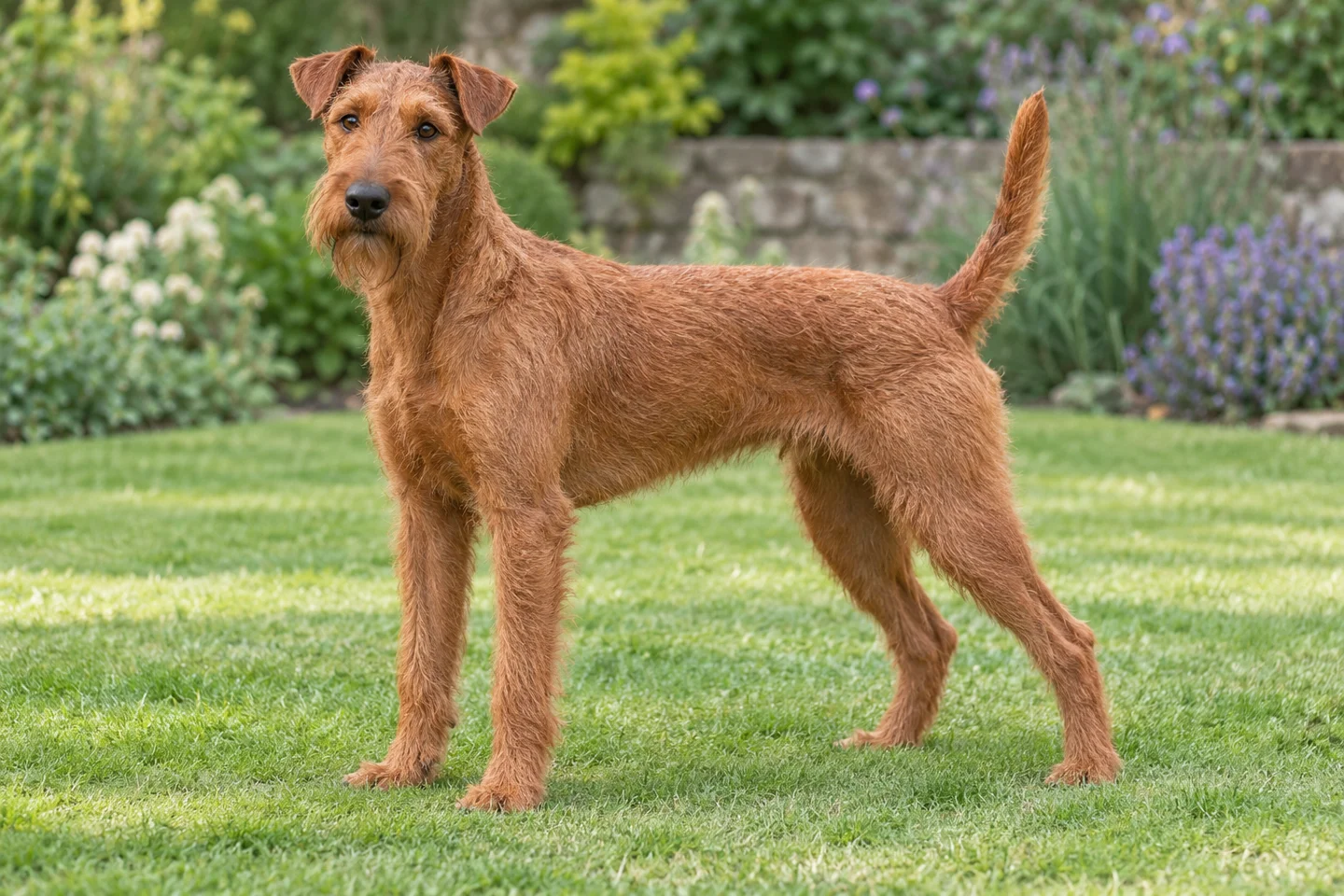
- Illustrated coat
- Red wiry coat with small beard
General information for owners. These articles have not been reviewed by a veterinarian. Medical decisions need your dog's history and an examination.
An Irish Terrier is more than a red outline
The Irish Terrier is an active, wiry dog with a farm and hunting background. A prospective owner should ask how the individual responds to movement, other animals, handling, and being left to rest. Its neat red appearance may suggest a simpler commitment than its daily learning and activity require. Meet adults and talk to people who care for them through ordinary weeks. A short show-ring appearance or an excited greeting cannot describe the entire life you are considering sharing.
The FCI identifies Ireland as the breed's origin and records a varied historical coat population before red became established. It also notes the formation of an early club in Dublin in 1879. Those details help distinguish the breed from a generic red terrier or another Irish breed with a similar color. History can guide questions about purpose without proving the temperament or medical condition of a puppy. Ask about the current family's behavior and upbringing, the source's placement decisions, and what support will be available after the animal enters your home.
Size, ears, and the natural tail
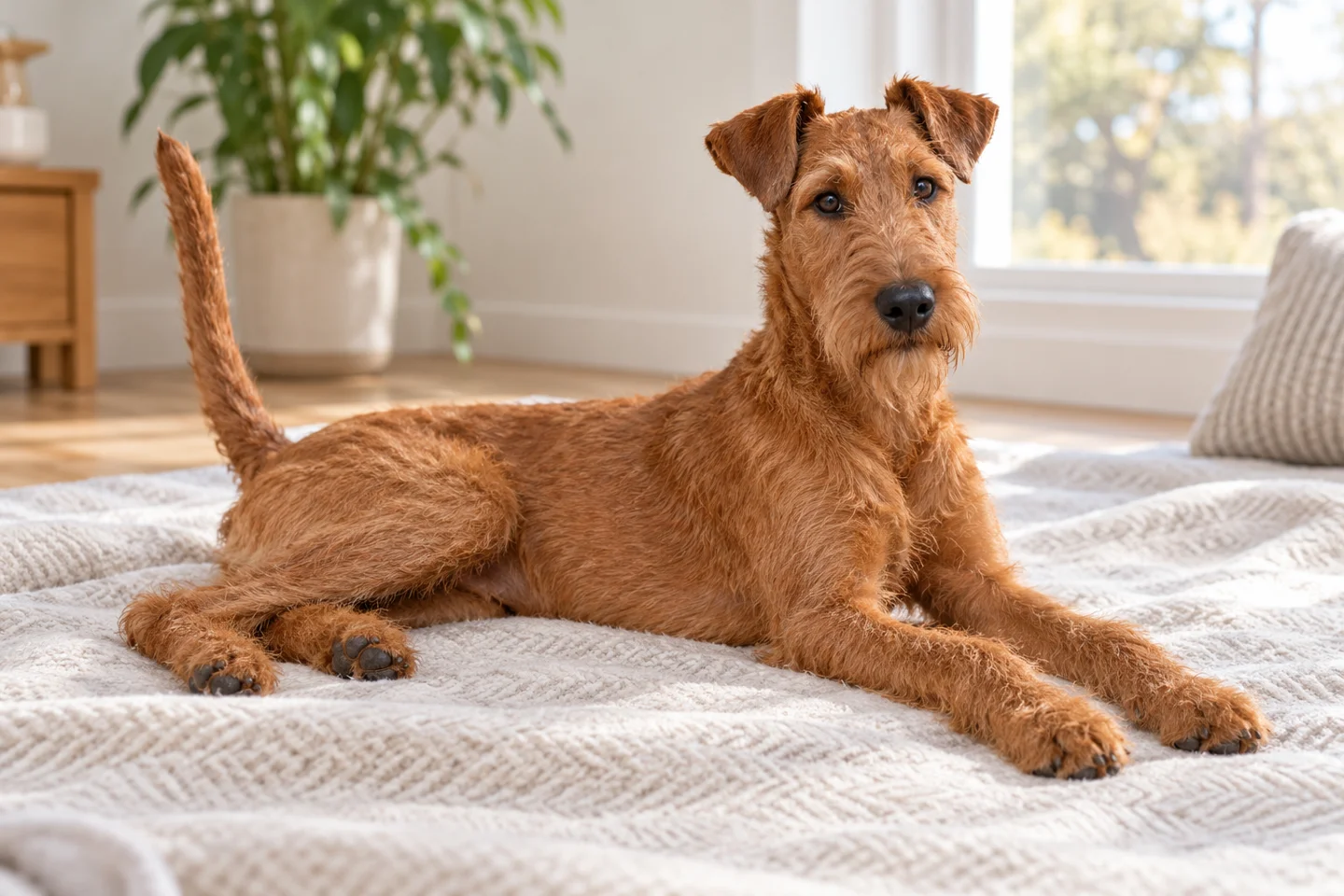
The FCI reference is approximately 45.5 cm at the withers, with weights of 12.25 kg for males and 11.4 kg for females. It describes a lithe, racy body rather than a heavy, compact build. Small V-shaped ears fold forward, and a long head has a modest beard. Red, red-wheaten, and yellow-red are recognized. The illustrations use red and an undocked natural tail. A standard reference is not a reason to change feeding until every dog reaches exactly the same number.
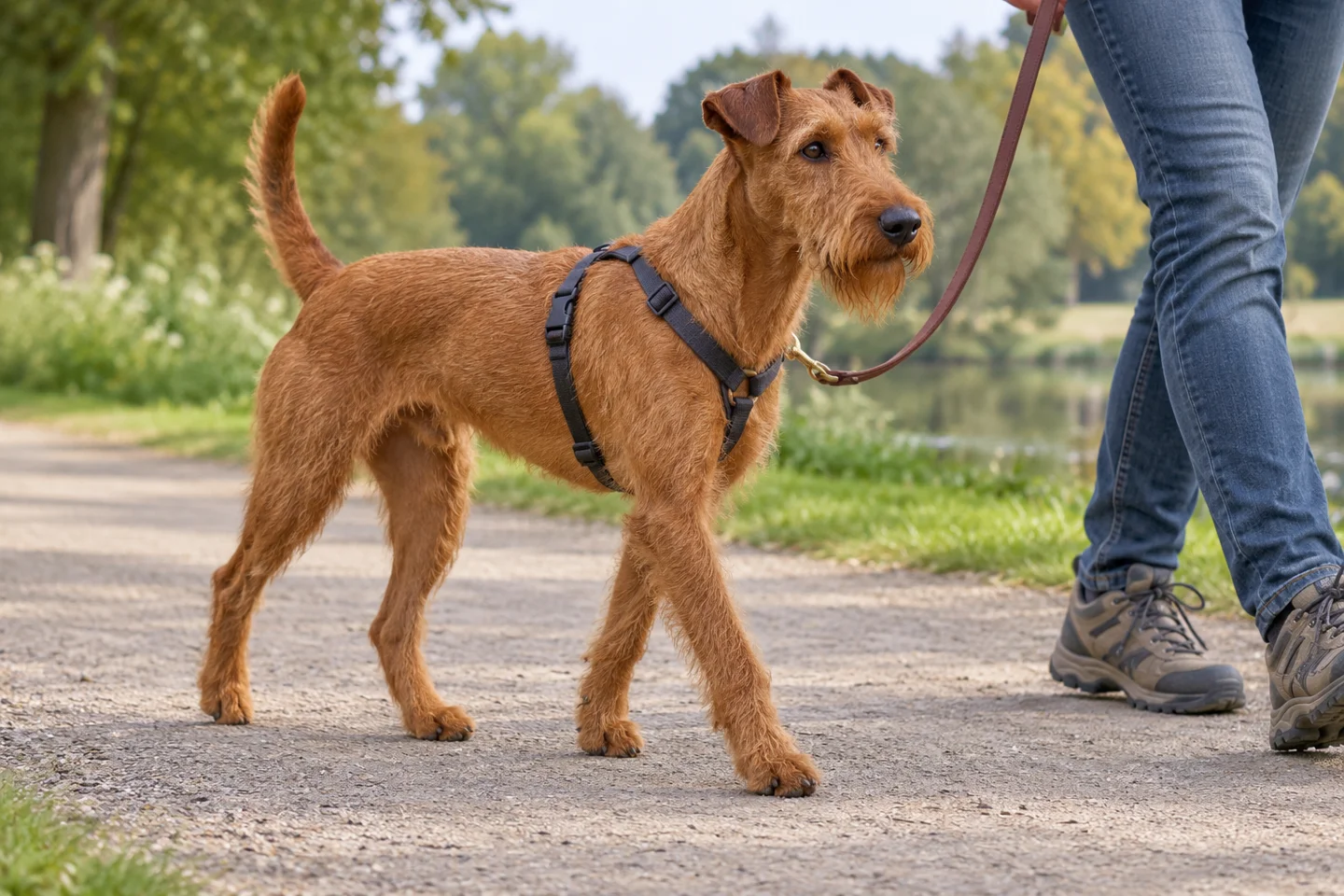
Watch an adult move comfortably and consider its actual measurements for travel and equipment. A terrier interested in something nearby can pull abruptly, so assess harness fit and fastening without making straps restrictive. Plan a secure entrance routine before opening the gate onto a pavement. Keep food and unsafe objects beyond the dog's reach, recognizing that an active animal may investigate more than floor-level items. Ask your veterinary team to evaluate condition and muscle during routine care. An AI illustration can explain general appearance but cannot assess gait, pedigree, or the health of a real dog.
Temperament should be described through events
A word such as bold needs a practical translation. What does the adult do when it hears a noise, encounters a strange dog, or cannot access an interesting object? Ask for examples and notice how it recovers. Confidence in one setting may coexist with discomfort in another. Avoid selecting an animal on the expectation that every terrier enjoys the same games or public places. The individual needs an environment in which it can participate comfortably, with enough management to prevent difficult situations becoming routine.
Prepare a resting area clear of busy routes and teach a simple settling routine. A dog can enjoy activity and still need help learning how to stop. Reward quiet behavior during easy practice rather than beginning only after the animal is exhausted or frustrated. Keep early days predictable and introduce visitors gradually. If the dog repeatedly cannot relax or shows distress during absence, obtain professional advice and review the schedule. A description of terrier character should never be used to dismiss a problem that is affecting the animal's welfare or the household's ability to care for it.
Training cooperation around interesting objects
Teach voluntary exchanges with safe items before a valuable or dangerous object creates conflict. Offer a useful reward, let the dog move away, and avoid turning every approach into a contest over its mouth. Keep unsafe objects inaccessible while learning develops. Ask an instructor to help if guarding or snapping has already occurred. A household should not provoke a warning by repeatedly removing bowls to demonstrate authority. The goal is a practical response that keeps everyone safer and leaves the animal willing to cooperate.
AVSAB recommends reward-based methods for ordinary training and behavior problems. Use brief lessons for turning with the handler, returning a short distance, waiting at an exit, and standing for equipment. Add distractions gradually. If the terrier cannot respond near movement, create more space rather than increasing force. Tell other carers which skills are ready for daily use and which still need a quieter setting. Consistency concerns the actual cues and rewards, not a requirement that every person physically overpower the dog in the same way when something difficult happens.
Exercise with controlled opportunities to investigate
Build activity around the dog's current stage, health, and conditioning. A controlled sniffing route, a short search, and appropriate movement in a secure area can provide useful variety. Formal sport needs separate instruction and preparation. Consult your veterinarian before sustained running, a major workload increase, or a program for a growing puppy. Watch the response later as well as during the outing. A changed gait, reluctance to rise, or persistent unusual fatigue deserves assessment even when the dog remains eager to investigate another distraction.
Check enclosures and entrances before allowing freer movement. Another dog's use of the space does not establish that every boundary will contain this individual. Keep control near roads, livestock, and wildlife. Adjust effort and timing for heat, footing, and water access. A short-coated or working terrier can still become unwell in unsuitable conditions. Stop when the animal struggles and obtain veterinary advice for concerning signs. Have a manageable shorter plan for days when the original activity is not appropriate rather than treating missed strenuous exercise as a failure requiring compensation later.
Social experiences without forced contact
Ask your veterinary team how to arrange useful puppy experiences while managing local disease risk. Calm observation of traffic, surfaces, people, and suitable animals can happen without compulsory greetings. Let the puppy approach and retreat. A visitor who sits quietly may provide a better lesson than one who repeatedly reaches over the dog's head. Keep outings brief enough for sleep and recovery. If fear persists, seek help rather than arranging increasingly busy experiences in the hope that the animal will stop expressing discomfort.
An adult joining your household also needs a transition suited to its actual experience. Ask about travel, stairs, slippery floors, absences, and previous animal encounters. Start with predictable routines and routes that provide space to turn away. Add unfamiliar situations according to the response, not a fixed calendar. Give visitors clear instructions about resting areas and contact. A dog that tolerates an event while unable to leave has supplied different evidence from one that comfortably chooses participation. Preserve that distinction when deciding whether a larger or more demanding outing is suitable next time.
Aggression and the risks of a terrier stereotype
Do not assume aggression is inevitable because the dog is a terrier, or impossible because it is affectionate with family. Assess the event. Record who approached, any food or object involved, available retreat, and behavior immediately before and after. If the dog growls, snaps, lunges, or freezes, create space and prevent another confrontation while arranging help. Asking another animal or person to repeat the encounter is an unsafe way to investigate. A warning can be enough information to justify a revised plan.
Contact your veterinarian about sudden behavioral changes or sensitivity associated with movement and touch. A qualified behavior professional can assess the pattern and support humane teaching alongside management. Do not punish warnings or force an interaction to establish control. If basket-muzzle use is advised, introduce it gradually and check that the design fits and allows appropriate ventilation. The animal still needs room and comfortable handling. Tell sitters and veterinary staff about actual incidents, including near misses. Clear disclosure lets them make suitable arrangements or decline a task they cannot manage safely.
Children and respectful household participation
Provide a dog-only resting space that children cannot enter. Supervise contact closely enough to stop grabbing, climbing, hugging, or interference with meals and chews. A child should understand that the dog walking away has ended the interaction. When the adult is occupied elsewhere, use secure comfortable separation. Expecting a child to read every subtle warning and manage excitement about a lively animal places too much responsibility on them. Physical arrangements should support the rule before an incident tests it.
Ask what a family-suitability claim means in practice. The ages of children, frequency of contact, setting, and any prior warnings all matter. A dog comfortable with a familiar older child may have no experience of toddlers or groups running in a garden. Plan shared activities with a clear adult role, such as managing the lead during a calm walk. Finish before excitement creates chasing or food competition. The Irish Terrier's manageable physical size does not remove the need for supervision, and a family's affection should include allowing the dog regular time without social demands.
Other dogs and the possibility of different preferences
Arrange an encounter in open space with separate handlers, beginning with movement in the same direction rather than pressure at a doorway. Observe whether both animals can look away and remain responsive. A confident approach from one dog may be unwelcome to the other. Do not decide compatibility from breed, sex, or shared enthusiasm alone. If one animal becomes tense or repeatedly retreats, increase distance or finish. Comfortable walking nearby can be a useful outcome without a direct greeting.
In a shared home, separate food and resting resources while you learn how the relationship works. Protect a resident dog's access to its people and quiet areas. If play occurs, provide breaks and notice whether both dogs choose to resume. Avoid allowing one-sided pursuit because the terrier appears happy to continue. Repeated conflict deserves professional help and a changed environment. A good first walk cannot assess every situation involved in sharing space, including tiredness, illness, valuable objects, or the arrival of unfamiliar people. Continue observing rather than treating the first meeting as permanent clearance.
Cats, small animals, and garden access
A farm and hunting background makes smaller-animal responses a practical question. Ask for specific observations around cats, birds, rabbits, and moving wildlife. Seeing an animal quietly through a barrier is different from unrestricted access when it runs. Keep reliable separation where needed and provide protected routes for a household cat. Do not let pursuit become the test of whether a dog can be interrupted. Some combinations require permanent management, and some proposed homes will not be suitable despite a favorable relationship with people.
Check the garden as part of the same plan. A fence, gate, or storage area should not depend on a person noticing an escape attempt immediately. Explain access rules to visitors and sitters and keep small animals' enclosures secure from direct contact. On walks, use routes and distances that allow the terrier to remain responsive. If it becomes fixed on movement, leave before the problem becomes harder. Household preparation should work during an ordinary busy day. A first introduction with everyone watching does not prove the same precautions can be relaxed when attention is elsewhere.
Grooming a close, wiry coat
The standard describes dense wiry hair that should preserve a clear outline, with a modest beard rather than long silky furnishings. Ask a groomer familiar with Irish Terriers to explain suitable maintenance for your dog's coat and your practical goals. Different procedures can affect texture and appearance, and the animal's comfort needs to remain central. Work gently in brief sessions and check the skin rather than judging the result only from the silhouette. Avoid treating coat care as permission to restrain the dog through escalating distress.
Inspect the beard after meals, the feet after outdoor activity, and areas beneath equipment for trapped material or irritation. A small surface tangle may be manageable, while painful mats close to skin need skilled help. Do not use scissors where the skin is hidden. Arrange bathing and drying around actual needs, and seek veterinary advice for persistent smell, hair loss, redness, or discomfort. Keep products and care instructions recorded for another carer. A naturally tidy appearance still requires observation, particularly when a familiar handling procedure suddenly becomes difficult or one area is repeatedly licked.
Footpads and urinary health questions
The Irish Terrier Club of America's 2017 health statement discusses hereditary footpad hyperkeratosis and cystinuria. The statement is useful for identifying questions, while its age and broad reassurance should not be treated as proof that no other inherited or acquired illness exists. Ask the club and source about current testing recommendations and the actual family records. Hyperkeratosis can involve thickened, cracked, uncomfortable pads. A sore foot needs clinical assessment rather than a diagnosis from a photograph or a decision to cut away hard tissue at home.
The club also explains that cystinuria can contribute to urinary stones and obstruction. Straining without producing urine or showing distress while trying to urinate needs urgent veterinary contact. Discuss relevant history and the interpretation of any test with your veterinarian. Avoid assuming that an old prediction about a future DNA test establishes what is available now or that a commercial panel excludes every urinary problem. Keep clinical records together and report persistent changes. The dog in front of you needs care based on current findings, regardless of a source's general description of breed hardiness.
Feeding and ordinary preventive care
Choose complete food appropriate to life stage and review measured portions with the veterinary team. Include training rewards and other extras in the same food record. A terrier that eagerly accepts food does not provide a useful measure of its calorie requirement. Monitor condition and weight trends, and investigate unexpected changes rather than continually switching products. Clear instructions about quantities and any prescribed diet help another carer maintain the plan. Ask before adding supplements intended to change coat, muscle, or growth to an already balanced diet.
Teach comfortable mouth, ear, and nail checks in small steps. Report repeated head shaking, discharge, altered chewing, or reluctance to allow touch. Do not use leftover medication or probe deeply into the ear canal. Keep a clinic contact and transport plan accessible. Collapse, serious breathing difficulty, suspected poisoning, severe injury, or repeated unsuccessful retching warrants prompt veterinary contact. Explain observed signs and handling needs before arrival. Earlier screening information can be valuable, but it cannot establish that a new symptom is harmless or that an active dog does not require examination.
Mixes and the cost of an achievable routine
A red wiry cross is not automatically an Irish Terrier. Ask which ancestry is documented and which came from an appearance-based estimate. Known parents warrant relevant health questions for each; crossing does not guarantee a predictable average temperament or remove inherited risks. For an adult, observed behavior, actual size, handling, and coat requirements can guide placement more usefully than a marketing name. A puppy leaves more uncertainty about mature traits, which should remain visible in planning.
Use current local quotations to budget for food, preventive veterinary care, grooming, training, equipment, and suitable care during absences. Read insurance exclusions and decide how an emergency would be funded. Review a breeder or rescue's continuing support and return arrangements before handover. Make sure another competent person understands walking, garden access, and household rules. If the routine depends entirely on one person never becoming unavailable, strengthen the support before adoption. An attractive breed identity should not distract from the ordinary work needed to keep the individual's life comfortable and manageable over time.
dogsDating walks with clear boundaries
Describe your Irish Terrier's current preferences in its dogsDating profile, including comfortable distance from unfamiliar dogs and any restrictions around smaller animals. Share an approximate area and choose a public meeting point while keeping your home address and exact coordinates private. Agree that each adult handles their own dog and choose a route with room to move aside. Avoid starting with direct contact, a shared toy, or a food game that creates competition before either handler understands the interaction.
Walk in parallel and observe both dogs. Increase space or end the outing if either becomes rigid, repeatedly retreats, or cannot disengage. Note practical details afterward, such as which part of the route was comfortable and what changed the response. Another meeting can repeat the manageable step without progressing automatically to play. A useful match may be a familiar dog for quiet walks at a respectful distance. The other animal's preferences matter as much as the terrier's willingness to continue, and both handlers should be able to finish without pressure to complete a greeting.
Sources and editorial notes
Sources checked October 21, 2026. Breed measurements describe reference ranges, not a diagnosis or an individual dog's ideal weight. Images are AI-generated breed illustrations and do not document a particular dog or health condition.
- AVSAB: Humane Dog Training Position Statement
- VCA Animal Hospitals: Food aggression in puppies
- VCA Animal Hospitals: Common emergencies in dogs
- Orthopedic Foundation for Animals: CHIC health screening programs
- VCA Animal Hospitals: Aggression toward unfamiliar dogs, diagnosis
- VCA Animal Hospitals: Grooming and coat care for your dog
- VCA Animal Hospitals: Ear infections in dogs (otitis externa)
- AAHA: Feeding plans for healthy, appropriate weight cats and dogs
- VCA Animal Hospitals: Heat stroke in dogs
- AVSAB: Puppy Socialization Position Statement
- VCA Animal Hospitals: Dog behavior problems, aggression toward children
- Irish Terrier Club of America: Health statement, July 2017
- Fédération Cynologique Internationale: Irish Terrier official breed standard
Keep getting to know dogs.
Read another guide or return to your dogsDating community.
Explore breed guidesBack to dogsDating