Kerry Blue Terrier
A soft-coated Irish terrier whose changing blue color, grooming, working interests, and social preferences need practical individual assessment.
How these guides are researched and reviewed
- Origin
- Ireland
- Adult height
- FCI males 45.5–49.5 cm; females 44.5–48 cm
- Adult weight reference
- Males 15–18 kg; females proportionately less
- Coat development
- Blue adult coat; young puppies may be predominantly black
General information for owners. These articles have not been reviewed by a veterinarian. Medical decisions need your dog's history and an examination.
A terrier whose blue coat comes with work
A Kerry Blue Terrier needs a home that values teaching, appropriate activity, and continuing coat care as much as its appearance. Meet adults and ask how they respond to unfamiliar dogs, visitors, grooming, and ordinary time indoors. A well-presented blue adult can make the care look simpler than it is. Find out who maintains that coat and what the animal has learned to make handling comfortable. Those details belong in the ownership decision before a puppy arrives.
Look at your regular week. Decide where walks and short lessons will fit, how the dog will rest while people are busy, and who can help during absences. A moderate-sized terrier can still be strong and active. Floor space alone does not establish suitability, and a garden does not teach household manners. Ask a source to describe the particular family's behavior with concrete examples, including situations that require management. The best information helps you judge what you can sustain after the excitement of acquiring an unusual coat color has faded.
Irish working history without repeating legends
The FCI places the breed's origin in Ireland and describes a working background involving farm tasks, vermin, otter, and badger. It acknowledges that early written references are limited. The standard's historical account records organized development in the early twentieth century, including the Dublin Blue Terrier Club in 1920. Those facts provide context without requiring an unsupported story about a single shipwrecked ancestor or an unchanged type reaching far into the past.
A modern companion's needs should be discussed directly with its source. Ask how parents live, what activities they perform, and how puppies are prepared for handling and everyday environments. A pedigree explains ancestry but not whether a particular animal knows your routines. For an adult, seek records of previous care and observed reactions in relevant settings. Distinguish a documented Kerry from a dog described as a blue terrier on appearance. Clear identity information and an honest account of the individual both matter, and one should not be used to invent the other.
Adult dimensions and a puppy that starts dark
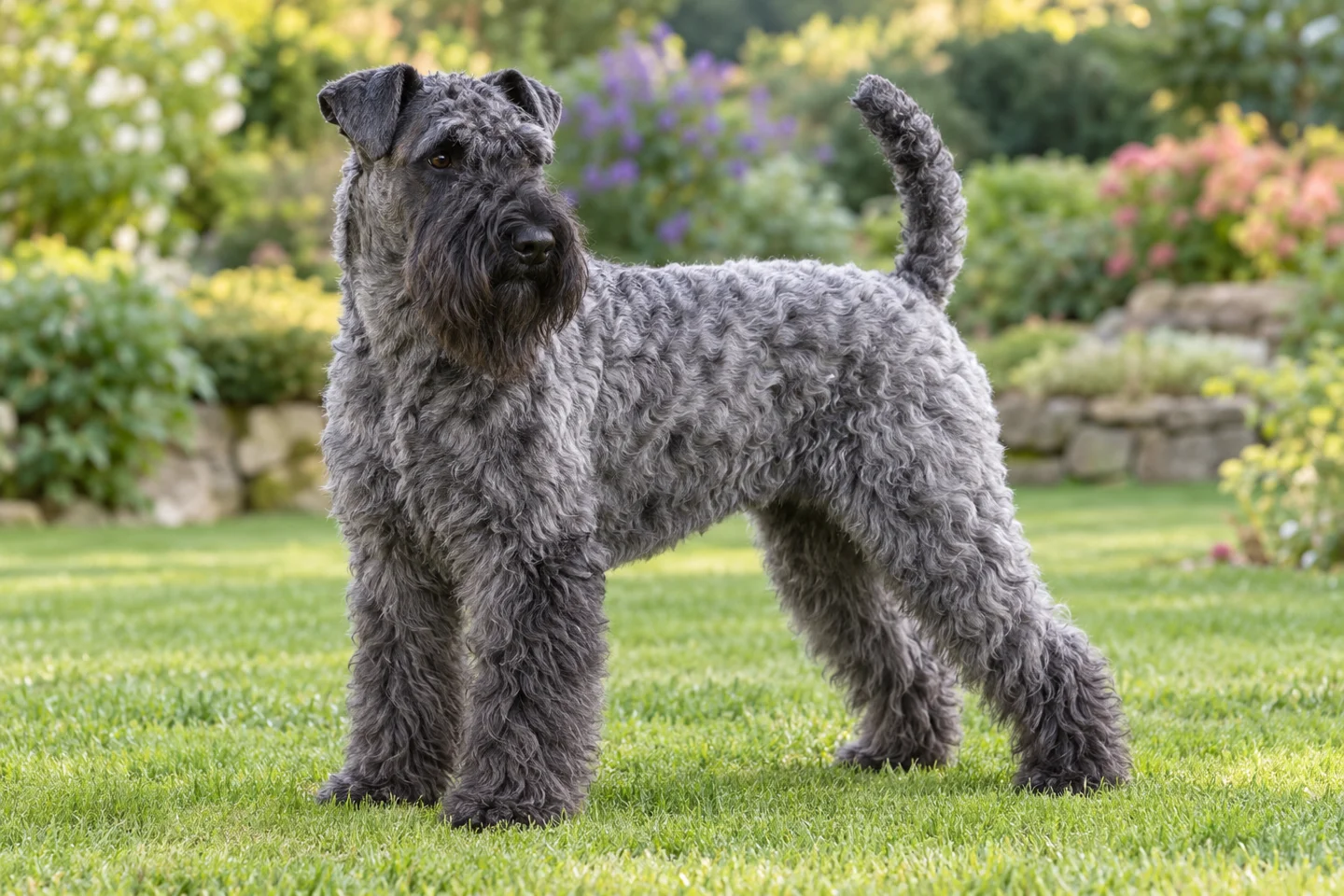
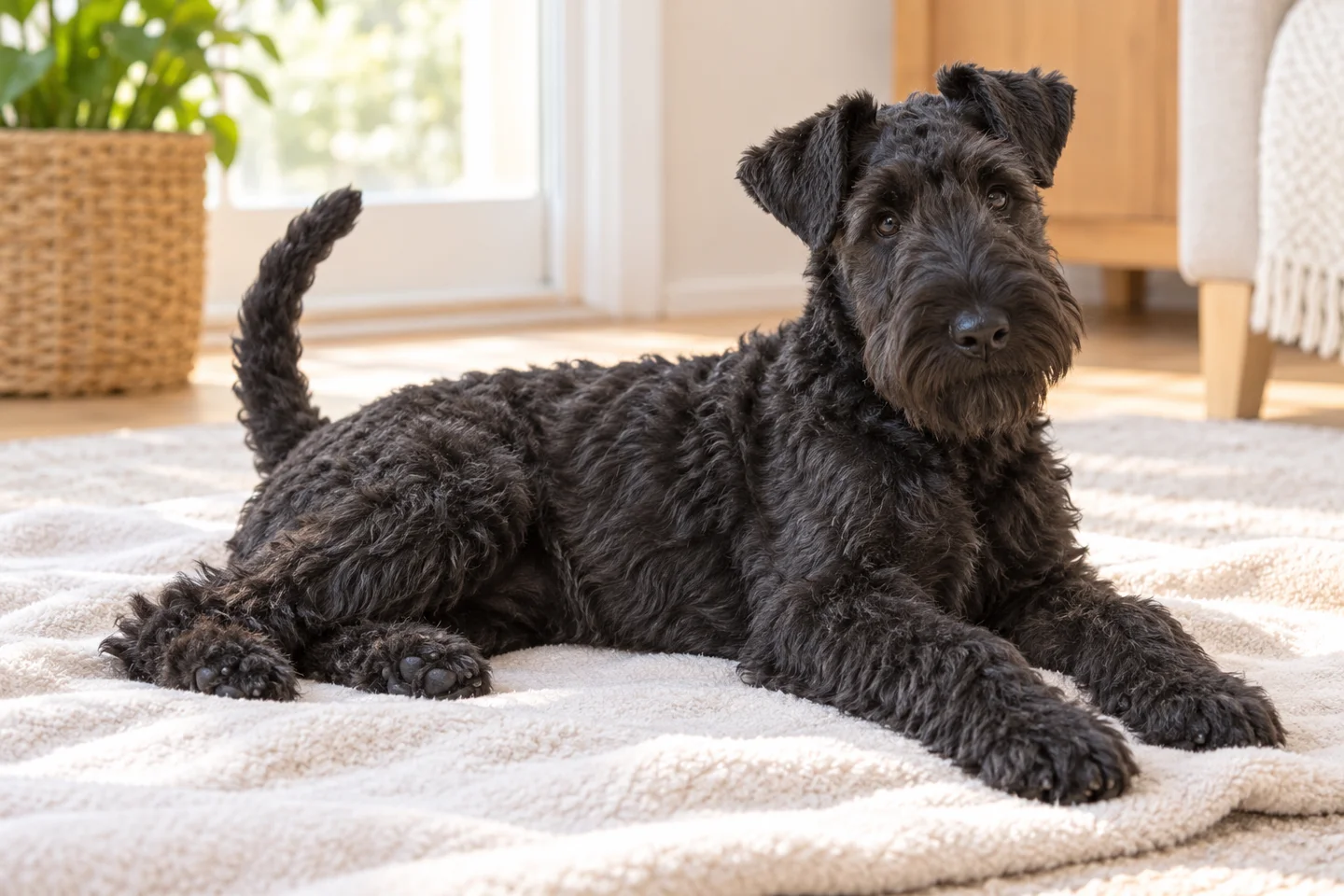
The FCI height ranges are 45.5–49.5 centimeters for males and 44.5–48 for females. Its male weight reference is 15–18 kilograms, with females proportionately less. The adult coat is soft, plentiful, and wavy, with blue shades and possible black points. The standard permits black and some tan in young dogs up to 18 months. This guide's adult images show blue-grey, while the puppy example is predominantly black. An illustration cannot predict when or how a particular puppy's coat will clear.
The long furnished head and small folded ears should belong to a balanced functional body. Watch actual movement rather than selecting for a dramatic trim or a very heavy silhouette. Fit equipment against the animal under the hair and reassess after growth or a grooming change. Prepare travel restraint and a rest area for adult measurements. The standard's numbers help with context, but a veterinarian should assess the individual's condition. Feeding toward a fixed adult weight without considering build and stage of growth is not an appropriate care plan.
Terrier attention inside the house
Ask what the Kerry does when movement begins around it. Does it follow activity, carry objects, watch a window, or settle again readily? Describe your household's pace to the breeder or rescue, including children, visiting pets, and hours alone. Broad words such as spirited do not tell you how to organize a busy kitchen or a quiet working afternoon. Useful information includes what triggers excitement and what has already helped the dog return to rest.
Give the new arrival a predictable place to sleep and limit unnecessary commotion while it learns the home. Reward quiet choices and teach an alternative to crowding a door or following every person. Avoid creating a routine in which the animal must become increasingly excited before it receives attention. If settling remains difficult, review triggers and seek help. A terrier's alertness gives context, but it should not become an excuse to leave persistent distress, pacing, or conflict unaddressed. The routine needs to work for the individual and the people sharing the space.
Training with clear tasks and humane methods
Teach practical responses before you need them under pressure. Moving onto a mat, returning from a short distance, and waiting while the lead is fitted can improve daily handling. Start in a quiet place and reward the action promptly. Keep the task simple enough that you can tell whether the dog understands it. If attention disappears outside, reduce the distraction and practice closer to the stage already learned rather than repeating the cue more forcefully.
AVSAB recommends reward-based methods and advises against aversive techniques. Choose an instructor who can explain how the desired behavior will be taught and how difficult situations will be managed meanwhile. Physical confrontation is not a useful substitute for an unclear lesson. Teach handling separately so a routine cue does not reliably predict being held through an unpleasant procedure. Use short sessions and record the conditions under which the response succeeds. Consistency across carers helps the animal understand the same task rather than guessing which person's rules apply.
Exercise with controlled outlets for curiosity
Arrange appropriate walks, exploratory activity, and short learning tasks for the dog's age and fitness. A Kerry's working background does not supply a universal daily mileage. Ask the veterinarian about growth, joint comfort, recovery from illness, or a planned sport. Look at movement and recovery afterward. Repeated stiffness, unusual fatigue, or a change in willingness to join normal activity deserves assessment rather than being dismissed as stubbornness or a temporary lack of interest.
Use secure equipment and suitable enclosed space where freedom is appropriate. Inspect boundaries and do not treat the first encounter with wildlife as a test of recall. Keep a calmer alternative for weather or household disruption. In heat, adjust timing and effort and preserve water and rest. More activity is not always better when a dog is already highly aroused. Review the quality of the routine and whether it has a clear end, rather than extending exciting games indefinitely in the hope that exhaustion will produce reliable household calm.
Children and handling a furnished face
Children should interact with the Kerry under active adult supervision and allow it to leave. The beard and brows are not handles, and a dog resting or eating should be protected from interference. Explain the rules before an excited visit and provide a place children cannot follow it. Do not ask a child to hold the collar, remove an object, or keep the animal still for grooming. Those tasks require an appropriate adult plan.
Ask the source about specific ages and activities the dog has encountered. Calm contact with one older child cannot establish safety around every younger child or running group. Choose shared activities that keep the arrangement simple, such as a child preparing a search while an adult manages the dog. Stop before excitement or competition increases. If supervision is interrupted, separate comfortably. A positive breed reputation or affectionate behavior with familiar adults cannot replace observation and prevention in a different situation involving children.
Aggression deserves a factual record
If the Kerry threatens over a resource, snaps during trimming, or lunges at another dog, write down the actual sequence. Note who approached, what the dog had, the distance, and whether it could leave. Prevent repetition while seeking qualified advice. New sensitivity during touch or movement should be discussed with a veterinarian, since discomfort can change behavior. Avoid treating all incidents as ordinary terrier character, which tells a professional little about the cause.
Do not punish warnings or arrange another confrontation to demonstrate control. VCA explains that aggression toward unfamiliar dogs can involve different motivations, and releasing a lunging dog is an unsafe way to investigate. Use barriers, distance, and separate resources as appropriate. Work with a qualified professional on a plan that carers can follow. Tell future handlers about snaps, bites, and near misses accurately. The absence of another incident under careful management is useful information, but it does not automatically prove the original trigger has become safe.
Other dogs cats and smaller animals
Discuss dog compatibility before placement rather than assuming every Kerry wants close play. Ask about actual partners, including sex, size, energy, and the settings in which contact occurred. A dog may share a home comfortably while finding a close greeting at a gate difficult. Begin introductions where both handlers can move apart and keep valuable items out of the initial setting. Watch whether each animal can disengage and settle, not simply whether the first moments look lively.
Take chasing interests seriously around cats and small pets. A working terrier background makes questions about observed behavior sensible, without predicting that every individual will act identically. Give cats protected routes and maintain secure housing for smaller animals. Never hold an animal still for inspection or use a chase as a test. If continuing separation may be necessary, decide whether the household can maintain it before arrival. Responsible planning includes recognizing a pairing that is unsuitable, even when both animals are pleasant in other contexts.
Grooming a soft wavy coat
A Kerry's coat needs regular maintenance and a knowledgeable grooming plan. Ask a groomer to demonstrate the tools and technique for the individual, including work behind the ears, beneath equipment, and around the legs. Check down to the skin instead of judging only the outer trim. Tight mats can be painful and should be handled professionally when skin is hidden. VCA warns against scissors used close to the body on tangled hair.
Separate companion comfort from a particular show outline. Discuss how much maintenance you can perform and choose a practical plan with the groomer. The beard needs inspection after eating and drinking, and wet furnishings should be kept comfortable. Persistent odor, redness, irritation, or sudden resistance to brushing requires veterinary advice. A low-shedding description should never become a promise of no grooming or no allergic reactions in a person. Meet real dogs and consider household needs rather than using coat marketing to decide a medical or practical question.
Cooperative care before a full trim
Teach a stable standing position on a nonslip surface and reward brief comfortable participation. Build gradually toward touching the face, lifting an ear, or examining a foot. Avoid holding the dog through a long struggle simply because an appointment or checklist must be completed. Ask the veterinary team or groomer how to proceed if it is painful or worried. A planned approach can preserve access to necessary care and reduce the pressure of improvising later.
Keep a record of what the animal accepts and which areas need attention. Ear odor, discharge, head shaking, or pain calls for examination rather than leftover drops or deep swabs. Ask about appropriate mouth care and nail maintenance. Share useful handling information when changing professionals. The goal is not motionlessness at any cost; it is comfortable care with an appropriate medical plan when ordinary handling is insufficient. A terrier that suddenly resists a familiar procedure may be communicating a change worth investigating.
Health evidence for the Kerry Blue Terrier
The AKC's current national-club recommendations list hip evaluation and ophthalmologist evaluation for Kerry Blue Terriers. Request identifiable reports, their dates, and the findings. Ask which current program the source follows and what further family information it considers. A health-tested label does not tell you whether a general examination, structural assessment, or selected DNA panel was performed. Those provide different kinds of evidence and should be interpreted accurately.
Review significant diagnoses in relatives and ask how later owner information is collected. Screening cannot promise lifelong freedom from illness, and a broad genetic panel cannot replace examination of present symptoms. For an adult with missing family records, keep the uncertainty clear and build care from current findings. Report persistent changes in skin, appetite, movement, vision, or exercise tolerance. An attractive blue coat or successful working demonstration is useful to observe, but it cannot establish normal findings in body systems that need their own clinical assessment.
Feeding and the routine between appointments
Select a complete food appropriate to life stage and any medical needs, then review portions with your veterinarian. Measure actual intake and include teaching rewards. Hair can alter the apparent shape, so learn a body-condition assessment and keep weights over time. AAHA's guidance limits extras to preserve balanced nutrition. Give every carer the same instructions and record significant changes instead of assuming a busy dog cannot gain excess weight.
Ask the clinic about prevention for local and travel risks and keep current medical records accessible. Persistent changes in drinking, eating, elimination, or weight warrant advice. Know the urgent-care route for collapse, severe breathing difficulty, serious injury, suspected poisoning, or repeated unsuccessful retching. Follow the receiving team's instructions and avoid human medicines or another animal's prescription. A dog may briefly look lively between episodes, so describe the full pattern. Practical organization helps ensure that care does not depend on the usual owner being present at exactly the right time.
Mixes and the responsibility behind the purchase price
A Kerry mix may have a different adult size, coat texture, or response to other animals. Ask what parentage is documented and what the label is based on. A blue-grey coat cannot identify all ancestors, and a crossbreed name does not guarantee easier care or freedom from disease. Review known parental findings where possible and use direct observations of an adult's daily needs. Preserve uncertainty rather than turning a visual guess into a promise.
Obtain current local costs for food, veterinary prevention, grooming, training help, and care during work or travel. Include the time needed to keep the coat comfortable between appointments. Ask a breeder or rescue what support follows placement and what happens if the home becomes unsuitable. Read written terms before committing. Scarcity, a fashionable trim, or an attractive puppy should not hurry the decision. A suitable home can provide the ordinary routine consistently while adapting to health, activity, and handling needs as the dog matures.
dogsDating introductions for a particular terrier
A dogsDating profile should describe the Kerry's observed preferences and any professional restrictions. Keep exact coordinates and the home address private. Use an approximate area to agree on a public route with enough width to create space. Each adult should manage their own dog and understand that a close greeting may not happen. Choose a setting that lets either person end the meeting easily rather than trapping the pair on a narrow path.
Start with parallel walking at a distance where both animals can look away and respond comfortably. Keep shared toys and food competition out of the first plan. Watch for stiffness, fixation, or repeated attempts to avoid the partner and increase space or finish when needed. A useful match can be another calm walking dog rather than a physical playmate. Record the conditions that helped and repeat them next time. Social company is valuable when it improves the outing, while compulsory contact adds pressure neither dog needs.
Sources and editorial notes
Sources checked October 21, 2026. Breed measurements describe reference ranges, not a diagnosis or an individual dog's ideal weight. Images are AI-generated breed illustrations and do not document a particular dog or health condition.
- AVSAB: Humane Dog Training Position Statement
- VCA Animal Hospitals: Food aggression in puppies
- VCA Animal Hospitals: Common emergencies in dogs
- Orthopedic Foundation for Animals: CHIC health screening programs
- VCA Animal Hospitals: Aggression toward unfamiliar dogs, diagnosis
- VCA Animal Hospitals: Grooming and coat care for your dog
- VCA Animal Hospitals: Ear infections in dogs (otitis externa)
- AAHA: Feeding plans for healthy, appropriate weight cats and dogs
- VCA Animal Hospitals: Heat stroke in dogs
- AVSAB: Puppy Socialization Position Statement
- VCA Animal Hospitals: Dog behavior problems, aggression toward children
- FCI: Kerry Blue Terrier official breed standard
- AKC: Terrier Group Health Testing Requirements
Keep getting to know dogs.
Read another guide or return to your dogsDating community.
Explore breed guidesBack to dogsDating