Kuvasz
A large Hungarian guardian with a wavy white coat, clear visitor routines, and practical guidance on screening, handling, and safe introductions.
How these guides are researched and reviewed
- Origin
- Hungary
- Adult height
- Males 71–76 cm; females 66–70 cm
- Adult weight
- Males 48–62 kg; females 37–50 kg
- Coat
- Dense white wavy double coat
General information for owners. These articles have not been reviewed by a veterinarian. Medical decisions need your dog's history and an examination.
A Hungarian guardian with a white wavy coat
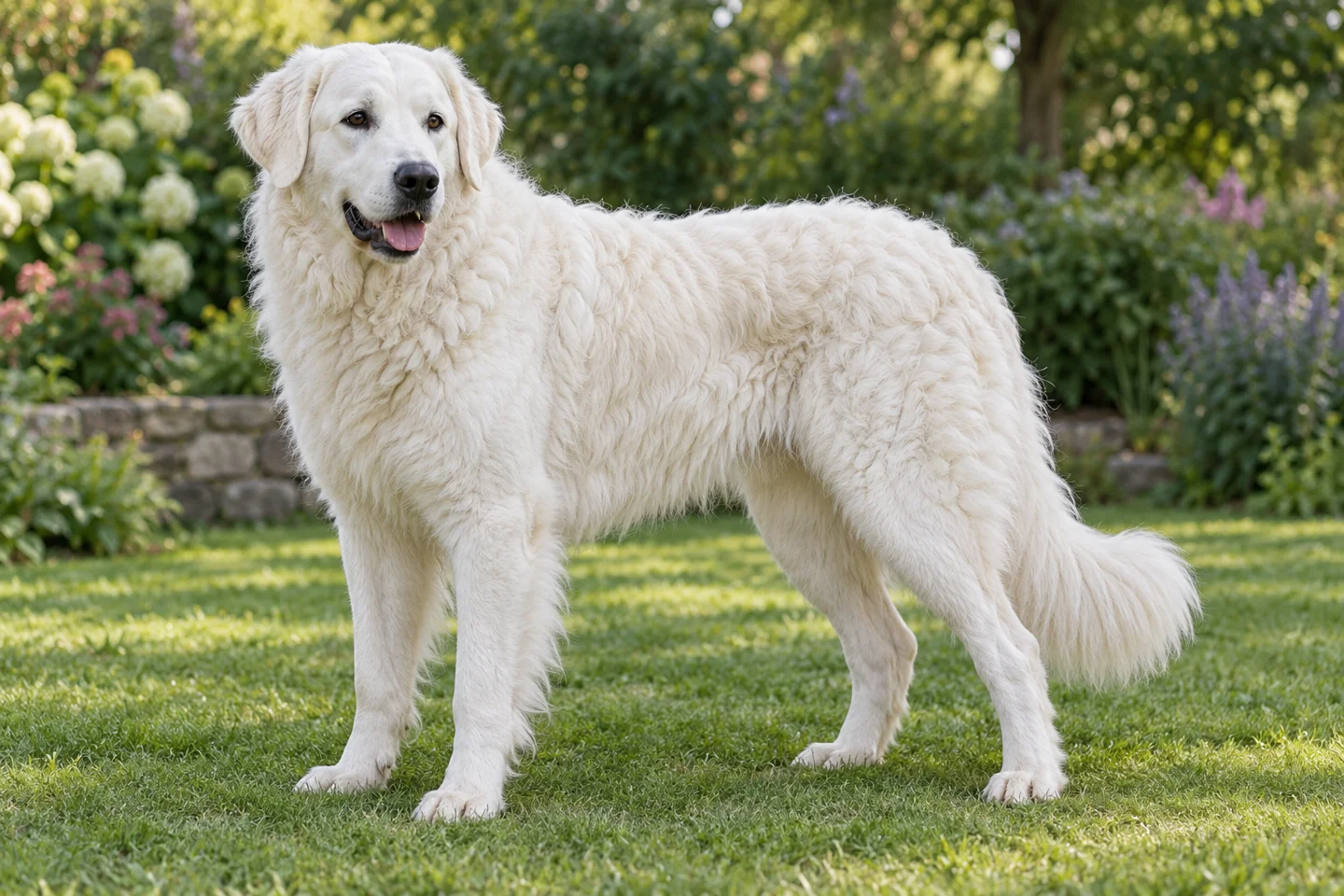
The Kuvasz is a large Hungarian guardian with a dense white coat, a wedge-shaped head, and a strong, athletic body. Its coat is wavy rather than corded. It is a separate breed from the Komondor and the Great Pyrenees, even though photographs of large pale guardian dogs are sometimes mislabeled. Correct identification matters when looking for breed records, health recommendations, or a breeder who understands the dog's development.
A Kuvasz can become a substantial presence in household decisions unless people establish practical routines early. Consider how visitors will enter, where deliveries will be left, and how the dog will be secured when a gate opens. The breed's guarding background is relevant to those arrangements, but it does not establish that an individual dog will protect safely or recognize every harmless visitor. Choose a dog whose observed temperament fits the household and obtain support before difficult situations become routine.
History and work that shaped ownership needs
The FCI standard describes the Kuvasz as a long-established Hungarian shepherd dog used to guard flocks, people, and property. It also records hunting and scenting work in the breed's history. Historical accounts explain why independent observation and responses to unfamiliar movement matter when discussing a modern companion. They do not mean that every suburban garden gives a dog suitable work or that barking through a boundary is harmless.
A present-day owner should ask what the dog's parents actually do. Livestock work, exhibitions, and household companionship expose dogs to different experiences, even within the same breed. Meet adults and ask how they behave when invited guests arrive, when unfamiliar dogs pass, and when a person needs to inspect an injury. Photographs beside livestock cannot replace those questions. A breeder who explains both strengths and management difficulties provides more useful information than a promise that the puppy will instinctively make correct decisions.
Adult size and room for a powerful body
The FCI standard gives males a height of 71–76 cm at the withers and a weight of 48–62 kg. Females measure 66–70 cm and weigh 37–50 kg. These figures describe adult standard references; they are not instructions to make a young dog grow as quickly as possible. Ask a veterinarian to assess body condition and growth rather than feeding toward the upper end of a published range.
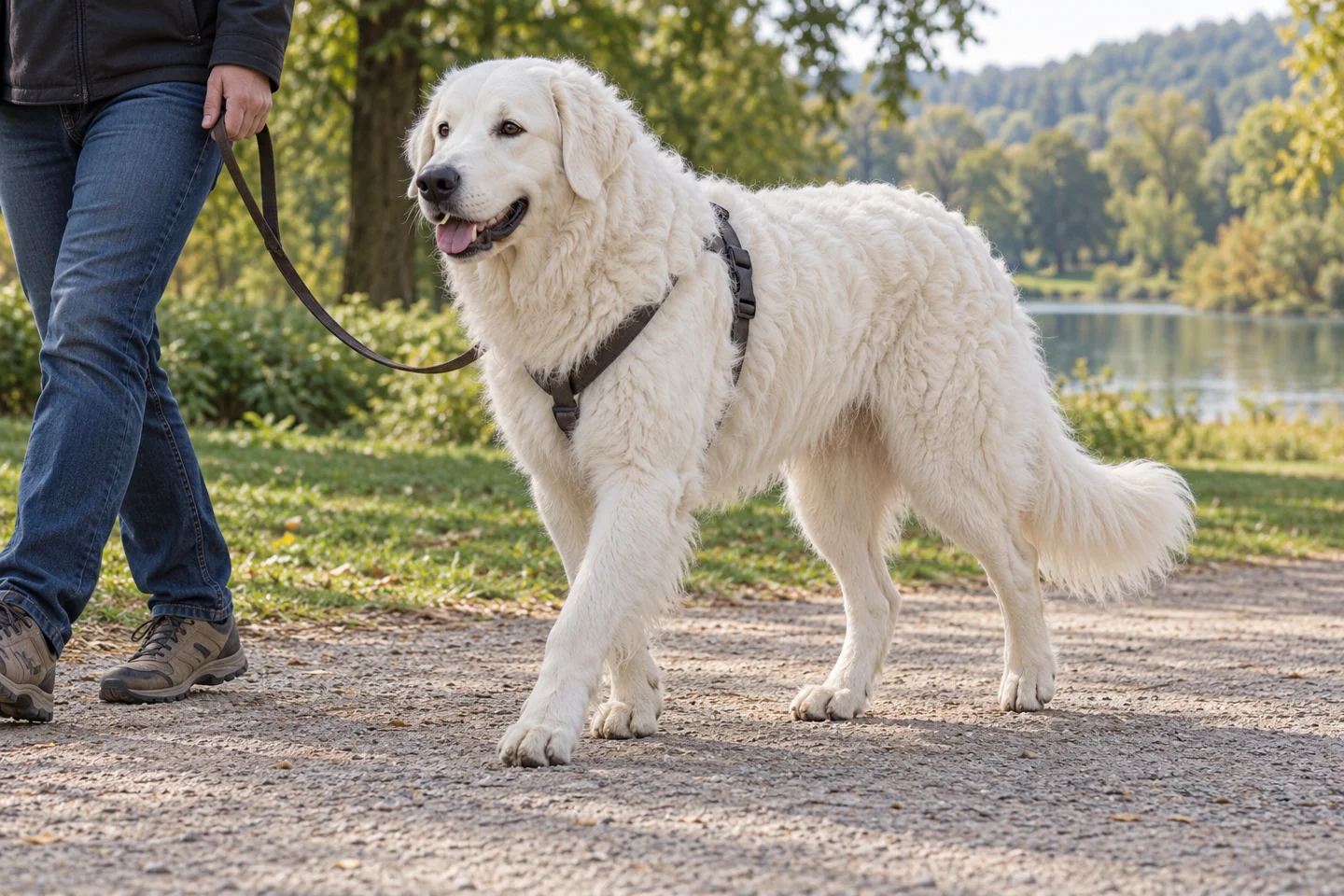
The Kuvasz has a body slightly longer than its height, strong limbs, natural pendant ears, and a full tail. Its coat creates volume around an already large dog. Measure the available space in a vehicle and check whether an injured adult could be transported safely. Choose sturdy gates, a harness that permits movement, and leads that an adult handler can use comfortably. A child should not be responsible for restraining this dog in public, regardless of how gentle it appears at home.
Temperament and the visitor routine
Expect to teach a Kuvasz what to do when someone arrives rather than relying on a vague instruction to be friendly. A dog may welcome familiar people and remain cautious with a new guest. Place the dog in a comfortable secure area before the door opens, settle the visitor, and decide whether an introduction is appropriate. The visitor should follow the owner's plan rather than reaching over a gate to prove confidence.
A quiet retreat must remain available after the first greeting. Workers carrying ladders, running children, and guests who move unpredictably can create a different situation from a seated adult. Manage each change instead of assuming the original introduction covers the whole visit. Rehearse the routine with familiar helpers when the dog is calm. If barking, lunging, or prolonged vigilance prevents recovery, seek help rather than inviting more people to expose the dog until it stops reacting.
Training that an independent dog can understand
Teach clear household skills with rewards and manageable steps. Coming away from a fence, walking beside a handler, waiting while a gate opens, and settling behind a barrier all make life safer. Practice before the dog is confronted by an exciting distraction. A large dog that knows sit in the kitchen still needs careful teaching to respond beside a delivery vehicle or another barking dog.
Use outcomes the individual values, which may include food, a chance to sniff, or permission to move forward. Keep sessions short enough to retain attention and avoid repeatedly issuing a cue the dog cannot follow in that setting. Physical confrontations and harsh corrections can make handling more dangerous and damage trust. For cooperative care, build a relaxed response to touch, brief restraint, and veterinary equipment. Do not wait until an adult needs painful treatment before discovering that nobody can safely examine its feet.
Socialization with distance and useful choices
A Kuvasz puppy needs varied, controlled experiences with people, surfaces, traffic, and ordinary household events. Start at a distance where it can notice something new without becoming overwhelmed. Allow it to look, take food if comfortable, and move away. Contact is optional. Being held while strangers lean over its head can teach a different lesson from quietly observing a person who respects space.
Continue that work as the dog matures. Responses can change with experience, development, pain, and the intensity of the situation. Keep notes about what the dog handles easily and what requires more preparation. Socialization cannot guarantee acceptance of every dog or person, and it should not become a reason to ignore warning signals. If the dog repeatedly freezes, barks, or tries to escape, reduce the challenge and ask a qualified professional to help build a plan that preserves everyone's ability to leave safely.
Exercise with boundaries and time to rest
Provide regular walks, opportunities to sniff, and suitable activities that keep a Kuvasz engaged without encouraging uncontrolled patrols. A fenced area is useful only when the boundary is secure and the dog can settle there. Repeatedly running at passersby can rehearse behavior that becomes difficult to interrupt. Consider visual screening, supervised time outside, and quieter exercise routes if the boundary keeps the dog on alert.
Adjust activity to age, health, terrain, and weather. Growing puppies need sensible movement and rest rather than forced long runs. An adult's willingness to keep walking does not prove that heat or joint strain is harmless. Carry water, choose cooler periods in warm weather, and plan a route with places to stop. Cold-weather working ancestry does not provide protection from heat illness. After exercise, assess recovery and comfort as well as distance covered; stiffness or reluctance the next morning warrants a change in the plan.
Children and the difference between affection and safety
A Kuvasz that is affectionate with household children still needs active adult supervision. Its size alone can knock a child over, and it may respond differently when visiting children shout, wrestle, or run toward someone. Separate the dog before rough play begins rather than expecting it to understand which apparent conflict is a game. Give it a protected sleeping area and keep children away from food, chews, and veterinary care.
Teach children to call the dog toward them instead of pursuing it and to stop touching when it moves away. Hugging the neck, climbing on the back, and leaning over a resting dog should not be part of play. Adults must notice changes such as stiffness, a closed mouth, avoidance, or prolonged staring and end the interaction. Never ask a child to correct guarding behavior or retrieve something from the dog's mouth. Physical barriers provide a dependable option when adult attention needs to move elsewhere.
Aggression and preventing avoidable confrontations
A bite risk assessment needs the individual dog's behavior, history, health, and circumstances. Breed descriptions cannot identify which visitor will be safe to approach. A Kuvasz that stiffens when someone enters its space is communicating information that should change the plan. Increase distance, secure the dog calmly, and prevent the person from continuing forward. Testing its tolerance by repeating the approach puts people and the dog at unnecessary risk.
Seek veterinary assessment for a sudden behavioral change or reactions connected to touch and movement. Pain may contribute even when a dog still eats and walks. For persistent guarding or defensive behavior, work with a qualified reward-based professional on realistic management and training. A basket muzzle can be introduced gradually when extra protection is needed, but it cannot replace distance or secure boundaries. After any bite, arrange appropriate human medical care, document the circumstances, and obtain professional guidance before recreating the situation.
Other dogs, livestock, and household cats
Introduce another dog on neutral ground with separate handlers and enough room for parallel walking. Avoid narrow gateways where a large dog can block movement. Familiarity develops over repeated calm experiences, and early play does not establish that food or resting spaces can be shared. Feed separately, remove valuable chews during introductions, and provide several comfortable places where neither dog must pass close to the other.
Livestock guarding history does not mean a puppy can be left to learn around vulnerable animals without supervision. Appropriate behavior needs assessment and guidance, especially around running stock and newborn animals. Introduce household cats through barriers, maintain elevated escape routes, and prevent chasing. A cat that stops moving because it is frightened is not consenting to contact. For any new animal, decide in advance how separation will work if the introduction fails. Owners should be able to maintain safe arrangements without depending on someone physically holding back an excited adult Kuvasz.
Grooming the wavy double coat
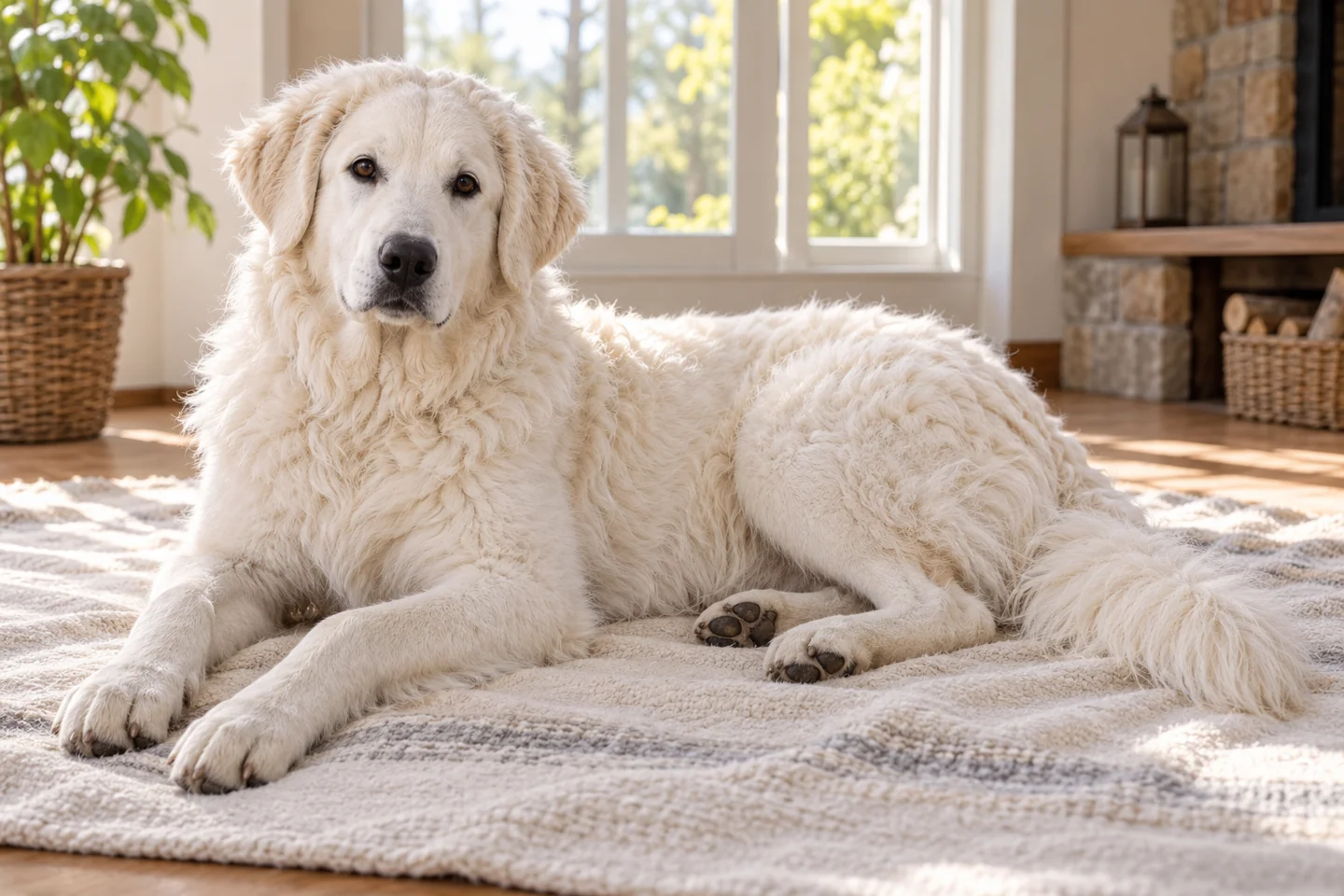
The Kuvasz has a dense coat with a wavy outer layer and undercoat. Brush and comb methodically so loose hair and tangles are removed without scraping the skin. Pay attention to the areas behind the ears, around the hindquarters, and under equipment. A pale coat can make surface dirt obvious while concealing skin irritation beneath it, so part the hair during checks rather than judging cleanliness from a photograph.
Expect grooming needs to change with shedding and outdoor conditions. Dry the coat properly after bathing and avoid assuming that a thick coat can remain damp against the skin indefinitely. Discuss major coat changes with a veterinarian or experienced groomer. Maintain nails, introduce tooth brushing, and inspect ears for soreness, discharge, or odor. Handling practice should make these tasks predictable. If the dog resists a particular area unexpectedly, check for pain instead of using greater force to complete the grooming session.
Health screening and records that matter
The AKC's current working-group health-testing recommendations list hip evaluation, elbow evaluation, and thyroid evaluation for the Kuvasz. Ask for the named dog's actual results and the dates of assessment, rather than accepting a general statement that a line is healthy. Have the breeder explain how those records informed the mating and whether relatives have had significant mobility, endocrine, or other medical problems.
An evaluation reduces uncertainty about a particular issue; it cannot predict every disease an offspring might develop. An ordinary puppy examination also does not replace adult parental screening. Share the records with your veterinarian and agree on a care plan appropriate to the dog's growth and circumstances. Avoid adding a long list of mandatory genetic tests simply because other large breeds use them. If a breeder offers additional results, ask which condition they address, whether the test applies to this breed, and what the result actually establishes.
Mobility, discomfort, and urgent changes
Watch the way a Kuvasz rises, turns, climbs into a vehicle, and recovers after activity. Difficulty with these ordinary movements can be easier to recognize than a clear limp. Keep a short record of changes and, when safe, a video for the veterinarian. Prevent repeated slipping with suitable flooring and use an appropriate ramp if recommended. Do not give human pain medicines without veterinary direction or treat reluctance to move as a training problem.
Know the emergency clinic route before an emergency occurs. Repeated unsuccessful attempts to vomit, a swollen abdomen, collapse, severe breathing trouble, or rapidly worsening distress need urgent veterinary contact. A large dog can be difficult to lift, so discuss transport arrangements while it is well. These signs do not identify a diagnosis from home, and an online conversation should not delay care. Keep medication names, current weight, and medical history accessible so another adult can communicate clearly if the regular carer is unavailable.
Feeding a growing large dog and an adult guardian
Choose food suitable for the dog's life stage, including an appropriate large-breed growth food for a puppy when advised by your veterinarian. Measure portions and review them as growth and activity change. Extra calcium or other supplements can interfere with a balanced growth diet, so ask before adding products. The aim is steady development and a suitable body condition, rather than producing the largest puppy in the litter.
For an adult, use hands as well as eyes to assess ribs and waist through the coat. Count chews and training rewards in the day's intake. Feed in a quiet location where other animals and children cannot approach the bowl, and avoid repeatedly taking food away to test tolerance. Discuss persistent weight loss, appetite changes, vomiting, or loose stools with the veterinarian. A homemade diet needs professional formulation; meat and supplements combined by guesswork do not automatically provide complete nutrition for a large dog.
Mixes and planning for the dog you actually have
A Kuvasz cross may inherit a different size, coat, sociability, and response to unfamiliar people from either parent. A crossbreed label cannot promise a softer guardian instinct or guarantee that shedding will decrease. For a planned litter, request appropriate screening for both parental breeds and ask about adult relatives. For a rescue dog of uncertain ancestry, prioritize observed behavior, examination findings, and the practical management the household can provide.
Discuss restrictions, housing rules, and insurance arrangements before committing to any large guardian or mix. A suitable home needs people who can maintain secure boundaries and consistent visitor routines, including when they are tired or away. If daily life requires frequent unstructured encounters with strangers, explain that honestly to a breeder or rescue. It is better to choose an individual suited to those circumstances than expect affection within the family to override every difficulty outside it.
Costs and care when the usual handler is away
Obtain local estimates for food, routine veterinary care, emergency treatment, grooming equipment, transport, and boarding that can accommodate a large guardian. A strong gate and suitable vehicle restraint are part of care costs, not optional extras to consider after a problem. Arrange an emergency reserve or suitable insurance and read exclusions carefully. Fixed price claims are rarely useful because region, medical history, and available services change the amount substantially.
Introduce potential carers while you are present and the dog is comfortable. Write down how entrances are managed, where equipment is kept, and which situations require separation. Confirm that a boarding service understands the individual dog's needs instead of relying on a friendly greeting during one visit. A practiced handover is particularly valuable if illness suddenly removes the usual handler. Keep the dog's veterinary permission and emergency contacts available, and make sure another adult can transport it safely if circumstances require.
dogsDating meetings with room for separate decisions
Describe a Kuvasz honestly on dogsDating, including comfort around unfamiliar dogs, visitor sensitivity, and the distance needed for a calm walk. Share an approximate area while keeping exact home coordinates and your address private. Choose a quiet public location with broad paths and separate ways to leave. An initial meeting should not take place inside the dog's guarded home or require the other person to pass through its gate.
Start with parallel walking and separate handlers. Keep leads organized, leave toys and shared treats out of the interaction, and watch both dogs rather than concentrating on conversation. A calm short walk is a useful outcome even if the dogs never touch. Stop when either animal needs more space, and do not interpret repeated pushing or pursuit as a requirement to sort things out. Before arranging another meeting, compare observations about recovery and comfort. Each handler should be free to decline without pressure to prove that the dogs can become friends.
Sources and editorial notes
Sources checked October 21, 2026. Breed measurements describe reference ranges, not a diagnosis or an individual dog's ideal weight. Images are AI-generated breed illustrations and do not document a particular dog or health condition.
- AVSAB: Humane Dog Training Position Statement
- VCA Animal Hospitals: Food aggression in puppies
- VCA Animal Hospitals: Common emergencies in dogs
- Orthopedic Foundation for Animals: CHIC health screening programs
- VCA Animal Hospitals: Aggression toward unfamiliar dogs, diagnosis
- VCA Animal Hospitals: Grooming and coat care for your dog
- VCA Animal Hospitals: Ear infections in dogs (otitis externa)
- AAHA: Feeding plans for healthy, appropriate weight cats and dogs
- VCA Animal Hospitals: Heat stroke in dogs
- AVSAB: Puppy Socialization Position Statement
- VCA Animal Hospitals: Dog behavior problems, aggression toward children
- FCI breed standard 54: Kuvasz, Hungarian history, guardian temperament, coat and adult measurements
- American Kennel Club: Working Group health testing requirements, including Kuvasz hip, elbow and thyroid evaluations
Keep getting to know dogs.
Read another guide or return to your dogsDating community.
Explore breed guidesBack to dogsDating