Otterhound
A large British rough-coated scenthound, with guidance on water safety, scent-led training, grooming and breed-specific health records.
How these guides are researched and reviewed
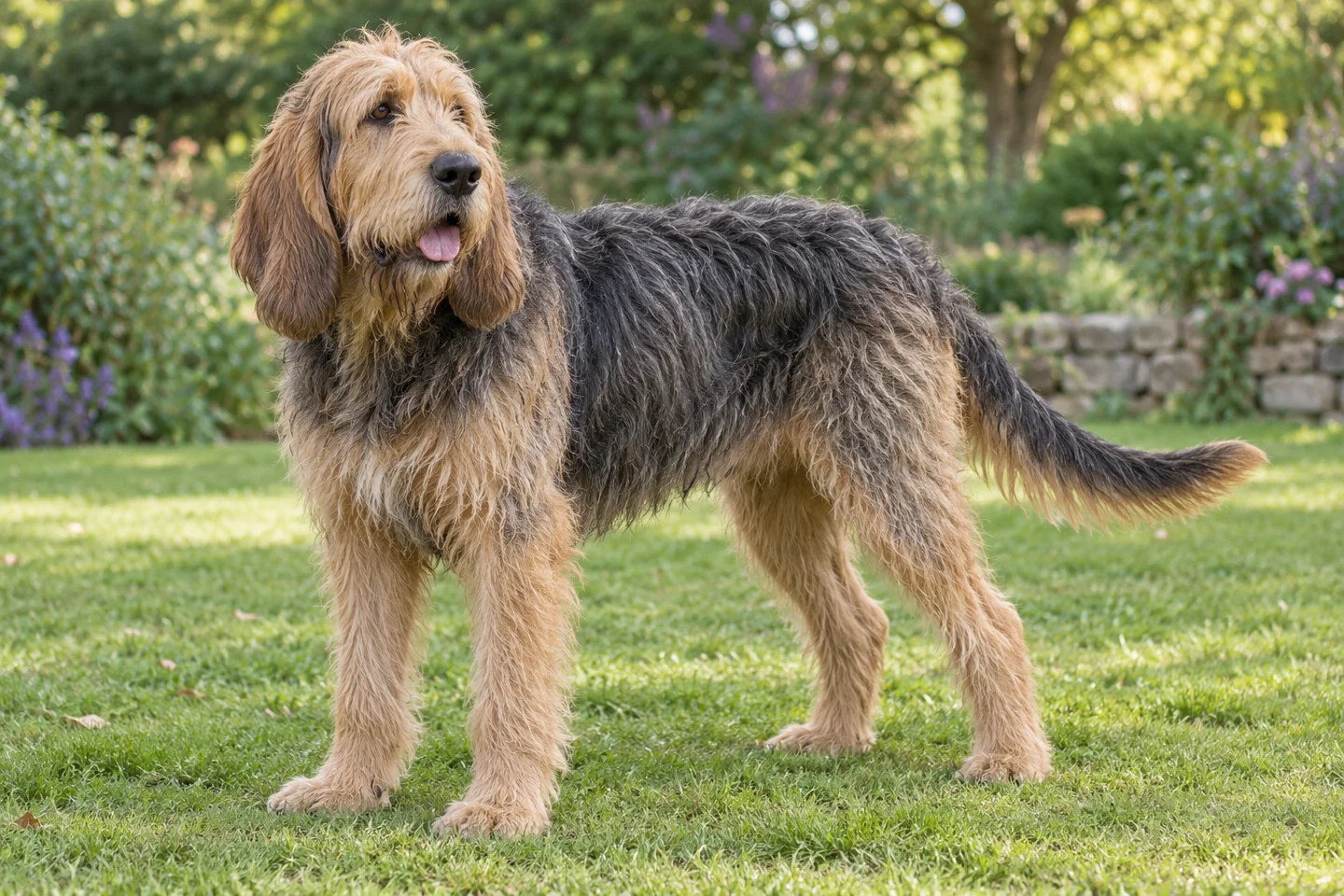
- Origin
- Great Britain
- Adult standard height
- Males approximately 69 cm; females approximately 61 cm
- Coat
- Harsh shaggy coat with natural pendant ears
General information for owners. These articles have not been reviewed by a veterinarian. Medical decisions need your dog's history and an examination.
A large rough hound with practical household needs
The Otterhound is a substantial British scenthound with a shaggy coat, a broad head, and long hanging ears. Its outline can make it look like a large bearded companion, but its working history belongs in the decision to bring one home. A nose-led dog needs safe opportunities to investigate, equipment that fits, and people who can manage its size when a promising smell appears beside the pavement.
Start by considering ordinary inconveniences. The dog may return from a walk with water in its beard, plant material in its coat, and considerable enthusiasm for investigating the kitchen. A home that can accommodate washable surfaces and a protected resting area will be easier to manage than one that depends on keeping the dog away from every practical activity. Meet adults where possible. Ask what happens after a wet walk, during a delivery, and when the family leaves for work, rather than judging suitability from a quiet photograph.
History without recreating an old hunting day
The current FCI standard describes a hound built for lengthy work on land and in water. The breed's traditional quarry gave it its name. That history helps explain why scent, water, and persistent exploration matter in modern care, but it does not require owners to recreate hunting conditions. A companion can use its nose through searches, structured trails, and walks that allow investigation without endangering wildlife.
Ask about the particular line and the experiences a puppy has already had. A dog reared around several other hounds may need deliberate preparation for quiet periods alone, while a dog accustomed to domestic routines may still find a busy street unfamiliar. Working descriptions are broad expectations, not instructions to ignore the animal in front of you. Before a purchase or adoption, agree who will teach lead skills, maintain boundaries, and provide the slower sniffing outings that may be less convenient than a quick circuit around the block.
Adult dimensions and transport planning
The October 2026 FCI standard gives approximate heights at the withers of 69 cm for males and 61 cm for females. It does not turn those figures into a fixed adult weight prescription. Frame, condition, and health matter when judging an individual. Ask the veterinarian to assess the waist and ribs beneath the coat, and record weight changes so a gradual increase does not disappear into the shaggy outline.
Plan equipment around the grown dog. Measure the vehicle compartment, check that the animal can stand and turn in a suitable travel space, and think through how an injured adult would reach veterinary care. Teach a comfortable response to a ramp or low step before it is urgently needed. Practice when nobody is in a hurry, reward a voluntary step, and keep the surface stable. A ramp that slides or makes a loud noise beneath the paws can create a problem that persists into future journeys. A strong lead is useful, but it cannot replace training or a handler who can maintain balance. Children should not be assigned sole responsibility for walking an adult Otterhound beside traffic, water, or unfamiliar dogs.
A water-oriented dog still needs water safety
Interest in water is different from understanding a current, a steep bank, or an unsafe entry point. Inspect the place before letting an Otterhound approach. Start in shallow, calm water with an easy exit and a handler close enough to help. A buoyancy aid that fits can be useful for suitable activities, but the dog still needs supervision and should never be thrown into water to discover whether it can swim.
Prevent access to canals, uncovered ponds, and floodwater at home or on walks. Rinse or clean the coat as advised after an outing, check the ears and feet, and let the dog rest and dry properly. Keep the lead or line arranged so it cannot catch around a submerged obstacle. If a dog struggles after swimming, coughs persistently, becomes weak, or seems unwell, contact a veterinarian. Confidence in a breed's traditional task should never delay assessment of an individual that is showing difficulty.
Training a nose that already has a plan
Reward an Otterhound for turning toward its name and for moving with the handler before a scent becomes all-consuming. Practice on a quiet path, then gradually introduce more interesting environments. Let sniffing become an earned part of the walk: a few comfortable steps together can lead to permission to inspect a verge. This makes cooperation relevant to the dog rather than presenting the lead as a device that constantly removes everything interesting.
Teach coming away from food preparation, waiting at a door, and settling while someone handles the beard or feet. Keep sessions brief and repeat useful tasks in different rooms. Avoid jerking the collar to interrupt investigation or shouting repeated recall cues when the dog is already out of reach. A well-fitted harness and an appropriate long line can preserve safety while learning continues. Seek practical instruction if the dog's pulling is already making walks unsafe; waiting for it to become stronger makes the physical problem harder.
Exercise through terrain, scent, and recovery
An Otterhound benefits from movement and investigation, but a daily exercise plan should fit its age and condition. Alternate purposeful walking with chances to sniff, and introduce uneven terrain gradually. A young dog needs rest between outings and should not be made to run long distances to prove that it belongs to a working breed. Older dogs may still enjoy following a short trail even when they cannot manage a previous route.
Watch recovery after activity. Stiffness, reluctance to climb into the car, or a change in stride may appear after the excitement has ended. Keep notes for the veterinarian if a pattern develops. In hot conditions, shorten outings, carry drinking water, and choose shade and cooler hours. Access to water does not cancel the risk of heat illness, especially if the dog remains highly excited. Avoid turning every walk into sustained chasing or repeated ball throwing; calmer exploration can meet important needs without keeping the dog in constant anticipation.
Children beside a powerful, enthusiastic hound
An Otterhound's height and movement can overwhelm a child even during friendly contact. Keep running games separate from dog time and teach children to invite the dog toward them rather than hang from its neck. Active supervision means an adult can notice the interaction and intervene promptly. If the adult needs to cook, answer a call, or help another child, place a barrier between dog and children.
Give the hound a resting space that children cannot enter. Keep meals, chews, and found objects outside children's reach, and ask an adult to manage exchanges. A shaggy face can make subtle changes around the mouth difficult to see, so notice stiffening, turning away, repeated retreat, and any attempt to hide. End contact when those signs appear. A dog that enjoys one child's calm company has not demonstrated that it will tolerate a group of visiting children competing over a toy nearby.
Aggression and conflict over things worth keeping
Describe concerning behavior in terms of what happened. An Otterhound that growls over a dropped sandwich needs a plan for food access and exchanges; calling it dominant does not explain the event. Prevent people from reaching into its mouth and move children away. Teach a trade with suitable low-value objects when the dog is relaxed, then build the skill under professional guidance if guarding is established.
Pain, fear, and frustration can contribute to defensive behavior. An abrupt change during ear handling or grooming warrants veterinary assessment before escalating restraint. Do not punish warning signals or deliberately repeat an incident to see whether the dog means it. A qualified reward-based professional can help identify triggers and build safe routines. Where added protection is needed, introduce a basket muzzle gradually with rewards. It should allow an appropriate fit and comfortable breathing, and it must not be used as permission to force an encounter the dog is struggling to tolerate.
Grooming that reaches beneath the rough surface
The rough coat needs regular attention that reaches the skin without scraping it. Work through the beard, legs, and areas where equipment rubs, checking for tangles, plant material, and hidden irritation. A naturally untidy outline should not be confused with neglect. Ask an experienced breeder or groomer to demonstrate appropriate tools and handling so the process remains manageable when the dog is fully grown.
Dry a wet beard and check skin that remains damp after drinking or an outing. Examine the long ears for soreness, odor, and discharge, and seek advice for repeated head shaking. Do not insert tools deeply into the ear or apply products because another owner's dog uses them. Keep nails at a comfortable length and teach tooth brushing in short stages. If the dog suddenly objects to grooming an area it previously accepted, investigate discomfort rather than using its substantial size as a reason to restrain it more forcefully.
Health screening with a breed-specific bleeding test
Glanzmann's thrombasthenia is a platelet-function disorder that deserves a specific discussion in the Otterhound. Auburn University's account explains that affected platelets do not adhere to one another normally, impairing the initial plug that helps stop bleeding after vessel injury. It also distinguishes the Otterhound mutation from the mutation identified in Great Pyrenees. A similarly named test for another breed is therefore not interchangeable evidence. Ask which variant the laboratory report covers and keep that report available before any procedure.
The AKC recommendations include the Otterhound GT DNA test, hip and elbow evaluations, and a CHIC DNA repository contribution. Repository participation preserves material for research; it does not tell a surgeon that platelet function is normal. Discuss the dog's own history of bleeding and any parental results with the veterinary team well before a planned operation. If a breeder says a puppy cannot be affected, ask how the parental reports and mating support that statement. A current diagnosis still requires clinical interpretation, because injury, medicines, and acquired disease can cause bleeding independently of the tested variant.
Bleeding, procedures, and information the clinic needs
A result concerning an inherited bleeding disorder is information the veterinary team needs before surgery, dental treatment, or an invasive procedure. Tell the clinic about the dog's own result, any known affected relatives, previous bleeding episodes, and medicines or supplements. Do this when booking, rather than assuming that a breed label in the record will automatically prompt every relevant question. The appropriate investigation depends on the individual and the planned procedure.
Unusual bruising, ongoing bleeding, collapse, or marked weakness needs prompt veterinary advice. Do not give a human medicine to stop a symptom or wait for a breed-group discussion to settle a diagnosis. A favorable genetic result cannot rule out every acquired reason for bleeding. Likewise, a carrier result needs interpretation rather than an assumption that the dog has the same clinical outlook as an affected animal. Ask the veterinarian to explain what is known and keep the written explanation accessible to future carers.
Feeding and the reality of a large appetite
Measure meals and assess body condition regularly instead of using enthusiasm for food as the main portion guide. Otterhounds can find plenty to investigate in bins, bags, and low cupboards, so secure food and rubbish physically. Teach useful leave and exchange skills, but do not depend on obedience when an unattended kitchen contains something dangerous. Contact a veterinarian promptly after a suspected toxic ingestion and keep the packaging when it can be retrieved safely.
Choose a balanced food appropriate to life stage and discuss growth with the veterinary team. Count treats, dental chews, and training rewards in the day's intake. If the dog loses interest in meals, drinks differently, or changes weight unexpectedly, investigate rather than immediately adding rich extras. A homemade diet requires suitable professional formulation. For multiple dogs, use separate feeding locations and remove empty bowls calmly after everyone has finished, without inviting children to practice taking food from the hound.
Mixes, cost, and whether the household fits
An Otterhound mix may differ substantially in adult size, coat care, voice, and interest in scent. A crossbreed name cannot promise the same outline with less shedding or less determination. For a planned litter, ask about relevant screening in both parental breeds. For a rescue with uncertain ancestry, make the care plan from observed behavior, examination findings, and the home's ability to manage the actual dog.
Budget for food, strong equipment, transport, grooming supplies, veterinary care, and a carer comfortable with a large hound. Obtain local estimates rather than relying on a single price from another country. Consider who will clean and dry the dog after wet outings and whether boarding arrangements allow adequate safe exercise. A person who enjoys patient scent-led walks and accepts mud and beard water may find the practical routine workable. Someone who needs an easily portable dog or immaculate shared spaces should examine those expectations before committing.
dogsDating plans for calm, spacious introductions
Use the dogsDating profile to describe actual social habits: whether the Otterhound enjoys one familiar walking companion, becomes vocal on seeing other dogs, or needs space while investigating a new place. Keep exact home coordinates and your address private. Use an approximate area to arrange a quiet public meeting point, with an accessible route for each handler to leave separately if the dogs need a shorter encounter.
Begin with movement at a distance rather than a prolonged greeting beside the cars. Leave shared toys and food out of the introduction, and avoid a first meeting beside deep water or a busy narrow bridge. Both handlers should be able to watch their dogs without holding a phone throughout the walk. Stop if either animal repeatedly avoids contact or cannot recover from excitement. Arrange another outing only when both people agree that the first was comfortable; playing together is optional, and a peaceful short walk is useful information.
Sources and editorial notes
Sources checked October 22, 2026. Breed measurements describe reference ranges, not a diagnosis or an individual dog's ideal weight. Images are AI-generated breed illustrations and do not document a particular dog or health condition.
- AVSAB: Humane Dog Training Position Statement
- VCA Animal Hospitals: Food aggression in puppies
- VCA Animal Hospitals: Common emergencies in dogs
- VCA Animal Hospitals: Aggression toward unfamiliar dogs, diagnosis
- VCA Animal Hospitals: Grooming and coat care for your dog
- VCA Animal Hospitals: Ear infections in dogs (otitis externa)
- AAHA: Feeding plans for healthy, appropriate weight cats and dogs
- VCA Animal Hospitals: Heat stroke in dogs
- AVSAB: Puppy Socialization Position Statement
- VCA Animal Hospitals: Dog behavior problems, aggression toward children
- FCI Otterhound standard 294, updated October 2026: working type, coat and adult size
- American Kennel Club: Hound Group health testing recommendations for Otterhound
- Auburn University College of Veterinary Medicine: Glanzmann thrombasthenia in Otterhounds, platelet function and breed-specific mutation
Keep getting to know dogs.
Read another guide or return to your dogsDating community.
Explore breed guidesBack to dogsDating