Patterdale Terrier
A compact northern English working terrier, with practical guidance on pursuit, secure boundaries, eye testing, and everyday cooperation.
How these guides are researched and reviewed

- Origin
- Northern England
- UKC adult height
- 10–15 inches at the withers
- Adult weight reference
- Proportional to height; no fixed UKC weight range
- Illustrated coat
- Solid black smooth coat
General information for owners. These articles have not been reviewed by a veterinarian. Medical decisions need your dog's history and an examination.
A working terrier rather than a miniature ornament
The Patterdale Terrier is a small, compact working terrier associated with northern England. The UKC standard describes an active dog whose structure reflects work in confined spaces. Its tidy size should not be confused with a low-demand personality. Before choosing one, consider how you will provide safe investigation, prevent escapes, and protect animals that might trigger pursuit. An owner needs workable boundaries and patient teaching, not simply enough room for a small bed.
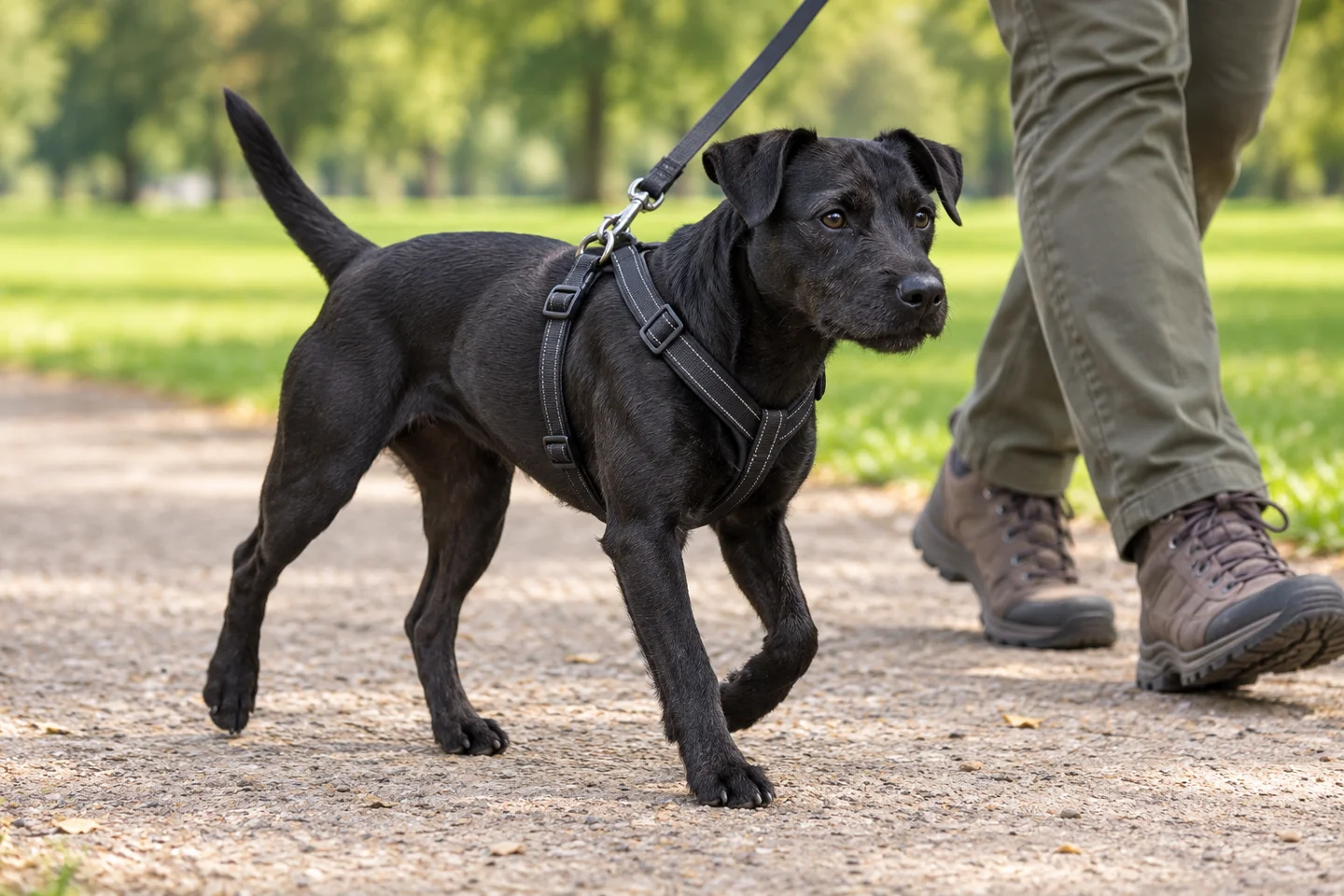
The illustrations show a solid black smooth-coated dog with natural folded ears and a full tail. Other permitted coats and colors are described by the standard, so this image choice is one example rather than a complete identification guide. A black dog of similar size is not automatically a Patterdale. Ask about documented ancestry and the registry being used, and give observed behavior and veterinary findings priority when caring for a rescue whose background is uncertain.
Fell terrier history and present-day choices
The UKC account traces the Patterdale mainly to black, smooth-coated Fell Terriers developed in northern England. It records recognition on January 1, 1995. The historical emphasis was on practical terrier work, including following quarry below ground. This context explains why persistence and exploration belong in a suitability discussion. It does not justify allowing a companion to enter unknown burrows or confront wildlife as a form of exercise.
Ask what the breeder means by working lines and how the parents live outside work. Some owners use that phrase without explaining domestic behavior, handling, or recovery after excitement. A puppy still needs a careful introduction to ordinary life, and experience in one setting does not teach every skill required in another. Discuss what the breeder has observed around household dogs, visitors, and quiet periods. Specific examples provide a better basis for choosing than a general promise that every Patterdale will be tough, fearless, or easy to train.
Adult height and a functional body condition
The UKC standard gives a height range of 10–15 inches at the withers and says weight should be proportional to height. It does not prescribe one kilogram figure for every adult. A dog should be fit without excess fat, but a working description is not a reason to restrict nutrition or accept unexplained weight loss. Have the veterinary team assess ribs, waist, muscle, and growth alongside the scale.
The body should allow comfortable movement, with a moderate chest and useful athletic balance. Beware of claims that a very heavy head or exaggerated chest improves the dog. Choose a harness that fits without rubbing behind the elbows and recheck it during development. The size range also means equipment and predicted adult needs should be discussed for the particular parents. A puppy's current weight is only part of that picture. Record the food offered, growth, and any digestive changes for the first veterinary visit. That makes it easier to discuss a feeding adjustment using the individual record rather than a guess based on the size of a littermate. Watch how it walks and turns rather than judging its future function from a posed photograph.
Persistence needs an outlet and an end point
A Patterdale may continue investigating after another dog has lost interest. Make that persistence useful through supervised food searches, a designated digging area, and manageable problem-solving games. Select materials that cannot be swallowed or trap a jaw or foot, and stay nearby. An occupied dog still needs supervision when a game involves containers, fabric, or loose objects. Remove the activity calmly before frustration leads to frantic tearing or guarding.
Teach a clear transition from activity to rest. Put equipment away, offer a quiet place, and reward settling instead of repeatedly restarting the game when the dog demands it. If the animal cannot disengage, lower the next session's intensity and review how much excitement is being rehearsed. A dog that paces all evening may need a different pattern of sleep, training, and exercise rather than another hour of chasing. Sudden changes in rest or tolerance should also prompt consideration of pain or illness.
Training useful responses before a distraction wins
Teach the dog to turn toward you when named, follow a hand target, and come away from an ordinary object. Begin in a quiet space and reward quickly. Increase the difficulty through distance and distractions one step at a time. Do not repeat a recall endlessly while the dog digs or watches an animal; arrange physical safety, reduce the challenge, and build a stronger response through practice the dog can complete.
A reliable exchange is especially useful for a terrier interested in found objects. Start with safe low-value items and offer something worthwhile without reaching into the mouth. Give access back sometimes when the object is appropriate, so an approach does not always predict loss. Avoid pinning, scruffing, or jerking the lead. These methods can create conflict without teaching the action you want. Ask a qualified reward-based professional for help if guarding, pulling, or intense fixation already prevents comfortable daily care.
Exercise that does not depend on uncontrolled chasing
Walks should include opportunities to investigate safely, with enough variety to engage the dog without requiring constant speed. Use an appropriate long line in open places and keep it clear of people, roots, and other dogs. Check an enclosed area before allowing free movement; a small gap, loose panel, or climbable object beside a fence can become an escape route. Gates need habits that remain reliable when someone is distracted.
Introduce running and sports according to age, health, and conditioning rather than assuming a terrier can tolerate unlimited repetitions. Growing dogs need rest and suitable surfaces. Watch recovery after an outing and change the plan if stiffness, limping, or reluctance appears. In warmth, use cooler hours and carry water. An eager response to a toy does not cancel heat risk. Avoid using wildlife pursuit, dangerous holes, or confrontation with another animal as entertainment; the dog's motivation can be met through safer, controlled activities.

Children and the rules around possessions
Adults should arrange supervised contact and separate children from the Patterdale during meals, chews, rest, and excited running. A small dog can be frightened or injured by grabbing and awkward lifting, while a child can be bitten during an attempted exchange. Teach children to call the dog toward them and let it leave, rather than following it behind a chair or reaching into its bed.
Adults should recover stolen objects using an established safe plan. Do not ask a child to show authority by removing a bowl or pulling a toy from the mouth. Safer shared activities include laying a supervised search or rewarding a familiar cue from a comfortable distance. Watch stiffness, avoidance, and turning away as signs that contact should stop. A dog that likes one familiar child's company has not demonstrated comfort with every visitor or a noisy group. Use a barrier whenever the supervising adult cannot pay close attention.
Aggression and the difference between warning and defiance
Growling, snapping, or biting requires attention even when the dog is small enough to lift. Record what occurred before the response, including approach, resource, touch, and escape route. A Patterdale that guards a found item needs prevention and exchange work, while a dog reacting during paw handling may need investigation of pain. General labels such as dominant or naughty obscure the changes that could actually prevent another incident.
Create distance, protect other animals and people, and seek suitable professional help. A sudden change in handling tolerance deserves veterinary assessment. Do not punish a growl or repeat a provoking approach to test whether the dog will follow through. Use barriers and separate resources while a plan develops. Muzzle training may add protection when advised, but should be introduced gradually and never used to force contact that the dog is already trying to avoid. After a bite, obtain appropriate medical advice and make preventing recurrence the immediate priority.
Cats, small pets, and an honest assessment of pursuit
A terrier's interest in small moving animals should be discussed before it joins a home with cats, rabbits, birds, or poultry. Start cat introductions through secure barriers and maintain routes the cat can use without approaching the dog. Prevent chasing rather than allowing it to see what happens. Quiet observation through a barrier is an early step, not proof that animals can share a room unsupervised.
Keep small pets securely separated and consider how feeding, cleaning, and movement will work every day. A person carrying a rabbit across a room can create a different situation from a stationary enclosure. If reliable separation is not realistic, the proposed household may be unsuitable. Recall practice and controlled exposure can improve responses, but no breed guide can guarantee that an individual will ignore every sudden movement. Ask rescues and breeders for specific information about the dog's previous behavior and treat unknown history as a reason for careful management.
Dog companions and space to recover
Introduce unfamiliar dogs with separate handlers and enough room for parallel walking. Look for voluntary approaches and the ability to pause. A Patterdale that enjoys a known companion can still object to being crowded, chased, or interrupted over an interesting smell. Stop repeated pursuit when the other dog tries to leave and avoid interpreting every tense interaction as a necessary negotiation between terriers.
In a multi-dog home, feed separately and provide resting areas that cannot all be blocked by one animal. Remove high-value objects during early shared time. Plan barriers before the new dog arrives so separation does not depend on lifting an aroused dog away from another. Observe recovery after meetings as well as the encounter itself. A dog that remains highly vigilant or unable to sleep may need shorter exposure and more distance. Compatibility develops through repeated evidence in ordinary circumstances, not a requirement to become friends immediately.
Grooming smooth, broken, or rough hair
The UKC standard recognizes smooth, broken, and rough coats. The illustrated smooth black dog needs gentle brushing and skin checks, while a rougher coat may require different maintenance advice. Work through the areas where a harness rubs and inspect feet after exploring. A naturally practical coat still deserves attention to soreness, parasites, and plant material. Do not ignore a hidden irritation because the dog remains eager to walk.
Maintain nails, practice tooth brushing, and examine the naturally folded ears for odor or discharge. Seek veterinary advice for repeated head shaking or painful touch. Avoid digging into a foot or ear with a tool to remove something you cannot see clearly. Introduce grooming as brief, rewarded handling sessions and stop before a struggle develops. If resistance repeatedly concerns one body part, assess discomfort rather than assuming the terrier is simply refusing. An experienced groomer can demonstrate appropriate tools without turning coat care into a contest of restraint.
Health questions and the scope of an eye DNA test
UC Davis Veterinary Genetics Laboratory includes the Patterdale Terrier among the breeds listed for primary lens luxation testing. Ask which parental results are available and have the veterinarian explain the particular variant and its interpretation. The laboratory notes that carriers can have a slight clinical risk. A carrier result should therefore not be casually translated into either a guarantee of normal eyes or the same outlook as an affected dog.
The test addresses a particular inherited cause of lens luxation. It cannot exclude every reason an eye might become painful or lose vision. Clinical examination remains important, and an abnormal or painful eye needs prompt veterinary advice even when a genetic report is favorable. Ask breeders about other significant diagnoses in relatives and how information is shared later. Avoid inventing a universal rare-breed checklist from unrelated terriers. Where a breeder uses a specific health program, check the current requirements and request named reports rather than accepting the number of tests advertised.
Feeding, injuries, and a practical veterinary plan
Use a balanced diet appropriate to life stage and measure meals. Include rewards and chews in the day's intake, and ask the veterinary team how to assess condition on the individual frame. High activity does not make excess weight harmless, and a small dog can gain gradually if every family member offers extras. Review portions when exercise, age, or health changes rather than following one amount indefinitely.
Keep medicines, rubbish, and dangerous food physically secured. A persistent terrier may investigate cupboards or bags that were previously ignored. Contact a veterinarian promptly after a suspected toxic ingestion or a significant injury, and provide packaging or circumstances if known. Changes in balance, vision, appetite, drinking, or movement need assessment rather than an online diagnosis based on breed. Keep an emergency transport plan and current records available to another adult. Do not give human pain medicines or wait for a social-media answer when the dog is clearly deteriorating.
Mixes, costs, and whether the routine is realistic
A Patterdale mix can differ in size, coat, sociability, and pursuit from either parent. A crossbreed label cannot promise a quieter or easier terrier. For a planned litter, ask about relevant assessment for both parental backgrounds. For a rescue dog, use observed behavior and clinical findings to decide the immediate routine. Trying to settle uncertain ancestry from a photograph can take attention away from practical needs that are already visible.
Budget for preventive care, secure boundaries, training, suitable equipment, and emergency treatment. Check local costs and whether a carer can manage the dog without depending on a child or a partly enclosed garden. Someone who enjoys patient teaching and can provide safe investigation may offer a workable home. A household expecting minimal exercise, unstructured access to small pets, or automatic recall near wildlife should reconsider those requirements before choosing. Discuss absences, visitor routines, and other animals honestly with the breeder or rescue rather than hoping a small body makes every difficulty manageable.
dogsDating walks without a rushed greeting
Use dogsDating to describe the dog's actual preferences: perhaps a quiet parallel walk, a familiar partner, or more room around rushing dogs. Keep exact home coordinates and your address private. Select a public meeting place from an approximate area and choose paths broad enough to increase distance. Avoid first meetings beside loose small animals or a fence where both dogs are likely to race repeatedly.
Each handler should stay responsible for one dog and keep attention on movement and body language. Start apart, walk in the same direction, and allow pauses without insisting on nose contact. Keep shared food and toys out of the encounter. If either dog stiffens, hides, or cannot disengage, shorten the walk or leave. A peaceful outing can remain brief and does not need to end in play. Before arranging another meeting, compare observations honestly so both people can decide whether the experience suited their dogs.
Sources and editorial notes
Sources checked October 22, 2026. Breed measurements describe reference ranges, not a diagnosis or an individual dog's ideal weight. Images are AI-generated breed illustrations and do not document a particular dog or health condition.
- AVSAB: Humane Dog Training Position Statement
- VCA Animal Hospitals: Food aggression in puppies
- VCA Animal Hospitals: Common emergencies in dogs
- Orthopedic Foundation for Animals: CHIC health screening programs
- VCA Animal Hospitals: Aggression toward unfamiliar dogs, diagnosis
- VCA Animal Hospitals: Grooming and coat care for your dog
- VCA Animal Hospitals: Ear infections in dogs (otitis externa)
- AAHA: Feeding plans for healthy, appropriate weight cats and dogs
- VCA Animal Hospitals: Heat stroke in dogs
- AVSAB: Puppy Socialization Position Statement
- VCA Animal Hospitals: Dog behavior problems, aggression toward children
- United Kennel Club: Patterdale Terrier official standard, working history, coats and adult height
- UC Davis Veterinary Genetics Laboratory: primary lens luxation testing and carrier interpretation
Keep getting to know dogs.
Read another guide or return to your dogsDating community.
Explore breed guidesBack to dogsDating