Petit Bleu de Gascogne
A medium-sized French blue-mottled scenthound, with practical guidance on scent work, ear care, household routines and safe introductions.
How these guides are researched and reviewed
- Origin
- France
- Adult male height
- 52–58 cm
- Adult female height
- 50–56 cm
- Coat
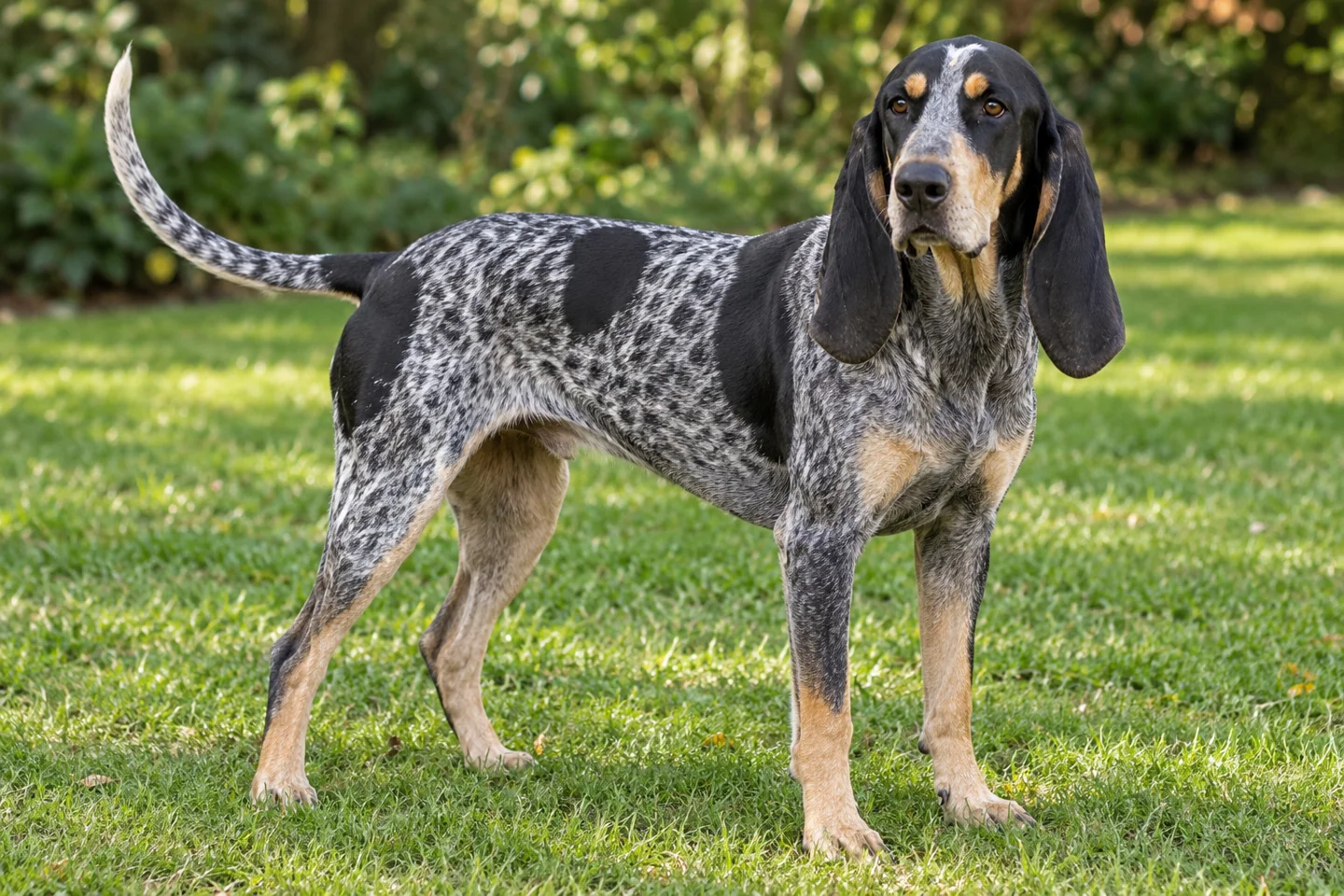
- Short dense black-and-white mottling, black patches and tan points
General information for owners. These articles have not been reviewed by a veterinarian. Medical decisions need your dog's history and an examination.
A medium-sized Gascon hound despite the name
The Petit Bleu de Gascogne is a French scenthound with a mottled blue-looking coat, black patches, tan points, and long hanging ears. Petit is relative to the Grand Bleu de Gascogne; it does not describe a tiny companion or a short-legged basset. Confirm the full breed name when examining documents, since several Gascon hounds share related names and markings while differing in structure and size.
A prospective owner should consider a dog whose interest in scent may shape the whole walk. The attraction of the coat and long face does not settle questions about recall, boundaries, voice, or time alone. Meet adults and ask how they live outside work. An ordinary visit can reveal practical details such as whether the dog settles after activity and how it responds when someone approaches the entrance. Choose from those observations and identifiable records rather than assuming all hounds with a gentle expression have the same domestic needs.
Historical identity and the type of work described
The FCI account places the Petit Bleu within the Gascon hound family and describes its use for smaller game, including hare. The current standard was published in 2023. Its hunting background gives useful context for endurance, scent interest, and work with people or other hounds. It does not establish that an individual companion requires hunting to have an appropriate life, or that it should be allowed to follow a trail wherever it leads.
Safer outlets include structured searches, supervised trails, and walks that offer time to investigate without access to wildlife. Ask a breeder to describe what the parents do when no task is available. A dog can perform well while still needing careful teaching about resting in a house, traveling, or being left alone. For a rescue animal, focus on its own previous routines and current responses. An inherited working identity is a starting point for questions, not a complete account of the animal's abilities or comfort in a new environment.
Adult dimensions without an invented weight target
The FCI gives adult heights at the withers of 52–58 cm for males and 50–56 cm for females. It does not supply a required weight range in this standard. Ask the veterinary team to assess body condition and muscle on the particular frame rather than borrowing a weight from another blue Gascon breed. A hound that continues enthusiastically on walks may still carry excess weight or show a gradual change that needs attention.
Measure the available vehicle space and select equipment that fits the long neck and chest comfortably. Check behind the elbows for rubbing and recheck the harness during growth. The tail should remain free to move normally during travel, and a crate or restraint should allow suitable positioning. Teach the dog to enter calmly rather than lifting or pulling it through a narrow opening. Practical preparation helps when the animal is fully grown and when an injury or illness temporarily makes ordinary movement more difficult.
Blue mottling and features that are easy to misread
The coat's blue effect comes from black-and-white mottling, with black patches and tan markings described in the standard. It is not a requirement for a solid blue coat or a special rare-color label. The head commonly carries black around the ears and eyes, with tan points and a lighter interval above. Individual markings vary, so identity should not depend on copying a single picture exactly.
The ears are long and naturally pendant, with a characteristic inward curl, while the body remains that of a medium scenthound. A puppy's developing pattern and proportions need time to mature. The illustrations here show selected features rather than proving ancestry, sound movement, or health. Ask the breeder to explain differences between this breed and the Grand, Basset, or Griffon relatives if paperwork is unclear. A seller who emphasizes an unusual color but avoids questions about parents, temperament, or clinical history is not providing the evidence needed for a careful ownership decision.
Training through the rewards a scenthound values
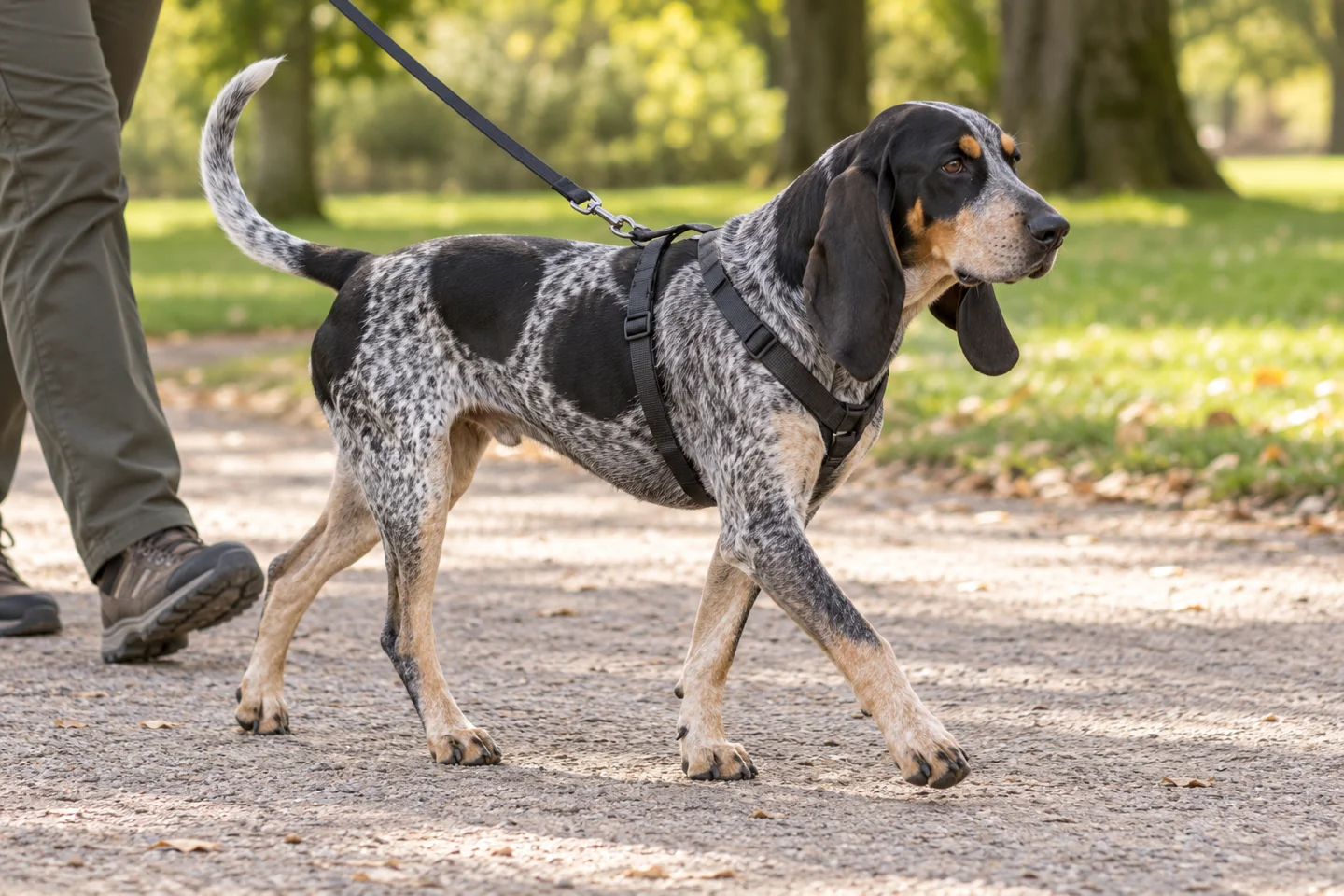
Teach the Petit Bleu to turn toward its name and move with the handler before working near an especially interesting verge. Permission to sniff can reward a few comfortable steps together. This gives cooperation a practical outcome the dog values, rather than making the lead a constant argument about leaving every scent. Begin where distractions are manageable and raise difficulty gradually.
Practice recall on a suitable line in open places, keeping it clear of people and obstacles. Use a worthwhile reward and release the dog back to safe exploration on some repetitions. Teach an exchange for found objects and a pause at gates before they become urgent. Avoid lead jerks, shouting, or physical confrontation. If the animal cannot respond, reduce the challenge and assess what prevented success. A reward-based instructor can help with timing and safe handling, particularly when a growing dog already pulls strongly enough to make an ordinary pavement walk difficult.
Exercise that uses scent without losing control of the route
Allow regular walking and investigation, with distance and terrain matched to age and fitness. A walk that includes deliberate sniffing can meet needs that a hurried straight route misses. Introduce longer or more demanding outings gradually and observe recovery afterward. Puppies need manageable activity and sleep rather than endurance tests based on a hunting description. An older hound may enjoy a short search even when its previous mileage is no longer suitable.
Inspect fences, gates, and possible digging points before relying on an enclosed space. A scent outside the boundary may become interesting at a moment when nobody expects escape. In warm weather, carry water and choose cooler periods, shortening the outing if recovery is uncomfortable. Watch feet and movement after rough ground. A dog that limps, becomes stiff, or hesitates the next morning needs a revised plan and possibly examination. Enthusiasm in the field cannot establish that every surface or distance is harmless.

Rest, voice, and learning to spend time apart
Observe what precedes vocalizing instead of assuming the dog is noisy for no reason. It may be responding to an animal outside, anticipating an outing, or finding separation difficult. Change the environment when a window or fence repeatedly creates a trigger, and reward coming away before excitement becomes prolonged. Teach a comfortable resting area away from the entrance so every delivery does not become a rehearsal of rushing and announcing.
Introduce absences in short, manageable stages and observe the response. A dog reared with several companions may need help learning to rest separately, but adding another dog does not automatically solve distress. Record pacing, vocalizing, eating, and recovery rather than guessing from damage alone. If the dog cannot settle, seek veterinary and behavior advice. The practical aim is a routine that meets needs while allowing ordinary household life, not a requirement that an animal remain silent for long periods without preparation or an appropriate opportunity to move.
Socialization and the value of quiet observation
A puppy should encounter people, dogs, sounds, surfaces, and handling in manageable conditions. Choose a distance where it can look without becoming overwhelmed, pair the experience with something pleasant, and leave while it can still recover. There is no requirement to let every passerby lift the ears or lean over its head. Ask people to wait and let the puppy approach voluntarily.
Practice passing dogs without contact as well as meeting suitable partners. A hound that can look and then return attention has a useful skill even when play never happens. If it becomes rigid, stops taking familiar rewards, or repeatedly tries to retreat, make the next step easier. Continue learning as the dog develops and after a major change of environment. Adult rescues need the same respect for pace. A breed account describing willingness to work does not establish that the individual already understands city traffic, veterinary handling, or a crowded communal hallway.
Children and protecting meals and quiet places
Adults should supervise contact closely and separate the Petit Bleu from children during meals, chews, and times when the dog is resting. A gentle-looking head can invite hugging, but the dog still needs room to leave. Teach a child to call the hound toward them, touch briefly, and pause. Prevent following into a bed, pulling ears, or leaning over a cornered animal.
Found objects and resource exchanges are an adult responsibility. A child should not remove a bowl to prove trust or reach into the mouth for something stolen. Safer participation includes laying a supervised food search or rewarding a familiar cue. Watch stillness, turning away, avoidance, and tightening movement rather than waiting for a growl. Familiarity with one child does not predict comfort with visitors running through the house. Use a gate when the supervising adult needs to cook, take a call, or attend to another task that prevents active observation.
Aggression and responding to the actual circumstances
A growl or snap is information about an interaction that needs to change. Record what happened before it: approach, touch, food, location, and whether the dog could leave. A Petit Bleu defending a chew needs resource management, while a dog reacting when an ear is lifted may need examination for pain. Broad labels such as dominant cannot identify which practical measure will prevent another incident.
Move people and animals away and avoid recreating the event as a test. Sudden changes in tolerance warrant veterinary assessment. For recurring defensive behavior, a qualified reward-based professional can help build exchanges, visitor routines, and comfortable distance from unfamiliar dogs. Do not punish warnings until they disappear without addressing their cause. Barriers and separate feeding areas provide useful protection while learning develops. A basket muzzle may be appropriate when introduced gradually, but it cannot turn an overwhelming encounter into a suitable one. Following a bite, obtain appropriate medical advice and prevent further exposure while help is arranged.
Other dogs, cats, and the difference between company and compatibility
Meet another dog with separate handlers and enough space for parallel movement. Pack-working ancestry cannot guarantee that every unfamiliar dog will be welcomed over a bed or food bowl. Look for loose movement, voluntary approaches, and the ability to pause. Interrupt pursuit when one dog repeatedly tries to leave and do not expect a tense meeting to improve simply because both animals are hounds.
At home, provide separate feeding areas and resting choices so one dog cannot block every useful space. Introduce cats through barriers and preserve routes that do not require passing close to the dog. Prevent chasing rather than allowing it once as an experiment. Smaller pets need secure separation, especially when their movement can trigger pursuit. Ask about the individual's history, while recognizing that behavior in a new setting may differ. If the household cannot maintain separation safely when necessary, reconsider the arrangement before adoption instead of relying on a general reputation for sociability.
Grooming a short coat and long ears
Brush the short dense coat gently and use grooming time to inspect skin, feet, and areas beneath equipment. Check for ticks, plant material, and small injuries after exploring. The coat may be less demanding than a rough or long-haired variety, but that does not remove the need to notice changes. A persistent sore or repeated licking deserves examination rather than repeated washing or application of a household product.
Long hanging ears need comfortable inspection, with attention to odor, discharge, redness, and head shaking. Ask the veterinary team how to clean the individual dog's ears if cleaning is appropriate. Do not insert tools deeply or assume that every ear problem requires the same drops. Maintain nails and introduce tooth brushing through short rewarded sessions. If handling resistance appears repeatedly on one side, assess discomfort before increasing restraint. A cooperative routine helps the dog accept necessary care and gives the owner a better chance of finding a problem before it becomes difficult to touch.
Health: ear symptoms need examination rather than a breed assumption
The breed's long ears make an inspection routine practical, but ear shape alone cannot diagnose infection or establish a disease rate. VCA's veterinary guidance explains that ear inflammation can have different contributing causes and that examination guides treatment. Tell the clinician whether signs began after swimming, exploration, a new product, or a previous course of treatment. Repeatedly applying leftover medication can obscure the problem and may be unsuitable for the current ear.
Ask what was found and when a recheck is needed. A dog that resists contact may be painful even if it still follows scents enthusiastically. Keep a record of which ear was affected and the prescribed treatment, especially if episodes recur. For breeding discussions, request identifiable health records and ask the relevant club which current assessments it recommends. A complete verified universal disease-testing panel was not established for this guide. That evidence gap should remain explicit rather than being filled with copied requirements from another Gascon hound or a different medium-sized breed.
Feet, fatigue, and outdoor findings worth recording
After rough-ground outings, inspect the pads, between the toes, nails, and areas where a line or harness may have rubbed. Keep the dog on a stable surface and reward brief handling. Do not dig into tissue to retrieve something you cannot see clearly or force a painful foot open. A persistent limp, swelling, or repeated licking needs veterinary advice, and a safely recorded video may help describe an intermittent movement change.
Plan for an outing that ends earlier than expected. Carry contact details, know the route back, and consider how the dog could be transported if it could not walk. Sudden collapse, severe breathing difficulty, or rapidly worsening distress needs urgent veterinary contact. A hunting reputation does not make a dog immune to injury or heat illness. Tell the clinician about terrain, duration, weather, and any known ingestion rather than offering only the breed name. The sequence of events can guide assessment more usefully than an assumption that the hound has simply overdone it.
Feeding, mixes, and the limits of ancestry predictions
Use a balanced food appropriate to life stage and measure portions against condition, activity, and growth. Count rewards and chews within the day's intake. Ask for an assessment if weight changes unexpectedly or appetite, drinking, or digestion remains different. A dog that wants more food is not necessarily underfed, and adding supplements should have a clear purpose rather than follow a breed-group recommendation without an individual need.
A Petit Bleu mix can differ in size, coat, voice, and pursuit from either parent. A crossbreed label cannot promise an easier hound or remove inherited risks. For a planned litter, discuss relevant parental assessment and the reason for the mating. For a rescue with uncertain ancestry, use observed behavior and clinical findings to build the immediate plan. The resemblance of mottling or ears may suggest a background, but it cannot establish which health program applies or guarantee how the adult will behave around children, cats, or unfamiliar dogs.
Ownership costs and a carer who understands the routine
Obtain local estimates for food, preventive care, equipment, training, transport, and emergency treatment or suitable insurance. A secure boundary and a reliable lead setup are part of ordinary ownership costs. Find a carer able to provide scent-led walks and maintain gates consistently. A person who can feed the dog but cannot manage its movement outside may be unable to cover an absence safely.
Introduce that carer while you are available and write down the dog's known preferences, handling needs, and veterinary contacts. Rehearse a handover instead of leaving it until an emergency. Consider whether the home can tolerate mud, some voice, and a hound that needs teaching to disengage. A patient owner who enjoys exploration may provide a workable routine, while a household requiring effortless silence and untrained off-lead access should reconsider those expectations. Discuss difficult details honestly with the breeder or rescue before committing, so the dog's needs are matched to the life it will actually have.
dogsDating meetings with space for two separate choices
Describe the Petit Bleu's actual social habits on dogsDating, including comfort around direct greetings, interest in quiet walking partners, and the distance needed to remain calm. Keep exact home coordinates and your address private. Use an approximate area to select a public location with broad paths, secure handling space, and separate exits. Avoid a first meeting in the dog's home or beside a narrow gate that forces contact.
Walk in the same direction at a comfortable separation and let both dogs notice one another without an obligation to touch. Keep toys and shared food out of the introduction. Each adult should watch one dog and be ready to change distance or leave. Stop if either animal becomes stiff, frightened, or unable to disengage from pursuit. A short peaceful walk offers useful evidence even when play never occurs. Compare observations afterward and arrange another encounter only if both handlers think the plan meets their dogs' needs.
Sources and editorial notes
Sources checked October 22, 2026. Breed measurements describe reference ranges, not a diagnosis or an individual dog's ideal weight. Images are AI-generated breed illustrations and do not document a particular dog or health condition.
- AVSAB: Humane Dog Training Position Statement
- VCA Animal Hospitals: Food aggression in puppies
- VCA Animal Hospitals: Common emergencies in dogs
- Orthopedic Foundation for Animals: CHIC health screening programs
- VCA Animal Hospitals: Aggression toward unfamiliar dogs, diagnosis
- VCA Animal Hospitals: Grooming and coat care for your dog
- VCA Animal Hospitals: Ear infections in dogs (otitis externa)
- AAHA: Feeding plans for healthy, appropriate weight cats and dogs
- VCA Animal Hospitals: Heat stroke in dogs
- AVSAB: Puppy Socialization Position Statement
- VCA Animal Hospitals: Dog behavior problems, aggression toward children
- FCI Petit Bleu de Gascogne standard 31, August 2023: identity, coat pattern and adult heights
Keep getting to know dogs.
Read another guide or return to your dogsDating community.
Explore breed guidesBack to dogsDating