Poitevin
A tall French scenthound whose move into companion life needs secure exploration, workable company, practical training, and a clear clinical handover.
How these guides are researched and reviewed
- Origin
- France
- Adult height
- Males 62–72 cm; females 60–70 cm
- Coat
- Short and glossy
- Illustrated appearance
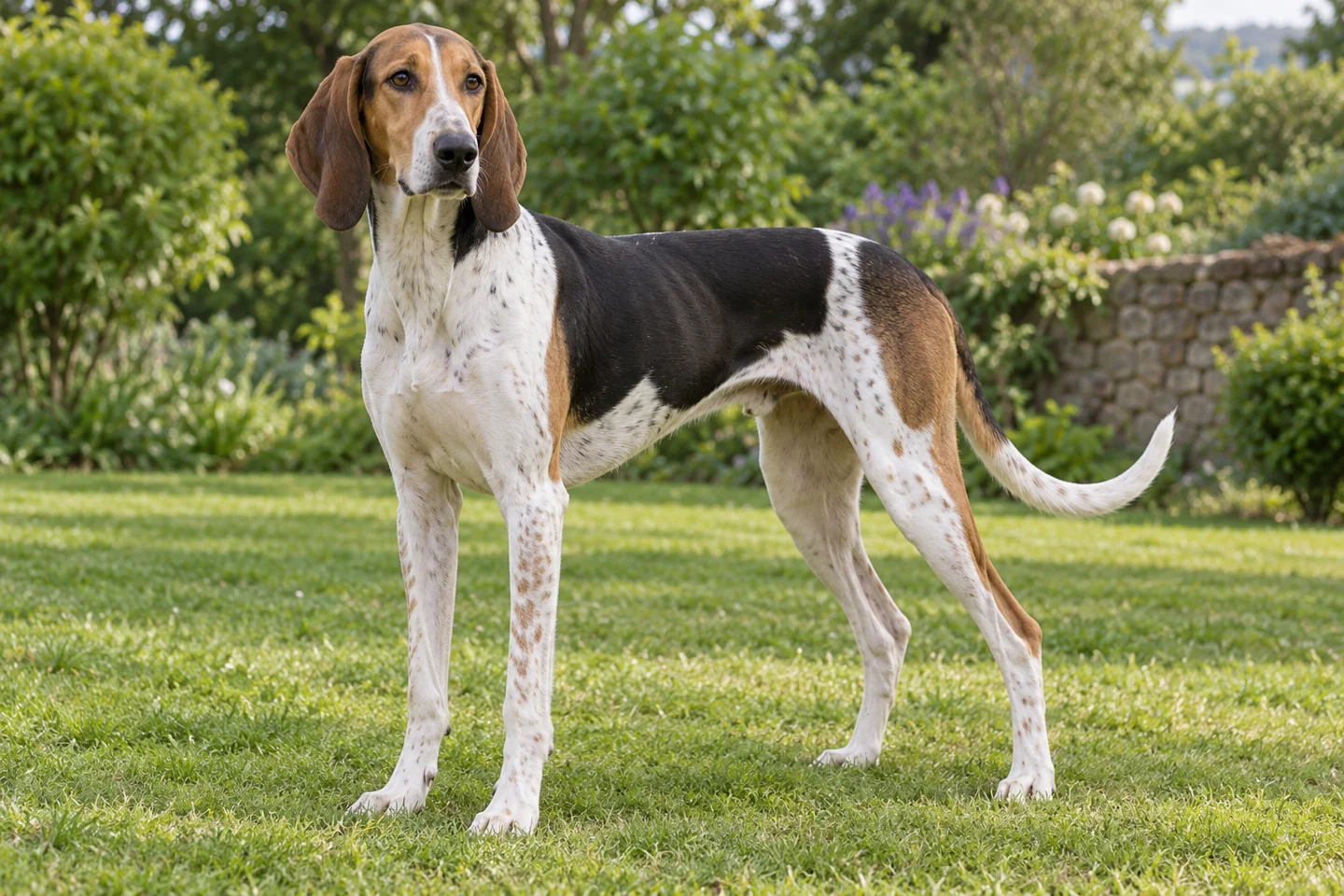
- Tricolor with a black saddle, natural hanging ears and full tail
General information for owners. These articles have not been reviewed by a veterinarian. Medical decisions need your dog's history and an examination.
A tall French hound in a household
A Poitevin needs an owner who has considered how a tall scenthound will live beyond the hours spent outdoors. Before choosing one, look at entrances, garden boundaries, resting space, and the people available for everyday care. A long-legged dog can be physically capable while still unfamiliar with household routines. Ask about the individual's experience rather than assuming that a working animal will immediately understand a sofa, a staircase, or being alone in a quiet room.
The breed originated in France and belongs among the scenthounds. Its lean appearance should not be mistaken for fragility or low activity needs. Meet adults in ordinary conditions if possible and watch how their handlers manage excitement. Discuss the conditions in which a proposed dog already succeeds, as well as situations it has not encountered. A useful source will explain both. An attractive photograph at the end of an outing cannot show how the same dog settles during the rest of the week.
Identity and the limits of a breed label
The Poitevin is a distinct named breed, rather than a general term for any tricolor French hound. The FCI places it among large scenthounds, and the United Kennel Club records recognition in 1996. When buying or adopting, check the documentation and identification attached to the actual dog. Similar markings occur in other hounds, so appearance alone cannot establish parentage or a particular family's behavior.
Ask what the dog has done and how that experience affects the proposed home. A dog familiar with regular group activity may need help learning to rest without that routine. Another may already have household experience and different needs. Describe your own schedule honestly, including the quieter days and the longest unavoidable absence. If you cannot provide the arrangement the dog currently needs, discuss alternatives before placement rather than hope a new address will remove the difficulty. Good information allows a match that can work in practice.
Height, coat, and equipment
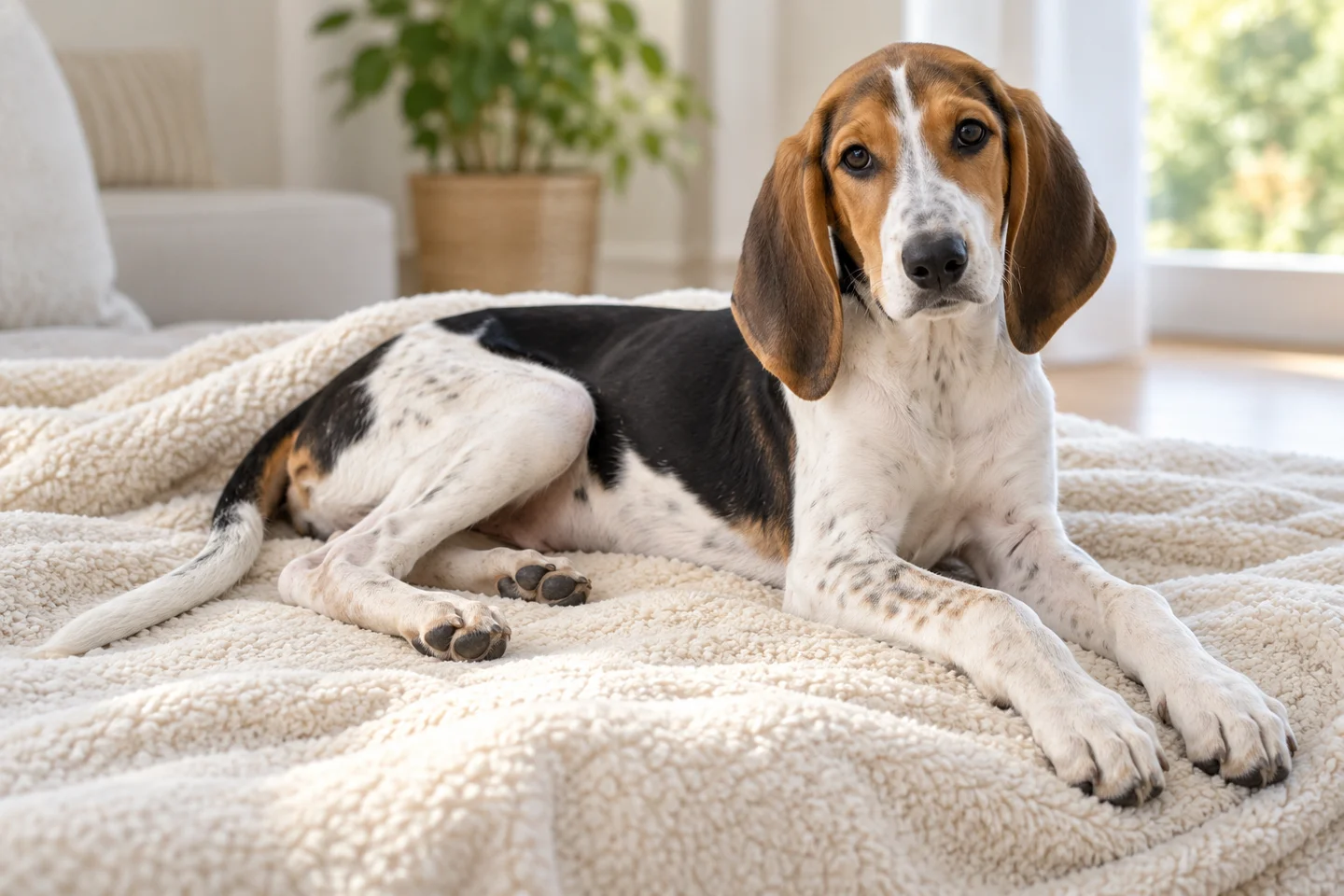
The FCI adult height ranges are 62–72 cm for males and 60–70 cm for females. It describes a long head, natural hanging ears, a deep chest, a short glossy coat, and a smooth natural tail carried with a curve. Tricolor with a black saddle or patches is among its coat patterns. The illustrations here show a tricolor example; they do not document a particular registered dog.
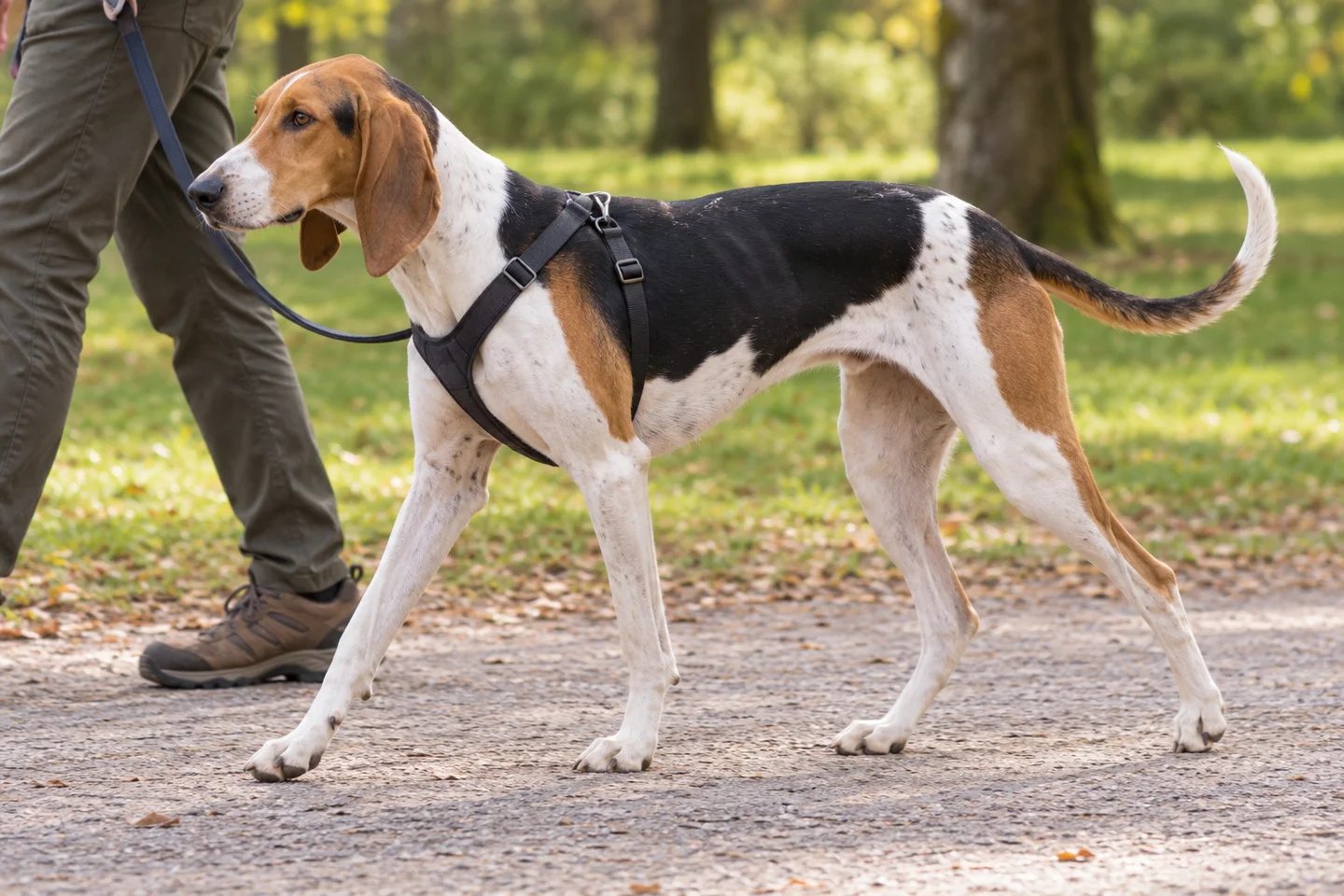
Fit equipment around the long neck, chest, and movement of the individual. Check whether a harness stays secure when the dog stops or steps backward. Give a new harness an ordinary short trial before taking it into a crowded setting. A long lead needs controlled handling so it cannot wrap around people or trees. Measure sleeping and vehicle spaces before purchase, and allow the dog to learn vehicle access calmly. A dog that fits lying down still needs room to turn and enter without being pushed into an awkward position.
Training around a powerful scent interest
Teach useful responses where the dog can first succeed. Coming toward the handler in the house is a different task from leaving an interesting verge. Build through easier outdoor settings and reward small choices to turn back toward you. Access to a safe sniffing area can be part of the reward. Keep the dog physically secure while you build reliability rather than test recall beside a road or wildlife.
Practice a calm pause at doors, moving away from a gate, and standing comfortably while equipment is attached. These skills reduce daily friction. If several people care for the Poitevin, agree on cues and show each person how they have been taught. Avoid relying on a powerful correction after the dog is already moving at speed. Change the distance or setting before the situation overwhelms either handler. An owner who can predict the next difficult moment has more opportunity to teach than one repeatedly recovering from it.
Exercise with a repeatable routine
Plan exercise that you can provide consistently. Exploratory walks, suitable training, and controlled activity give the dog opportunities to use its body and attention. An occasional exceptionally long outing is not a substitute for a sustainable week. Adjust the amount and intensity to age, health, experience, and the terrain. A young dog and a mature conditioned adult should not be expected to manage the same session.
Build new activities gradually and watch the following day's movement. Reluctance to rise, stiffness, or a change in stride needs attention even if the dog pulled enthusiastically during the outing. In warm weather choose a cooler route, take water, and avoid trapping yourself far from transport. A short coat does not prevent heat illness. If the dog's recovery changes, discuss it with the veterinary team. Do not treat an ability to keep following a scent as proof that discomfort or overheating is absent.
Company, voice, and rest
Discuss vocal behavior with the source before bringing a Poitevin into a noise-sensitive home. Ask what actually triggers the individual, how long it continues, and what helps it recover. A brief meeting may not reveal the response to departure, activity outside a window, or other dogs calling nearby. Consider the neighbors and the available quieter rooms when planning the home, rather than waiting until complaints become the first evidence of a problem.
Teach rest as a skill with a comfortable place and a predictable routine. Begin short separations while somebody can observe the dog's response. Increase duration only when it remains comfortable. Persistent pacing, calling, or escape attempts require a revised plan and appropriate help. Acquiring a second dog is a substantial decision with no guarantee that it resolves separation distress. Arrange practical company for absences the dog cannot yet manage, and choose a professional who can assess both the behavior and the household's real constraints.
Children and lively household movement
A tall hound can reach food and faces at a height children may not expect. Arrange adult supervision during greetings and meals, and keep the dog separate from running indoor games. Teach children to leave resting areas and bowls alone. The family's account of a gentle temperament does not remove the possibility of a collision, a startled reaction, or conflict over an object.
Give children a clear way to interact: sit quietly, invite the dog over, and stop when it leaves. They should not pull the ears, climb on the dog, or take its lead into a busy place. An adult must intervene before repeated avoidance turns into a defensive response. When attention is divided, use comfortable physical separation instead of asking a child to monitor the situation. If the dog has guarded a toy or chew, the retrieval plan belongs with an informed adult and professional guidance, not an experiment to establish whether children can take it.
Aggression and changing the setup
Understand a reaction through its circumstances. Record what approached, how close it came, what the dog was doing, and whether there was an escape route. A Poitevin that reacts at a gate may respond differently on an open walk, and one that resists touch may need a medical assessment. A broad label such as dominant or bad with people can hide details that would help someone prevent repetition.
Secure the dog calmly and stop recreating the encounter while advice is sought. Sudden sensitivity, reduced movement, or other behavior changes warrant veterinary discussion. A qualified reward-based professional can help plan training around persistent difficulties. Be precise about bites and near misses when arranging help or handing over care. Safety equipment, including a properly fitted basket muzzle introduced gradually when appropriate, supports a plan; it cannot turn an unwanted close encounter into a suitable one. Retain enough distance and control for both people and animals to leave.
Dogs, cats, and chasing
Do not infer compatibility from experience around a familiar group. An unfamiliar dog may move, greet, or compete for space differently. Start introductions outdoors with separate handlers and a route that allows parallel movement. Keep shared food and toys out of the first encounter. Watch the quieter dog as carefully as the more active one, and end a greeting when one repeatedly tries to move away.
For cats and small animals, prevent pursuit while assessing responses. Cats need protected escape routes and resources the dog cannot obstruct. A stationary cat behind a barrier does not demonstrate how the dog will respond when it runs. Keep small animals securely separated and arrange professional support if you need help interpreting behavior. If long-term separation is necessary, assess honestly whether the household can maintain it. A dog should not have to be physically held back every time another resident needs to cross a room.
Grooming and checks after outings
A short coat makes some tasks straightforward but does not eliminate grooming. Brush to remove loose hair and use the opportunity to examine skin, feet, and equipment contact points. After rough vegetation, check for trapped plant material and small injuries. Note repeated licking or discomfort rather than assuming an active dog will recover without help. Introduce touch and inspection as predictable routines before an injury makes them urgent.
Inspect the hanging ears for redness, unusual discharge, odor, or soreness. Ask the veterinary team which cleaning approach, if any, suits the individual. Avoid pushing tools into the canal or repeatedly treating an apparent infection with leftover products. Maintain nails and oral care, using a stable nonslip surface for handling. If the dog objects to one area that was previously comfortable, pause and consider pain. A quiet professional examination is more useful than increasing restraint to finish a cosmetic task at any cost.
Health: a useful handover from field to home
For a Poitevin coming from an active kennel, begin the clinical handover with the dog's own work and treatment history. Ask about previous lameness, wounds, medications, dental treatment, and time taken out of activity. Record which concerns were investigated and whether restrictions remain. The dates and reports can help a new veterinarian understand a current finding. A general statement that the dog works well cannot supply those details.
Keep family-health questions separate from current fitness. Ask which inherited concerns the source monitors, what screening it has actually undertaken, and where those requirements are published if a formal programme is claimed. The conformation standard does not provide reliable disease frequencies or a universal medical panel. Avoid adding unsupported risks merely because another hound has them. For an older rescue, assemble available reports and build an individual care plan from examination findings. Missing evidence calls for practical follow-up, rather than an invented guarantee that rarity implies robust health.
Travel and exposure history
Tell the clinic where the dog has lived and travelled, including earlier field activity outside its current region. ESCCAP explains that parasite advice depends on geography and the dog's history and circumstances. A French breed name cannot identify the actual exposures of a dog raised elsewhere. Prepare an itinerary before future journeys so preventive advice can be arranged in time.
Obtain exact names and administration dates for previous preventive products instead of accepting a phrase such as fully treated. Retain the original records where possible, especially across borders or changes of owner. Ask the receiving practice how to communicate unfamiliar products or languages. Keep routine checks for ticks and other outdoor hazards practical, but do not assume that visual inspection excludes every infection. New signs should be investigated according to the clinical picture. Travel preparation supplements ordinary care; it is not a diagnosis based on where the dog's ancestors originated.
Feeding and maintaining usable condition
Choose a complete diet appropriate to life stage and health, and reassess portions when the work routine changes. A dog moving from regular field activity to a household may have different energy needs. Measure food and account for rewards and chews. Ask the veterinary team to demonstrate a suitable body-condition assessment rather than using a standard photograph or the appearance of another hound as the target.
Feed where the dog can eat without competition from other animals or children. A new household should not test tolerance by repeatedly taking the bowl away. If appetite, stools, drinking, or weight changes, keep a useful record and contact the clinic when the problem persists or is marked. Include access to scraps and bins in the history. A homemade ration needs professional formulation. Adding meat or supplements to make a diet seem more natural does not establish that its nutrients remain balanced for the individual.
Mixes and unverified ancestry
A Poitevin mix can vary in size, coat, scent interest, and response to animals. A label based on appearance may be particularly uncertain when several hounds share tricolor markings and hanging ears. Keep that uncertainty clear. If both parents are documented, ask about their own health and behavior rather than expecting the offspring to be an average of two breed descriptions.
With an adopted dog, prioritize the history you can establish and the behavior you observe. Assess secure handling, household access, company, and veterinary needs directly. An ancestry result may offer context but cannot decide whether the dog will live comfortably with a particular cat or tolerate being left for your whole workday. Try arrangements gradually with support from the placing organization. A suitable placement depends on what can be managed consistently, including on difficult days when extra help or temporary separation is necessary.
Costs and finding reliable cover
Obtain local estimates for feeding, routine veterinary care, appropriate transport, and emergency provision. Check boarding facilities can accommodate a tall active hound and its actual response to unfamiliar surroundings. Insurance needs careful reading, including exclusions and existing conditions. A fixed worldwide price would hide differences in services and medical needs. Include boundary repairs and training support in your own practical budget.
Practice a handover with anyone who may care for the dog. Show how the harness is fitted, where gates must be secured, and which routes are suitable. Provide written feeding and medical instructions, emergency contacts, and a clear account of known triggers. A friend who likes dogs may still be unable to manage this individual's pace or strength. Find that out in a supervised ordinary walk, before an absence forces a rushed arrangement. Reliable cover allows care to continue when the regular handler is unavailable.
dogsDating with an open route
Describe your Poitevin's actual pace, vocal habits, and comfort with dogs before arranging a dogsDating outing. Keep exact home coordinates and your address private, using an approximate area to agree on a public location. A broad quiet route offers more options than a narrow gate into an enclosed park. Ask the other owner what their dog needs to feel comfortable as well.
Begin with a short parallel walk and separate handlers. Leave enough room for each dog to investigate independently without being pulled toward the other. Avoid shared treats, toys, or crowded stopping points until you understand both animals better. If the Poitevin becomes focused on a scent, keep the lead organized while allowing the other handler space. A brief relaxed walk is a useful first result. Compare observations afterward and repeat the same easy arrangement if it worked, rather than lengthen the next meeting automatically.
Sources and editorial notes
Sources checked October 22, 2026. Breed measurements describe reference ranges, not a diagnosis or an individual dog's ideal weight. Images are AI-generated breed illustrations and do not document a particular dog or health condition.
- AVSAB: Humane Dog Training Position Statement
- VCA Animal Hospitals: Food aggression in puppies
- VCA Animal Hospitals: Aggression toward unfamiliar dogs, diagnosis
- VCA Animal Hospitals: Grooming and coat care for your dog
- VCA Animal Hospitals: Ear infections in dogs (otitis externa)
- AAHA: Feeding plans for healthy, appropriate weight cats and dogs
- VCA Animal Hospitals: Heat stroke in dogs
- Orthopedic Foundation for Animals: CHIC health screening programs
- AVSAB: Puppy Socialization Position Statement
- VCA Animal Hospitals: Dog behavior problems, aggression toward children
- FCI standard 24: Poitevin adult height, coat and hound structure
- United Kennel Club: Poitevin identity, recognition and breed standard
- ESCCAP: travel planning and regional parasite risks for dogs in Europe
Keep getting to know dogs.
Read another guide or return to your dogsDating community.
Explore breed guidesBack to dogsDating