Polish Hunting Dog
The Gończy Polski is a Polish working scenthound with a leaner build than the Ogar, a purposeful voice, and placement needs that should be discussed openly.
How these guides are researched and reviewed
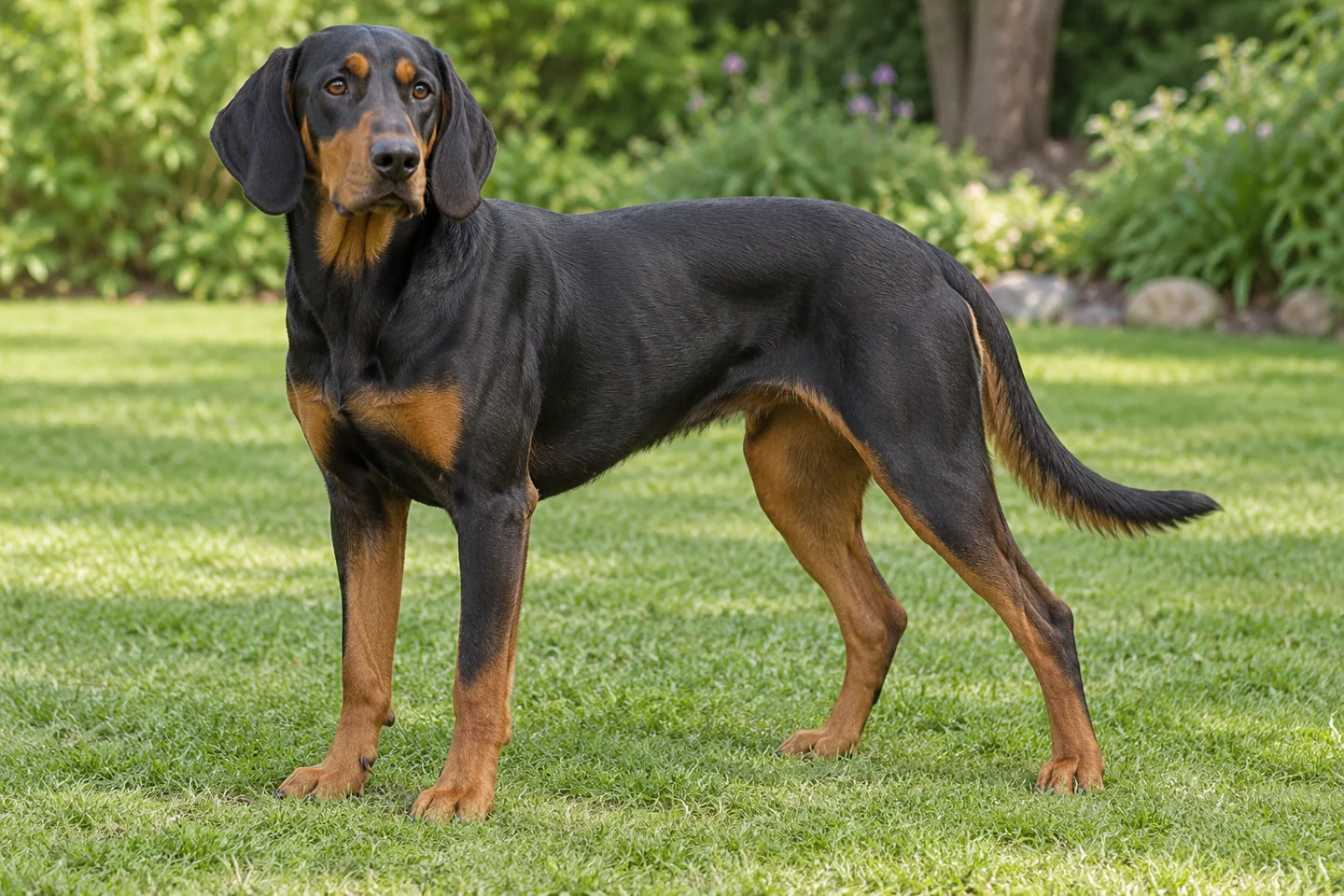
- Origin
- Poland
- Adult height
- Males 55–59 cm; females 50–55 cm
- Original name
- Gończy Polski
- Illustrated coat
- Black and rich rust tan
General information for owners. These articles have not been reviewed by a veterinarian. Medical decisions need your dog's history and an examination.
A Gończy Polski is not simply another name for the Ogar
This guide concerns the Gończy Polski, called Polish Hunting Dog in the FCI standard. The Ogar Polski, or Polish Hound, is a different breed. English descriptions sometimes blur the names, which can lead to swapped sizes, appearance, and medical claims. Ask the source for the original breed name and registry identity. The Gończy has a comparatively lean athletic outline, while the Ogar is more substantial. Neither a black-and-tan coat nor a general Polish hound label supplies a documented ancestry account for a rescue whose background remains uncertain.
Begin the placement discussion with the life the particular source expects the dog to lead. A working breeding programme may have requirements your household cannot meet, and those should be clear before you select a puppy. Describe your intentions honestly and ask about the adults' routines outside work. A dog that appears affectionate during a visit may still need substantial teaching, appropriate activity, and support with unfamiliar experiences. The right decision fits the known needs of the individual to the time, setting, and capable help you can provide throughout an ordinary week.
Southern Polish work and a modern standard
The FCI history describes scenthound traditions in Poland and the development associated with working dogs in the country's southern mountain regions. The standard identifies use on game including boar and deer. Keep a historical working description separate from a promise about every puppy's mature behavior. It gives owners reasons to investigate searching interest, voice, and cooperation, but it cannot determine how this individual will cope with a busy street, a visiting child, or a new household dog. Contemporary family information remains essential.
If you intend to work the dog, obtain instruction appropriate to the environment and animals involved. Do not treat the breed name as permission for uncontrolled pursuit. If you are considering a different kind of home, ask the source whether a particular adult or family has been assessed as suitable for that arrangement. A general promise of long walks may not answer a source's specific placement expectations. Honest disagreement before collection is easier to address than a mismatch after the dog arrives. A sound decision protects the animal's welfare and avoids using enthusiasm for an unfamiliar breed as a substitute for a workable routine.
An athletic frame and close coat
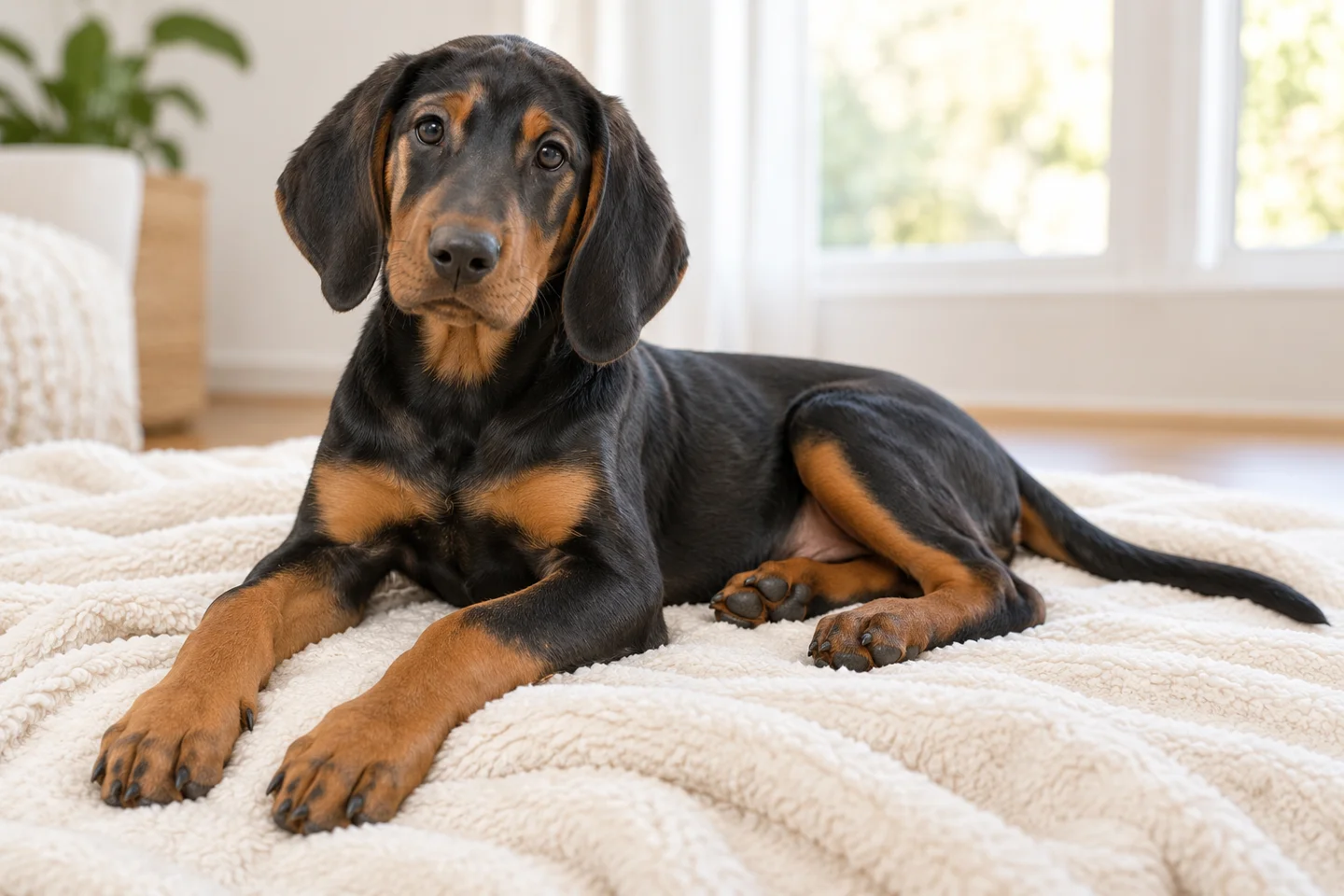
Male shoulder height is 55–59 cm and female height 50–55 cm in the FCI standard. The body is strong and athletic, with a deep chest, straight back, and no heavy dewlap. Medium naturally hanging ears have rounded tips, and a full sabre-like tail reaches toward the hock. Black and tan, chocolate and tan, and red are described. The illustrations select black with rich rust points and retain natural ears and tail. They do not depict the Ogar's heavier head or turn the dog into a generic black-and-tan guardian.
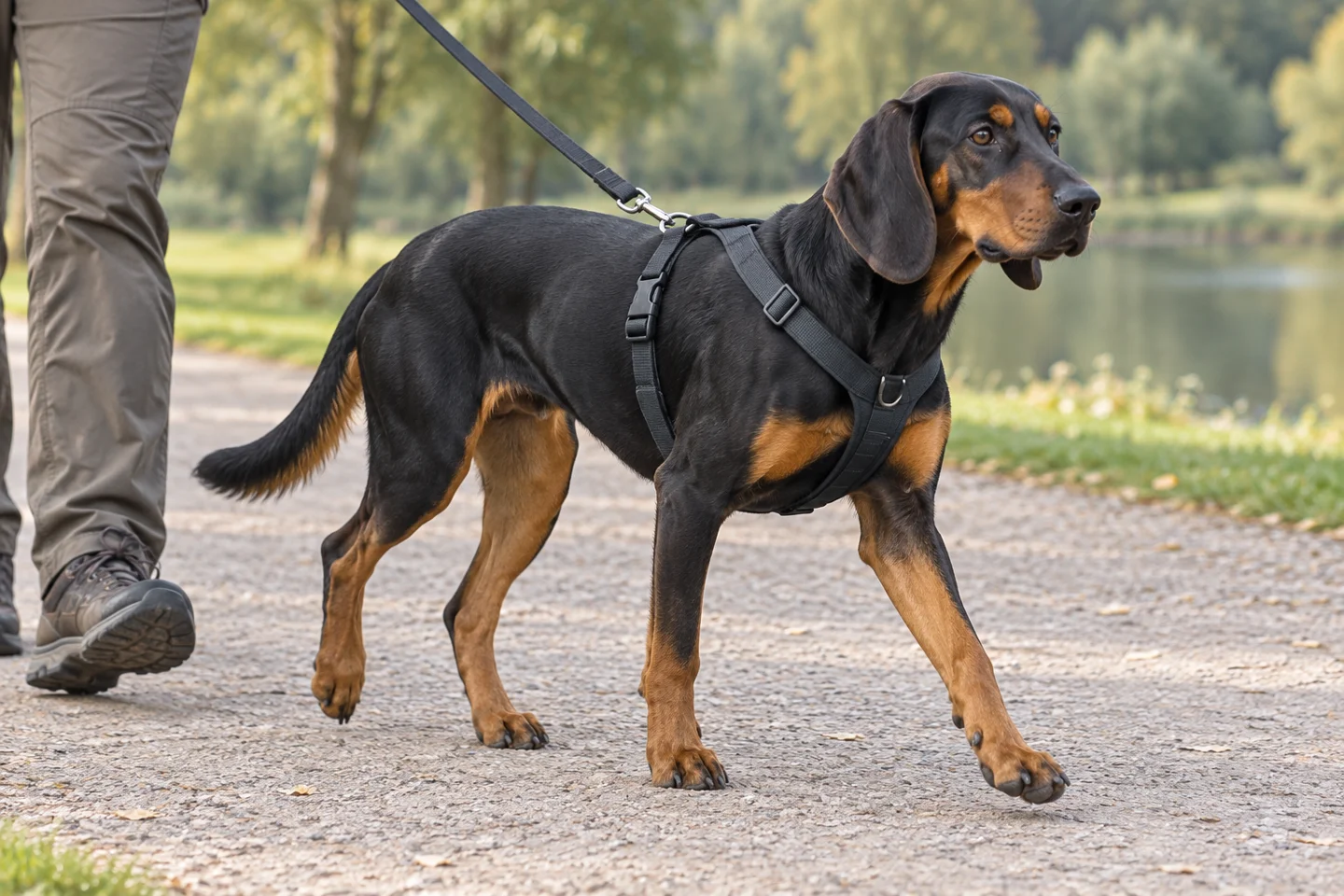
Assess the individual for comfortable movement and appropriate condition. A breed standard does not provide a feeding target for every frame. Ask the veterinary team to examine changes in gait, recovery, or body condition rather than deciding from a photograph. Check equipment during walking and turning, including security if the dog backs away. Puppies need refitting as they develop. Arrange transport and rest for the adult body, with enough room to stretch naturally. A practical owner plans for daily comfort as well as activity, including the possibility that illness or injury later changes how the animal can enter a vehicle or reach its usual sleeping place.
Training a hound to return and to finish work
Start recall and attention exercises where the dog can succeed. Reward returning, then sometimes allow further suitable investigation so the cue does not always predict the end of interest. Add distraction gradually and use secure equipment while the skill develops. Calling repeatedly after a scent has absorbed the hound supplies less useful teaching than practising at a workable distance first. A reward-based instructor can help choose that starting point and explain how to progress without turning each outing into a contest over who can be louder.
Teach a clear transition when activity ends. Practise moving onto a bed, waiting while equipment is removed, and resting while people are occupied. A household needs those skills even if it enjoys more demanding work. Prepare safe exchanges for objects through planned games and keep dangerous finds inaccessible. Everyone responsible should understand the same cues and what still requires management. A working title does not automatically transfer to a new context, and physical maturity does not mean a recently adopted dog knows the rules of its new home. Consistent understandable teaching gives the animal a fair way to participate in the routine you expect.
Voice and boundaries belong in the first ownership conversation
The standard describes a characteristic voice during work. Ask how the individual vocalizes in ordinary life and what starts it. A response to scent differs from alarm at a gate or distress during absence. Explain neighboring homes, shared walls, and the dog's proposed daytime area before placement. A source should describe successful management and remaining difficulties without promising that one command will erase every sound. The household needs a setting that can support the animal while training proceeds, rather than discovering a serious mismatch only when complaints arrive.
Check gates and fences as practical equipment, not scenery. Decide who opens them, where the dog waits, and how visitors enter without creating an escape opportunity. Supervise use of outdoor space and do not expect a tracking device to prevent an unsafe road crossing. A comfortable rest area away from constant boundary disturbance can reduce repeated rehearsals of an unwanted response. Teach that routine during easy moments. The owner should be able to maintain calm access even when attention is divided, with a backup arrangement if the usual handler is unavailable. Reliable management makes unfinished learning safer while it improves.
Exercise based on readiness instead of a fixed daily distance
Plan activity around age, health, recent work, and recovery. A hound bred for demanding terrain still needs preparation for a new workload. Ask the veterinarian about growing puppies, return after injury, and the readiness of an adult beginning a sport. Include investigation and learning as well as movement. Continually extending distance until the dog is exhausted is not the only way to provide engagement and may make quiet weekdays harder to sustain. Watch how the animal settles and moves later, including the following morning.
Water, shade, surface conditions, and the journey affect the actual demand. Choose routes with an easy option to shorten the outing and avoid adding a hot vehicle to a strenuous day. If a dog cannot continue, the person responsible needs clinic contact details and a transport plan appropriate to the location. Persistent lameness, unusual fatigue, or altered recovery deserves advice rather than an assumption of stubbornness. Record when signs began and what preceded them. The useful goal is comfortable ordinary function for this individual, not completion of an arbitrary route chosen because another owner says the breed can manage it.
Aggression requires a history rather than a working-breed excuse
Record a warning or bite through the actual sequence. Note who approached, the available space, any object or handling involved, contact, and injury. Prevent another exposure while arranging veterinary and behavior advice. Sudden changes around touch or movement deserve clinical attention. Do not recreate the event to demonstrate courage or to show that the dog can be provoked. The purpose is to understand the difficulty and reduce risk. An affectionate relationship with the owner does not cancel a problem in a different setting or make a visitor's concern irrelevant.
Protect food and sleep from interference and practise appropriate exchanges only in safe planned situations. Keep distance around unfamiliar animals where needed rather than forcing close greetings. A qualified professional can help decide what restrictions are necessary and whether the home can maintain them. Give carers a factual incident history before they agree to take responsibility. If muzzle conditioning is recommended, obtain instruction on fit and comfortable introduction while retaining barriers and supervision. The device supports a wider prevention plan. It cannot make repeated crowding, competition over resources, or rough handling an acceptable experiment in the dog's tolerance.
Children and household animals need distinct decisions
Adults should manage leads, care, visitor access, and object recovery. Teach children to invite contact, stop when the dog leaves, and avoid disturbing meals or rest. Active supervision means noticing pressure before the animal is cornered or required to react. Provide a comfortable protected area during gatherings when adult attention must be divided. Ask the source what ages and situations it has observed. A good response to one calm older child cannot establish safety during every later noisy visit, and a small child should not be expected to enforce a training rule alone.
Ask separately about canine companions, cats, livestock, and smaller pets. A working history makes pursuit relevant without proving every individual's response. Keep vulnerable animals physically protected when safety is uncertain; do not release one as a test. Introduce dogs with enough room for both handlers to leave, and organize individual food and sleeping spaces indoors. A successful outdoor walk does not automatically permit unrestricted sharing at home. The household layout and daily habits must support any necessary boundaries. If they cannot, choose a more suitable arrangement before relying on the animals to resolve a risk that the people cannot reliably prevent.
Grooming and everyday clinical observations
The close coat still needs inspection and suitable gentle maintenance. Check skin under equipment and feet after outings, and keep nails and dental care in the routine advised by the clinic. Introduce touch while the dog is comfortable so care does not begin only after something hurts. A source's description of a robust working animal should not make pain normal. If the hound suddenly resists an area it previously accepted, consider discomfort and obtain advice rather than turning a medical change into a repeated struggle over cooperation.
Ear odor, redness, discharge, pain, or repeated head shaking needs veterinary attention. Avoid deep tools or medication left from another episode. Keep details of treatments, products, and the dog's response when a problem recurs. An alternate carer needs clear instructions and the contact to use if something changes. Those records are particularly useful when a dog has moved from a working kennel or another country, where the receiving owner may not know how to interpret informal shorthand. A readable dated account helps the clinician investigate today's problem without assuming that every previous difficulty had the same cause.
Health evidence in a named breeding programme
The German Gończy Polski club publishes a breeding process that includes hip assessment and a genetic fingerprint before its breeding approval. The fingerprint establishes identity-related information; it is not a declaration that all hereditary disease has been excluded. Ask which programme governs the proposed parents and obtain their individual hip reports as well as the documents showing identity. A working examination and a medical assessment do different work. Do not describe one club's process as a universal legal requirement or transplant a different Polish hound's disease findings into this breed.
A useful medical conversation also includes injuries, repeated diagnoses, and information from older relatives. Ask how the source receives later owner reports and what remains unknown. Rarity does not establish an absence of illness or supply a reliable prevalence number. For an adult placement, assemble the actual treatment history, medication, previous activity, and follow-up instructions. A new change in movement or condition needs veterinary assessment of the patient, even when its family has reassuring paperwork. Good evidence distinguishes an individual examination from a breeding decision, helping the new owner plan current care without inventing certainty where the records are incomplete. Ask the previous clinic for readable copies rather than relying on a vaccination booklet to describe every prior problem. Confirm who will continue a prescribed treatment during the handover and where any unfinished investigation will be followed up, so responsibility does not disappear between the old and new carers.
Nutrition and support that continues after collection
Use complete food appropriate to life stage and current body condition. Measure portions, include rewards, and review the plan with the veterinary team when activity changes. Do not feed toward a guessed universal working-hound weight. Separate meals if another animal creates pressure or makes intake difficult to observe. Persistent changes in appetite, digestion, drinking, or condition deserve a clinical conversation before successive unrecorded diet switches obscure the timeline. A supplement should have a clear purpose and professional guidance, rather than being added because the breed is described as active or because a seller promises stronger growth.
Find out what local care costs and who can provide it. Veterinary visits, secure equipment, transport, training help, and appropriate sitting or boarding belong in the budget. A carer should understand recall limits, voice, and current restrictions before agreeing to cover an absence. Clarify written support and return arrangements with the source, and arrange emergency funding or suitable insurance. The ownership plan must work when the usual person is ill or the dog needs quieter activity. It should not depend on every week following the same ideal schedule, nor on one handler always being available to solve each practical problem.
Mixes and dogsDating companionship need individual information
A Gończy mix needs a separate parentage account where records exist. Black-and-tan markings do not establish the combination, and a rescue label based on resemblance should remain tentative. Consider relevant information about both known parents without assuming crossing removes inherited illness or makes the temperament a predictable average. On dogsDating, describe the actual hound's pace, scent interest, and greeting restrictions. Share an approximate area while keeping exact coordinates and the home address private. A useful profile should prepare the conditions of the outing rather than promise compatibility from a breed name.
Choose a public open meeting point, begin in parallel, and ensure each adult can manage their own dog. Keep shared toys and food placed between unfamiliar animals out of the first encounter. Increase distance or finish if either repeatedly withdraws, stiffens, or becomes too excited to disengage comfortably. Compare route, separation, and pace afterward instead of judging success only by play or nose contact. A calm walking partner can be valuable without close greetings. Continued meetings should follow the evidence from these individuals, with the owners retaining the ability to change course or leave whenever the animals' needs require it.
Sources and editorial notes
Sources checked October 22, 2026. Breed measurements describe reference ranges, not a diagnosis or an individual dog's ideal weight. Images are AI-generated breed illustrations and do not document a particular dog or health condition.
- AVSAB: Humane Dog Training Position Statement
- VCA Animal Hospitals: Food aggression in puppies
- VCA Animal Hospitals: Common emergencies in dogs
- Orthopedic Foundation for Animals: CHIC health screening programs
- VCA Animal Hospitals: Aggression toward unfamiliar dogs, diagnosis
- VCA Animal Hospitals: Grooming and coat care for your dog
- VCA Animal Hospitals: Ear infections in dogs (otitis externa)
- AAHA: Feeding plans for healthy, appropriate weight cats and dogs
- VCA Animal Hospitals: Heat stroke in dogs
- AVSAB: Puppy Socialization Position Statement
- VCA Animal Hospitals: Dog behavior problems, aggression toward children
- Official breed standard: Polish Hunting Dog
- Verein Gonczy Polski Deutschland: Breeding requirements and placement advice
Keep getting to know dogs.
Read another guide or return to your dogsDating community.
Explore breed guidesBack to dogsDating