Slovakian Hound
The Slovenský kopov is a black-and-tan Slovak scenthound with persistent tracking interests, needing secure opportunities, reliable care, and an informed assessment of its working background.
How these guides are researched and reviewed
- Origin
- Slovakia
- FCI male height
- 45–50 cm
- FCI female height
- 40–45 cm
- FCI weight
- 15–20 kg
- Color
- Black with brown to mahogany tan markings
General information for owners. These articles have not been reviewed by a veterinarian. Medical decisions need your dog's history and an examination.
Slovenský kopov means a particular Slovak scenthound
The Slovakian Hound is the Slovenský kopov, a medium black-and-tan scenthound from Slovakia. The FCI describes persistent vocal tracking work and its use around wild boar and other quarry in its home country. Those tasks explain why a prospective owner should discuss scent interest, voice, and recovery in detail. A compact body and shortish coat do not turn this dog into an undemanding substitute for a quieter companion. A suitable home needs safe investigation, useful training, secure boundaries, and people who can meet everyday needs when work or weather changes the usual plan.
Ask how the available dog lives now. A working kennel, a mixed household, and a foster home provide different experiences with doors, visitors, resting indoors, and separation. Meet adults and watch ordinary behavior instead of relying on an impressive account of hunting performance. A good source should describe difficult moments as well as successful routines. A new owner needs to know what support made the dog manageable and whether that support can be provided after a move. Arrange a calm first week, reliable care, transport, and veterinary contact before the animal arrives, rather than testing it immediately through repeated outings and visitors.
Identity, aliases, and avoiding a misleading comparison
Slovenský kopov, Slovakian Hound, and Slovakian Black and Tan Hound refer to this breed in common English-language material. It is distinct from the much larger Bloodhound and from other black-and-tan European scenthounds. Color cannot establish ancestry, and an unknown hound should not receive a confirmed pedigree from a photograph. When comparing records, keep the registered name, identification, date, and issuing organization together. A translated description should preserve the original result so a veterinarian or registry can understand exactly which animal and examination it refers to.
The practical history is scent work requiring persistence and independent decisions away from a person. That background can coexist with close household attachment, but it does not make recall automatic. Ask what current selection emphasizes and what the source knows about relatives in everyday homes. A working title answers a defined performance question, while clinical reports and behavior observations answer others. Do not treat one as evidence that all the rest are favorable. For a rescue without lineage information, prioritize the animal's observed needs and keep uncertainty visible. A careful plan does not require inventing a distinguished ancestry to justify providing appropriate activity and care.
Size, coat, ears, and the full tail
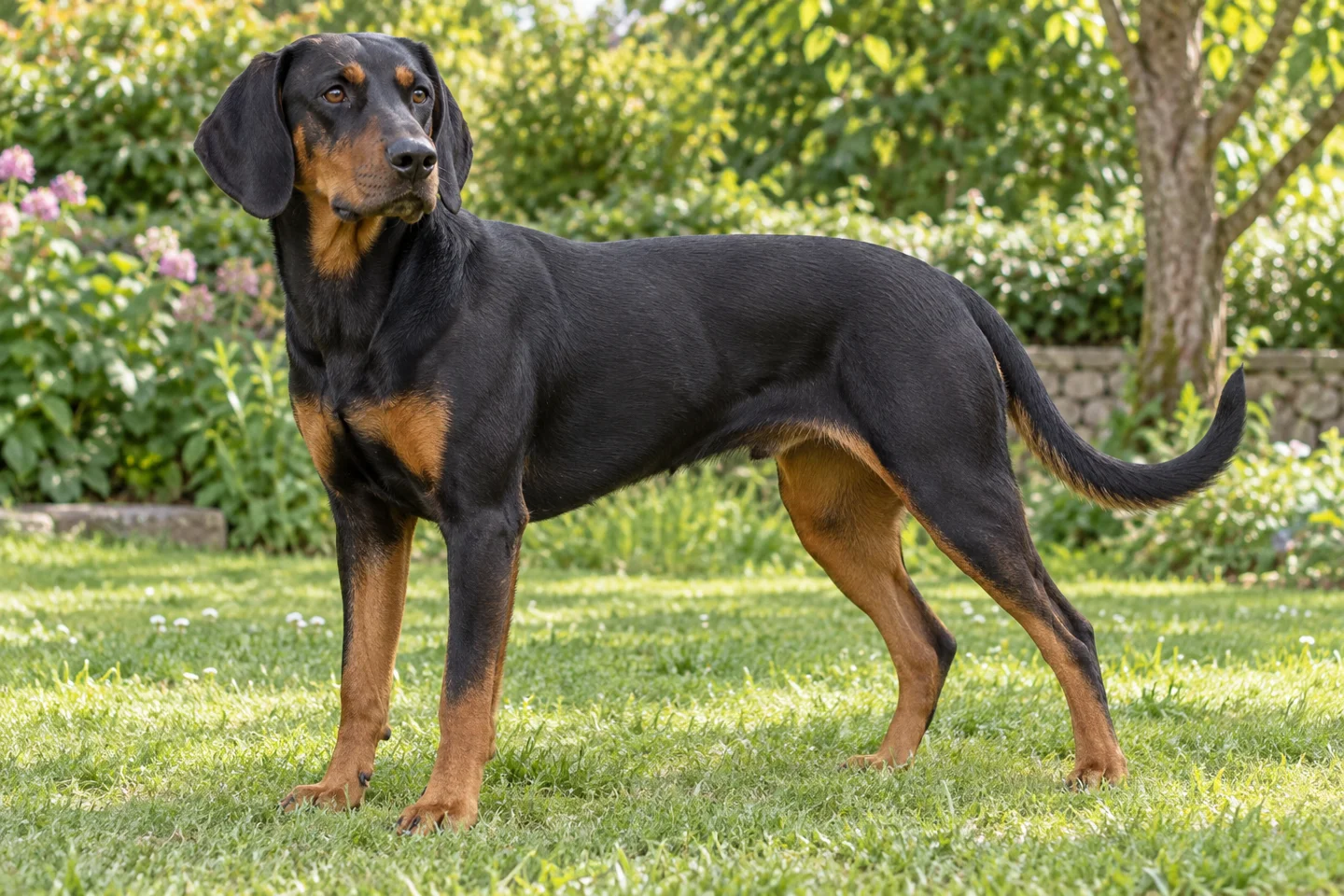
The FCI height ranges are 45–50 cm for males and 40–45 cm for females, with weight listed as 15–20 kg. The body is somewhat long and light in build while retaining substantial bone. A dense black coat carries brown to mahogany tan markings, and the natural medium-length ears hang flat beside the head. The full tail reaches the hock, hangs when relaxed, and curves upward in a sabre shape when alert. The illustrations choose that natural outline and clear black-and-tan coloring. They are labeled AI illustrations rather than records of a particular registered dog.
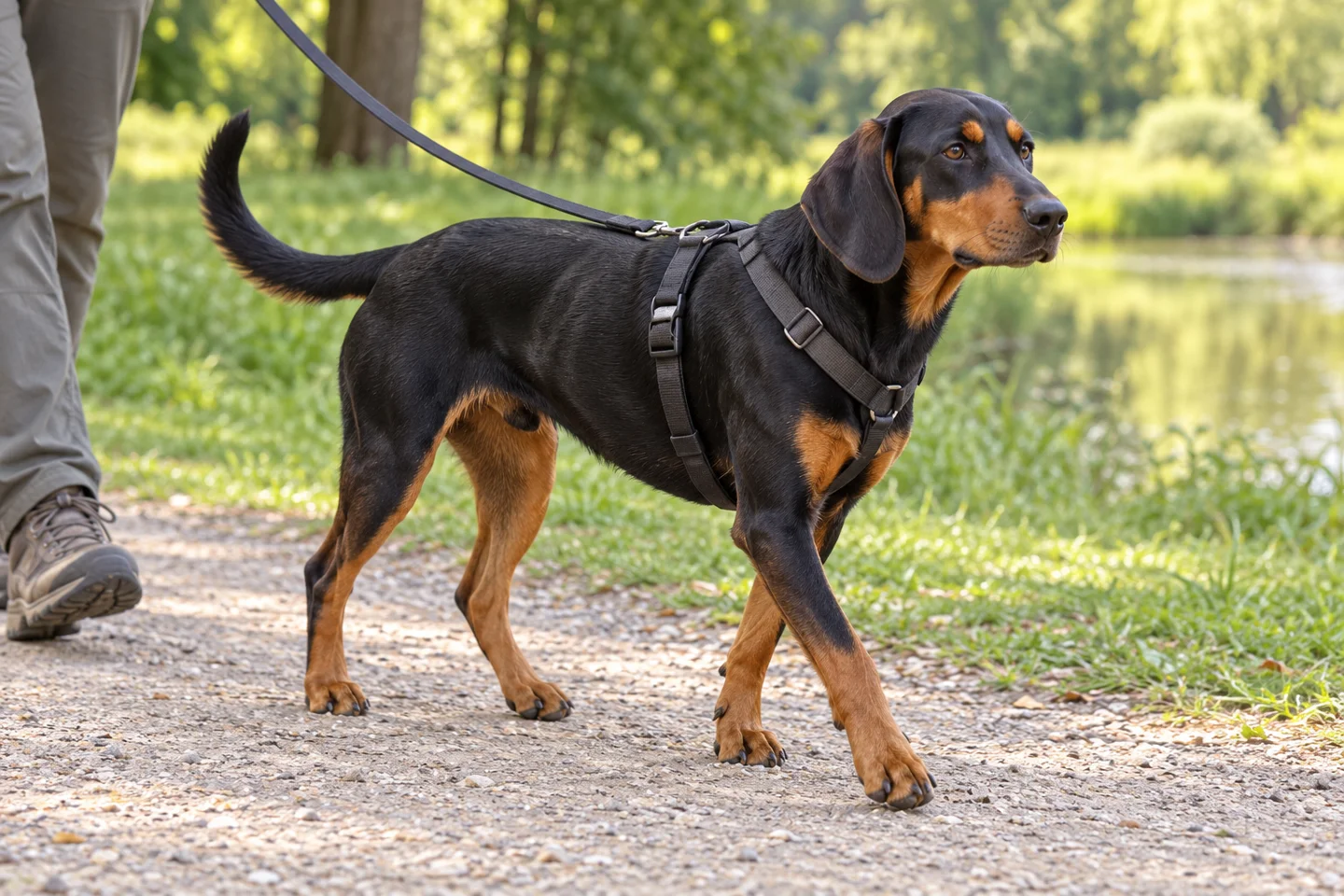
Look beyond the markings when meeting an animal. Watch comfortable walking, turning, and rest, and ask about any injuries or changed activity. Assess body condition with appropriate hands-on guidance rather than feeding toward a number because it appears in a standard. Puppies need balanced growth and suitable activity without pressure to become adult athletes early. Fit equipment securely to the actual chest and neck and test escape risk in a safe place. A frightened hound backing out of a loose harness near traffic can become an emergency quickly, so preparation matters even when the familiar dog seems confident at home.
Voice, searching interest, and indoor settling
Vocal tracking is part of the breed's documented work, so discuss sound honestly before placement in a noise-sensitive home. Ask what starts this individual's barking or baying and what allows it to stop. Scent excitement, a barrier, a visitor, and distress during absence require different practical responses. Reduce repeated access to a trigger where possible and teach an achievable alternative, such as turning with the handler or moving to a quiet resting place. Shouting over the animal's voice can add arousal without identifying the problem. Observe the context before deciding that more exercise or firmer correction will solve it.
Rest should have a place in the routine. Provide an undisturbed area away from constant window activity and reward quiet transitions after outings. Short manageable absences should be introduced gradually with observation guiding progress. Another dog is a separate commitment whose effect on separation distress cannot be promised. For an adult entering an unfamiliar house, retain useful cues and make initial expectations modest. The first days can reveal preferences without becoming a test of every possible social situation. Predictable meals, toilet opportunities, sleep, and company make learning the new environment easier than a crowded schedule intended to tire the dog into compliance.
Training recall and preventing unsafe pursuit
Begin recall in a secure low-distraction setting and reinforce returning promptly. Often let the animal resume a safe investigation afterward, so responding does not always predict the end of interest. Increase difficulty gradually and use suitable equipment to manage opportunities while skills develop. A long line on a correctly fitted harness can help where it can be handled without entanglement. Do not release the dog near livestock, roads, or wildlife to discover whether it will return. A history of persistent tracking is a reason for preparation, not proof that the animal knows which trails are safe to follow.
Teach waiting at exits, moving with the handler, and a practiced turn away from activity. Use short scent games with clear beginnings and endings so searching has a permitted outlet. Keep difficulty manageable and stop before frustration or frantic behavior dominates. Practise exchanging objects rather than chasing the dog or grabbing from its mouth. Guarding warrants a revised setup and qualified advice. Handling lessons should cover feet, ears, mouth, and skin inspection in brief comfortable steps. Useful training should make ordinary care and movement safer, rather than concentrate solely on impressive performance in a setting the household cannot reproduce.
Exercise with attention to recovery and the route
Offer varied movement and investigation suited to age, health, and established fitness. A healthy mature working dog may have considerable endurance, but that cannot set a daily target for every member of the breed. Build new routes and workloads gradually, especially after illness, travel, or reduced activity. Young dogs need exploration and coordination rather than forced adult distances. Watch movement and recovery later in the day and the following morning. Persistent stiffness, reduced willingness, or unusual fatigue needs veterinary assessment. A dog excited by scent can still be uncomfortable, and enthusiasm should not be the only measure used to continue an outing.
Select routes with permission and a manageable level of wildlife, traffic, and livestock exposure. Check boundaries, gates, and vehicle transfers so a scent opportunity does not become an escape. Carry drinking water, provide shade and rest, and shorten demands in hot conditions. A familiar route may be unsuitable after a weather change. Inspect feet and coat after rough vegetation and dry the animal comfortably after wet work. Quiet days also belong in a sustainable plan. Short cooperative tasks and appropriate enrichment can provide interest without trying to reproduce a long working outing through frantic indoor games.

Aggression and listening before a warning becomes a bite
A working hound can be affectionate with familiar people and still react when afraid, painful, trapped, or protecting something valuable. Assess the individual rather than assuming its breed label guarantees safety. Withdrawal, freezing, stiffness, a hard stare, or growling calls for more room and a change in the interaction. Do not punish a warning while the pressure remains. A sudden reaction to a previously comfortable care task deserves veterinary attention, particularly when ears, feet, mouth, or movement appear involved. Record the circumstances so a professional can investigate the cause without relying on a vague label for the dog's motives.
Use barriers and routines to prevent repeated conflict while obtaining help. Protect meals and rest, manage visitor arrivals, and remove access to unsafe objects. All adults and carers need an honest account of bites or close calls and the same handling plan. Where risk exists, involve the veterinarian and a suitably qualified behavior professional. Positively introduced basket-muzzle training may be appropriate, but it does not make forced greetings or painful handling acceptable. Progress is a more comfortable and manageable animal, with successful choices at suitable distances, rather than silence achieved through repeated suppression of warnings.
Children, dogs, and vulnerable household pets
Children need adult supervision and a physical arrangement that prevents crowding. Stop ear pulling, hugging, climbing, chasing, and interruption of sleep or meals. Use a separate resting area and separate before running games become difficult for the dog to ignore. Teach a brief invitation to contact followed by a pause, respecting withdrawal. A child cannot carry responsibility for judging every warning or controlling an absorbed hound beside a road. Familiarity with the family's children is useful information, while visiting children and a noisy gathering can create a different situation requiring its own plan.
Introduce dog companions with separate handlers and space to move independently. Familiar hound company does not establish compatibility with every size or play style. Observe whether each animal can stop and disengage before allowing closer interaction. Cats, poultry, rodents, and other small pets need appropriate barriers and individual assessment. Acceptance of one familiar animal does not predict behavior toward every fleeing animal outdoors. Some combinations require lasting separation. Do not permit an uncontrolled chase to test what the dog will do. Accurate prior observations and gradual safe introduction are more useful than an avoidable incident obtained in the name of finding out.
Grooming and post-walk inspection
Brush gently with tools suitable for the close coat and use the routine to inspect skin and equipment contact points. Look at feet after rough ground and remove loose surface debris before it causes further rubbing. Short hair makes some checks easier but does not prevent wounds, attached parasites, or irritation under straps. Bathe as needed with suitable products and dry comfortably. Recurrent itching, hair loss, or new lesions deserves clinical assessment. Keep bedding clean and check nails and pads, especially after a change in terrain or workload.
The visible outer ears should be checked for odor, redness, discharge, and sensitivity. Repeated head shaking after vegetation exposure can have several causes and should not automatically receive leftover drops from a previous infection. Avoid probing down the canal and seek appropriate advice. Teach calm ear lifting and paw inspection when the animal is well, with seconds of comfortable contact and rewards. Dental care needs a routine too. A dog participating willingly is easier to examine accurately than one held in place until it struggles. If a familiar step suddenly becomes difficult, investigate discomfort before demanding more tolerance.
Health records and the dated KCHSK breeding framework
KCHSK's published breeding conditions dated May 2017 include hip dysplasia assessment through qualified evaluators. The club's individual records can also show an identified hip result alongside measurements and working information. Those are useful reasons to request actual documents. A dated webpage should not be treated as proof that every rule remains unchanged for a future litter. Ask the source and club which current conditions apply and how a proposed pairing was assessed. Keep medical findings separate from working or show results so each is interpreted according to the question it answers.
A family's information is more useful when diagnoses and missing records are both described honestly. Ask about repeated treatment, surgery, eye or skin problems, lameness, unexplained collapse, and reasons close relatives died when known. These are history questions, not assertions that every listed condition is a proven Slovakian Hound predisposition. A veterinarian can assess relevance and explain unfamiliar grades or test claims. A generic DNA panel cannot exclude all future illness. For an adopted adult, collect its own clinical history and ongoing instructions first, then use parental information if available to improve the picture rather than inventing certainty where records are absent.
Outdoor health includes injury preparation
A hound associated with difficult tracking work should have practical injury preparation suited to its actual activities. Agriculture Victoria's working-dog guidance discusses routine inspection and risks such as penetrating grass seeds. Check exposed areas after vegetation, and obtain clinical help for suspected embedded material instead of digging into tissue. Persistent foot licking, pain, swelling, or abrupt head shaking after a route provides useful information for the veterinarian. It does not identify the cause by itself. A small visible mark also cannot establish that an injury is superficial, so describe the event and follow professional advice.
Before remote outings, know how to reach a clinic and transport a dog unable to walk. Keep identification and carer contacts current. Prevent access to dangerous quarry, roads, and carcasses through management rather than relying on boldness as protection. Major bleeding, collapse, severe breathing trouble, or rapid deterioration requires urgent veterinary contact. Do not give human pain medicine or continue activity because the animal is willing to follow scent. After a diagnosed injury, follow the rehabilitation and return-to-activity plan. Performance can resume only on a schedule appropriate to the patient, not because another hound recovered after a similar-looking incident.
Nutrition, mixes, and practical ownership costs
Use complete food appropriate to life stage, medical needs, and workload. Measure portions and include rewards used in training or scent games. Review condition with the veterinary team when activity changes, rather than feeding the same amount through every season. A mix needs the same individual approach and consideration of both known parental backgrounds. Black-and-tan coloring cannot confirm Kopov ancestry. Crossing does not guarantee moderate activity, reduced pursuit interest, or freedom from inherited disorders. Keep uncertain labels honest and choose care based on the actual animal's condition and behavior.
Budget for routine and urgent veterinary care, suitable insurance or an emergency reserve, training support, secure boundaries, transport, and competent care during absences. Ask a sitter how it will manage gates and scent distractions. Clarify the source's ongoing help and return arrangements in writing. An active owner still needs a plan for illness, bad weather, and later changes in the dog's mobility. A sustainable placement meets ordinary needs consistently, rather than depending on a few exceptional outings. The commitment is to this particular animal throughout its changing life, with practical resources that remain available after the novelty of a rare working breed has passed.
dogsDating meetings for a scent-focused companion
On dogsDating, mention whether this Kopov becomes vocal when following an interesting trail. An owner expecting a silent stroll can then decide whether the proposed route suits both dogs. Select a public starting point away from roads and narrow access gates, with room for the handlers to maintain separate walking lines. The profile should locate a general district without publishing exact coordinates or the household's address. Explain that the first outing will be lead walking, not a test of off-lead recall. Keep enough flexibility to leave a heavily scented patch without pulling both dogs into close contact. A companion that wants constant wrestling may be less suitable than one content to investigate the same landscape at a respectful distance.
Observe whether both animals can sniff, look away, and continue comfortably. Repeated freezing, withdrawal, blocking, or chasing means the setup needs more distance or an early finish. Calm repeated walks can provide companionship without immediate play. Compare route, duration, spacing, and pace afterward and use those observations for another invitation. Public photographs should not reveal exact addresses or another person's private information. The outing should leave both owners able to manage their dogs and both animals able to leave calmly, even when the first meeting is shorter than expected.
Sources and editorial notes
Sources checked October 22, 2026. Breed measurements describe reference ranges, not a diagnosis or an individual dog's ideal weight. Images are AI-generated breed illustrations and do not document a particular dog or health condition.
- AVSAB: Humane Dog Training Position Statement
- VCA Animal Hospitals: Food aggression in puppies
- VCA Animal Hospitals: Common emergencies in dogs
- Orthopedic Foundation for Animals: CHIC health screening programs
- VCA Animal Hospitals: Aggression toward unfamiliar dogs, diagnosis
- VCA Animal Hospitals: Grooming and coat care for your dog
- VCA Animal Hospitals: Ear infections in dogs (otitis externa)
- AAHA: Feeding plans for healthy, appropriate weight cats and dogs
- VCA Animal Hospitals: Heat stroke in dogs
- AVSAB: Puppy Socialization Position Statement
- VCA Animal Hospitals: Dog behavior problems, aggression toward children
- Official breed standard: Slovakian Hound
- KCHSK: Published Slovakian Hound breeding conditions dated May 2017, including hip assessment
- KCHSK: Example identified breeding record with hip result, measurements and working information
- Agriculture Victoria: Routine care and injury prevention for working dogs
Keep getting to know dogs.
Read another guide or return to your dogsDating community.
Explore breed guidesBack to dogsDating