Pont-Audemer Spaniel
A French wetland pointing dog with a curly topknot, practical working coat, and a need for thoughtful exercise, cooperative teaching, and clear health records.
How these guides are researched and reviewed
- Origin
- France
- FCI adult height
- 52–58 cm
- Coat
- Curly brown or brown and gray mottled
- Working background
- Pointing and retrieving in wet ground
General information for owners. These articles have not been reviewed by a veterinarian. Medical decisions need your dog's history and an examination.
A wetland pointing dog in an everyday home
The Pont-Audemer Spaniel is a French pointing dog whose appearance can distract from its working purpose. Long curled ears and a topknot frame a relatively smooth face. Behind that head is an active, substantial dog developed for searching, indicating game, and recovering it. A prospective owner should discuss those tasks with the source even when no hunting is planned. Daily life needs safe opportunities to investigate scent and work with a person. Being uncommon does not make the breed an easy apartment novelty or establish the temperament of a particular puppy.
Start the ownership discussion with ordinary practical questions. How does this family's dog settle after an outing? What happens when birds rise nearby, a visitor enters, or a handler leaves for an appointment? An honest source should be able to describe both successful routines and difficult situations. Arrange quiet accommodation, a safe outdoor boundary, transport, and a workable care schedule before bringing a dog home. Adults and puppies have different support needs, but neither benefits from an owner relying on rarity or an appealing photograph as evidence of suitability. A successful placement includes help when the first plan requires adjustment.
French origins and the limits of a neat ancestry story
Pont-Audemer takes its name from a town in Normandy. UKC's history discusses French spaniel ancestry and possible contributions from other curly-coated working dogs, while describing Irish Water Spaniel crossing after the Second World War. Those accounts should be presented with their stated uncertainty. They do not provide a precise ingredient list for every modern pedigree. A current registered Pont-Audemer belongs to an established breed, and an accidental spaniel cross does not acquire that identity because its head grows curly hair.
For an uncommon breed, preserving accurate records has particular practical value. Ask how a planned litter relates to the wider population, what information is shared with the breed club, and how the source balances working ability, health, and temperament. A long pedigree is useful only when its entries can be interpreted. Neither a famous ancestor nor a dramatic recovery story excuses withholding a parent's medical history. If importing, request original identification and veterinary records with understandable translations. Establish who can help after arrival, including advice about coat care, age-appropriate activities, and a return arrangement if the home cannot keep the dog.
Size, coat, and the recognizable curly head
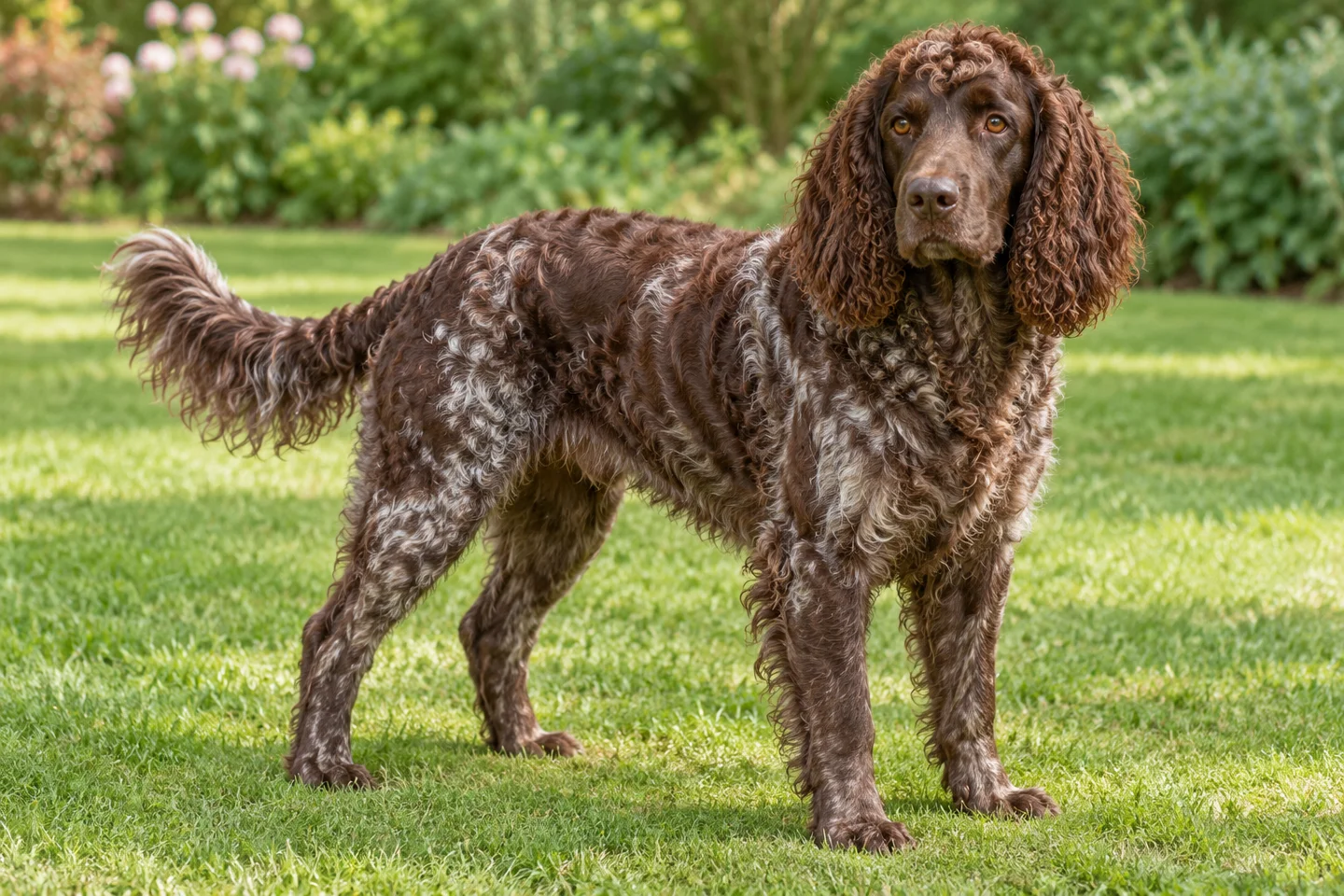
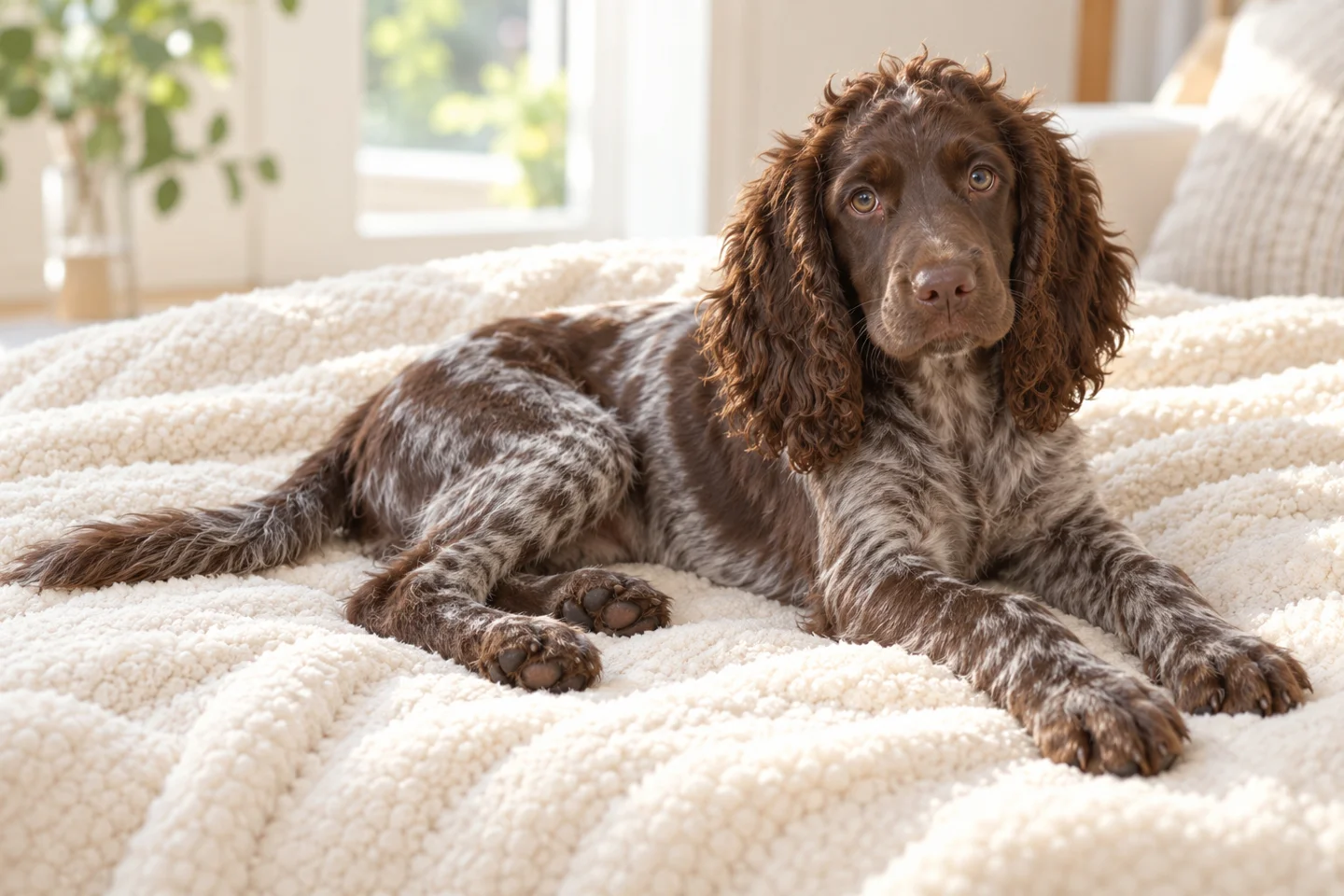
The FCI standard gives an adult height of 52–58 cm without separate male and female ranges in that size statement. It describes a stocky, strong dog with a curly coat, brown or brown and gray mottled coloring, and the characteristic topknot. The face is comparatively smooth, with a long muzzle rather than a short compressed nose. Long ears carry curly hair. The illustrations accompanying this guide show a brown and gray mottled animal with natural ears and a full tail. They explain an appearance and are labeled illustrations, rather than records of a particular available dog.
Assess an adult standing and moving on a comfortable surface, with enough time to see ordinary walking and recovery. Curl quantity does not tell you whether the skin beneath is healthy or the dog moves comfortably. Ask about the care behind the coat and look for clean, uninjured skin, comfortable eyes, and free movement. A puppy's coat and proportions will change. Avoid choosing entirely by the most elaborate head hair in the litter, and do not attempt to manufacture an adult outline through supplements or excessive exercise. A clinician can help judge growth and body condition without turning a show description into a health diagnosis.
Temperament and the ability to rest after searching
Working interest and family companionship can coexist, but the transition between them needs teaching. A Pont-Audemer may find a pond edge or fresh bird scent far more compelling than a repeated verbal cue. Build the routine around that reality. Offer a permitted investigation, reinforce voluntary check-ins, and practice calm transitions back into the house. Inside, make a resting place available away from door traffic. Reward relaxation without constantly asking the dog to perform. A household that supplies only excitement may struggle to discover whether the animal can settle because it has never made quiet behavior easy.
Meet related adults when possible and ask for observations across several settings. Behavior in a familiar kitchen does not answer every question about a crowded street or separation. Record how long the dog takes to recover after a surprise and what support helps. For a newly adopted adult, begin with a modest routine and add demands gradually. Avoid arranging a busy welcome party to test sociability. Predictable access to sleep, toilets, meals, and quiet company provides a better starting point for learning the animal's preferences than continuous introductions. Individual evidence should guide the pace of the first weeks.
Training for recall, retrieves, and useful cooperation
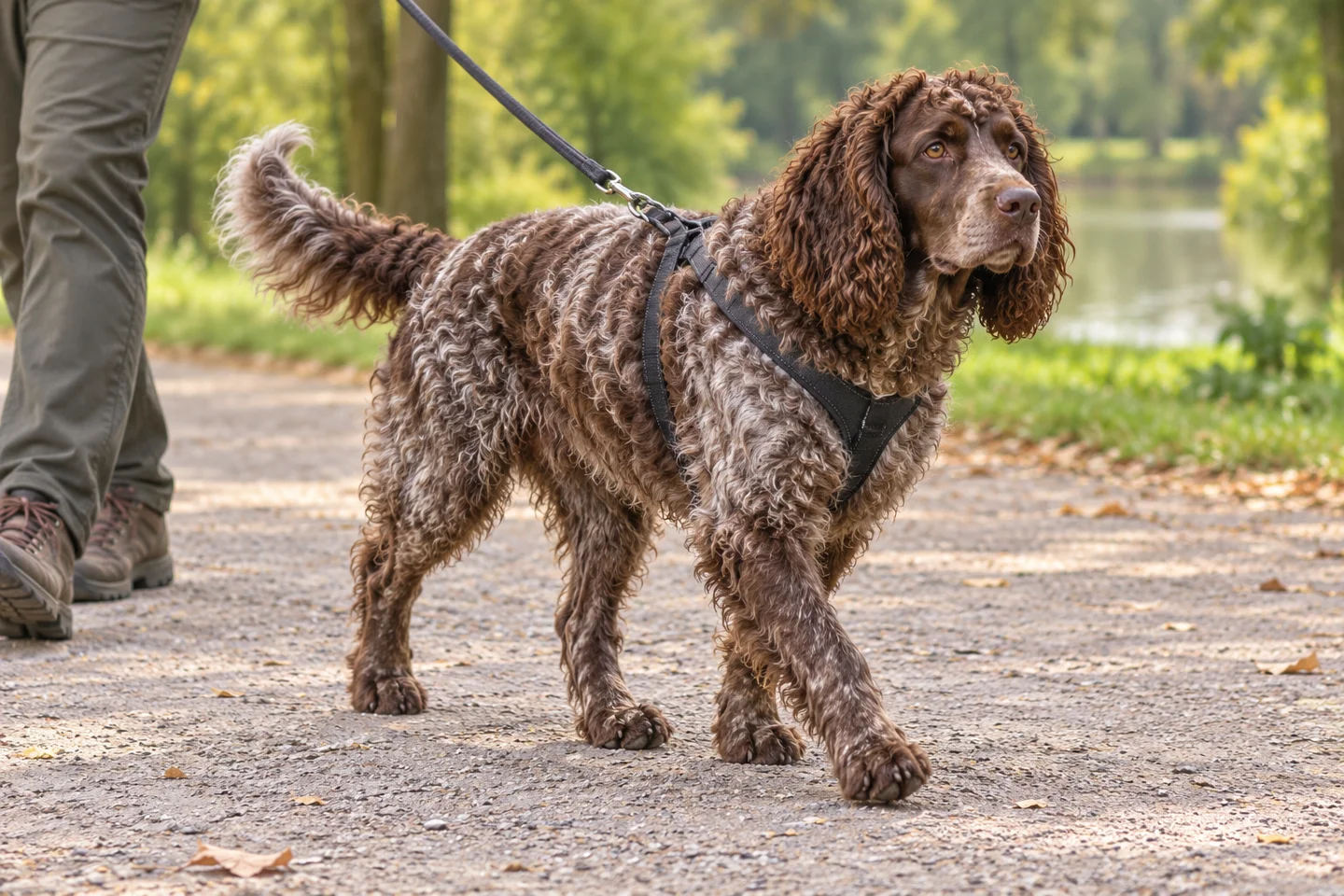
Teach recall in a setting where the dog can succeed before expecting it near wildlife. Reward a prompt turn toward you, then often release the dog to a safe permitted activity. A correctly fitted long line attached to a harness provides a management option while skills develop. Keep it clear of other people, vegetation, and the dog's legs. Progress from quiet ground to more interesting places in manageable steps. Repeating a cue while the dog is fully committed to distant scent teaches little, while an unsecured chase can rehearse exactly the behavior the owner hopes to reduce.
Retrieving practice should include returning and releasing, rather than only throwing. Begin with an ordinary safe object in a small space, reward delivery, and exchange for food or another appropriate item. Stop before the session becomes a frantic race. If the dog stiffens over an object, avoid grabbing or confronting it. Change the setup and obtain qualified help for guarding concerns. Train cooperative inspection of ears, feet, and coat through very short comfortable steps. These handling skills support daily wetland care as directly as an impressive retrieve, and they should not require physical restraint to look successful.
Exercise on land and careful access to water
Provide varied activity that fits age, fitness, weather, and the individual's recovery. A searching walk, a short problem-solving exercise, and quiet time afterward may be more useful than uninterrupted ball chasing. Let young dogs explore on suitable surfaces without prescribing adult endurance work. Build longer routes gradually and notice whether the dog remains comfortable later that evening and the following morning. Persistent stiffness or a change in willingness to move deserves veterinary discussion. There is no single daily distance that proves every member of an uncommon breed has received the right care.
A water-working history does not make unfamiliar water safe. Check permission, water quality, banks, current, boat traffic, and an easy exit before allowing access. Introduce swimming gradually with appropriate supervision and suitable flotation support when needed. Never throw a hesitant dog in, and avoid repeated retrieves in cold or rough conditions. Carry drinking water so thirst does not encourage drinking from questionable pools. Afterward, inspect feet and coat, dry the dog, and provide warmth or shade appropriate to the conditions. A handler should be able to finish the outing before fatigue turns a manageable swim into a rescue situation.
Aggression, pressure, and bite prevention
No breed label guarantees freedom from aggression. Pain, fear, trapped space, valuable objects, and repeated unwanted handling can alter any dog's response. With a Pont-Audemer, pay particular attention to people reaching into long ear hair or taking retrieved objects without an exchange. A still body, hard stare, withdrawal, or growl calls for more space and a change in approach. Punishing that warning does not resolve the discomfort. Protect the animal from repeated pressure while arranging appropriate assessment, especially when behavior changes suddenly or a previously comfortable care task becomes difficult.
Management should make daily life safer while a qualified professional helps identify the cause. Use doors or barriers to prevent rehearsed conflict around food, resting places, or visitors. Explain the routine to every adult instead of relying on the dog's favorite person to supervise constantly. Where bite risk exists, seek veterinary and behavior support and discuss positively introduced basket-muzzle training if appropriate. A muzzle permits neither forced greetings nor rough handling. Track the actual triggers and successful distances so progress is measured by comfort and safe choices, rather than by how much unpleasant contact the dog will endure.
Children, other dogs, and animals that move like quarry
Children need adult supervision and a space arrangement that prevents crowding the dog. Curly ears are especially tempting to grasp, and a child should never pull them or treat the topknot as a handle. Give the animal a resting area children cannot enter, and separate during meals and high excitement. Teach an older child to invite contact briefly and pause to see whether the dog chooses to return. A puppy also needs protection from overhandling. Responsibility belongs to the adults, even when a child has promised to do all the work involved in keeping a dog.
Introduce another dog with parallel movement and enough room for both handlers to increase distance. Avoid assuming shared gundog ancestry guarantees play compatibility. Cats, poultry, and small pets require their own assessment and physical safeguards. A familiar household cat does not establish safety around a fleeing unfamiliar animal. Use secure barriers and supervised gradual exposure where appropriate, with no chase allowed as a greeting experiment. Some combinations will need permanent separation. A practical household plan accepts that limit instead of demanding a photograph of every animal resting together as proof that introductions have worked.
Grooming curls without overlooking ears and skin
Part the coat to examine the skin rather than brushing only the visible curls. Work through small areas gently, paying attention behind ears, in the armpits, and where harness straps rub. Remove plant material before it tightens into knots. Have a groomer demonstrate tools and a manageable schedule for the individual coat. A painful mat should not become a prolonged wrestling session. Ask for professional help when needed and use the experience to improve maintenance. Coat comfort takes priority over preserving a particular length for a photograph. Keep a small post-walk kit by the entrance: towels, a suitable comb, good lighting, and rewards for standing quietly. This makes a careful inspection possible before wet curls dry around hidden burrs, rather than discovering painful knots at the next full grooming appointment.
Inspect the outer ears after wet or brushy outings. Redness, odor, discharge, head shaking, or pain warrants veterinary advice, rather than repeated home treatment with whatever bottle remains in a cupboard. Follow the clinician's cleaning instructions and avoid pushing objects down the canal. Teach the dog to offer its head for brief inspection, reward that cooperation, and stop before it becomes uncomfortable. Keep nails and feet comfortable for ordinary movement and dry the coat thoroughly after bathing. Clean equipment and blankets matter too, particularly when a working dog returns carrying moisture and vegetation into its sleeping area.
Health records: hips, hair loss, and different kinds of DNA tests
The French parent club CEPPA publishes an official hip-screening procedure, including identification and formal reporting. Ask to see the actual parental reports and how the planned pairing was assessed. The club also distinguishes DNA identification from disease testing. An identity fingerprint supports identity or parentage; it does not establish that the dog has been screened for every inherited disorder. Read the report's purpose before interpreting a claim that parents are DNA tested. Keep copies linked to the correct animal so a veterinarian or later owner can understand exactly what was done.
CEPPA identifies non-color-linked follicular dysplasia among concerns known in the Pont-Audemer. That warrants an informed discussion about hair loss in relatives, but it does not mean every thin coat has the same diagnosis or establish a current population frequency. Ask whether affected relatives received a dermatologist's assessment and what conclusions are documented. New hair loss, irritation, or recurrent skin trouble needs clinical investigation. Do not start an unproven supplement simply because a breed name appears in an online list. An accurate diagnosis is more useful than assuming a cosmetic explanation from the dog's curls or color.
Hyperuricosuria needs specific interpretation
UC Davis lists the Spaniel de Pont-Audemer among breeds appropriate for its hyperuricosuria test. This inherited recessive condition raises urinary uric acid and can lead to bladder or kidney stones. Ask whether the relevant variant was tested and obtain the named result, rather than a generic statement about a clear panel. A carrier result and a genetically affected result have different implications. Discuss the pairing and the individual's care with professionals who can interpret them. The presence of a test does not establish how common the condition is in today's Pont-Audemer population.
Difficulty passing urine, repeated straining, blood, or distress calls for veterinary attention, and inability to pass urine is urgent. Do not treat those signs as a training accident or wait for a DNA result before seeking help. If the dog has diagnosed urinary disease, follow the treating veterinarian's diet and monitoring plan, provide reliable water access, and make sure carers know the instructions. A special diet should address an identified need, rather than be imposed on every puppy of the breed. Preserve laboratory and treatment records so another clinic can distinguish historical risk from the reason for a current episode.
Nutrition, mixes, and the real cost of an uncommon dog
Choose complete food appropriate to life stage, health, and activity. Measure portions, account for training rewards, and adjust with the veterinary team as condition changes. A busy searching dog can still carry excess weight, especially when exercise decreases seasonally. Evaluate the body with your hands beneath the curls rather than relying on outline alone. For a mix, assess both known parental backgrounds and the individual's behavior. Curly hair does not prove Pont-Audemer ancestry, and crossing does not guarantee a predictable coat, lower medical risk, or an automatic reduction in hunting interest.
Budget for routine veterinary care, grooming tools or appointments, training support, safe transport, insurance or an emergency reserve, and knowledgeable care when away. Rarity can add travel and communication costs, but it does not justify pressure to buy without meeting records and support standards. Ask what happens if a placement fails and how the source remains available after collection. An adult rescue may offer useful behavior observations, while still needing a gradual transition and clinical check. Choose the particular dog because its requirements fit a realistic household plan, including ordinary workdays and illness, rather than because a rare name seems to promise a special experience.
dogsDating introductions for a curly wetland companion
A dogsDating profile should describe the individual's preferred pace, comfort around other dogs, and response to water or wildlife. Share an approximate location while keeping exact coordinates and a home address private. Agree on a public meeting place with open space and an easy departure route. Begin with separate handlers walking in parallel, rather than a nose-to-nose greeting on a narrow bank. Leave retrieving toys out of the first meeting, particularly when either dog values possession. A pond should not become the central attraction before the owners know whether the animals can move comfortably beside one another.
Observe whether both dogs can look away, sniff, and maintain comfortable distance. Increase separation or finish when either animal repeatedly withdraws, stiffens, or becomes too excited to disengage. Good companionship may mean repeated quiet walks without close play. Review the route and duration afterward, and use that evidence to plan another outing. Never post precise home coordinates, identifiable address details, or another owner's private contact information in public photographs. The aim is a safe useful introduction for these dogs, with enough choice that their owners can stop before discomfort becomes a conflict.
Sources and editorial notes
Sources checked October 22, 2026. Breed measurements describe reference ranges, not a diagnosis or an individual dog's ideal weight. Images are AI-generated breed illustrations and do not document a particular dog or health condition.
- AVSAB: Humane Dog Training Position Statement
- VCA Animal Hospitals: Food aggression in puppies
- VCA Animal Hospitals: Common emergencies in dogs
- Orthopedic Foundation for Animals: CHIC health screening programs
- VCA Animal Hospitals: Aggression toward unfamiliar dogs, diagnosis
- VCA Animal Hospitals: Grooming and coat care for your dog
- VCA Animal Hospitals: Ear infections in dogs (otitis externa)
- AAHA: Feeding plans for healthy, appropriate weight cats and dogs
- VCA Animal Hospitals: Heat stroke in dogs
- AVSAB: Puppy Socialization Position Statement
- VCA Animal Hospitals: Dog behavior problems, aggression toward children
- Official breed standard: Pont-Audemer Spaniel
- United Kennel Club: Epagneul Pont-Audemer history and standard
- CEPPA: DNA identity, disease testing, and Pont-Audemer health concerns
- CEPPA: Official hip dysplasia examination and reporting procedure
- UC Davis Veterinary Genetics Laboratory: Hyperuricosuria inheritance and testing
Keep getting to know dogs.
Read another guide or return to your dogsDating community.
Explore breed guidesBack to dogsDating