Portuguese Pointer
The Perdigueiro Português is a close-working pointing dog whose active life should combine searching, cooperative skills, family company, and individually informed medical care.
How these guides are researched and reviewed

- Origin
- Portugal
- FCI male size
- 56 cm ±4 cm; 20–27 kg
- FCI female size
- 52 cm ±4 cm; 16–22 kg
- Coat
- Short dense yellow, solid or with white markings
General information for owners. These articles have not been reviewed by a veterinarian. Medical decisions need your dog's history and an examination.
A pointing dog needs a partnership beyond the field
The Portuguese Pointer, or Perdigueiro Português, is a Portuguese pointing dog developed to search for game in cooperation with a hunter. That background gives a prospective owner a useful starting question: what daily activities will let this dog investigate and work with a person? A home need not hunt to provide meaningful tasks, but it should understand the interest behind the dog's behavior. A short coat and affectionate company do not remove the need for varied activity, deliberate teaching, and the ability to rest. The right placement connects those needs with a realistic household schedule.
Ask about related adults and the particular dog being offered. How does it respond to birds, unfamiliar people, separation, or another dog approaching a valued object? What routine helps it settle? Meet in ordinary circumstances where possible, rather than judging only a performance demonstration. A young puppy's future behavior is still developing, while an adult changing homes may need time to learn new expectations. Plan the transition with the source, arrange clinical care, and identify practical support. Honest discussion of difficult days makes a placement easier to sustain than a promise that a breed's devotion will solve every inconvenience.
Perdigueiro history and modern identity
The Portuguese canine organization describes the Perdigueiro as descending from the old Peninsular pointing dog, an ancestor shared with other pointing breeds. Its history in Portugal is longstanding, but an ancestry account is not a precise modern breeding recipe. Distinguish this breed from the Pointer often called English Pointer, and from an unknown yellow pointing-dog mix. Accurate naming helps owners locate the right standard, relatives, and records. Similar work and a broadly similar coat do not establish identical health information or the same temperament in every dog.
Ask what present-day selection means within the source's programme. Working performance, comfortable structure, medical information, and a temperament suitable for the intended home all matter. A parent that performs well in the field still needs a transparent health history, and an appealing family companion can still require careful management around game. For a rescue whose pedigree is unknown, describe observed behavior and preserve uncertainty. Do not claim a distinguished national ancestry from appearance alone. The useful modern ownership task is providing safe opportunities, clear learning, and reliable care for this individual, regardless of whether its background is fully documented.
Adult dimensions and the characteristic head
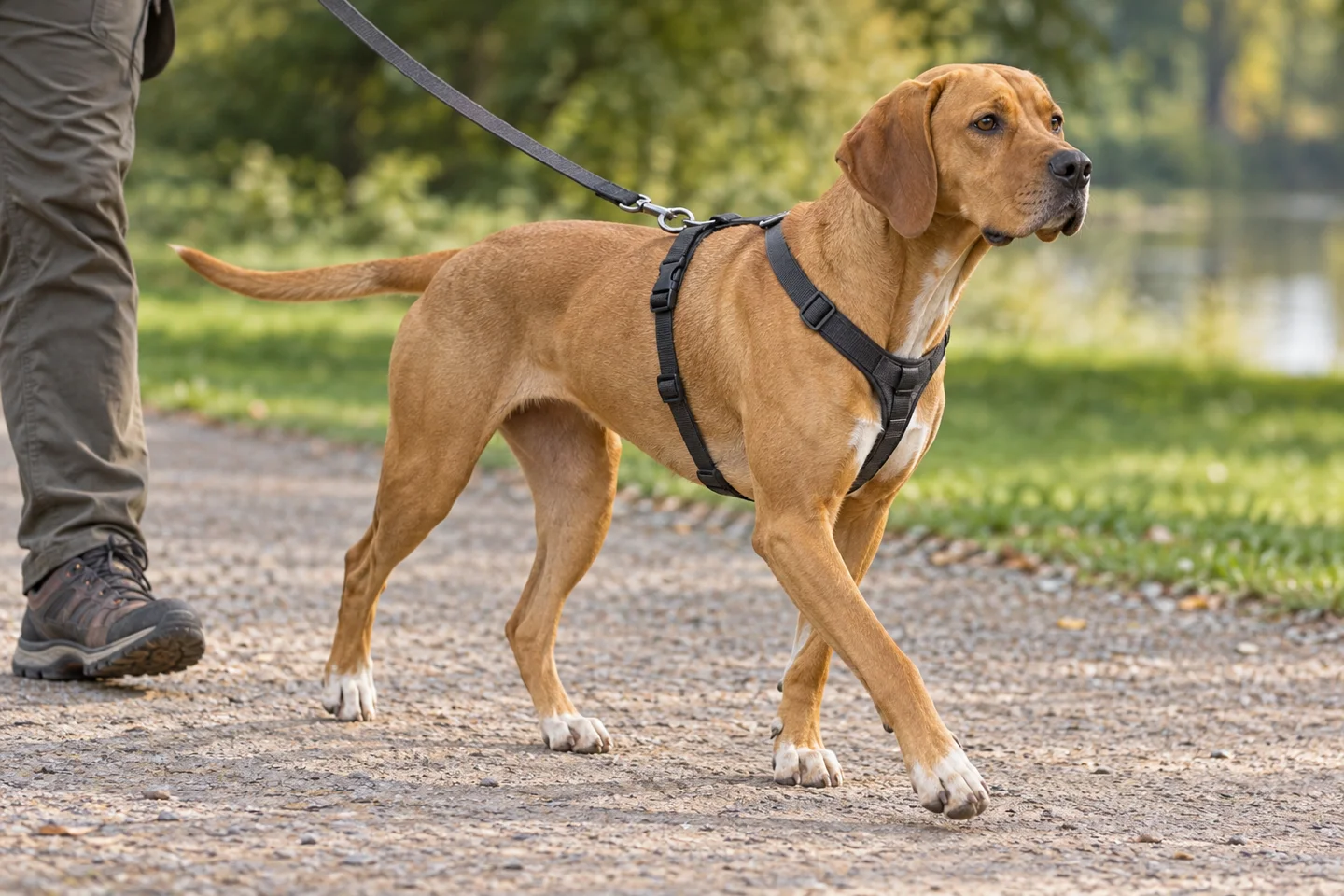
The FCI gives a male height of 56 cm with a 4 cm allowance and a female height of 52 cm with the same allowance. Listed weights are 20–27 kg for males and 16–22 kg for females. The breed has a substantial distinctive head, a broad skull, short dense hair, and natural hanging ears. Yellow can be solid or combined with white in the permitted pattern. The illustrations here show yellow-fawn coloring, modest white markings, natural ears, and a full tail. They are labeled AI illustrations, not photographs proving a particular dog's pedigree.
Assess movement and comfort directly instead of treating head shape or size as a health guarantee. Look for easy walking, comfortable turning, and willingness to change position without obvious pain. Ask about any injury or change in activity. A puppy's growth should be supported with appropriate nutrition and suitable movement, rather than extra supplements or repeated jumping intended to create muscle quickly. Standard weights describe a range, while body condition needs individual assessment. Fit transport restraints and harnesses to the actual frame and check for rubbing, restriction, or escape risk before relying on equipment in a busy public place.
Family attachment, arousal, and quiet routines
Close cooperation in a working description should encourage useful engagement, not constant demands for attention. Teach the dog that resting near a person can be rewarding without continuous petting or games. Offer a comfortable place away from busy doorways and reinforce calm transitions after an outing. When birds or other distractions are present, manage distance so the animal can still respond. Excitement is information about the setup. Repeatedly asking for more self-control than the dog has learned can create frustration for both handler and animal, while an easier step allows successful practice.
Plan short comfortable separations and observe how the dog copes before increasing them. Being attached to people does not establish either an inevitable separation problem or the ability to tolerate a full working day without support. Arrange toilet access and a knowledgeable carer where needed. An adult newly moved into a family house may need help learning routines different from its previous setting. Keep the first week modest and predictable, with plenty of sleep. More company is not always better when it means repeated visitors and introductions that leave no opportunity for the dog to recover or understand its new environment.
Training recall, searching, and releasing an object
Make everyday cues useful before expecting field-like control in a distracting place. Teach a reinforced recall, waiting before an exit, turning with the handler, and comfortable loose-lead movement. Begin where the dog can think, then add distractions gradually. A suitable long line attached to a harness provides a management option in appropriate space, but it must be handled to avoid entanglement. Never release the dog near roads or protected wildlife as a test of confidence. A history of successful returns is built through practice, not through assuming a cooperative breed will ignore every competing interest.
Searching games can use hidden safe food or a permitted object in a controlled area. Keep difficulty fair, provide clear beginnings and endings, and stop before repeated failure or frantic arousal takes over. A retrieve should include returning and releasing rather than only repeated throwing. Practice exchanging for something the dog values, and avoid wrestling prized objects from its mouth. If possession produces stiffness or guarding, adjust the setup and obtain qualified help. Cooperative foot, ear, and mouth inspection should also be taught in small steps, because practical care skills will be needed more often than an impressive trick performed for visitors.
Exercise for an active pointer with time to recover
Provide varied walks, scent investigation, appropriate training, and rest. Match demand to age, health, weather, and existing fitness rather than prescribing a universal daily distance. A healthy mature dog can build substantial capacity, but growth, illness, or a period of inactivity changes the starting point. Notice how the dog moves later that day and the next morning. Repeated stiffness, slow recovery, or reluctance to do familiar activities merits veterinary discussion. More throwing is not always the answer when an excited animal seems unable to settle, and exhaustion should not be the main strategy for achieving a quiet evening.
Check the route for livestock, roads, and access to unsafe water. Use secure boundaries and deliberate transfers from vehicle to building. Carry drinking water and adjust timing, shade, and duration in warm conditions. A dog following scent may continue working past the point when a handler should stop, so the person must make sensible decisions about rest. Introduce new terrain gradually and inspect feet after rough or brushy ground. On a necessary quiet day, short learning tasks and appropriate food enrichment can add interest without reproducing the physical demands of a long outing. Recovery is part of maintaining activity, rather than evidence that the dog has been underused.

Aggression and preventing pressure from becoming conflict
A pointing-dog label does not rule out aggression arising from fear, pain, restraint, or resource guarding. Watch how this individual responds when someone approaches food, reaches into its resting space, or handles a sensitive area. A freeze, hard stare, withdrawal, or growl should lead to more space and a revised interaction. Punishing the warning does not identify or resolve the cause. Sudden changes in tolerance warrant a veterinary check, particularly when touching a limb, ear, mouth, or back appears to be involved. Describe events concretely rather than diagnosing jealousy from an isolated incident.
While seeking help, arrange the home to prevent repeated conflict. Use separate feeding space, protected rest, and barriers during busy arrivals where needed. Every adult must understand the plan, including what visitors should do. A bite or credible bite risk calls for professional assessment and practical safety measures; a positively introduced basket muzzle may be appropriate within that plan. It does not make forced greetings acceptable. Record triggers, distances, and successful routines so improvement can be judged through comfort and manageable behavior. The goal is safer daily life, not proof that a dog will submit to repeated handling despite clear attempts to avoid it.
Children, dogs, and animals that trigger pursuit
Adults should supervise children's contact and protect the dog from grabbing, climbing, cornering, and interruption of meals or sleep. An energetic animal can accidentally knock over a small child, while a resting dog may not welcome close face contact. Provide a separate calm space and use it before running games become intense. Teach children to invite contact briefly and accept the dog's choice to leave. A child cannot carry responsibility for managing a distracted pointer beside a road. Safe arrangements must remain effective when a promised rule is forgotten during excitement.
Meet another dog with separate handlers and room for parallel movement. Do not begin by placing valued retrieving toys between unfamiliar animals. Compare size, pace, and play style, and ensure each can disengage. Birds, cats, and small pets need careful assessment and physical safeguards because pointing or chasing interest can appear in particular contexts. Comfort with one household animal does not prove safety around every fleeing animal outside. Some combinations require lasting separation. Ask for truthful prior observations, and never release the dog toward a small pet to see whether training or affection will prevent a chase.
Grooming a short coat and inspecting field wear
Use gentle regular brushing to remove loose hair and inspect the skin. Short dense hair can conceal ticks, small wounds, or irritation beneath a harness, so make a brief post-walk check part of the routine. Look between toes and at pads after rough ground. Bathe when needed with suitable products and dry comfortably. A sudden rash or persistent itch needs clinical advice rather than an automatic food switch. Keep nails at a comfortable functional length and teach foot handling before a problem requires urgent inspection. Cooperative care is easier to establish in calm seconds than during a painful first encounter with clippers.
Inspect the visible ear area for redness, odor, discharge, or sensitivity. A hanging ear deserves attention, but routine deep cleaning or leftover drops are not a universal prevention plan. Follow the veterinarian's instructions for this patient and seek advice about repeated head shaking or pain. Include dental care and comfortable mouth checks in regular handling. Clean bedding and well-fitting equipment help keep the routine practical. The aim is an owner who notices changes early and a dog that can participate without fear, rather than a spotless appearance achieved through repeated restraint or treatment for a condition that has not been diagnosed.
Health: family information matters more than a reassuring slogan
The AKC's health discussion asks breeders to consider known problems in relatives, including seizures, hip dysplasia, early-onset cancers, and autoimmune disease. This is a reason to ask careful family questions, not evidence that each is common in Portuguese Pointers or that all have a single useful DNA screen. Ask what occurred, at what age, what diagnosis was made, and how the planned pairing takes the information into account. A claim that the breed has no specific problems cannot establish that a particular family is free of inherited or acquired illness.
Request the actual examination or laboratory reports underlying testing claims, with the dog's identification and date. Separate a formal parental screen from an ordinary wellness visit, a genetic fingerprint, or a commercial panel containing many variants of uncertain relevance to this breed. The veterinarian can help interpret what a result does and does not answer. For an adult with incomplete records, establish an individual baseline and ask for prior treatment information. Retain uncertainty without inventing a universal panel or a precise lifespan. Medical planning should be useful to the dog, not simply a longer checklist that looks impressive in a sales conversation.
Responding to a possible seizure or a change in movement
If the dog has an unexplained episode, note the time, duration, movement, responsiveness, and recovery while keeping the environment safe. Contact the veterinarian for advice and seek urgent help for prolonged or repeated episodes, injury, or poor recovery. Do not put hands into the mouth or give human medication. Video can help a clinician when it can be obtained safely, but filming should not delay care. An episode described as a seizure needs professional assessment; a breed reference does not establish its cause or prove that every unusual movement is epilepsy.
Similarly, limping or a reduction in comfortable activity should not be dismissed because the dog still wants to search. Give the clinician a clear timeline, previous injuries, workload changes, and any relevant family records. Follow the patient's actual diagnosis and rehabilitation plan instead of copying exercises or supplements from another dog's experience. Maintain appropriate body condition and adapt activity as advised. A parental hip result informs one part of breeding risk; it does not diagnose the current animal's pain. Organized records let a new clinic distinguish established history from assumptions and make later treatment decisions without losing important details during a move.
Nutrition, mixes, and choosing an affordable routine
Feed complete food appropriate to life stage, medical needs, and workload. Measure portions, account for training rewards, and check condition with the veterinary team as activity changes. An athletic outline does not guarantee an appropriate weight, and a temporary quiet period may require a review of intake. A mix should be assessed through the individual and both known parental backgrounds. Yellow coloring or a pointing stance cannot establish confirmed Portuguese Pointer ancestry. Crossing does not guarantee a lower medical risk, a moderate activity level, or a coat that will match one parent's appearance.
Budget for routine and urgent veterinary care, suitable insurance or a reserve, training support, secure transport, equipment, and reliable care during absences. Clarify source support and return arrangements in writing. Ask a prospective sitter how they will manage doors and wildlife distractions rather than assuming enthusiasm is enough. Plan for the owner's illness and the dog's later changes in mobility. An active lifestyle can be a good fit only when the quieter practical parts also work. The best choice is the particular animal whose needs can be met consistently through ordinary weeks, rather than one selected because a close-working history sounds like effortless obedience.
Sources and editorial notes
Sources checked October 22, 2026. Breed measurements describe reference ranges, not a diagnosis or an individual dog's ideal weight. Images are AI-generated breed illustrations and do not document a particular dog or health condition.
- AVSAB: Humane Dog Training Position Statement
- VCA Animal Hospitals: Food aggression in puppies
- VCA Animal Hospitals: Common emergencies in dogs
- Orthopedic Foundation for Animals: CHIC health screening programs
- VCA Animal Hospitals: Aggression toward unfamiliar dogs, diagnosis
- VCA Animal Hospitals: Grooming and coat care for your dog
- VCA Animal Hospitals: Ear infections in dogs (otitis externa)
- AAHA: Feeding plans for healthy, appropriate weight cats and dogs
- VCA Animal Hospitals: Heat stroke in dogs
- AVSAB: Puppy Socialization Position Statement
- VCA Animal Hospitals: Dog behavior problems, aggression toward children
- Official breed standard: Portuguese Pointer
- Clube Português de Canicultura: Perdigueiro Português breed and working standard
- American Kennel Club: Portuguese Pointer family health and care considerations
Keep getting to know dogs.
Read another guide or return to your dogsDating community.
Explore breed guidesBack to dogsDating