Pumi
The Pumi is a Hungarian herding breed with an elongated muzzle, tipped ears, and a springy curled coat. Its responsive nature needs clear daily routines, useful activity, and preparation for both excitement and quiet rest.
How these guides are researched and reviewed
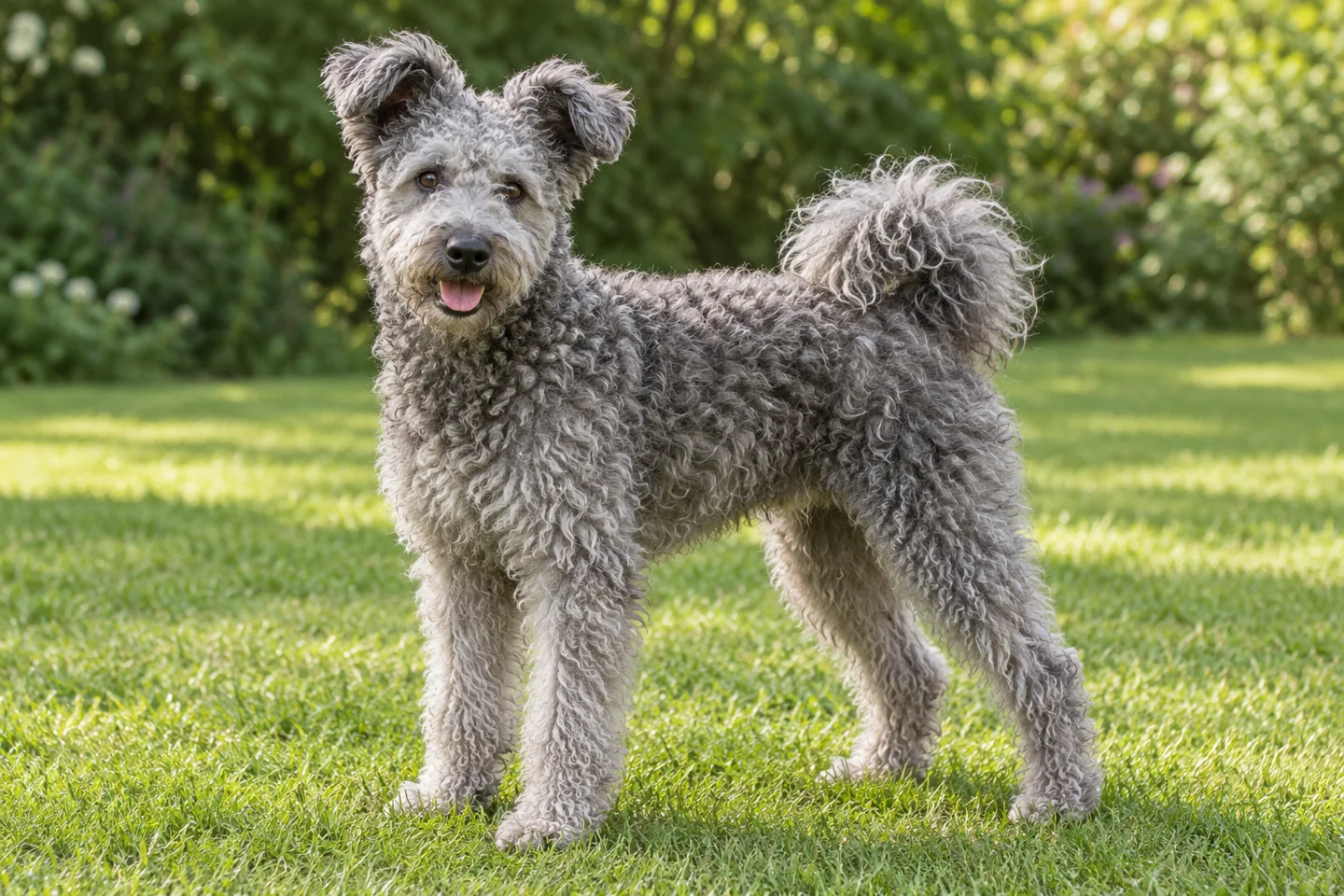
- Origin
- Hungary
- Adult standard size
- Males 41–47 cm/10–15 kg; females 38–44 cm/8–13 kg
- Illustrated coat
- Solid grey wavy-curly coat
General information for owners. These articles have not been reviewed by a veterinarian. Medical decisions need your dog's history and an examination.
A Pumi is distinct from a Puli
The Pumi and Puli are different Hungarian herding breeds. The Pumi has a longer-looking foreface, distinctive ears with forward-tipped upper portions, and a wavy-curly tufted coat that is not corded. Its outline should not be confused with a terrier cross solely because the standard describes a terrier-like character. Ask for registered identity and parentage when those form part of a puppy sale. For a rescue identified from appearance, keep the certainty of the name separate from confirmed observations of the dog.
Before choosing one, investigate ordinary life beyond an attractive photograph. Ask what the adults do when a visitor enters, a bicycle passes, or the family settles to work. Can the dog recover after activity and accept necessary handling? A source who discusses difficult situations as well as favorite traits gives you useful evidence. The breed's convenient dimensions do not make it a passive household ornament. A sustainable placement provides learning, movement, rest, and practical support when the owner's normal schedule changes.
Herding roots and contemporary expectations
The FCI account describes the Pumi's development in Hungary and recognition as an independent breed in the early twentieth century. Its working background helps explain attention to movement and a ready response to activity. It does not provide an individual puppy with trained livestock skills or guarantee an easy response to every person and dog. Ask about the parents' actual work and daily environment rather than relying on a broad historical description.
A companion can use attention constructively through searches, learning sequences, and foundations for suitable organized activities. Equally important is what follows the task. Teach a clear finish and provide uninterrupted sleep. An owner who continually adds challenges may unintentionally make ordinary quiet periods difficult. Spend time around adults between demonstrations if you are drawn to energetic performance videos. Ask about routine care, travel, and absences. Those details reveal the work of ownership that a short clip leaves out and help determine whether the proposed home fits the individual rather than only the breed's appealing image.
Adult measurements and grey coat development
The FCI ranges are 41–47 cm and 10–15 kg for males, and 38–44 cm and 8–13 kg for females. Narrower ideal ranges appear within the standard. These are adult conformation references, not targets for rapid growth or food restriction. Ask the veterinarian to evaluate frame, muscle, and body condition. Coat volume can hide changes, so learn to assess by touch as well as watching a scale.
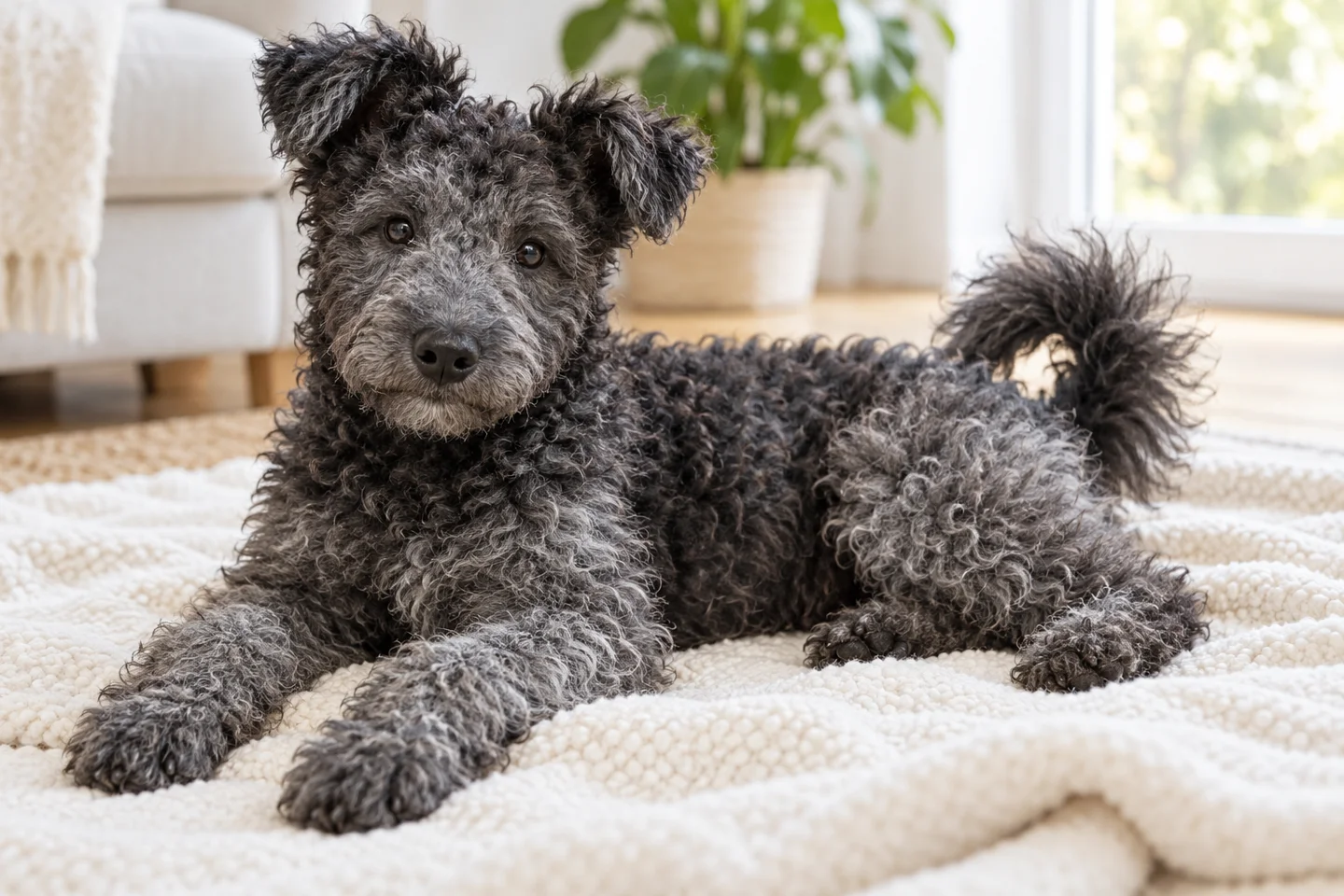
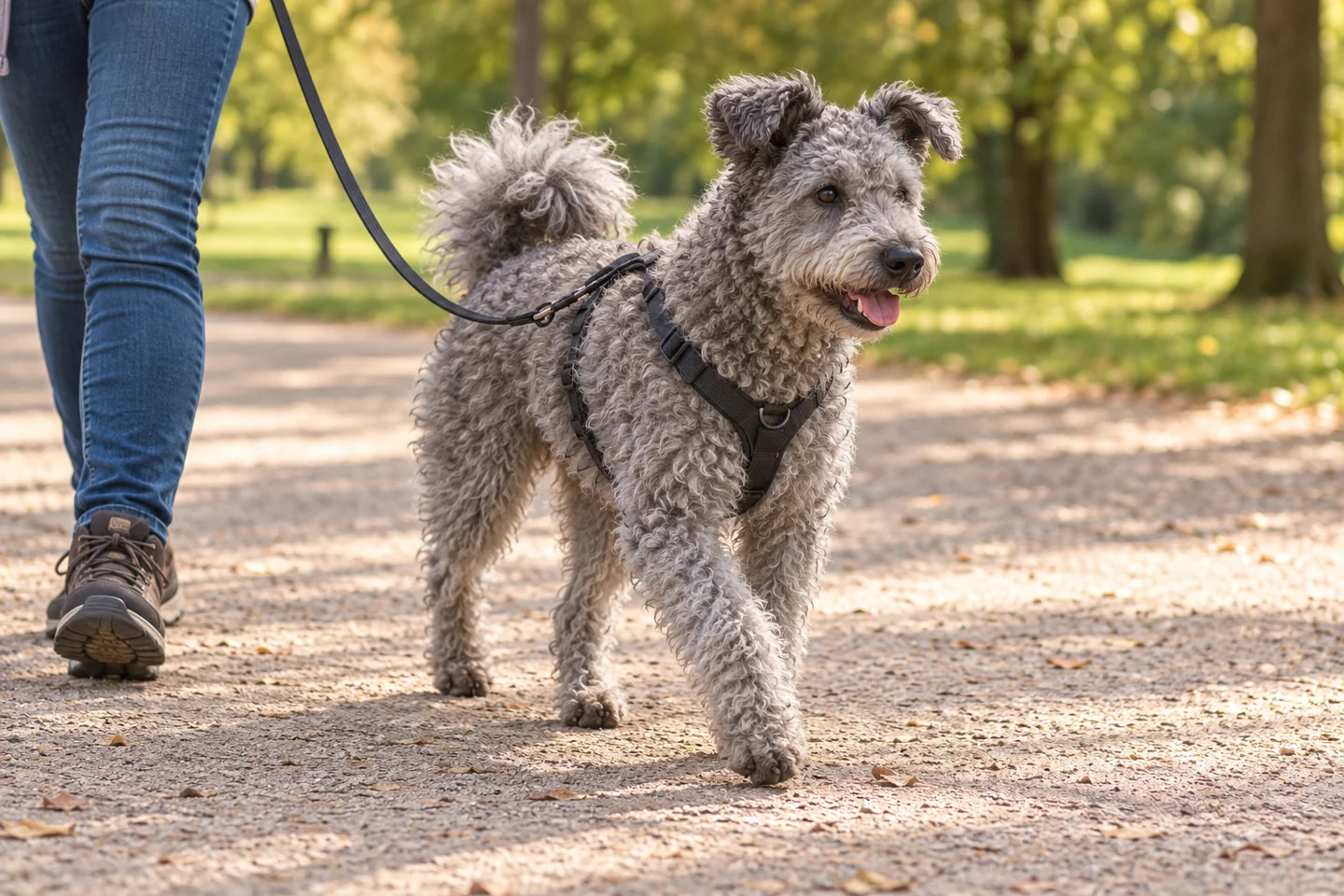
Several solid colors are recognized. Grey dogs may begin darker and lighten as they develop. This guide's AI-generated illustrations select grey, natural ears with tipped upper portions, and a full tail curled over the back. The puppy has softer developing hair rather than a finished adult presentation. The images cannot document a real dog's pedigree, medical status, or movement. Observe an actual candidate and ask about previous treatment. An alert expression and springy appearance are not proof that the dog is conditioned for every activity or comfortable with every handling procedure a new owner may expect.
Temperament and the cost of constant readiness
A Pumi may notice small movements and participate quickly. Give that interest a useful direction without making every household event a command to become active. Reward a short quiet pause while you move nearby, then gradually extend the practice. Position the resting place where the dog is not repeatedly stepped over and does not have to supervise the busiest entrance. Protect sleep, even when visitors want to see a clever puppy perform.
Watch recovery after a stimulating event. If the dog cannot settle, examine the context: too much activity, an unresolved worry, insufficient rest, or physical discomfort may require different responses. Adding exercise indefinitely is an incomplete automatic answer. Prepare manageable periods apart and observe the actual response during absences. Persistent distress needs veterinary and qualified behavioral assessment rather than an assumption that attachment makes it inevitable. Another dog cannot be presumed to solve it. For a new adult, allow adjustment and gather information across settings before treating the first lively greeting or quiet evening as its permanent personality.
Training clear cues and everyday cooperation
Teach the skills that make ordinary life safer: returning in a secure place, waiting at an opening, releasing a found object, and moving with the handler. Start with an easy version and rewards the dog values. Increase distraction gradually instead of repeating a cue in conditions where it cannot yet respond. A familiar garden offers different demands from a street with other dogs or a path beside livestock.
Manage the environment while learning develops. A second barrier protects doorway practice, and suitable walking equipment prevents a missed cue from becoming an escape. Teach calm fastening and entry into a secured travel space before a busy departure. Household members should agree on cues and the signal that releases the dog from a task. A reward-based professional can help when excitement or worry interferes. Ask how they change the setup after a failed attempt. Frightening pressure may add concern about the handler or surroundings without clarifying what the dog should do. Useful teaching makes the alternative achievable and keeps repetition from becoming a rehearsal of failure.
Movement, barking, and practical boundaries
Identify what starts a reaction before choosing a response. A dog announcing a passerby, barking during play, or vocalizing in distress when alone may need different help. Reduce repeated exposure where practical, such as moving a bed away from a busy window. Then teach an alternative around a manageable version of the event, rewarding a turn toward you or movement to a resting place before excitement becomes overwhelming.
Movement-related grabbing also needs a plan. Herding identity does not make chasing children or catching clothing harmless. Use separation during activity the dog cannot yet manage, and teach another response at a suitable distance. Avoid arranging repeated difficult encounters and punishing the predictable result. Keep notes about triggers, intensity, and recovery if the pattern is unclear. A useful household routine should work for more than one experienced person. Demonstrate it to occasional carers and visitors so their actions do not repeatedly restart the problem. Seek professional help early when people are becoming fearful or management is failing.
Exercise and physical preparation
Provide daily movement and opportunities to investigate, with demands adjusted to health, maturity, and current fitness. A young dog that appears quick and agile still needs age-appropriate preparation before strenuous repetitive tasks. Ask the veterinarian about intended activities and build duration progressively. Ordinary walks with time to smell can complement structured work without making every outing a performance test. Include genuine recovery and sleep.
Check footing before running, jumping, or sharp turns. Slippery surfaces and awkward landings can alter a seemingly simple task. In warm conditions, change timing, carry water, and make a cool resting place available. Inspect feet and equipment-contact areas after outdoor activity. Notice changes in stride, willingness, or recovery rather than using enthusiasm as evidence that nothing hurts. Seek assessment when normal exercise becomes unusually difficult. During medical restriction, clarify which quiet tasks are appropriate and explain the limits to carers. Energetic indoor chasing may place the same demands on the body as the outdoor activity the treatment plan is intended to prevent.
Socialization without compulsory greetings
A puppy benefits from manageable experience of people, traffic, surfaces, and ordinary sounds. Discuss local disease precautions with the veterinarian. Watching from a comfortable distance can be useful learning; close handling by every passerby is unnecessary. Observe whether the puppy can investigate and recover, and leave room for rest. A crowded event that overwhelms it is not automatically better because it includes many encounters.
Adults changing homes may need similarly gradual introductions. Ask what environments and procedures are familiar, then begin with an easy version. Let the dog move away from contact and avoid trapping it between people for a greeting. If it repeatedly freezes or tries to flee, reduce pressure and obtain appropriate help. Coordinate outings among household members so the animal does not face several demanding new experiences on the same day. Consistency also matters in care procedures. A predictable approach helps a dog learn what happens next and reduces the number of stressful first attempts repeated by different people using different methods.
Aggression and a response based on context
An animated ear position does not establish comfort. Watch the individual dog's posture, movement, and attempts to withdraw. If it becomes still, growls, snaps, or avoids an approaching hand, stop and review the circumstances. Restraint, a painful area, a valued object, or lack of an exit can change an interaction. New handling reactions should prompt medical consideration rather than an immediate conclusion about temperament.
Teach exchanges with safe objects and prevent access to recurring hazards. Do not repeatedly remove meals or corner the dog as a test of trust. A bite history needs honest disclosure to carers and qualified support for an individual plan. Describe the sequence and any injury, including whether the dog could leave. Reliable barriers can prevent another incident while assessment and teaching proceed. Physical confrontation intended to establish authority is an unreliable route to cooperation. No breed profile can certify an individual's safety, and a dog affectionate with familiar people may still need careful management in a particular difficult setting.
Children and games with a clear ending
Adults should arrange activities that remain manageable for both child and dog. A search or familiar cue can provide shared enjoyment without encouraging pursuit. Children should invite contact and allow the dog to leave. They should not pull ears, hug around the neck, or disturb sleeping and eating. A protected resting area and a barrier are useful when the household becomes too busy for direct supervision.
Ask which ages and situations the individual has experienced. A calm meeting with an older child offers limited evidence about living with a toddler or a noisy visiting group. Children should call an adult about stolen objects and never intervene in animal conflict. Watch for avoidance before a warning becomes necessary. If fear or repeated warnings develop, change the arrangement and seek help rather than expecting familiarity alone to solve it. A comfortable relationship grows through suitable experiences over time. The dog's energetic manner should not become a reason to make children responsible for tiring it out or controlling its response during exciting play.
Grooming the tufted Pumi coat
The Pumi's coat should remain wavy and curly rather than form Puli-style cords. The breed club's grooming guide explains how combing and subsequent wetting affect its characteristic tufts. Obtain a demonstration on the actual dog's hair from someone experienced with the breed. Ask what maintenance is needed between appointments and how to recognize tangles close to the skin. A show outline and a sustainable companion routine may involve different practical choices.
Use a stable nonslip surface and introduce tools gradually. Do not pull through a painful knot while someone increases restraint. Report persistent redness, odor, or discomfort and investigate a sudden change in tolerance. Check feet after outdoor activity and include nail care, dental brushing, and external ear observation. Avoid pushing implements into the ear canal or choosing medication from another owner's experience. Tell the groomer or clinic about handling concerns before an appointment. Necessary care may need a professional plan while cooperative skills develop, so repeated sessions do not depend on holding a frightened animal still for as long as possible.
Health screening and a specific PLL discussion
Primary lens luxation deserves a named discussion when choosing a Pumi. The current AKC recommendations include its DNA test alongside hip and patella evaluation and a degenerative myelopathy DNA test. Ask for each parent's PLL result rather than a summary that the litter is genetically checked. UC Davis explains that the known variant affects interpretation of inherited risk and that carriers retain a slight clinical risk. A carrier should therefore not be described simply as guaranteed to have normal eyes.
If the pet develops a painful or visibly abnormal eye, contact the veterinarian promptly. Do not use a parental result to decide that a new problem cannot be serious, and do not diagnose it from a photograph. The genetic result addresses the variant tested; a clinical examination addresses what is happening now. Ask the clinic which signs require urgent attention so the household has a clear plan before a problem occurs.
For the orthopedic records, verify the identity, assessment, and actual findings. A Pumi moving enthusiastically at a visit has not thereby supplied documented joint screening. Ask how the breeder weighs the results for this pairing and how significant later diagnoses in relatives are communicated. Keep reports with the dog's clinical notes when changing practices. That continuity gives a new veterinarian something more useful than a remembered reassuring phrase from the original advertisement.
Feeding, mixes, and realistic recurring costs
Use a measured complete food suited to the Pumi's life stage. During training, put a portion of that day's ration into the reward container so frequent lessons do not quietly add another meal. If higher-value food is needed, account for it as well. Ask the clinic to assess condition by touch beneath the curls. An owner who knows the dog's usual weight and intake can give more useful information when appetite changes than one who judges everything from its eagerness at dinner.
A Pumi cross could have a straighter coat, different adult proportions, or a different response to movement. Ask whether the parents are known and which health results belong to each one. An informal name for the cross does not answer those questions. For a puppy with uncertain ancestry, choose a care plan that can adapt as the coat and behavior develop rather than promising a particular adult result.
Plan the budget around the services this household will use. A groomer should explain the Pumi's wetting and drying routine, while a backup carer needs to understand both coat care and management of excited barking. Request local quotes and inspect insurance exclusions before committing. Ask the source how continuing advice and a possible return would work. The ability to get practical help after placement matters more than an impressive waiting list.
Planning a dogsDating walk
A Pumi's animated arrival can obscure whether another dog welcomes its attention. On dogsDating, explain any tendency to bark during greetings or to restart movement when a partner pauses. Ask whether the other dog finds that pattern comfortable. A companion that enjoys brisk walking may still dislike repeated attempts to initiate chase, so agree on the activity before arriving.
For the opening walk, use an uncrowded public area where both people can alter pace and create a gap. Begin with the Pumi occupied in ordinary exploration rather than heading directly into the other dog's face. Notice whether it can stop watching the partner and respond to a familiar cue. If excitement keeps rising, shorten the outing and discuss an easier location instead of insisting that both animals run until tired.
Keep exact user coordinates private when exchanging plans. Discovery can identify the general neighborhood, and a named public entrance can serve as the rendezvous. Avoid disclosing a home training field or publishing a photograph containing address information. After the walk, compare the moments when both dogs were at ease. That gives the next meeting a concrete starting point and allows either owner to decline closer contact without pressure.
Sources and editorial notes
Sources checked October 22, 2026. Breed measurements describe reference ranges, not a diagnosis or an individual dog's ideal weight. Images are AI-generated breed illustrations and do not document a particular dog or health condition.
- AVSAB: Humane Dog Training Position Statement
- VCA Animal Hospitals: Food aggression in puppies
- Orthopedic Foundation for Animals: CHIC health screening programs
- VCA Animal Hospitals: Aggression toward unfamiliar dogs, diagnosis
- VCA Animal Hospitals: Grooming and coat care for your dog
- AAHA: Feeding plans for healthy, appropriate weight cats and dogs
- VCA Animal Hospitals: Heat stroke in dogs
- AVSAB: Puppy Socialization Position Statement
- VCA Animal Hospitals: Dog behavior problems, aggression toward children
- American Kennel Club: Herding group health testing requirements
- Hungarian Pumi Club of America: the Pumi coat and its grooming
- UC Davis Veterinary Genetics Laboratory: primary lens luxation
- Fédération Cynologique Internationale: Pumi official breed standard
Keep getting to know dogs.
Read another guide or return to your dogsDating community.
Explore breed guidesBack to dogsDating