Rat Terrier
The Rat Terrier is an American farm terrier available in two AKC size divisions. Its smooth coat is straightforward to inspect, while pursuit, containment, daily activity, and a current set of health reports need deliberate attention.
How these guides are researched and reviewed
- Origin
- United States
- Adult standard size
- AKC miniature 10–13 inches; standard over 13–18 inches
- Illustrated coat
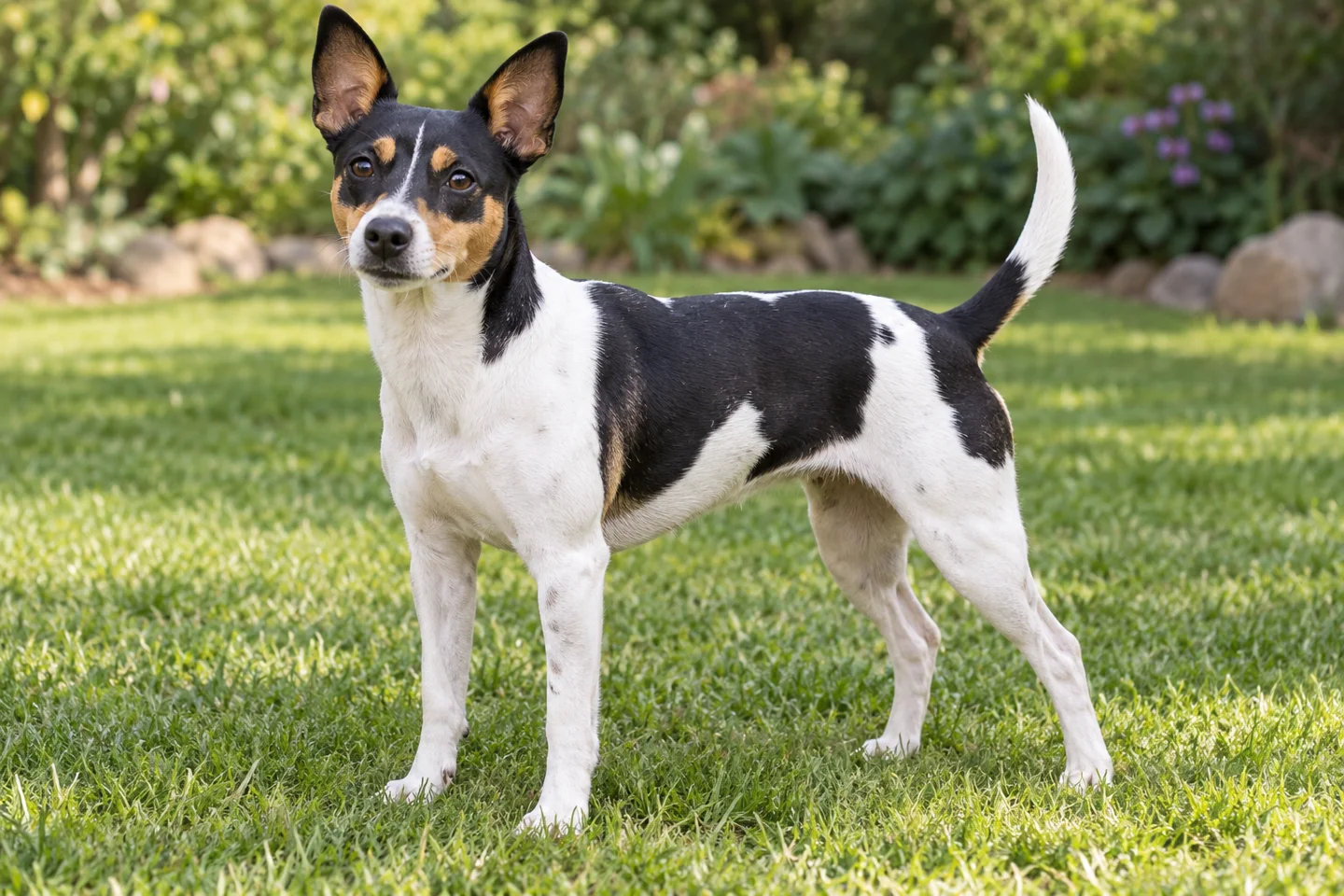
- Tricolor piebald short coat
General information for owners. These articles have not been reviewed by a veterinarian. Medical decisions need your dog's history and an examination.
Two sizes within the Rat Terrier standard
The American Kennel Club standard separates miniature and standard Rat Terriers by height. Miniatures measure at least 10 inches and no more than 13 inches; standards are over 13 inches through 18 inches at the withers. These are divisions within the breed, not a prediction that every puppy will finish at a particular measurement. Ask about the actual adults and the registry involved when comparing sources.
The body is athletic and slightly longer than tall, with useful leg length rather than an exaggerated low silhouette. A breed name in a rescue listing may reflect appearance instead of documented ancestry. Keep that distinction separate from confirmed observations of the dog. Before choosing one, consider secure boundaries, walking, and what happens around other pets. Convenient size and a short coat can make some tasks easier while leaving behavior and medical care fully individual. Meet adults and ask about ordinary life instead of deciding from a portable-looking puppy and a claim that every terrier can fit any household.
Farm work and a modern small-animal problem
The breed's historical identity includes ratting and varied farm work. That context makes pursuit and investigation relevant questions for a companion owner. It does not mean every individual will hunt identically or that a puppy arrives with useful control around livestock and household animals. Ask what its parents do, which animals they encounter, and which behaviors the source manages carefully.
In a home with rabbits, poultry, or other small pets, discuss the actual arrangements before placement. Secure housing should prevent repeated rushing and pawing as well as physical contact. The smaller animal's stress matters. A dog comfortable with one cat indoors can still pursue an unfamiliar running cat outside. Do not hold an animal still to make an introduction happen. Reward the terrier for disengaging and use dependable separation while assessing the response. If the proposed household cannot protect the other animals reliably, that is important information to recognize early rather than treating the dog's interest as an amusing feature of its working heritage.
Coat, ears, and the full-tail illustrations
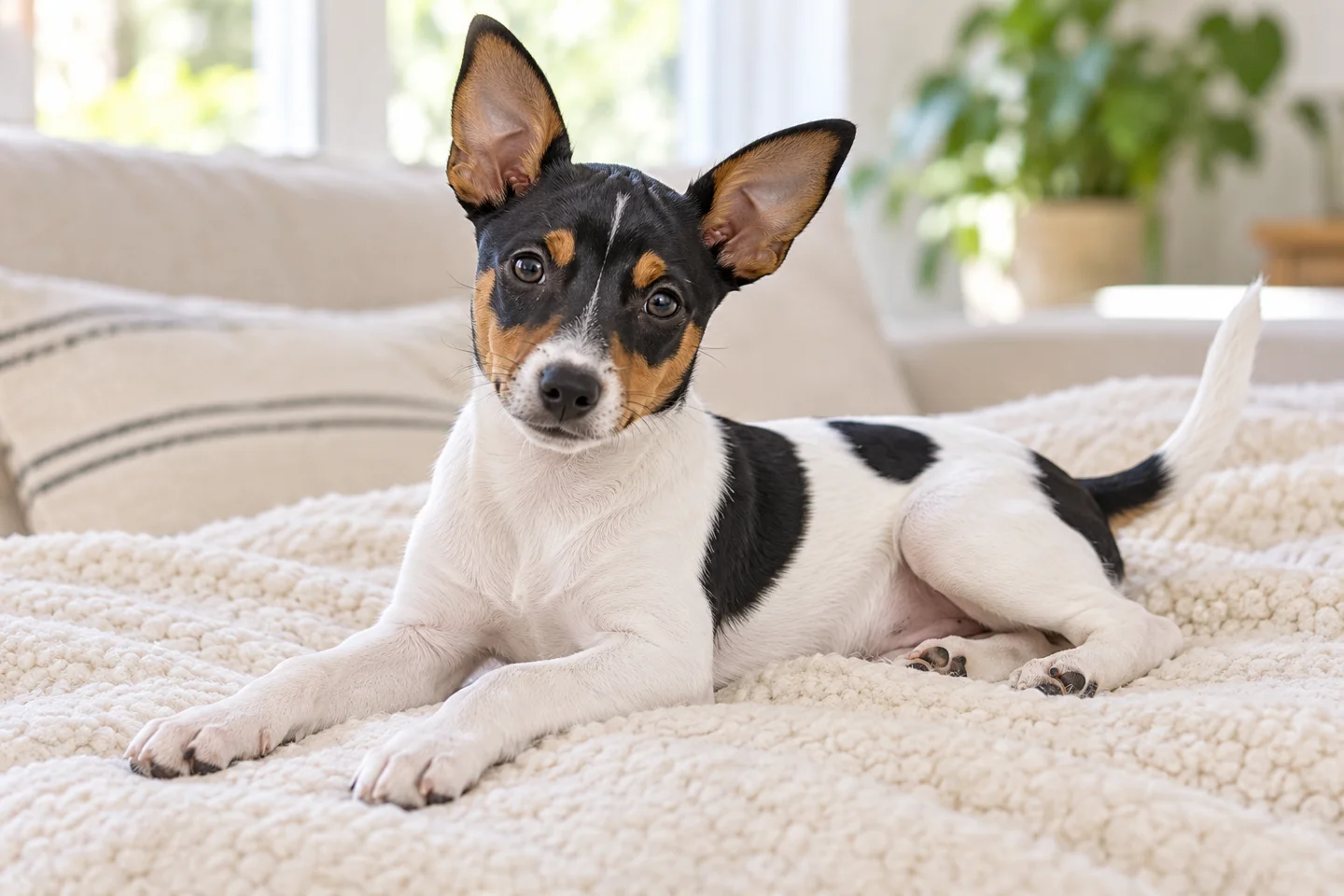
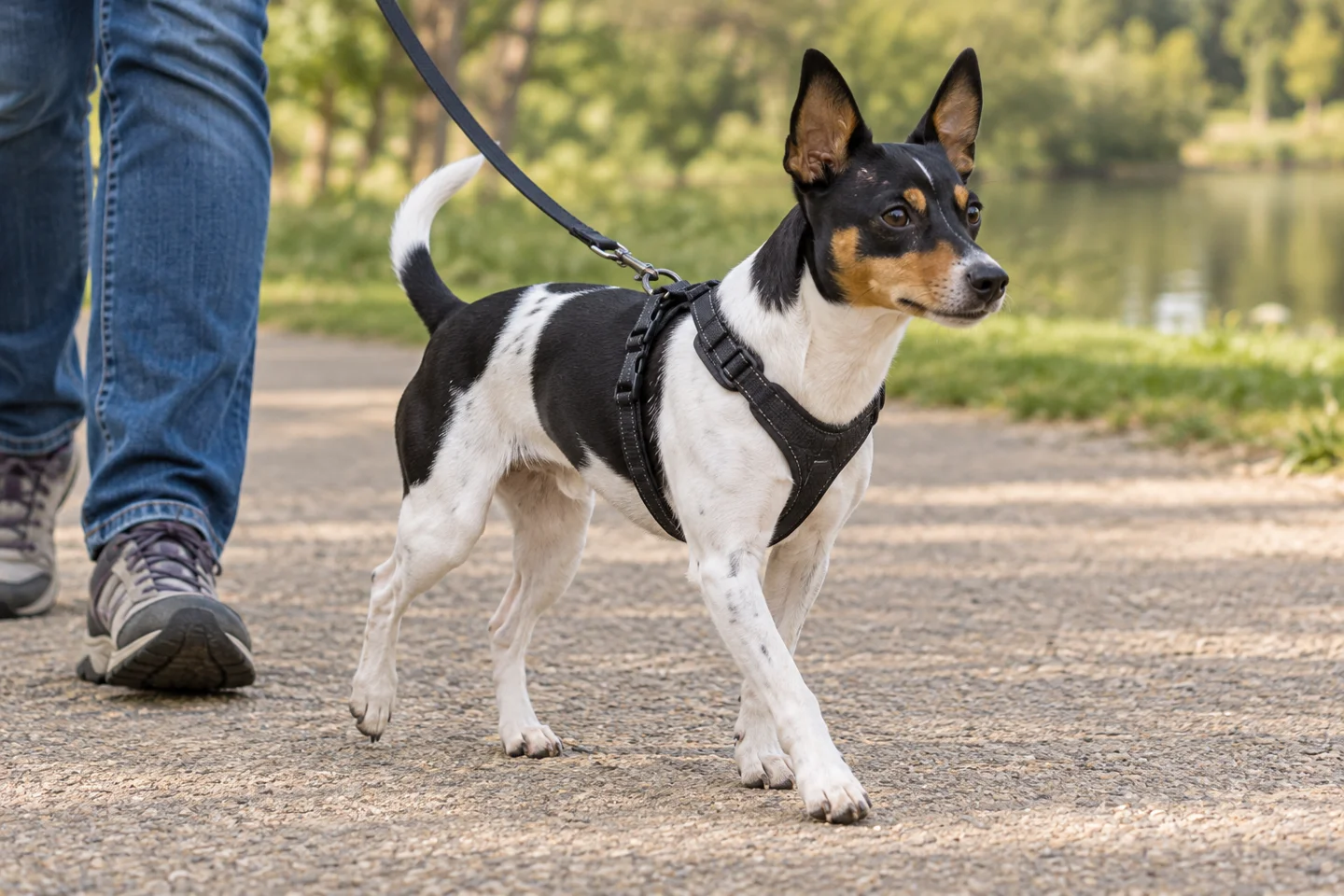
The standard describes a smooth, short coat and a parti-colored appearance. This guide's AI-generated illustrations select black, tan, and white piebald coloring in the standard size division. Natural upright ears and a full tail are shown; the standard also allows other natural ear carriage. Tail length or a preferred ear silhouette alone cannot verify a real dog's identity or medical condition.
Observe an actual candidate moving, resting, and accepting routine care. A neat coat may make the body easier to inspect than a heavily furnished one, but it does not reveal every joint, cardiac, or eye concern. Ask for original records and a clinical history. Size should guide equipment fit without replacing an individual fitting check. A product marked small breed may rub or allow escape if its shape does not suit this dog. Reassess after growth and changes in condition. Color and a lively expression can be appealing while remaining secondary to comfortable function and the match between the animal's needs and the home.
Containment begins at floor level
Inspect gaps beneath gates, loose panels, and places where stored items provide a route over a barrier. A garden that held another dog may have different weak points for a Rat Terrier. Recheck after repairs and visitors. Provide a second barrier around a busy entrance where practical, and teach a waiting routine before an open door predicts an opportunity to leave. Identification and current contact details are backup, not substitutes for preventing repeated escape.
Do not rely on a quiet-looking landscape. A scent or moving animal can lead beyond view toward traffic or property where dogs are unwelcome. Explain pursuit concerns to every walker and carer. Rehearse the actual lead and gate sequence while you are present, including car exits. Written instructions do not show a sticking latch or the dog's response when something passes unexpectedly. A workable system should protect the dog when the most experienced owner is absent, rather than depending on a quick reaction from one person after a barrier has already opened.
Training a return that remains worth doing
Begin recall in secure easy settings and use rewards the individual values. Increase distraction gradually. Sometimes reward the return and allow safe exploration to resume, so responding does not always predict the end of enjoyment. A cue learned in the kitchen cannot be assumed reliable beside fresh wildlife activity. Use suitable boundaries and walking equipment while the response develops instead of testing it where failure could cause injury.
Teach turning with the handler, releasing an object, waiting at an opening, and calm entry into a travel space. Practice the easy version before a busy departure. If several household members train, agree on cues and release words. A reward-based instructor can help when excitement or frustration interferes. Ask how they change difficulty after a failed attempt and how they consider pain or fear. Frightening pressure may suppress visible behavior while adding concern about the handler or surroundings. Clear teaching makes the desired alternative achievable, with management preventing repeated rehearsal of the unsafe choice while learning catches up.
Exercise that includes investigation and rest
Provide daily movement, safe investigation, and learning according to age, health, and fitness. Build longer outings progressively. A young terrier's enthusiasm does not make strenuous repetitive activity appropriate during growth. Discuss intended sports or demanding routes with the veterinarian when relevant. A walk with time to smell can complement structured tasks without turning every outing into a performance or an attempt to exhaust the dog into silence.
Check terrain and surfaces before running or jumping. In warm weather, adjust timing, carry water, and offer shade and a cool place to recover. Inspect feet after rough ground and watch for changed stride or unusual recovery. Willingness to continue cannot rule out pain. Seek assessment when familiar activity becomes difficult. During medical restriction, obtain clear advice about allowed tasks and explain the limits to carers. An energetic game moved indoors may recreate the demands the treatment plan is intended to prevent. Keep toys appropriate to the individual, inspect them for damage, and supervise unfamiliar equipment rather than assuming every terrier product is safe.
A home routine beyond constant activity
A Rat Terrier may be ready to investigate what people are doing and keen to start another game. Teach quiet behavior while the environment is easy. Reward a short pause on a comfortable bed as you move nearby, then gradually extend the duration. Protect sleep and place the bed away from a passage where people continually step over the dog. Visitors do not need a performance every time they notice a resting puppy.
Watch how the individual recovers after excitement. Persistent inability to settle may involve an unsuitable environment, too little rest, a particular worry, or discomfort. Adding stimulation indefinitely is an incomplete answer. Prepare manageable periods apart and observe the actual response during absences. Persistent pacing, noise, or distress warrants veterinary and qualified behavioral help. Another dog cannot be assumed to solve the cause. For a newly adopted adult, allow adjustment and gather information across settings before treating the first lively greeting or quiet evening as a permanent description of its personality. The care plan should follow the developing evidence about that animal.
Aggression and conflict over found objects
A dog carrying something should not automatically be chased or grabbed. Prevent access to recurring hazards and teach exchanges with safe objects before a crisis. Offer a reward and allow release rather than repeatedly reaching into the mouth. If an unsafe item may have been swallowed, contact the clinic. A small dog's ability to squeeze into a cupboard or reach a visitor's bag can create a problem a previous larger dog never attempted.
Take warnings around food, touch, or restraint seriously. Stillness, avoidance, growling, or snapping calls for a pause and a review of the circumstances. New handling reactions warrant consideration of pain. A bite history requires honest disclosure and an individual plan with qualified support. Describe the sequence, any injury, and whether the dog could leave. Avoid physical contests intended to establish authority or repeated removal of meals as a test of trust. Reliable barriers can prevent another incident while assessment proceeds. A breed description cannot certify safety, and a small mouth can still cause an injury needing attention.
Children and games an adult can supervise
Children can take part through suitable tasks such as hiding a reward or asking for a familiar cue. An adult should control the setup and stop before excitement makes gentle behavior difficult. Avoid games that encourage pursuit of a child or repeated grabbing toward hands. Invite contact at floor level and allow the dog to leave. Carrying, hugging, and following it into a protected bed can create pressure it cannot easily escape.
Ask which ages and situations a prospective dog has experienced. A calm encounter with an older child differs from living with a toddler or receiving a noisy group. Protect food and sleep and use separation when direct supervision is impractical. Children should call an adult about stolen items and never intervene in animal conflict. Watch for repeated avoidance before a warning becomes necessary. If fear or warnings recur, change the arrangement and seek advice. A comfortable relationship grows through manageable experiences; neither participant should be forced into closeness to demonstrate that the dog belongs in a family home.
Grooming a short coat and practicing care
Use gentle suitable tools to remove loose hair and inspect the skin, especially where equipment rubs and after outdoor activity. Short hair can conceal a small injury or irritation. Check paws and nails rather than assuming frequent walking wears every nail comfortably. Introduce trimming and toothbrushing in small rewarded steps on a stable nonslip surface. The mouth deserves its own care plan even when the coat looks clean.
Observe ears externally and seek veterinary advice about persistent odor, discharge, scratching, or head shaking. Do not insert implements into the canal or choose medication because another owner used it. If a previously easy procedure suddenly becomes difficult, investigate discomfort and technique. Tell the clinic or groomer about handling concerns before an appointment. Necessary treatment may require a professional plan while cooperative skills develop. The ability to hold a small dog still does not establish that the procedure is comfortable or the best preparation for future care. Short successful practice between necessary appointments can make repeated handling more predictable.
Health records under the June 2025 club statement
The Rat Terrier Club of America's June 2025 statement separates its core screening program from optional assessments. The core includes cardiac, hip, patella, and primary lens luxation DNA evaluations. Request the actual parental results and check that the identity on each report matches the dog described. A puppy's routine examination is important, but it does not substitute for that adult breeding-stock information.
The statement's optional list includes Legg-Calve-Perthes assessment, specialist eye examination, BAER hearing testing, elbow evaluation, and prcd-PRA DNA testing. Ask which additions were selected for this family and why. Listing them as optional should not be translated into saying they are unnecessary, or into claiming that all are mandatory everywhere. A breeder should explain the decisions without presenting a general commercial DNA package as equivalent to every clinical assessment.
The club also monitors concerns outside the core list. Ask for confirmed diagnoses in close relatives and how owners are informed when new information emerges. A monitoring topic does not automatically have a universally reliable screening test. For your own Rat Terrier, keep records of mobility, vision, and changes in stamina, and bring new symptoms to the veterinarian. The pet needs an assessment of the present problem even if its parents completed every recommended examination.
PLL interpretation and prompt eye care
Primary lens luxation concerns displacement of the lens and can lead to painful complications. UC Davis notes that carriers of the tested variant can have a slight clinical risk, so do not interpret every carrier as either guaranteed unaffected or equivalent to an affected dog. Ask the veterinarian to explain the specific report. A genetic result addresses a particular inherited cause and cannot exclude every reason for a painful or visually abnormal eye.
Contact the clinic promptly when the eye changes or appears uncomfortable, even if the dog's parents had favorable results. Do not use leftover drops or wait to determine a breed-specific diagnosis yourself. Provide the onset, previous treatment, and original reports. Keep the information accessible to alternate carers. If a procedure has been performed, retain operative and follow-up records rather than compressing the history into the phrase eye fixed. Clinical decisions need the patient's current signs and evidence, while breeding decisions use the appropriate identified family information. Keeping those purposes distinct makes both conversations clearer and avoids false reassurance when the animal develops a new problem.
Feeding, mixes, and financial planning
Measure meals and reward food together, taking account of whether the dog is a miniature or a standard-sized Rat Terrier and its actual condition. The clinic can demonstrate how to check the ribs and waist. If activity falls during recovery from an injury, review intake rather than continuing the former working-day ration by habit. Tell the veterinarian what else the dog receives, including chews and supplements, when discussing appetite or gastrointestinal changes.
A Rat Terrier cross may differ in adult height, ear carriage, coat, and pursuit behavior. Ask what supports the claimed ancestry and which medical records can be linked to the parents. A tricolor coat or lively expression cannot identify another parent from a photograph. For an adopted adult, observed life with people and animals provides practical evidence even when the family tree remains unknown.
Obtain prices for the arrangements you actually need: secure transport, preventive care, dentistry, training help, and reliable cover when the regular owner is unavailable. Check a boarding provider's handover and fencing procedures, since a small terrier can find gaps that larger dogs overlook. Read policy exclusions before buying insurance, and ask the source what support follows placement. A sustainable budget includes time and capable people as well as the amount paid at acquisition.
A dogsDating introduction with clear choices
On dogsDating, tell the prospective partner's owner whether this Rat Terrier is comfortable with large dogs and whether moving toys intensify chasing or competition. Leave toys out of the first encounter if they would make the situation harder to read. The useful first question is whether both dogs can share a walk, not whether they will immediately play together.
Select a public path with good visibility and no narrow gate where the dogs must meet head-on. Each handler should have room to turn away while keeping the lead clear. Begin with independent sniffing at a workable separation and watch how the dogs recover after looking at each other. Persistent crowding by either animal is a reason to interrupt. A shorter outing may be enough to decide whether another attempt would be helpful.
Keep exact user coordinates private throughout the arrangement. A general discovery area and a chosen public landmark can organize the walk without revealing a household or private exercise location. Check shared pictures for visible identification paperwork. Discuss the actual observations afterward, including differences in pace or tolerance of close approach. The owners can then choose another walk, a different setup, or no further meeting without treating the original digital match as an obligation.
Sources and editorial notes
Sources checked October 22, 2026. Breed measurements describe reference ranges, not a diagnosis or an individual dog's ideal weight. Images are AI-generated breed illustrations and do not document a particular dog or health condition.
- AVSAB: Humane Dog Training Position Statement
- VCA Animal Hospitals: Food aggression in puppies
- VCA Animal Hospitals: Common emergencies in dogs
- Orthopedic Foundation for Animals: CHIC health screening programs
- VCA Animal Hospitals: Aggression toward unfamiliar dogs, diagnosis
- VCA Animal Hospitals: Grooming and coat care for your dog
- VCA Animal Hospitals: Ear infections in dogs (otitis externa)
- AAHA: Feeding plans for healthy, appropriate weight cats and dogs
- VCA Animal Hospitals: Heat stroke in dogs
- AVSAB: Puppy Socialization Position Statement
- VCA Animal Hospitals: Dog behavior problems, aggression toward children
- American Kennel Club: Terrier group health testing requirements
- Rat Terrier Club of America: June 2025 health statement
- UC Davis Veterinary Genetics Laboratory: primary lens luxation
- American Kennel Club: Rat Terrier official breed standard
Keep getting to know dogs.
Read another guide or return to your dogsDating community.
Explore breed guidesBack to dogsDating