Redbone Coonhound
A red American scenthound whose tracking drive, carrying voice, and need for secure exercise shape everyday family life.
How these guides are researched and reviewed
- Origin
- United States
- Adult standard size
- AKC males 22–27 inches; females 21–26 inches
- Illustrated coat
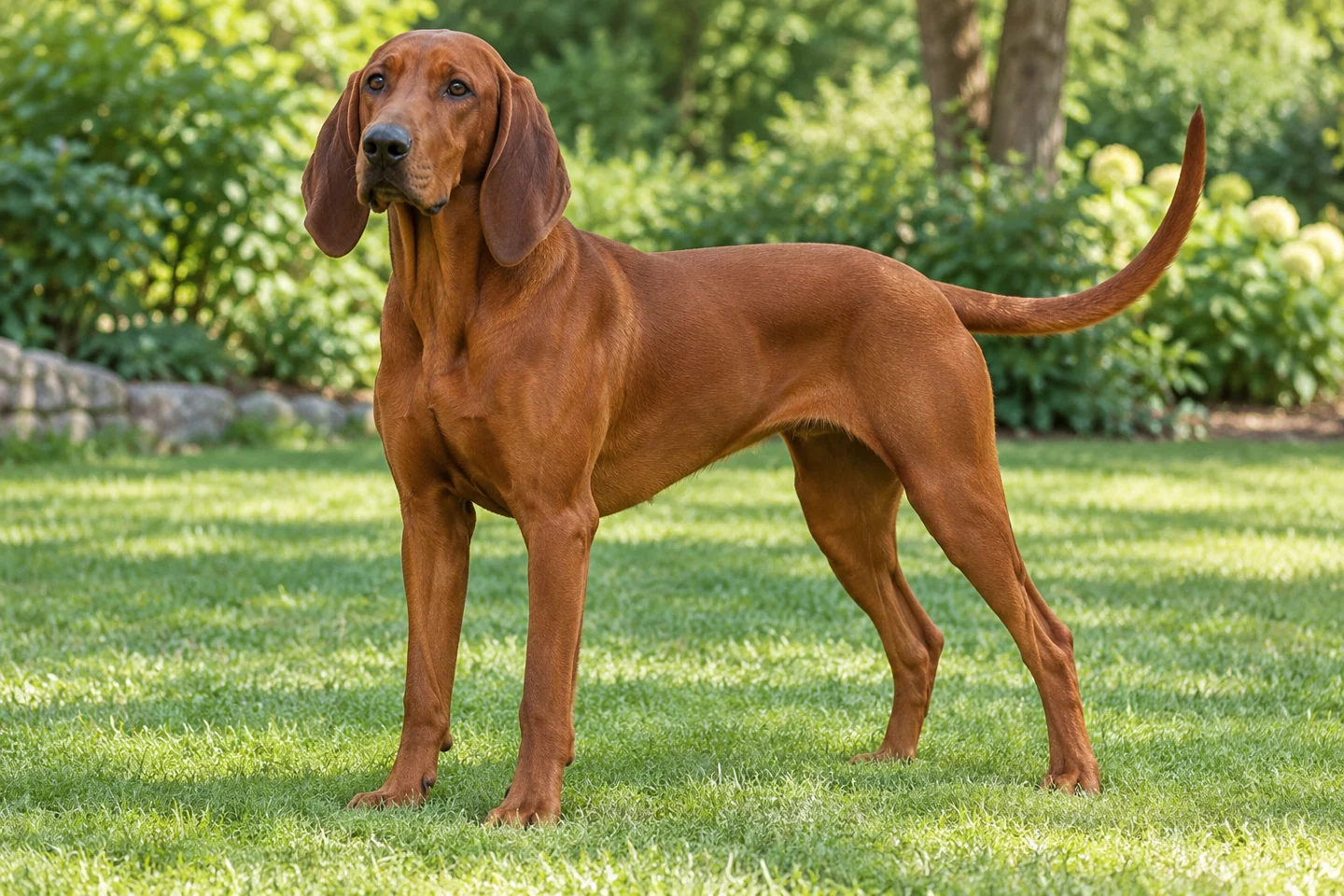
- Solid red short coat
General information for owners. These articles have not been reviewed by a veterinarian. Medical decisions need your dog's history and an examination.
A hound built to keep following
The Redbone Coonhound is an American scenthound with a short red coat, long hanging ears, and a voice that can travel beyond a garden fence. Its working background helps explain the contrast owners may see between a dog resting comfortably indoors and the same dog pulling toward an interesting trail. Choosing one means planning for both states. A quiet afternoon on the sofa does not establish that the dog will remain close when a rabbit crosses the path.
The breed's name describes its characteristic color. It does not identify a separate red variety of every coonhound, and a red mixed-breed dog cannot be assigned this ancestry from a photograph alone. Registration documents or known parentage establish a different kind of evidence from a visual guess. Rescue descriptions remain useful when they describe the actual dog's behavior, daily care, and history rather than treating a possible breed label as a complete explanation.
The American Kennel Club describes a rhythm of vigorous activity followed by rest. In practical terms, a household needs opportunities for purposeful outdoor movement alongside a place where the hound can sleep without constant interruption. People who enjoy walking slowly enough to let a dog investigate scents may find that rhythm easier than people who want every outing to be a silent, brisk march. Hunting experience is not a prerequisite for ownership, but an honest interest in scenthound behavior matters.
Appearance, size, and the red coat
The AKC standard gives adult males a shoulder height of 22 to 27 inches and females 21 to 26 inches. Weight should suit the frame rather than meet a single compulsory figure. These are adult conformation ranges, not an instruction to make a growing puppy heavier. Ask a veterinarian to assess body condition beneath the short coat and to follow growth over time. A hound can have an athletic outline without showing every rib or carrying a heavy layer over its waist.
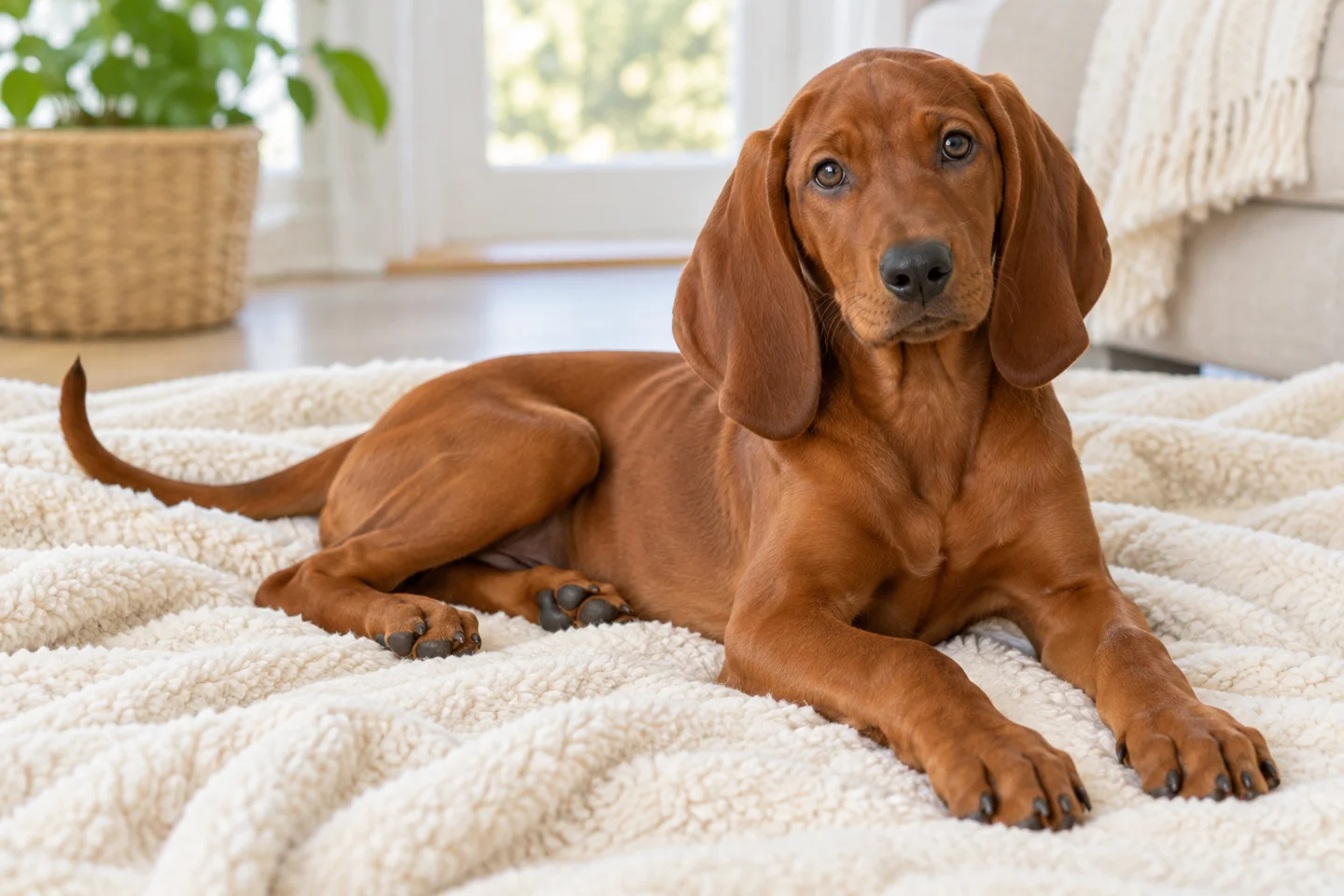
The standard describes a balanced hunting dog with strong limbs, a fairly broad chest, a short smooth coat, and a solid red color. Small white markings in permitted locations do not turn the dog into another breed. The nose is black, the eyes are brown to hazel, and the ears hang from a relatively low setting. The long tail is carried freely. The illustrations accompanying this guide show natural ears and a complete tail; they are labeled artwork rather than records of individual dogs.
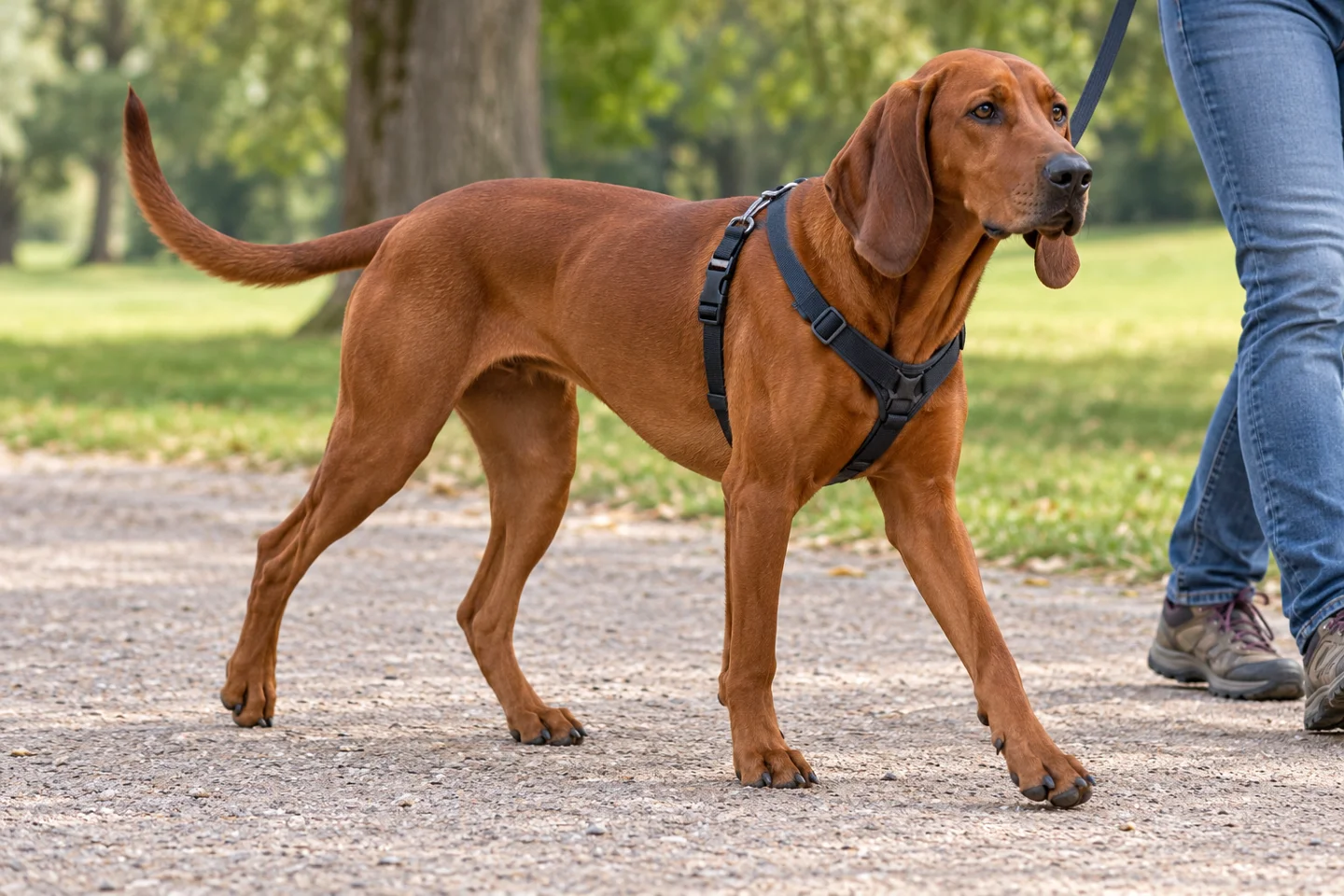
Check practical details when choosing equipment. A collar needs to fit without slipping over the head, while a harness should allow the shoulders to move and avoid rubbing behind the elbows. Recheck fit during adolescence. A dog that leans into a trail can place sustained pressure on poor equipment, and an apparently tight harness may still allow escape when the dog backs away. Identification belongs on the dog even when the outing starts inside a fenced area.
Home life, sound, and settling
A Redbone's voice deserves discussion before adoption. A bay during tracking is different from the brief alert bark some owners expect. Neighbors may hear it through walls or across a field. Ask what triggers the particular dog: wildlife at the fence, seeing another hound, being left alone, or waiting for dinner. Those situations call for different changes. Closing a visual gap in a fence may help with one problem while doing little for distress during an absence.
Give the dog a predictable transition after an outing. Water, a comfortable resting place, and a quiet household activity can help make rest available. Constantly restarting games whenever the hound stirs may prevent the routine you want. With a new adult, watch sleep and eating patterns over several weeks rather than deciding personality from the first exhausting day. A dog may initially appear unusually subdued because its surroundings have changed.
Practice short absences while somebody can observe the response directly or through a suitable recording. Resting, changing position, and briefly listening at the door differ from prolonged pacing, frantic attempts to escape, or repeated distress vocalization. If the latter occur, seek help and adjust arrangements. A second dog is a separate responsibility and cannot be promised to resolve separation-related distress. The sound a hound makes tells you to investigate the circumstances, not to assume that every noise is stubbornness.
Training around an absorbing scent
Training is easiest when the dog can still notice the handler. Start a recall indoors, reward arrival, and release the dog again when appropriate. Then add difficulty gradually in enclosed settings. Calling repeatedly while the hound is already racing along a powerful trail rehearses a different lesson. Use a long line where it is safe and lawful, taking care around legs, trees, and other walkers. A long line is equipment for managed practice, not proof that the dog is ready to run beside roads.
Teach a practical turn-away cue and reward a few steps with the person. Practice before the dog reaches the most interesting verge. You can then allow further sniffing as part of the reward. This makes cooperation relevant to the activity the hound wants. Food rewards should be small enough to use repeatedly and included in the daily intake. If the dog cannot take familiar food, notice whether the difficulty, fear, or physical condition has changed.
Handling lessons are equally useful. Briefly touch an ear, reward, and stop before the dog needs to pull away. Build toward checking feet after a woodland walk and standing quietly for an examination. Reward-based teaching gives the dog clear information without requiring a physical contest. Ask a trainer to explain the setup, the behavior being rewarded, and the next manageable step. A class that repeatedly places an overwhelmed hound next to unfamiliar dogs may teach less than a quieter private session.
Exercise that gives the nose a job
A secure field, a varied walk, and a simple scent search offer different experiences. Scatter part of a meal in a safe patch of short grass or hide a familiar object at an easy level. Let the dog succeed before making the task complicated. Check the area for litter, chemicals, and wildlife hazards first. Scent work can fit an ordinary home, but it does not remove the need for movement, toileting opportunities, or contact with the people caring for the dog.
No universal daily mileage suits every Redbone. A healthy conditioned adult, a growing puppy, and a dog recovering from injury need different plans. Build distance gradually, pay attention to surfaces, and include easier days. Hard repeated running on a new schedule may reveal soreness only later at home. Ask for veterinary guidance when the dog changes gait, hesitates at stairs, or takes longer than usual to recover. A willing hound may continue following scent while uncomfortable.
Use cooler times for demanding outings in hot weather and carry water. Check access to shade before committing to an exposed route. Swimming needs supervision, a safe entry and exit, and an individual assessment of confidence; a breed description mentioning water does not make every dog a competent swimmer. After any demanding trip, inspect pads, nails, and the spaces between toes. Practical recovery is part of the outing rather than a separate luxury.
Aggression, resources, and safe interruption
A hunting background does not tell you whether an individual dog will bite a person. Fear, pain, crowding, and conflict over resources can affect dogs of any breed. Record the situation when a Redbone freezes over a bowl, stiffens as someone approaches a bed, or snaps during handling. The useful question is what happened immediately before the response and how to prevent another risky encounter while help is arranged.
Do not reach into the mouth to retrieve a found object unless an immediate emergency leaves no safer option. Teach exchanges with safe items during calm practice, and manage access to tempting rubbish. If the dog already guards, a qualified professional should help design the process. Taking away every meal to prove ownership can make the approach of a person predict loss. Let the hound eat behind a suitable barrier where children and other animals cannot interrupt.
A bite history needs factual disclosure. Include what contact occurred, whether skin was injured, the surrounding circumstances, and the management now used. A friendly greeting on a walk does not erase a different response at home. Sudden irritability or reluctance to be touched also warrants a veterinary assessment. Safety improves when people can plan around accurate information; reassuring labels such as gentle or harmless cannot replace that detail.
Children and other animals
Children can participate in care through activities an adult controls, such as putting a bowl down while the dog waits elsewhere or tossing a treat onto a mat. They should not drag the hound by its collar, climb across it, or approach its face while it sleeps. Long ears can be tempting to small hands, so explain that touching requires the dog's willingness and adult guidance. Use physical separation when supervision will be interrupted.
A large, enthusiastic young hound can knock over a child without intending to hurt anyone. Arrange greetings with room to move and teach the dog where its feet belong before adding a crowd of visitors. A child running away with food combines movement and a resource, so prevent that setup. If the dog follows children intensely, mouths clothing, or becomes too excited to respond, end the interaction and seek a more manageable activity.
Living with another dog needs observation around feeding, doorways, and resting places. Hunting alongside dogs does not establish compatibility with every household companion. Small pets require particularly cautious decisions because following and pursuing animals are relevant parts of a coonhound's background. Securely separate rabbits and rodents. A calm introduction to one confident cat does not establish safety with a fleeing kitten, and no owner should use a small animal to test whether chasing will happen.
Grooming and the working dog's ears
The short coat makes loose hair easy to see and relatively straightforward to remove with gentle regular brushing. It still sheds. Inspect the skin while brushing, especially under equipment and after travel through vegetation. A bath should use a dog-appropriate product and thorough rinsing. Persistent odor, itching, or recurrent skin trouble calls for a diagnosis rather than progressively stronger washing or a collection of untested supplements.
Lift the ear flap gently and look without pushing anything down the canal. Redness, discharge, pain, and head shaking are reasons to contact the clinic. Ask your veterinarian whether this dog needs a cleaning routine and which product and technique suit it. Long hanging ears make careful inspection convenient, but appearance alone cannot establish an infection or its cause. Repeated episodes deserve investigation rather than repeated use of leftover drops.
Keep nails short enough for comfortable movement and introduce toothbrushing in brief stages. After muddy walks, clean and dry the feet rather than leaving packed debris between the toes. A hound that suddenly resists paw care may have a split nail, thorn, or painful joint. Restraint that becomes more forceful each week can hide the original problem. Bring observations to the veterinarian and return to easier handling practice when the cause has been addressed.
Health questions when a formal panel is absent
The AKC's published hound health-testing list states that no health tests are recommended for the Redbone Coonhound in that listing. This is a description of the listed breed-club recommendations. It does not establish that every Redbone is free of inherited illness, or that a seller has no responsibility to discuss health. Ask what examinations the parents have actually had and request reports for any screening advertised in the litter announcement.
A useful conversation includes the ages and causes of death of close relatives, persistent mobility problems, recurrent ear or skin disease, and any long-term medication in the family. Distinguish a confirmed diagnosis from a suspicion repeated between owners. For a rescue hound, obtain available clinical notes and arrange a baseline visit. Even incomplete records can show vaccination dates, previous treatment, or an unresolved concern that should be followed rather than forgotten after the transfer.
Outdoor activity also shapes preventive care. Tell the veterinarian where the dog travels, whether it encounters wildlife, and what parasite prevention has already been used. Bring the actual product names and dates. A plan for a suburban garden may need review before extended trips elsewhere. Avoid selecting medication from hunting anecdotes or combining products without advice. Prevention should fit the dog, local risks, and the proposed travel.
Feed a complete food appropriate to life stage and measure portions. Include training rewards and food supplied by other household members when judging intake. Body weight alone cannot distinguish muscle from excess fat, so ask the clinic to show you how to assess the waist and ribs. A hunting-season ration may become excessive when activity falls. Marked changes in appetite, thirst, weight, or exercise tolerance deserve attention rather than automatic attribution to age or an easy-going temperament.
Mixes, budgets, and choosing the household
A Redbone cross may have a different coat, size, voice, or hunting intensity from either parent. A familiar crossbreed label is a description of claimed ancestry, not a health certificate or a prediction of compatibility with cats. Ask what is known about both parents, the adult dog's observed behavior, and any medical history. When parentage is unknown, planning from the dog's present needs is more useful than building expectations around an attractive guess.
Budget for secure fencing, suitable walking equipment, veterinary care, feeding, and reliable cover when the household travels. Check whether local boarding providers are comfortable with vocal hounds and can describe secure handover procedures. Obtain quotes from the services you would actually use. Purchase price does not tell you the long-term cost, and an unusually cheap puppy can still need extensive treatment or behavioral support.
Before committing, discuss noise with everyone sharing the home and check housing restrictions. Consider who will manage an urgent evening outing during bad weather, how the dog travels safely, and what happens when the usual walker is ill. A household that enjoys the nose-led pace and can manage containment may find the Redbone a practical companion. A household dependent on effortless off-lead recall beside traffic needs a different plan before bringing one home.
A dogsDating walk with a Redbone
On dogsDating, describe the activities the hound actually enjoys. Mention whether it bays on seeing another dog, needs space at the beginning, or becomes absorbed by wildlife scents. Ask the other owner about chase games and sensitivity to loud vocalization. Two dogs can be physically compatible yet prefer very different play. The first meeting can establish whether a shared walk feels comfortable without requiring wrestling or free running.
Select a broad public path with room to step aside, rather than a narrow woodland track rich in animal scent. Arrive with equipment already fitted and avoid handing leads between people during the initial excitement. Start far enough apart that each dog can sniff and move without repeatedly pulling toward the other. If one becomes fixated, take a different direction and reassess instead of tightening the gap to force a greeting.
Keep exact user coordinates private. Approximate location discovery and a chosen public meeting point provide enough information to arrange the outing without publishing a home address. Exchange practical observations afterward, including what distance worked and whether either dog struggled to settle. A short walk ending with both hounds comfortable gives better information for a second meeting than an overlong encounter that finishes in exhaustion or conflict.
Sources and editorial notes
Sources checked October 22, 2026. Breed measurements describe reference ranges, not a diagnosis or an individual dog's ideal weight. Images are AI-generated breed illustrations and do not document a particular dog or health condition.
- AVSAB: Humane Dog Training Position Statement
- VCA Animal Hospitals: Food aggression in puppies
- Orthopedic Foundation for Animals: CHIC health screening programs
- VCA Animal Hospitals: Aggression toward unfamiliar dogs, diagnosis
- VCA Animal Hospitals: Grooming and coat care for your dog
- VCA Animal Hospitals: Ear infections in dogs (otitis externa)
- AAHA: Feeding plans for healthy, appropriate weight cats and dogs
- VCA Animal Hospitals: Heat stroke in dogs
- AVSAB: Puppy Socialization Position Statement
- VCA Animal Hospitals: Dog behavior problems, aggression toward children
- American Kennel Club: Hound group health testing requirements
- American Kennel Club: Redbone Coonhound
- American Kennel Club: Redbone Coonhound official breed standard
Keep getting to know dogs.
Read another guide or return to your dogsDating community.
Explore breed guidesBack to dogsDating